Ireland versus England – The quest for footballing approval
Relationships can be tricky at the best of times. Even when they’re over feelings can remain, passions linger, doubts about whether breaking up was the right decision can cloud one’s judgement.
The unhealthiest of relationships can provoke these reactions and much as we like to think we’ve moved on and we’re being the bigger person we still crave attention; a reaction from our former partner.
Much of recent Irish history, and almost all of our football history has lived out this type of conflict with our spurned partners England. Identifying ourselves as our own strong, confident, distinct individual nation while also being constantly obsessed with either getting one over on the English (Euro 88!) or craving their attention and approval to give validation to our actions.
The footballing split between North and South, between IFA and FAI, was in many ways related back to our messy divorce with the English. Tensions between the footballing centres of Belfast and Dublin had been running high for some time but it was the refusal of a Glenavon side to travel to Dublin for an Irish Cup match against Shelbourne in 1921 due to the civil unrest in the city caused by the War of Independence that proved to be the final straw that triggered the schism.
The split in the associations meant that the FAI were out in the footballing cold as the other UK based associations continued to recognise the IFA as the only legitimate association for the island and refused to play matches involving FAI teams or to release British based players for international matches.
The FAI also lost out on participation in the prestigious home nation championship and a crucial source of revenue. Despite competing the 1924 Olympics it would be 1927 before the FAI would manage to arrange an international match when they lined out against Italy.
While the FAI were understandably put out by these developments and felt that the British associations were acting unfairly they still desperately craved their attention and approval. Britain was after all the home of football and was viewed as the pre-eminent soccer power at the time.
When a South American touring side visited Dublin in 1933 there was much excitement among the Irish media, Uruguay had won gold at the 1928 Olympics as well as the inaugural World Cup but journalists wondered whether South Americans were “capable of challenging English and Scottish supremacy at the game”.
For the Irish football public at the time the British associations were the be all and end all, although they were loath to admit it. Two games highlight this preoccupation more than most, if we look at the two home internationals that bookended World War II, the game against Hungary in March 1939 and the first ever international match against England in September 1946.
The Hungarians had been runners up to Italy in the 1938 World Cup and had played against Ireland twice before in recent years, on both occasions the matches took place in Dalymount Park. However on this occasion the match took place in the Mardyke, the grounds of University College Cork and home to League of Ireland side Cork F.C.
This was the first FAI organised international since the split that had been held outside of Dublin. So why were the World Cup runners up being asked to play in a University sports ground rather than at the larger capacity Dalymount? Well because there was a bigger game taking place in Dalymount just two days earlier on St. Patrick’s Day 1939, when the League of Ireland representative side were taking on their Scottish counterparts.
Even a game against a Scottish League XI was viewed as a huge mark of acceptance for a football association that was yet to reach its 20th birthday. While the game in the Mardyke would attract 18,000 spectators, a respectable return, over 35,000 would pack into Dalymount Park to see the stars of the Scottish League.

Newspaper advertisement for the match against the Scottish League
Sean Ryan, writing in his history of the FAI, noted that as the match against the Scottish League was played at the larger venue and achieved double the attendance to be further evidence of the “massive inferiority complex which Irish soccer had towards Britain”.
He also remarked that commentators at the time were moved to describe the match against the Scottish League as “the most attractive and far reaching fixture that had been secured and staged by the South since they set out to fend for themselves” before adding “for 20 years various and futile efforts have been made to gain recognition and equal status with the big countries at home. Equality is admitted by the visit of the Scottish League.”
This notion of the “big countries” is crucial, by 1939 Ireland had already played against the likes of Italy (world cup winners in 1934 and 1938), Hungary, Germany, Poland and France but it was the visit of the Scottish League that was viewed as delivering some notion of football “equality”.
The Scottish FA wouldn’t accept the offer of a match against the Republic of Ireland until they were drawn together in a qualifying group for the 1962 World Cup so whether this game was actually a sign of acceptance by the Scots, or “equal status” is far from proven.
For the record a competitive Scottish League (valued at staggering £60,000 at the time) side lost 2-1 to their League of Ireland opposition, Johnstone of Sligo Rovers and Paddy Bradshaw of St. James Gate getting the goals. Five of those who played against the Scots on St. Patricks Day; Mick Hoy (Dundalk), Kevin O’Flanagan (Bohemians), Jimmy Dunne (Shamrock Rovers), Joe O’Reilly and goalscorer Bradshaw (both St. James Gate) left Dalymount and headed straight to Cork for the game against Hungary two days later.
Perhaps not the best preparation but slightly better organisation than that arranged for Raith Rovers Tim O’Keefe who missed the match as the ferry to Larne was delayed by two hours.
O’Keefe’s absence meant that there were no Cork men in the XI for the Hungary match which may go some way to explaining the less than electric atmosphere in the ground in what WP Murphy of the Irish Independent described as “one of the most apathetic crowds I have ever seen at an International”. Bradshaw was on the score sheet again along with Manchester United’s Johnny Carey as the Irish gained a 2-2 draw against the Hungarians.
The Scottish League visit and the unexpected victory provided a fillip for Ireland and perhaps suggested some level of acceptance from the home nations, however a full international match had yet to take place. World War II would disrupt football fixtures for the next six years and it was 1946 before an Irish national team took to the field again in a pair of away games, against Portugal (a 3-1 defeat) and Spain (a surprise 1-0 win).
The first home game would be in September against England, the English FA sending a letter a month earlier saying that they would play a game in Dublin two days after their fixture against Northern Ireland in Belfast. It was not an occasion that Official Ireland could pass up.
At an earlier international game against Poland in 1938 Irish President Douglas Hyde had been expelled by the GAA because of his presence at an Association Football match, in contravention of the infamous rule 27. This had provoked significant criticism of the GAA at the time in both the press and from government benches.
However, the arrival of England was too big a deal for the political elite of Ireland to miss out on. The game was seen as a sort of fence mending exercise with the English after the “Economic war” of the 1930’s and the verbal sparring of De Valera and Churchill during the war years.
De Valera hosted a pre-match reception for the teams and officials, President Sean T. O’Kelly was there for the pre-match introductions and Tánaiste Sean Lemass (alleged to have been a member of Michael Collins’ infamous Squad) was present in the stands for the match.
The English officials were even presented with a replica of the Ardagh Chalice as a memento of their visit. Clearly the Irish wanted to make a big impression on their illustrious visitors and had put a great deal of thought and effort into the reception and hospitality for their guests.
This did not however extend to the team selection, Shamrock Rovers’ Paddy Coad had to cancel his honeymoon to play against England while West Brom centre-forward Davy Walsh pulled out late with injury meaning a late call-up for Mick O’Flanagan of Bohemians as his replacement.
O’Flanagan ran a pub in Marlborough Street in Dublin City Centre and received a phone call there on the morning of the game from Tommy Hutchinson the Bohemian rep on the Irish team selection committee. He was told to get his boots and get to Dalymount Park for the game that evening.
As O’Flanagan recalled:
I went home to Terenure for a bite to eat, had a short rest and then headed off to Dalymount. It was not really sufficient notice as only the previous evening I had brought a party of English journalists to Templeogue tennis club and I hadn’t got home until nearly two in the morning.
It was only when his brother Kevin, then of Arsenal arrived to the stadium straight from the boat that he realised that he would be playing alongside his younger brother against England.
Despite this usual shambolic preparation the Irish team more than put it up to their English opponents. The English had easily defeated Northern Ireland by seven goals to two only two days earlier but were up against more formidable opposition in Dublin.
With eight minutes to go it was still nil all but a young Tom Finney, making only his second appearance for England managed to beat Tommy Breen in the Irish goal. Ireland had pushed their illustrious guests all the way, Everton’s Alex Stephenson had rattled the English crossbar while Kevin O’Flanagan had been agonisingly close with a header.
The Irish had also had to play much of the game with effectively ten men after Huddersfield Town’s Bill Hayes was injured early on and, in the days before substitutions was shunted out to the wing, forcing Johnny Carey into the centre half position.
The Irish Times’ PD MacWeeney was moved to describe the match as “the most exciting International football match ever played at Dalymount Park” while his English equivalents were no less effusive in their descriptions, Henry Rose in the Daily Express was moved to write “If ever a team deserved to win Eire did. They out-played, out-fought, out-tackled, out-starred generally the cream of English talent, reduced the brilliant English team of Saturday to an ordinary looking side that never got on top of the job”.
Though the game could be seen as another in a long line of famous Irish “moral victories” or “glorious failures”, it certainly had the desired effect for the FAI as the game was both a huge commercial success and also gained the craved for recognition from the English.
While Scotland, Wales and Northern Ireland would avoid matches against the Irish further games against the English were more forthcoming. Within three years the Irish had even beaten the English on home soil when they emerged as 2-0 winners in Goodison Park.
And next week we get to live it all over again. While we’d like to think that we are not as needy and requiring of validation from England as we were in 1946 the game on Sunday has still captured the public imagination more than any other friendly.
Some commentators, like The Guardian’s Barney Ronay have gone so far as to call the game “pointless and a mistake” , and there are concerns about a recurrence of the ever-popular “Fuck the IRA” chants from sections of the English travelling support while almost 2000 “supporters” will be barred from travelling to Dublin for the game for fear of a repeat of the violent scenes of 1995.
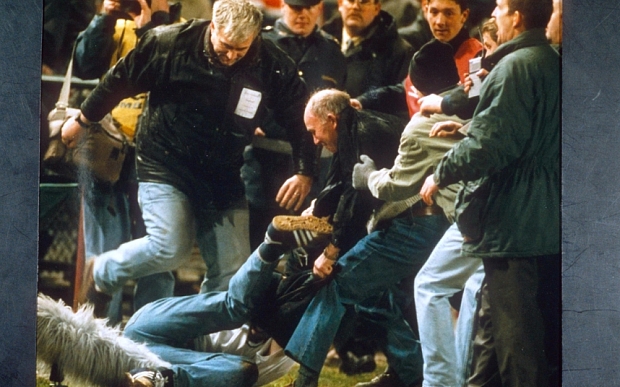
English hooligans in the Lansdowne Road riot of 1995
Aside from that there is also the slightly thorny issue of Jack Grealish’s international allegiances as a sidebar to the game. But still we look to this game against the English and see a guaranteed full house for an international friendly, not something that can always be counted on.
The English FA for their part, perhaps cognisant of the events of ’95 made sure to include a friendly against Ireland in Wembley as part of their 150th anniversary celebrations, along with friendlies against original international opponents Scotland and prestige matches against the likes of Germany and Brazil. Were we secretly pleased that they invited us to the party and have chosen to return the favour by coming to Dublin?
It’s 20 years since the debacle in Lansdowne Road and 30 years since Ireland have lost to England, whether that has lessened any Irish inferiority complex will be seen on Sunday.
Originally posted on backpagefootball.com June 2015