Football, revolutionaries and my great-grandfather – 1916 and all that

We’ve only begun the year of commemorations and there has already been a great deal written about the various organisations, groupings and competing actors around the dramatic events of Easter 1916.  In much of nationalist history there is a huge role played by sport in the recruitment and training of the Volunteers, this is something often celebrated by the GAA and is born testament to in the naming of stadiums and club teams around the county.

This involvement with the nationalist cause was not limited only to the sphere of Gaelic games. Despite its occasional portrayal as a “Garrison Game” many individuals who were actively involved with football clubs also became key players in the struggle for independence. Among them were family members of my own.

In doing some family tree research I’ve started looking into the history and background of some of the relatives on my Da’s side of the family, people I was vaguely aware of but who by and large had died before I was born. This trail has brought me to a few individuals, my great-grandfather Thomas Kieran (occasionally spelled Kiernan) his sister Brigid and her husband , my great-uncle, Peadar Halpin.

At this point I must state that I do indeed have some non-Dublin blood in my veins, not much mind, but both Thomas and Peadar were from Co. Louth. Peadar would come to prominence due to his association with Dundalk FC and the FAI. He was a founder member of the club and spent decades on the management committee of Dundalk FC and was also club President. He also served as Chairman of the FAI’s international affairs committee and President of the League of Ireland and also Chairman of the FAI Council.

Football in Dundalk, in a somewhat disorganised fashion could be found as far back as the late 19th Century and some of the impetus given to the game in the early 20th Century can be traced back to a Dundalk architect named Vincent J. O’Connell. He had played for scratch teams in the town in his youth and had been a member of Bohemian FC between 1902 and 1907 during a sojourn in Dublin. Upon his return north he set about working with others to bring some structure to the playing of the association game in the town.  The club we know today as Dundalk FC began life as Dundalk GNR, the GNR standing for Great Northern Railway, and they spent a number of years in junior football before being elected to the League of Ireland in the 1926-27 season. The campaign for election to the league as well as the eventual re-branding of the club to Dundalk FC was apparently the result of the machinations of a group of local football enthusiasts comprised of Peadar Halpin, Paddy McCarthy, Jack Logan, Paddy Markey and Gerry Hannon. According to a report in the Irish Times the decision to change the club’s colours from black and amber to white and black was made by one Barney O’Hanlon-Kennedy who promised his silver watch as a raffle prize for a fundraiser for the club. As he was the one putting forward the funds he was given the honour of selecting the team’s colours.

That Dundalk should be so connected with the railway shouldn’t be that surprising, then as now, Dundalk was a major station between Dublin and Belfast, even if the creation of the border did cause disruption. My great-grandfather Thomas Kieran (born in 1889, son of Patrick and Annie Kieran) was a worker for the railway, at the time of the 1911 census when he was 22 years old and residing in the family home of 14 Vincent Avenue in Dundalk (five minutes from the train station). He was listed as being an “engine fitter”, while his father Patrick was a carpenter for the railway as well. Later reports show that Patrick was also involved with the union (the Irish Vehicle builders and Woodworkers Union) and was among the workers representatives when a strike was threatened in 1932. The census also reveals that of the family of five both Thomas and his sister Brigid spoke Irish.

Vincent Avenue

House in Vincent Avenue today, they were build c.1880

Republican roots, what the records say…

When searching through the Bureau of Military history records I came across a number of references to the Kieran family. One referred to the family as a “Volunteer family….railway people”. This came from the witness statement of Muriel MacSwiney, the wife of future TD and Lord Mayor of Cork, Terence MacSwiney who stayed with the Kieran family during one of Terence’s frequent bouts of imprisonment. This is confirmed by the witness statement of another local Volunteer James McGuill who referred directly to Brigid saying that Muriel MacSwiney “stayed in Dundalk with Miss Kieran now Mrs. Peadar Halpin.”

78-1926-08-15-Muriel-MacSwiney-1920

Muriel MacSwiney

On a slight digression Muriel MacSwiney was a fascinating woman, born Muriel Murphy, her family owned the Midleton Distillery and they were firmly against her marriage to Terence MacSwiney and even tried to get the Bishop of Cork to intervene to delay it. As a footnote that will become relevant later, the best man at their wedding was Richard Mulcahy the future Chief of Staff of the IRA, Minister for Defence during the Civil War and later still, leader of Fine Gael. Terence was in and out of various gaols during the course of his short marriage with Muriel, he would be dead by 1920 at the age of just 41, wasting away on hunger strike in Brixton Jail. The impact his death had on the wider world is probably comparable to that of Bobby Sands six decades later. MacSwiney was viewed by many as a martyr in a fight against Imperialism and was cited as an influence by  Mahatma Gandhi as well as India’s first Prime Minister Jawaharlal Nehru.

Apart from providing lodgings for Muriel MacSwiney it’s worth looking at what else the Halpins and Kieran’s were up to at this turbulent time. Thomas Kieran is mentioned again the the Bureau of Military History. In the witness statement of Patrick McHugh, Operational Commander and Lieutenant of the Irish Volunteers in Dundalk during Easter week 1916 listed Thomas Kieran among those “who served Easter Sunday 23rd April 1916, remained with company that day and, volunteered to return home when uncertainty of position was explained to them. Some returning Sunday night, others Monday morning or as Stated.”  Interestingly Thomas is already listed as living in Dublin by this stage while most of those mentioned were still living in Dundalk. Peter Kieran (a possible relation?) another Dundalk based Volunteer declared in his witness statement that Thomas Kieran was among a group of Volunteers who had arranged to meet on the night of Thursday 20th April with plans to make their way to Dublin to join the rest of the Volunteers in the Rising. They had elaborate plans to get there via motor boat but were warned that the Royal Navy had vessels patrolling the area.

The plans for the Thursday journey to Dublin was called off and the group met again on Friday and Saturday night, however word came that the Rising was off, probably a reference to Eoin MacNeill’s order cancelling the Rising, which obviously had a significant impact on the numbers of those who arrived in Dublin. Peter Kieran went on to state that about the second week in May arrests were made in the town by the RIC. The family version of the story that I’ve been told was that Thomas was one of those arrested while cycling his bike with a rifle on his back and that he was later interned!

Peter Kieran in his statement also noted that “Those who served 23rd, 24th and 25th April 1916 and became disconnected, were ordered home on account of age, infirmity or as stated. [included] Peter Halpenny or Halpin [of] Byrnes Row Dundalk”  Although it is hard to be absolutely certain this Peter Halpin could well be our Peadar Halpin, he was listed as Peter on the earlier census return. There is also a record of a P. Halpin from Byrne’s Row who was arrested a couple of weeks after the Rising and sent to Stafford Detention Barracks in England on 8 May 1916. There are other references in other sources to a P. Halpin of Byrne’s/Burn’s Row being arrested and sent to Stafford.

In searching the medal rolls for this issued the 1917-21 Service Medal both Peadar and Brigid appear. Both were issued the medal, Brigid in 1943 and Peadar in 1951. Her deposition states that Brigid was a member of Cumann na mBan from before the Rising. She was involved in dispatch work, fundraising for the purchase of arms, did election work for local candidates and visited republican prisoners. Peadar in his deposition states he was a member of “A” company of the 4th Northern Division of the IRA and that his involvement also predated the Rising, going back to 1915. It doesn’t however, detail individual operations of which he was part.

Patrick McHugh (who we encountered above) managed to escape arrest although he was interrogated by RIC men just after the Rising. He then moved up to Dublin to stay with his sister on Iona Road for a short time until he “got in touch with friends Tom Kieran and his wife [the granny Kiernan], who had a room in Mountjoy Street.” It seems that Thomas Kieran had moved to Dublin sometime between 1911 and 1916. I know he ended up working in the CIE engineering works in Inchicore for many more years. He obviously met Jane Brennan (2 years his junior) when he moved to Dublin, she had been living on Dominick Street Upper at the time.
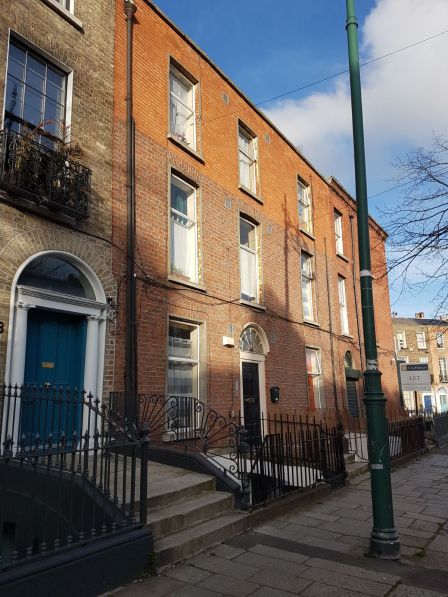
Blessington St1

The house at 27 Blessington Street, just off Mountjoy Street, where the Kierans lived.

Peadar was born in 1895 and grew up in Stockwell Lane, Drogheda. He trained as a cooper, (the trade of his father John) before moving to Dundalk to work in the Macardle Moore Brewery where he later became the foreman cooper. It is interesting to note that his wife Brigid was 12 years his senior. He came from something of a Republican family and a street (Halpin Terrace) in Drogheda bears the family name. This street has something of a tragic history to it as it was named after Peadar’s younger brother Thomas, who was killed there by the Black and Tans in February 1921. At the time Thomas was an Alderman of the local Corporation representing the Sinn Féin party. Thomas Halpin, along with another man, John Moran were abducted from their homes and brought to the local West Gate barracks where they were brutally beaten. They were then dragged to a third man`s home, that of a Thomas Grogan whose house was also raided but fortunately Grogan had been tipped off and had made his escape before the Tans arrival. It was at this spot that Thomas Halpin and John Moran were murdered, their bloodied bodies being discovered there the following morning. Each year the local Council commemorates this event and a monument now stands at the site of the men’s murder.

IRA memorial

Commemorations for Alderman Thomas Halpin & Captain John Moran in 2014


Footballing connections; all roads lead to Bohs

Thomas, is something of a family name, Peader’s brother Thomas was tragically killed and Peadar would name a son of his as Thomas, perhaps in tribute to his murdered sibling. Thomas Kieran would also have a son named Thomas and there is an interesting football overlap as both of these men named Thomas would have a part to play in the history of Bohemian FC.

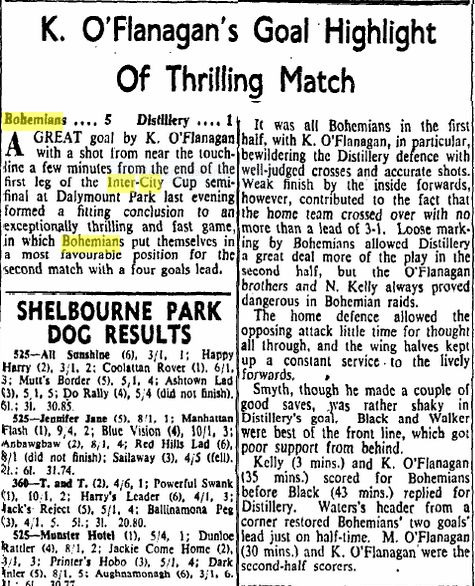
Peadar’s son Tom lined out for Dundalk in the early 40s before moving to Bohemians in 1947. He featured prominently in Bohs run to that season’s FAI Cup Final where he was part of a team that defeated Drumcondra FC, Shelbourne in the semi-final (where Halpin scored a penalty) and took on a highly talented Cork United side in the final. Cork United had been the dominant team of the 1940s and had already won five league titles by the time they took on Bohemians in front of over 20,000 fans at Dalymount Park on April 20th 1947. The Leesiders were the strong favourites. Bohs were at an added disadvantage as two of their key, experienced defenders (Snell and Richardson) were out injured. Halpin was playing at right half and spent most of his time trying to counteract the attacking threat of Cork’s forward line which included Irish internationals like Tommy Moroney and Owen Madden.

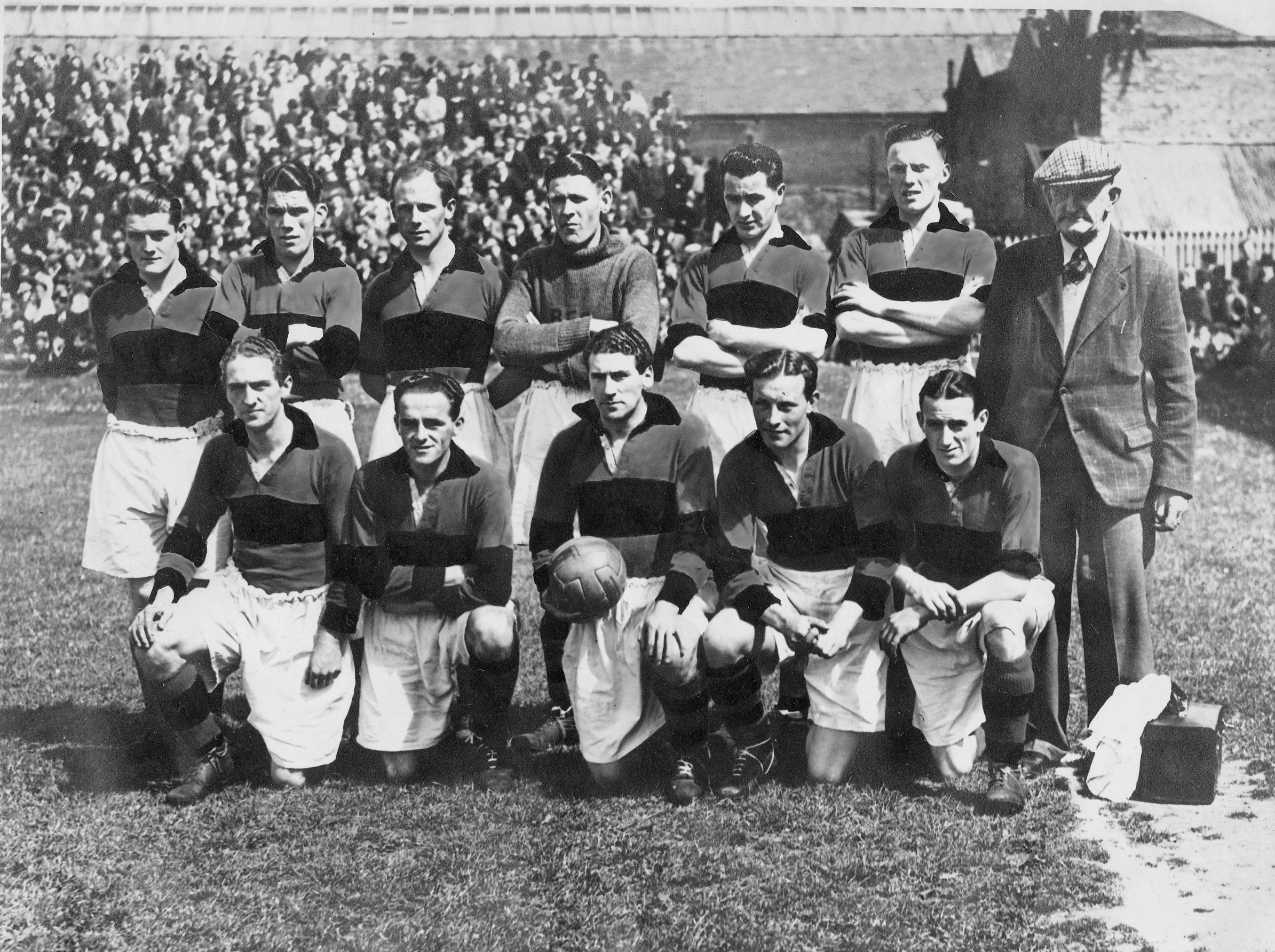
Bohs 1947

The Bohemian team from the 1947 final

Bohs were already 2-0 down before 30 minutes were on the clock but Mick O’Flanagan managed to pull one back before Halpin scored a penalty after Frank Morris was fouled in the box. The game finished 2-2 and went to a replay four days later. In a howling gale and lashing rain Bohs lost out in the replay in front of barely 5,500 people with the Munstermen winning 2-0.

Tom Kieran’s connection with Bohemians was a very long one, a referee for decades, including at League of Ireland level in the 1960s. The uncle Tom was a member of Bohemians since 1969 and was Vice-President of the club from 1985 to 2000 and was later made an Honorary Vice-President for life. Tom’s daughter Susan and her husband Dominic are of course still very familiar faces down at Dalymount to this day.

the uncle Tom

The uncle Tom as photographed for an Evening Herald profile in Dalymount Park

There are further remarkable connections with the Halpin family and with Dundalk and Bohemians as Thomas Halpin’s grandson; Peter was the Commercial Manager at both Dundalk FC and Bohemian FC as well as having a spell with Belfast club Glentoran.

Despite these many connections with the beautiful game the strongest and most influential roles in Irish football were undoubtedly held by Peadar Halpin. He was on the committee of Dundalk FC since at least 1926 and had two spells as Club Chairman from 1928-1941 and 1951-1965 and in 1966 he was appointed Club President, a position he was re-elected to in 1973. He also held a number of roles for the FAI, he was Chairman from 1956-1958 and had many years previous experience on various FAI committees and had made an unsuccessful attempt at arranging UEFA mediation to help resolve the long-running schism between the FAI and the IFA. At the age of 70 he was elected as President of the League of Ireland, it was a role he hadn’t been expecting to fill but after the Dundalk rep Joe McGrath became ill Peadar was the only member of the Dundalk committee with sufficient experience to take on the role. While the FAI and League of Ireland have (with good reason) been seen as conservative and at times backward there were a number of advances that took place during his tenure. It was the Dundalk committee that suggested the introduction of the B division which would eventually lead to the creation of the First Division as well as overseeing the admittance of new clubs to the League of Ireland. On a local level he was crucially involved with the development of Dundalk FC as a force within the League of Ireland, at present they are the second most successful side in Irish club football with 11 League titles and 10 FAI Cups. He claimed that of the many successful years that Dundalk enjoyed his favourite was 1942 when Dundalk beat Cork United 3-1 in the FAI Cup final and Shamrock Rovers 1-0 in the Inter City Cup.

Dundalkimage

Mattie Clarke in action for Dundalk in the 1950s as featured in the Irish Times

A potential politician?

Despite this extremely long connection with Dundalk FC the earliest reference to his involvement was in 1926. Prior to that we know that he was working as a foreman cooper in the Macardle Moore Brewery but in March 1923 his name appears in a debate in Dáil Éireann when his local TD Cathal O’Shannon raised a question on his behalf with the then Minister for Defence, General Richard Mulcahy. This is the same Richard Mulcahy who had performed best man duties at the wedding of Terence MacSwiney and Muriel Murphy who the Halpin’s would later shelter. It is testament to the divisiveness of the Civil War that such former allies could be so opposed.

O’Shannon had been elected TD for Louth-Meath in 1922 as a member of the Labour Party and was a supporter of the Treaty of 1921 which had officially led to the partition of Ireland. Mulcahy as Minster for Defence was a highly controversial figure for some as it was he who gave the order for 77 executions during the Civil War. The content of O’Shannon’s query was a request for an update on the status of Peadar Halpin and the likelihood of his release from Newbridge Barracks where he had been held since August 1922. Mulcahy replied that “Mr. Halpin was arrested for aiding and abetting Irregulars during the time of their occupation of Dundalk. It is not considered advisable to release him at present”, he further added that Peadar was not to be allowed send or receive letters.

As for what “aiding and abetting the Irregulars” referred to, the most likely answer given the fact that Peadar was arrested in August 1922 in Dundalk was that he was involved in assisting the anti-Treaty IRA (or “Irregulars”) in their attack on Dundalk on August 16th 1922. During this attack, led by future Tánaiste Frank Aiken, the anti- Treaty forces captured the town, freed over 200 prisoners held in the barracks and also took over 400 rifles. Rather than try to hold their position the town was re-taken the following day by Free State forces. In all the attack on Dundalk cost the lives of six Free State soldiers and one officer as well as the lives of two of the “Irregulars”. It is not clear what assistance Peadar provided during this time but it was obviously significant enough to warrant him being held in gaol for months without charge.

Family recollections of Jane Kieran née Brennan, the wife of Thomas Kieran are fairly clear on her views on Mulcahy and Cumann na nGaedheal, she put it bluntly and succinctly, saying “they cut the old age pension and they shot them in pairs”. It was not to be the last connection between Peadar and Cathal O’Shannon or Frank Aiken for that matter as the below excerpt shows.
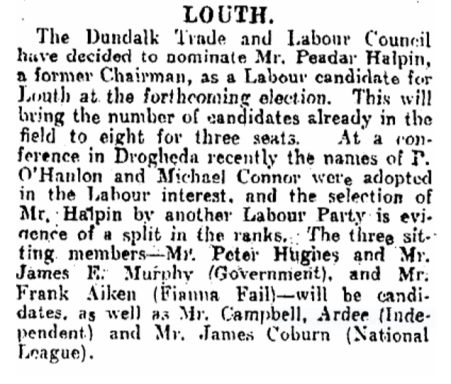
Peadar Labour snip

From the Irish Times April 29th 1927


Cathal O’Shannon stood in the new Meath constituency in the first general election of 1927 and in his absence as the Labour candidate it was proposed that Peadar should run. Among his competition would have been the man he likely assisted during the Civil War, Frank Aiken. However as is the cross that left-wing politics must bear, there was a split, those who proposed Peadar as a candidate were not successful in securing his nomination and Thomas O’Hanlon and Michael Connor ran, unsuccessfully, for the Labour Party. As another of my many side notes, Cathal O’Shannon was unsuccessful in gaining election in 1927 however he later became the first Secretary of the Congress of Irish Unions in 1945, the last president of this Congress was one Terence Farrell, head of the Irish Bookbinders and Allied Trades Union. His nephew Gerard, after whom I’m named, married Nancy Kieran which brings together the Farrell and Kieran clans. Their eldest son was my Da, Leo and as many in the family will know he played for Bohs in the early 60s.

Anyone who has read this blog regularly will know that I often try to look at life and history through the prism of football. Of particular interest is the role that “soccer men” played in the Rising and subsequent War of Independence and Civil War. This is probably the most personal post as I’ve tried to do the same with my own family and their involvement with the nationalist movement. There are many stories that I would love to include but haven’t but would appreciate any feedback or additional information from family members. I hope that this could be the first in a series of posts that might be of interest or maybe just a first draft of something more extensive, there were certainly enough stories told at uncle Joe’s funeral to fill a book, but I hope this might be a start.


With a special thanks to Jim Murphy, Dundalk FC historian for his assistance with some of the research for this piece.

The Magyar martyr- the killing of Sándor Szűcs

There are certain teams that occupy a space in the popular imagination of the football fan not because of the trophies that they’ve won but due to their style of play and to an extent the romanticism of their glorious failure. The two that most readily spring to mind are the Dutch side of 1974 and the Hungarian side of 1954, both beaten by West German teams in the World Cup Final.

Even more than 60 years later there is a certain mystique around the Hungarian side of the 50s, the Magical Magyars or the Aranycsapat (Golden Team) as they were know in Hungary. Foremost in the minds of football fans surely are names like Ferenc Puskás, the goalscoring “Galloping Major” who would later star for Real Madrid and score 4 goals in the 1960 European Cup final. Other key figures included the wing half József Bozsik after whom the stadium of Honvéd is named, or Nándor Hidegkuti who revolutionised attacking play in his role as a deep lying centre-forward which gave free reign for the exceptional talents of inside-forwards Puskás and Sándor Kocsis to raid forward to devastating effect.

Despite losing the 1954 final in surprising (and according to plenty of Hungarians, controversial circumstances) the modern reputation of the Golden Team lies with their numerous other achievements, not least their twice systematic dismantling of the English national team (6-3 in Wembley in 1953 and 7-1 in Budapest in 1954) which did away once and for all of the notion of innate British superiority or the idea that England could not lose to Continental opposition on home turf. This Hungarian side were also Olympic gold medallists in 1952, Central European Champions in 1953 after defeating Italy, and went over four years undefeated in international football.

Golden_Team_1953

The Hungarian National team circa 1953- Ferenc Puskás is crouched front and centre.

Hungarian football had emerged from the war strongly with a new generation of stars who it was felt could deliver international success. This team was born from a time of violence and into one of political tension and civil unrest from which even the brilliance of their play could not be a defence.

The Hungarians had lost out 4-2 to Italy in the 1938 World Cup final, by 1945 with the War in Europe complete, Hungary witnessed the international début of an 18 year old Puskás while the other stars of the Golden Team would follow in their débuts within the next few years. Despite the terrible damage caused by the battle of Budapest in 1944-45 which claimed the lives of over 45,000 people Hungary witnessed free elections at the end of 1945, despite the powerful influence of the Soviet Union, and a coalition government was formed, with some Communist officials in positions of significant influence. For these first few post-war seasons professional football existed in Hungary and the emerging star players could earn decent money.

However as time progressed the political situation began to change. Mátyás Rákosi, the chief secretary of the Stalinist Hungarian Communist Party slowly set about removing political opponents from positions of power and influence while consolidating his own power base. He later boasted that he removed his supposed partners in government one by one, “cutting them off like slices of salami”. By 1949 there was a change in constitution, Hungary became the People’s Republic of Hungary and the nation officially fell behind the Iron Curtain. With this change of government came a change to how football was run in the country. Kispest, the club of Puskás and Bozsik became Honvéd the team of the Hungarian army, while Újpest FC became the team of the team of the police. Among the star players at Újpest was the international defender Sándor Szűcs. He’d be executed in secret within two years.

Szűcs was born in November 1921 in the town of Szolnok about 100km from Budapest and began his football career with local side Szolnoki MÁV. Already an international by the time he moved to Újpest in 1944 he would win three consecutive league titles with the Budapest club between 1945 and 1947 playing alongside team-mates like Gyula Zsengellér, who had played in the 1938 World Cup final and would later move to AS Roma, and Ferenc Szusza who still holds the record as the Hungarian League’s highest goalscorer and after whom Újpest named their stadium. Szűcs was also an established international by the time Puskás would make his scoring international début against Austria, both men playing in a comprehensive 5-2 victory.

However things started to go wrong for Sándor after the change of government and a chance meeting with a young, and crucially, a married woman. In 1950 a passionate Újpest fan invited Szűcs and some of his team-mates back to his house for a get together, it was that fateful night that Sándor met Erzsi Kovacs the 21 year old wife of their generous host. The young Erzsi was already becoming well known in Hungary as a popular jazz singer and the two apparently fell for each other immediately.

Sándor, then only 29, was also married and a popular international footballer playing for a club then just coming under the control of the police was in a hugely difficult position and tried to hide their affair to avoid a scandal that seemed inevitable. In fact due to the re-allingment of the club with the police force Sándor had technically become a policeman in the same way that Puskás and his Honvéd team-mates were army officers. That didn’t stop Erzsi being called for questioning by the AVH, the notorious secret police about the affair. After the interview Sándor recieved a chilling phone call advising him to cease the relationship or else he would end up somewhere where his footballer’s legs couldn’t help him.

The couple resolved to flee the country. Under the new Rakosi regime everything that they had in Hungary was reliant on the good will of the state. Szűcs received better clothing and food than the regular working person and was able to benefit from additional income through the black market. As a form of bonus top Hungarian athletes were able to bring in black market goods from away internationals and foreign tours to supplement their income, the state security forces would conveniently look the other way. However in the current circumstance all that was at risk.

Their plan was to cross the border into Yugoslavia and from there into Italy. Sándor knew that the Italian side Torino had been interested in him in the past and he would have known that former team-mates like Zsengellér had found some success as a player in Italy but this bold plan carried a serious risk. An illegal attempt to cross the border carried the death penalty.

They resolved to borrow a car and to pay a smuggler a fee to arrange safe passage across the border and into Italy. They were to leave in March of 1951. Sándor had to be careful, he couldn’t risk telling his team-mates seeing as Újpest was the police club and a player, a team-mate, could turn informer to the dreaded AVH. The club were certainly not immune from AVH interference, indeed the club had only signed their new star striker Ferenc Deák after he got into a fight with two AVH men who threatened him with serious jail time if he didn’t move from Ferencváros to Újpest.

The young couple set out on March 6th, the person who agreed to smuggle them out had advised Sándor to take along a pistol as an added precaution, however this seems to have been just another part of an elaborate trap. The couple were stopped by a security patrol on the way to the border, at first everything seemed to be alright, they merely asked for their ID before sending them on their way, however a few kilometres later they were surrounded by AVH men, the smuggler had been a plant and they were waiting for the young couple all along. The gun that Sándor had been told to carry was seized and he and Erzsi were taken to the AVH headquarters at 60 Andrássy Avenue, commonly known as the House of Terror. Both were brutally interrogated before Sándor was charged with illegally attempting to cross the border and with high treason. He was tried in a Military Court in May 1951 with a court appointed lawyer that he did not know, the sham trial found him guilty of all charges and sentenced him to hang along with the confiscation of all his property. Erzsi was sentenced to four years in prison.

Former team-mates including national team players József Bozsik , Ferenc Szusza and Ferenc Puskás petitioned the National Defence Minister, Mihály Farkas for clemency on behalf of Szűcs but they were refused. Puskás had in the past been able to use his influence to get team-mates and friends out of trouble but now his pleas fell on the deaf ears of the new Stalinist regime. On June 4th 1951 Sándor Szűcs was executed in secret. Erzsi didn’t learn about his death until her release in 1954 and details of the execution and the location of Sándor’s grave did not emerge publicly until 1989.

One theory explaining the severity of the sentence and the elaborate set up of Szűcs and Kovacs was that aside from the fact that their relationship offended a conservative Stalinist regime the execution of Szűcs would act as a deterrent to other sports stars or entertainers who might consider defecting. This is only a theory but perhaps it did work. We know that Puskás was offered a huge salary by Juventus which he turned down and he wasn’t the only player offered such inducements. Part of the reason for this could well have been the brutal treatment meted out to their erstwhile colleague Sándor Szűcs. It was only after the vicious reprisals against those who took part in the 1956 Uprising that players defected en masse. This was aided by the fact that Puskás and his Honvéd team-mates were out of the country, in Spain to play a European Cup match against Athletic Bilbao. Ultimately Puskás would have a hugely successful “second” career in the white of Real Madrid, international team-mates such as Koscis and Czibor would also find success in the blaugrana of Barcelona.

Erzsi was released towards the end of 1954 and after a short time was able to resume her singing career and found popular success in Hungary in the 1950s and 60s before moving abroad and performing around Europe as well as on cruise ships. She eventually returned to Budapest and continued recording music well into her 70s. She passed away in 2014 at the age of 85.

A later album of Erzsi Kovacs

With the collapse of Communism in Europe, Hungary held free, multi-party elections in May 1990, as part of this return to democracy the crimes of the country’s past could be redressed and the execution of Sándor Szűcs came back to the fore publicly. In 1989 his death sentence was revoked, he was posthumously promoted to the rank of lieutenant-colonel in the police force and today a school is named after him as is a stand at the Ferenc Szusza Stadium where Újpest play. He was the only professional footballer killed by the regime although many more fell victim to the AVH and the House of Terror. Sándor Szűcs is now better remembered in modern Hungary but his death casts a dark shadow on the glory of the Golden Team.

Szuszastadion.jpg

The Ferenc Szusza stadium, home of Újpest

Dick Forshaw – Waterford pioneer and troubled soul

Waterford has had its share of visitors over the centuries, ever since the Vikings first set up shop there back in the 9th Century. The football team have been no different, whether it was former World Cup winner Bobby Charlton, Polish international Piotr Suski or the Coventry born duo of Johnny Matthews and Peter Thomas who would enjoy great success down on the south coast, all playing in the blue of the city at one stage or other.

In his recent, meticulously researched history of soccer in Munster, David Toms goes into some detail in the development of the sport in the southern province and he focuses especially on developments in urban centres like Cork, Limerick and Waterford. What Toms’ research shows is that the Waterford predilection for a British footballing import has a long history. In 1930, despite the city suffering significant unemployment levels as well as the economics effects of the Great Depression the city’s business community and local football supporters embarked on a significant fundraising venture. Their aim? To provide sufficient funds to have a competitive Waterford team in the League of Ireland.

To compete with the likes of Shelbourne, Bohemians, Dundalk and Shamrock Rovers it was felt that Waterford FC would need to invest in bringing in some quality professional imports to play along home grown stars like Alfie Hale Sr. and future Ireland international Tom Arrigan. Brought in as player-coach was former Brighton and Man City player Jack Doran who had been capped three times by Ireland and he used his connections in the game to recruit a number of players with experience of the English league.

In fact for Waterford’s opening fixture in league football seven out of their starting XI were players who had some experience of cross-channel football. That opening game was in front of 10,000 spectators in the Dundalk Athletic Grounds on August 24th 1930 where the fledgling Waterford site were defeated 7-3 by the home side. It was somewhat of an inauspicious start for the Munster side but their undoubted star on the day was an Englishman named Dick Forshaw who scored Waterford’s first goal in league football. Forshaw opened the scoring in the match against Dundalk and was unlucky not to grab a second as he struck the post late on in the second half. He’d grab two goals the following week in Waterford’s first home league fixture as they secured their first win of the season, a 3-2 victory over St. James’s Gate.

That Forshaw was such as instant success should not be that surprising, although he had just turned 35 before he made his Waterford debut he had until very recently been playing in the English second division for Wolves. Prior to that he had enjoyed an illustrious and record-making career with both Liverpool and Everton.

Born in the Lancashire town of Preston in 1895, Forshaw had joined the British army as a young man and spent some time during World War I stationed in the British colony of Ceylon (modern day Sri Lanka), at the time a fairly favourable posting as the area was spared the sort of brutality endured on the like of the Western Front. Upon returning to Britain he was signed by Liverpool manager George Patterson and made his debut for the Reds in September of 1919 with the Evening Telegraph describing him as a hockey and tennis enthusiast who was destined to “develop into a top-notcher”. Forshaw was a skillful right sided inside-forward, his early seasons for Liverpool weren’t prolific in goal scoring terms but he did tend to enjoy “purple patches”, for instance he grabbed a hat-trick against Derby County in his first season.

Dick’s progress in those early seasons was steady, he became a first team regular as Liverpool enjoyed consecutive fourth place finishes, it was however in the 1921-22 and 1922-23 seasons that Forshaw would really make his name. It was in these seasons that Liverpool would win back to back titles and Forshaw wouldn’t miss a single league game for those two years, chipping in with an impressive 36 goals from 84 matches, second only to centre forward Harry Chambers in the club’s goalscoring stakes. One of his team-mates in that Liverpool side was Wexford man Billy Lacey who he would encounter again as player-manager of Cork Bohemians during Forshaw’s sojourn with Waterford.

Although further titles would elude Liverpool for the next two decades Forshaw continued his good form including a knack of scoring hat-tricks against Manchester United. In fact he scored three against United at Anfield two seasons running in 1925 and 1926! In all he scored seven hat-tricks in his time at Anfield and also jointly holds the record (with John Aldridge) for scoring in the most consecutive games (9 in case you’re wondering) in one season.

It wasn’t just with Liverpool that Forshaw made history, he made history by leaving the club as well. Despite playing well during the 1926-27 season (he was on 14 league goals at the time of his departure) the club sold him for £3,750 to city rivals Everton in March of 1927. While this was a significant sum at the time (the transfer record was the £6,500 Sunderland paid for Bob Kelly) especially for a man that was nearly 32, it still came as somewhat of a shock to the Liverpool faithful and to Forshaw and his family. As was the style of the time this was something agreed by the Directors of the two clubs with no discussion with the player. His wife was said to have declared  “I have never been an Evertonian and I don’t know what I shall do about it.” By the time he left he had scored 123 goals in 288 games for the Reds in all competitions.

Success followed Forshaw to Goodison Park however and he made history by becoming the first, and so far only man, to win league titles with both Everton and Liverpool when he was part of the triumphant Everton side of 1927-28. Central to this achievement of course was “Dixie” Dean who would score his record breaking 60 league goals that season, he was helped in part by his forward partner Forshaw.

However by the start of the 1929 season Forshaw was on the move again, aged 34 he signed for a “substantial fee” to second division Wolves. He was only there a matter of months before he handed in a transfer request and began somewhat of a peripatetic existence, popping up at non-league sides like Hednesford Town and Rhyl Athletic (now simply Rhyl FC) for short spells. It was in this set of circumstances that John Doran was able to sign Forshaw for Waterford, only two years after he was playing alongside Dixie Dean and winning a Championship with Everton.

Dean of course, would also enjoy a spell in the League of Ireland in the 1930s, spending some time on the books of Sligo Rovers in 1939 and scoring a club record 5 goals against a hapless Waterford side, however by that stage Forshaw was long gone and his life after football was filled with more tragedy than joy.

Within a year of leaving Waterford Forshaw was up in court charged with defrauding an acquaintance of his, one Richard Green. In April 1932 Green had given Forshaw £100 to place a bet on a horse at Ascot, the horse won and Green of course expected to collect his winnings of over £2,000, however Forshaw was nowhere to be found. Not expecting the horse to win Forshaw had doctored betting slips to make it appear that he had placed the full wager when in fact he had only placed a couple of £2 bets and kept the remained of the stake money for himself.

Forshaw had acted, according to the judge, with “peculiar meanness”, and he gave little consideration to Forshaw’s justifications about needing the money. Now aged 36, Forshaw claimed that due to an accident he had been forced to give up on his playing career, he had tried his hand at other trades and at the time of his trial was living in Kilburn, London and running a Fish and Chip shop with his wife. This carried little weight and the unfortunate ex-footballer was sentenced to 12 months of hard labour for his offence.

His difficulties did not end here, within months of completing his sentence Forshaw was back in court, when in November 1933 and listing his livelihood as a salesman, he pleaded guilty to four counts of theft and was sentenced to a further 17 months of hard labour. The next few years would repeat this pattern, release from gaol before almost immediate re-arrest, mainly for offences like theft. In 1937, then he was in the dock on two counts of theft. Only hours after release from his previous sentence Forshaw had gone out drinking, he had stolen some silverware from a London hotel before drunkenly stealing two suitcases from Euston train station. At the trial the magistrate spoke to Forshaw, a married man, father of three who was now stuck in a cycle of crime and punishment, he said the following to Forshaw as he told him he was likely to face imprisonment with hard labour;

“I want you to take warning from this. Can’t you pull yourself up before it is too late?”
Forshaw  replied– “That’s what I want to do.”

Forshaw would pass away in 1963, in what was an era of dominance for his former clubs, Everton winning the league in 1962-63 and Liverpool bringing the title across Stanley Park the following year. Waterford too were improving, they finished second in the 1962-63 season with Mick Lynch taking up the role as the side’s main attacking threat. Lynch, who was a friend of Coventry City manager Jimmy Hill used that connection to bring over the likes of goalkeeper Peter Thomas and Johnny Matthews to Waterford where they would help (along with the likes of the returning Alfie Hale) bring unprecedented success to the south coast by the end of the decade.

Waterford Shield

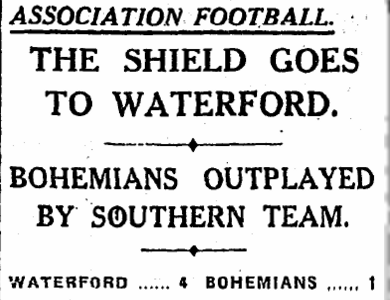
Forshaw played a small part in helping to establish a league footfall foothold in the city, Waterford finished a credible 9th in their first season of League football and even picked up some silverware with a victory of the League of Ireland shield. Despite the hardship of his later life it’s worth remembering his small contribution to the growth of football in Ireland.

There is some great further reading available at the excellent http://playupliverpool.com/

On being the Best

In a recent interview with journalist Andy Mitten the great Xavi Hernandez was asked if Lionel Messi was the “best ever”. Xavi is a true football anorak, he tends not to give glib answers, he’s been one of the greatest midfielders in arguably the greatest club and international sides ever, so his responses should be given a certain gravitas. He replied to Mitten that:

Yes [Messi is the best ever]. Pele and [Diego] Maradona both made a huge difference, but football has evolved. The players are better than they were, the game is better. Physically, tactically, technically and psychologically, football is better than ever. And Messi stands out as the best at the best time in the history of football.

pic_2015-03-08_OTRO_BARCELONA-RAYO_18.v1428485118

Succinctly put. It’s easy to see the logic of Xavi’s arguement, he even name-checks Pele and Maradona, those players who would traditionally vie for the title of the “best ever”. Messi does indeed play at a level, a pace and at a tactical evolve that would be alien to Pelé or even Maradona. If we had access to a time machine and dropped either of these two historical greats into the current Barcelona side then it is likely that we would see what Xavi is talking about. The frenetic pace of elite level football, the amount of ground that would have to be covered, the tactics and shape, the diet and conditioning, even the very rules of the game would be unfamiliar to the Pelé of 1970 or the Maradona of 1986, so of course the 2015 Messi would appear the better player.

To be clear there is a very strong argument that Lionel Messi is indeed the best player in the history of the game. His attacking versatility, his scarcely believable goal scoring rate, the collection of winners medals that he has accumulated through a glittering club career are all testament to this. The one mark in the debit column against Messi that is usually stated is that despite his amazing achievements with Barcelona he has yet to win a senior international tournament with Argentina while both Pele and Maradona were instrumental in winning the World Cup for Brazil and Argentina respectively.

For much of the global history of football the international game was considered the very highest standard of excellence and Pele and Maradona are rightly recognised for their success at this level. However in recent years with the growing dominance of elite European leagues, and an upper echelon of super-wealthy elite clubs within these leagues this has begun to change. It is now arguable that even the best sides at a World Cup would be overall inferior to the matchday squad of better Champions League sides. The expansion in player scouting to truly global proportions, as well as football’s growth in popularity and professionalism (there are now estimated to be more than 265 million active players worldwide according to FIFA) has meant that competitiveness for places and the breath of playing talent available to elite clubs is far beyond anything in the earlier history of the sport.

The hot-housing and accumulation of talent within clubs like Barcelona, Real Madrid and Bayern Munich, means that the elite levels of European club football are the ultimate proving grounds for individual footballing excellence. So surely Messi, having now won four Champions League titles, has achieved as much at such a high standard as any other player who could lay a claim to being the Best?

This would all point to fact that Xavi is right in his choice of Messi as the greatest ever player, that the pace of the modern game and its tactical advancement would mean that players of earlier generations would look like something from that Harry Enfield sketch of black and white era football buffoons. But I feel that this is somewhat unfair, the modern game has become obsessed with the 24 hour football news cycle and a couple of events have suggested that we find it difficult as modern football fans to appreciate footballing achievement if its historical context pre-dates the 1990’s.

Two recent events apart from the Xavi’s quote above have brought this into focus for me. Jamie Vardy’s consecutive goalscoring record and the tenth anniversary of George’s Best’s death. In Vardy’s case he has claimed a very significant landmark, he now has the record for most consecutive goals in the history of the Premier League with  goals in 11 consecutive games. That is to say a record since the rebrand of top flight English football in 1992. This is still a significant achievement, he’s done something that Ruud van Nistelrooy, Alan Shearer or Theirry Henry never managed, and of course we like to view history in bite size chunks, there is no harm in that. Prior to the Premier League there was often mention as I recall of “post-war” records because that’s just how we like to process the passing of time. Credit should be reserved for the likes of Sky Sports who have consistently highlighted that the overall record still belongs to Jimmy Dunne who scored 18 goals over 12 consecutive games in the 1931-32 season.

Little footage remains of Dunne and it’s only Vardy’s recent record breaking feats that have brought him back into the footballing consciousness. Even in Ireland where Dunne was our record goalscorer for 27 years (until this was broken by Noel Cantwell) few are really aware of his feats on a football pitch and Dunne is seldom ever mentioned in greatest Irish XI’s or such like.

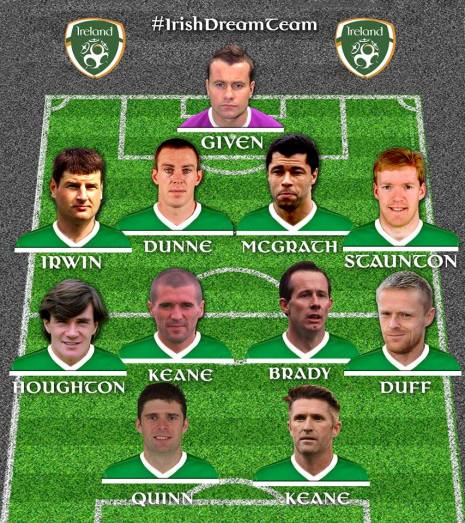
Such polls are always fickle, in fact a recent poll by the FAI to select the greatest Irish team in the last 50 years didn’t even include Johnny Giles! And it can’t be said that John lacks any media profile.

FAI XI

The best Irish team of the last 50 years as chosen by Irish football fans. No room for John Giles.

The other landmark in recent days was the tenth anniversary of the death of George Best. Manchester United fans were commemorated Best with banners and chants at Old Trafford and there were many comparisons drawn between the swashbuckling playing style of Best, Law and Charlton with the more prosaic football on offer from Louis van Gaal’s charges.

Best is often cited as the first of a new generation of footballers, one of the first “modern” players. Best made his first team debut in 1963, the year the first Beatles album came out, and the year that poet Philip Larkin claimed “Sexual intercourse began”. That’s the problem with the past, we can only view it in retrospect so of course it appears that Best’s life and career were always on a pre-destined course. So it seems to us he was always the handsome Belfast-boy who was destined to become the “fifth Beatle” , the supremely talented player who was doomed to live fast and burn out young.

But did it have to be that way? Returning to Xavi’s point about Lionel Messi being the best ever, does the comparison with Pelé and Maradona work the other way. Yes they might appear off the pace if they were magically transported into the modern game but then that could be said of any discipline; Jessie Owens would lose to Usain Bolt in a sprint,  in the arts the master practitioners of past would be out of their depth if thrown into a modern milieu, imagine asking Alfred Hitchcock or Cecil B. DeMille to direct a modern Hollywood blockbuster, on digital, with the current demands of a global film industry, they’d be overwhelmed but it doesn’t mean they are not great directors.

What if Best and Pelé were born later? What if Maradona had been born in 1990 not 1960? Players with their control, technique and vision would always thrive, they’d be better protected now from the darker arts of opposing defenders, and they could avail of the most modern training techniques, tactical instruction, diets and so on. Best was at the forefront of the tortuous birth of the modern celebrity sportsman, today Best would have been better understood, the level of public scrutiny to which he was suggested would now be commonplace and both player and his club better able to deal with these extremes. Similarly the excesses of his personal life are better understood, today there would be a far better chance of Best firstly being better protected from the rigours of celebrity and secondly to have better supports available if he did begin to develop a dependency on alcohol. While it might be cynical it is in the best interests of hyper-wealthy football clubs to protect their stars as best they can.

Similarly with Maradona or Pelé, the modern club structures would have meant that Maradona would have been unlikely to move from Barcelona to Napoli (while Napoli are top of Serie A at the time of writing they were struggling when Diego arrived in 1984) due to the wealth gap between even the top clubs in Serie A and the small elite band of hyper-wealthy sides. Perhaps he would never have fallen in with the Camorra, perhaps his drug habit, which had begun towards the end of his time at Barcelona would never have developed as it did. Pelé might likely have followed a similar route to current Brazilian international and fellow Santos alumni Neymar Jr. staying only in Brazil to his early 20s before a lucrative move to Europe.

The greatest players probably should only be judged on their individual eras as one of the greatest facets of football is that while it remains quite close to the original rules of the 1860’s that made it “the simplest game” it is also constantly changing, progressing and reacting. Football would be both instantly recognisable to a time traveller from the past and bewilderingly different.

Messi is unique in world football at present and has a strong claim to being one of the greatest players of all time but our standards for greatness change as time progresses. Just as it would be folly for a football fan in 30 years time to write off Messi’s achievements because of the victories of some as yet unborn player, so to is it our folly to underestimate the accomplishments of those who have gone before.


Euro 88 Scotland v Ireland & how Lawro got the bandwagon rolling

We’re only a playoff away from our third ever European Championships so here’s a bit of nostalgia ahead of the Bosnia game going all they way back to another qualifying group with Scotland.

When thinking of the Scottish national team and its relationship to that of the Republic of Ireland the match that jumps out most is not our most recent encounter, a narrow victory in the little loved Nations Cup.

Some may be old enough to remember the famous 1-0 in Dalymount Park way back in 1963, but the Scottish match that most Irish fans think of probably didn’t even feature Ireland. It was that win in Sofia when Gary Mackay scored the only goal of his short international career, a goal which meant that the Bulgarians, who had needed only a draw and were favourites to qualify stayed at home in the glorious summer of 1988.

Instead it was Ireland, in their maiden campaign under Jack Charlton who were off to West Germany for their first major international tournament.

 That tournament, arguably featured the strongest even Irish squad and would go a long way in broadening the appeal of soccer in Ireland, it would help to galvanise the travelling support that would make Irish fans famous throughout the world and it gave us moments of joy (Houghton putting the ball in the English net, Ronnie Whelan’s amazing shinned volley) and despair (Wim Kieft’s looping header off a Ronald Koeman shot to send Ireland home). It would give us Joxer goes to Stuttgart, and raise our national sporting expectations.

According to some it would even help to kick start the nation’s economy?

And yet the qualifying campaign was more than just Mackay’s unexpected winner, Ireland had topped a tough group having only lost once during qualifying. After draws in their opening two games, away to Belgium and home to Scotland the Irish needed a win to properly kick start their drive for the Euros.

They got that win in the intimidating atmosphere of Hampden Park and the goal would be scored by a man who little realised that his career at the highest level would be over within a year. It would also mark the first occasion that a Republic of Ireland team would defeat a Scottish side on their home turf and can perhaps be seen as a changing of the guard in terms of the hierarchies of the two Celtic nations?

As mentioned Euro 88 qualifying was Jack Charlton’s first major outing as Ireland manager. Eoin Hand had departed early in 1986 after a disappointing World Cup campaign which saw Ireland finish fourth in a five team group behind Denmark, USSR and Switzerland.

The exciting talents of the Danish Dynamite side that would light up the World Cup in Mexico were especially evident against Ireland as they recorded a 3-0 win in Copenhagen before winning 4-1 in the last qualifying game in Lansdowne Road. Preben Elkjær, then starring for Verona in Serie A proving particularly lethal against Hand’s side.

While Charlton managed to restore some faith in Irish camp early on by gaining victories over Iceland and Czechoslovakia in Reykjavik, in the process winning Ireland’s first piece of silverware he had also managed to alienate Arsenal’s classy centre half Dave O’Leary.

He did, however, give a first cap to O’Leary’s young teammate Niall Quinn, as well as unearthing two “granny –rule” players of considerable quality after Oxford United defender Dave Langan put Charlton on to the Irish connections of his teammates John Aldridge and Ray Houghton. This would become a player acquisition route much favoured by Charlton.

While the squad may have gained some confidence from their friendly tournament win in Iceland they still faced a daunting qualifying group which included Belgium (semi-finalists in Mexico 86) an emerging Bulgaria side featuring the talents of a young Hristo Stoichkov, Scotland and Luxembourg.

Ireland’s opening home draws with Belgium (2-2) and Scotland (0-0) meant that the significant task of defeating the Scots in Hampden grew in importance. Playing away from home suited Charlton’s teams to a certain extent, set up as they were for high-pressure, counter attacking football.

It could sometimes be less effective when playing at home when there was a greater onus to take the game to the opponent but it worked in crucial away fixtures like those in Glasgow.

Ireland took on Scotland in Hampden on the 18th February 1987 and would line-up in a standard 4-4-2 formation. A huge Irish contingent travelled to Glasgow for the game (topical) and this became a sign of things to come for the Irish team in terms of vociferous travelling support. In goal was Packie Bonner who was establishing himself as Charlton’s No. 1 having previously played second fiddle to Seamus McDonagh and on occasion Gerry Peyton.

Sport, Football, European Championship Qualifier, Dublin, 15th October 1986, Republic of Ireland 0 v Scotland 0, Republic of Ireland's Liam Brady moves away from Scotland's Roy Aitken  (Photo by Bob Thomas/Getty Images)

Sport, Football, European Championship Qualifier, Dublin, 15th October 1986, Republic of Ireland 0 v Scotland 0, Republic of Ireland’s Liam Brady moves away from Scotland’s Roy Aitken (Photo by Bob Thomas/Getty Images)

The back four consisted of Mick McCarthy, Kevin Moran, Ronnie Whelan and Paul McGrath, with Whelan and McGrath unusually operating in the full back positions after both Dave Langan and Jim Beglin had suffered serious injuries. Midfield saw Liam Brady (then coming to the end of his Italian sojourn with Ascoli) partner Mark Lawrenson who was positioned in front of the back four allowing Brady space to roam forward.

The pair were flanked by Ray Houghton and Spurs’ Tony Galvin. Up front Frank Stapleton was partnered by John Aldridge who enjoyed a fairly thankless task in Charlton’s system as the prime exponent of his pressing game, harassing the opposing defence high up the pitch the force errors in their build-up play.

The strength of the Scottish XI is evidenced by the fact that the trailing Scots were able to introduce Celtic legends Paul McStay and Roy Aitken as substitutes to compliment the talents of Hansen, Strachan, McClair and McCoist.

The role of Lawrenson in the team was key. He was starting in a defensive midfield role partially because of the competition in defence but mainly due to the gap left in the Irish team by the ultimately career ending injury to his Liverpool teammate Jim Beglin forcing Whelan into the left back slot.

Ever versatile Lawrenson had played in central defence alongside Hansen for much of his time at Liverpool but had also featured in midfield and at full back, especially from the 1986 onward as Gary Gillespie began to establish himself alongside Hansen in the heart of the Red’s defence.

Lawrenson had had injury problems of his own over the last year after damaging his Achilles in a game against Wimbledon meaning he would only feature in three of the Euro 88 qualifiers. However it is worth noting that Lawrenson started in the crucial victories against Scotland and Bulgaria as well as the 2-2 draw with Belgium.

The Bulgaria game would be his last competitive match for Ireland. Having never properly recovered from that earlier Achilles injury he did further damage during a Liverpool game versus Arsenal in early 1988 and by the age of 30 his top level playing career was effectively over.

As was the chance of being part of the Irish squad for the Euros. A combination of injury and suspension would also rob Ireland of the services of the veteran Brady, an ever-present throughout qualifying. He was another who had played at the very highest level who would never get the opportunity to compete at an international tournament.

Lawrenson’s winner against Scotland also showed how the Irish had changed under Charlton. The Irish had usually been cast as the victims, the injured parties in international games as more savvy nations took advantage, or at least that was the comforting narrative.

In the opening game against Belgium Frank Stapleton’s cuteness had won Ireland a late penalty that Brady converted. Early on against Scotland it was Stapleton again who won Ireland a crucial set piece, towering above two Scottish defenders in a challenge for a high ball he won a free while managing to leave Dundee United’s Maurice Malpas sprawled on the deck.

The keen-witted Lawrenson called to John Aldridge to take the free quickly as he rushed past Richard Gough to fire the ball into Jim Leighton’s net before the Scottish defence had time to regroup and with Malpas still lying prone on the field. Lawrenson had struck early, with only seven minutes on the clock but Big Jack’s “Put em under pressure” approach was paying off, the Scots were stifled by the constant pressing and tight marking of the Irish.

It was a famous victory that helped kick-start the Irish qualifying campaign and gathered momentum behind Charlton.

Ireland entered their final group game eight months later at home to Bulgaria and the same eleven that had taken on Scotland did not disappoint, securing a fine 2-0 victory thanks to goal-scoring defenders Moran and McGrath and leaving the Boys in Green with a slim but mathematical chance of qualification.

And so it was that with qualifying over for the Irish that RTE screened the game between Scotland and Bulgaria, in Sofia a city that had brought so much disappointed and controversy to the Irish national team in the past. It was in Sofia that Jimmy Holmes had his leg broken in a vicious tackle, it was in Sofia that questionable hometown decisions were given and where Liam Brady had been given his marching orders only the month before.

Few expected a Scottish victory, least of all Jack Charlton who recorded the game and went out fishing instead. It was only later when watching the game on tape and he started to get phone calls of congratulations that he realised that Ireland had qualified.

The Green Bandwagon had begun to roll and Joxer was off to Stuttgart.

Originally published in 2014 for backpagefootball.com 

UCD – teaching a football lesson?

Something I did up for The Football Pink on the unique place occupied by UCD in Irish football.

It’s a strange situation when the most famous player ever to play for your club didn’t actually do so; but then that’s the League of Ireland for you. The player in question was the louche, chain-smoking, erudite Brazilian genius Sócrates and the story went that while studying medicine at UCD (University College Dublin) he joined the College football team (UCD AFC) and played in the unremarkable surroundings of the League of Ireland B division. It’s a lovely image, a young Sócrates, maybe 20 years old playing against the reserve sides of League of Ireland teams in front of a couple of hundred spectators on a muddy pitch in Belfield, the University’s sports grounds. The only problem is it never happened. Sócrates did indeed study medicine and was a qualified Doctor but he studied in the state of Sao Paulo and not in the leafy suburbs of south Dublin.

socrates

While the concept of a University team playing league football is not unique, UCD are a bit of a quirk in Irish football. A rock of stability in the financially turbulent League of Ireland, UCD – because of their connection with Ireland’s largest university and their focus on providing sports scholarships to aspiring students – have a “business model” that has always been different from some of the more established League of Ireland clubs.

While no Brazilian philosopher-footballers have turned out for the Students there have been some well-known players who’ve donned the blue and navy of UCD. Peter Lorimer played a handful of games for them before his second spell with Leeds United while Irish international Kevin Moran also played while studying for his degree. There are other points of interest with the club; their Executive Vice President is the remarkable Josef Veselsky; a formidable table tennis player in his youth in his home city of Bratislava, he joined the Czech resistance when the Nazis invaded before relocating to Ireland in the 1940s. Even UCD’s rare forays into Europe have been of note; back in the 1984-85 Cup Winners Cup, the Students were the width of a crossbar away from knocking Everton out of a competition they would eventually win.

Then, of course, there is the “fan culture” of the club. One of the team’s most famous fans was University alumnus Dermot Morgan, better known to international audiences as Fr. Ted Crilly from Channel 4 sitcom Father Ted. In typical Morgan style, when asked why he supported UCD he is reported to have replied “because I don’t like crowds” – an apt response. UCD’s ground; the Belfield Bowl has a seated area of 1,500 and can accommodate more standing but the ground stewards are rarely troubled with capacity crowds. A couple of hundred students and alumni attending games is par for the course for UCD which is low even for the First Division where they currently reside; indeed it is not unusual for opposition supporters to outnumber home fans.

belfield

This has raised the question as to what UCD bring to the league. In terms of boisterous travelling support and match day atmosphere not a great deal, but in other areas they offer a lot. The scholarship system has offered talented young footballers the chance to play league football while pursuing further education. Though not a scholarship student, UCD’s most famous ex-player – the former Manchester United and Ireland defender Kevin Moran – has often said that delaying his move to England until after he completed his Commerce degree meant both that he was more mature when heading over and also less worried about his future, as he had his degree to fall back on. The most recent Ireland international to come through the UCD scholarship system has been Conor Sammon, (dubbed the “Sammon of College” during his stay there) who’s currently on-loan at Sheffield United from Derby County while many other League of Ireland of clubs have benefitted from UCD’s approach.

Dundalk, for example, have just won their second league title in a row and central to this latest triumph has been midfielder Ronan Finn, who won a football scholarship to UCD while one of the star performers who helped St. Patrick’s Athletic win last year’s FAI Cup was Conan Byrne, another UCD past man. UCD aren’t expected to challenge for trophies and are not reliant on generating big gates or chasing prize money, they expect their best performers like Finn and Byrne to get poached by other clubs offering decent wages which means they have always been the club to give youth a chance and to develop quality young players.

At the time of writing, UCD occupy a play-off spot in the First Division having been relegated from the Premier Division last year, yet despite this state of affairs 2015 has seen UCD secure one of the greatest financial windfalls of any League of Ireland club. The University side qualified for the Europa League this year by the Fair Play award route. UCD have always focussed on trying to play expansive, passing football – perhaps best exemplified by previous coach Martin Russell – and eschewing the more physical side of the game which has ultimately benefitted them. While many in Irish football expected UCD to be humiliated in Europe, they surprised many commentators when their young side defeated F91 Dudelange of Luxembourg 2-1 over two legs. Star of the tie was 19-year-old striker Ryan Swan, the third generation of the Swan family to play in the League of Ireland; his father Derek had finished his career at UCD and his cousin Tony McDonnell was the clubs’ erstwhile captain. Progress through the first qualifying round meant the Students met Slovan Bratislava in the next phase, but a heavy home defeat meant that UCD would progress no further. The blow was softened as the club banked over €400,000 in UEFA prize money during their European adventure. To put this into context Dundalk won just €100,000 in prize money for winning the league title. A club that was relegated and only got to play in Europe due to the Fair Play league got several multiples of that amount, and this sums up the dilemma in the League of Ireland.

swan

Dundalk, so impressive over the last two years, were on the brink of going bust only a year earlier and the club is still in dispute with their former owner over lease arrangements of their ground, Oriel Park, and their youth development facilities. UCD and other clubs such as Cabinteely F.C. and especially Wexford Youths present an alternative model to the more established sides in the league. While Wexford, Cabinteely and UCD might lack the trophies and support levels of other clubs, their focus on the youth development of mostly amateur players raises a dilemma for the league.

Dundalk, Bohemians, Shelbourne, Shamrock Rovers, Cork City, Drogheda United, Derry City and others have all chased, and in some cases achieved, on field success but have very nearly gone out of business in the process due to overspending, mostly in terms of player wages. A discussion is now whether the aim for clubs should be one of full professionalism of players and coaching staff with a focus on European progress and using such successes to grow existing fan bases, or a return to a mostly amateur player set up with resources focused more on local area player development.

Wexford Youths are newly crowned First Division champions and UCD may yet join them in the Premier Division next year via the play-offs. Some League of Ireland fans are asking themselves if these clubs are good for the nation’s top flight; they are not going to bring legions of travelling fans nor are they likely to entice the sceptical armchair football fans of Ireland through the turnstiles of Irish clubs in the way that the stylish football of Richie Towell, Daryl Horgan and co. have brought crowds back to Dundalk games.

That is unlikely to be of concern to UCD, their European windfall has helped to secure the future of the club even further and they are likely to continue offering young men the chance to play league football while pursuing further education. Those same players are likely to be hoovered up by League of Ireland sides with bigger wage budgets and UCD will begin again, as they always do – with a minimum of fuss.


Bohemians and world beaters: Ireland’s international triumph

The split between the footballing associations of the FAI and the IFA has had many consequences for football on our island, many hours have been whiled away with “what if” scenarios with barflies imagining an Irish side of the 60’s featuring the likes of John Giles and George Best. Another less discussed consequence of the split between the two associations was for many the loss of any sense of identity with the all Ireland side that had competed from the 1880’s through to 1921. Any connection with the history of this 32 county team has for most football fans in the Republic, (and indeed some in the North) been severed and there is little sense of identification with the players and their achievements pre -1921.

I for one think that this is a great pity, it ignores the history of the sport and the rich and interesting personal stories of those involved. It also means modern fans in the Republic often feel little pride or connection to the victory by a truly representative Irish team in the Home Nations Championship of 1914. At the time the Home Nations Championship was viewed, in the British Isles at least, as the foremost International football competition in the world with the winners rating themselves as the best international side in the world. While this is obviously an isolated and arrogant viewpoint it is reasonable to say that the winners could legitimately claim to be among the very best international sides in the world.

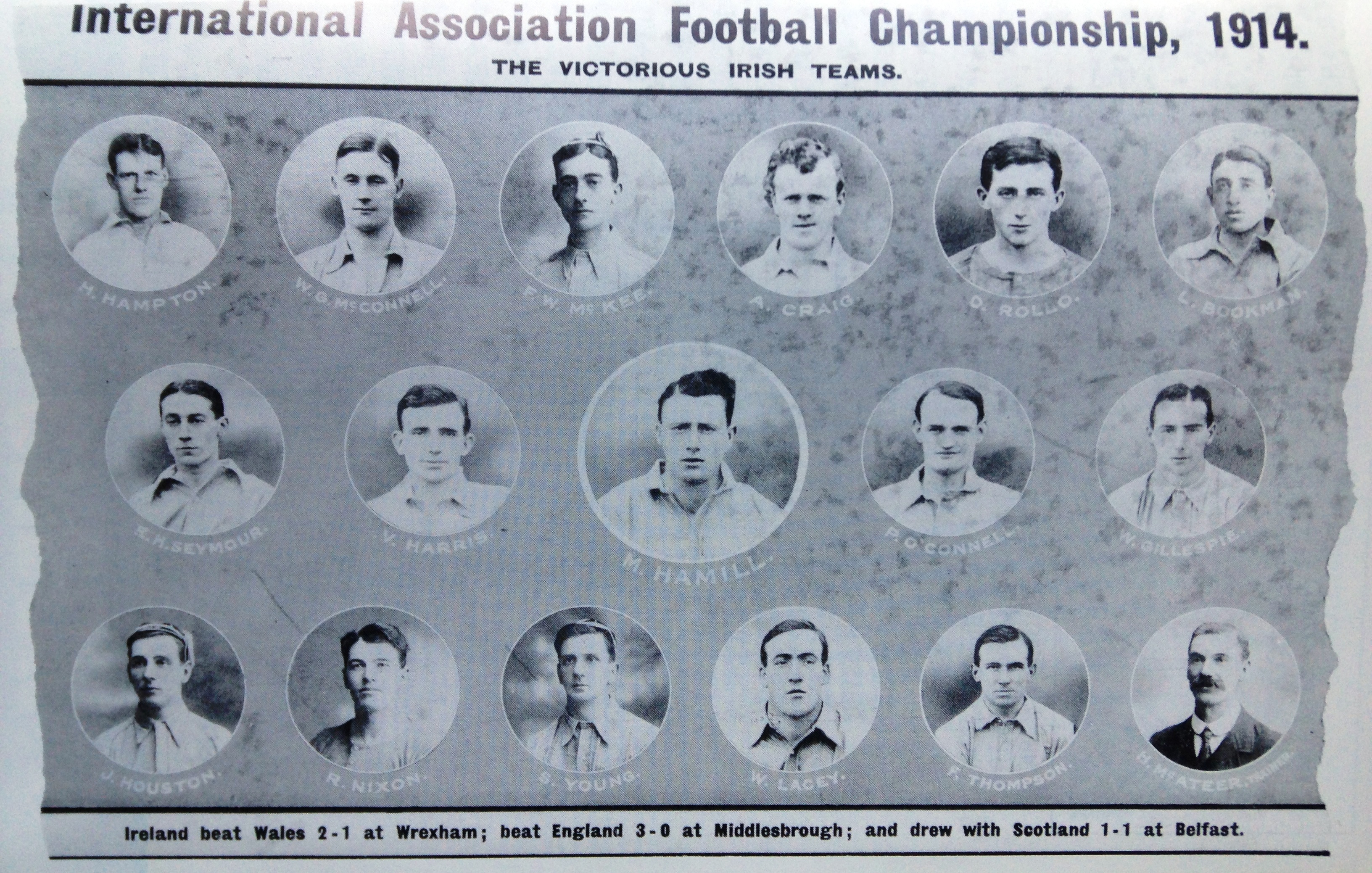
The side that triumphed in 1914 was a young, impressive and truly representative team. While in previous years there had been a great deal of tension and legitimate criticism about Belfast based players being favoured ahead of Leinster based players, the squad for the 1914 Championship was a truly all island affair. It featured players from the footballing hotbeds of Dublin and Belfast but also players born in the likes of Wexford (Billy Lacey), Galway (Alex Craig) and even Lithuania in the case of Louis Bookman who was born in what was then part of the Russian Empire. Bookman’s  family fled to Dublin when he was a boy to escape the persution of Jews then taking place, he began his footballing career for Belfast Celtic before moving to England with Bradford City, in course becoming the first Jewish professional  footballer in Britain. Bookman was playing for Bradford when he was called up in 1914 but the squad was a mix of players who were plying their trade in both Ireland and Britain, it also included two players from Bohemians, William McConnell and Ted Seymour.

1914_ireland_british_champions

1914 Home Nations Champions

Both players were of course amateurs in keeping with the traditions in place at Bohs which meant that they were in a minority even by 1914 as most of the major teams in Ireland had already embraced professionalism by that time. The two main exceptions being Bohemians and Cliftonville. Seymour was an outside-right for Bohemians and one of the stand-out forwards for the Gypsies at the time, the son of an RIC officer who lived in the nearby Phoenix Park he won his first amateur cap for Ireland by 1912 scoring in a 3-2 victory against England, the same year he would win the Leinster Senior Cup with Bohemians. His lone senior cap would come in Ireland’s opening match of the Home Nations Championship, an away fixture against Wales which Ireland won 2-1 when he was called up as a replacement for Everton’s injured winger John Houston. Sheffield United forward Billy Gillespie got both goals in that game but Seymour obviously impressed over the course of the match as he was quickly signed up by Cardiff City on the strength of his performance.

Amateur team pic

The Irish amateur team which defeated England 3-2 in 1912. The side featured three Bohemian F.C. players; William McConnell, Ted Seymour and Dinny Hannon.

William McConnell had a somewhat more extensive career at International level. Regarded as one of the best full backs in Ireland McConnell was a strong and physically dominant defender for Bohemians and Ireland. A member of the Bohemians team that lost out in the 1911 Cup Final to Shelbourne he also won a pair of Leinster Senior Cups with Bohemians and represented the Irish League on three occasions. At International level McConnell won six senior caps and was only on the losing side once, in a 2-1 defeat to Scotland in 1913. McConnell made his debut in 1912 in a 3-2 win over Wales and was part of an historic victory in only his second cap as Ireland beat England for the first time ever. Billy Gillespie grabbed both goals in a 2-1 victory in Windsor Park as McConnell lined out alongside his Bohs team-mate Dinny Hannon. Despite that landmark victory the Irish side still finished bottom of the Home Nations Championship but things were to be much different the following year. McDonnell was an ever present in the successful Home Nations campaign starting every game at full back.

The Ireland side before the opening game against Wales

The Ireland side before the opening game against Wales

The campaign opened with the aforementioned 2-1 win away to Wales and was followed by another away fixture, this time against England in Middlesboro’s Ayresome Park. Proving that the previous victory against England was no flash in the pan the Irish trounced the English on home soil, two goals from the ever versatile Billy Lacey, then of Liverpool and a third from Billy Gillespie eased Ireland to victory over a stunned England. The Donegal born Gillespie would end the tournament as its top scorer with three goals and was arguably one of the greatest players in the world at this time. He would captain Sheffield United to victory in the 1925 FA Cup final and play on for them until he was more than 40, towards the end of his career his role at the heart of the Blades attack would be taken over by another Irishman, Jimmy Dunne who would later coach Bohemians in the 1940’s. At international level his 13 goals for Ireland/Northern Ireland would remain a record until it was eclipsed by David Healy in 2004.

However Gillespie would miss the final match that could guarantee Ireland the 1914 Championship, as Sheffield United had to replay an FA cup tie they refused to release Gillespie for the game against Scotland in Belfast’s Windsor Park. This would require a significant reshuffle on behalf of the Irish with Samuel Young of Linfield coming into the forward line and Billy Lacey taking over Gillespie’s role in the attack. McConnell continued as usual alongside Alex Craig (Greenock Morton) in a defence that had proven solid over the previous two games.

William

William “Bill” McConnell

The match would be the only home game for Ireland that year taking place in Windsor Park, but under far from ideal conditions. Not only was Gillespie unavailable but there was a downpour the day before the game which continued through to the game meaning that both sets of players were ankle deep in mud. The view of the press at the time was that this would suit a more physically imposing Scottish side. Worse was to come for the Irish as the conditions and the hard-fought nature of the game began to take their toll and injuries on the Irish side began to mount. Paddy O’Connell, then of Manchester United and later manager of Barcelona picked up a knock as did McConnell who had to leave the field of play. However the Bohs man wasn’t out of the action long as the Irish keeper Fred McKee of Cliftonville suffered a broken collar bone during the first half. McKee managed to struggle on until half time but once the second half commenced McConnell took to the field in his place in a sodden goalkeeper jersey that was supposedly “two sizes too small” . As substitutions were not in use at the time Ireland were down to ten men with Lacey dropping back from the forwards to take McConnell’s place at full back.

This was not the first time Ireland had found themselves in this situation, Lacey had been forced off in the Welsh game yet Ireland had triumphed and now he was in defence helping protect McConnell in goal. Forced into making a couple of saves early on McConnell seemed to be doing alright in his unfamiliar position but a mis-timed run forward  meant he gave possession to the onrushing Scottish forward Joe Donnachie who had a simple finish to give Scotland the lead. It seemed like all could be lost in the cruellest fashion. The team without its main goalscoring threat in Gillespie and down to ten men looked doomed but with just eight minutes remaining a fine pass from Patrick O’Connell sent Sam Young free and he blasted the ball home to send the crowd wild. Despite the terrible weather the huge crowd had been in full voice behind the Irish team and Windsor Park saw record gate receipts of £1,600 on the day. The supporters had gotten their moneys worth, the underdog team, shorn of their best player, having finished two of their three matches with only ten men were now outright Champions for the first time.

This victory was met with great joy and optimism on behalf of the footballing community throughout Ireland. Having defeated England in their last two outings and having won the Home Nations Championship outright there were high hopes that the team could push on from this achievement and defend their title the following year. Other matters were to intercede however.

While the outbreak of War did not bring about a halt to all football it did end international matches. Players were encouraged to set a good example to other young men and enlist. Football clubs in all parts of the country faced tough times losing both players and fans to the trenches of France and Belgium while the league would split for the course of the war creating regional leagues focusing on Dublin and Belfast.

By the time peace was restored to Europe several of the squad had passed their prime and although players like Lacey and Gillespie were still top performers for their clubs in England the split between the Irish football associations which led to the formation of what we know today as the FAI meant that the potential of a united Irish XI would never be realised.

For those players with a Bohemians connection their careers were varied. Ted Seymour’s stay in the Welsh capital was brief and included works in a Welsh munitions factory to support the War effort, he left Cardiff City in 1915 and returned to Ireland with Glentoran for whom he lined out for much of the War years. Despite twice winning the Irish Cup (once with Glentoran and later with Linfield) Seymour was never again selected to represent Ireland.

McConnell also transferred to Britain, signing for Bradford Park Avenue who were then in enjoying their best ever league season, finishing 9th in the Football League in 1914/15, McConnell would have a limited role however, making only 4 league appearances. He would spend a brief sojourn in Belfast with Linfield before returning to Bohemians in 1916 where he played a handful of games. This was not to be the end of his sporting career however, he found significant success as an amateur golfer being successful enough to triumph in the 1925 and 1929 West of Ireland Amateur Championships. Some Pathé newsreel footage even survives of McConnell playing a round at a new golf course in Dun Laoghaire.

Though the war would disrupt the career of Billy Lacey he would still go on to have considerable success in the 1920s as a player for Liverpool, winning back to back titles. Lacey would return to Ireland to finish his playing career at Shelbourne and then as player-coach of Cork Bohemians. It was in 1930 during this spell in Cork that he would win his final cap for Ireland at the age of 41, he remains to this date the oldest player ever capped by the FAI. With his playing career finally over Lacey brought his considerable experience to the Bohemians of the Dublin variety. During his five years at Dalymount Park (between 1933 and 1938) Lacey would lead Bohs to two league titles and an FAI Cup as well as a host of other minor honours. During this stint Lacey would also provide his coaching talents to the Irish national side.

While the split remains as wide as ever between the FAI and the IFA and relations between the associations have been strained over players like James McClean and Darron Gibson electing to play for the Republic, it is worth remembering a time when a truly all-Ireland team triumphed against the odds and the role that key figures in the history of Bohemians would play in that victory.

If you are interested in further reading on the subject I’d suggest David Owen’s article in The Blizzard Issue 8. Neil Garnham’s “Association Football and Society in pre-partition Ireland” and also Cormac Moore’s “The Irish Soccer Split”. Finally a special thanks to Stephen Burke of Bohemian F.C. for providing additional information on the career of Bill McConnell. For more on Louis Bookman and his fascinating life try “Does your Rabbi know you’re here?” by Anthony Clavane.

Catalonia: Mixing football and politics

I wrote this on Catalan independence back in 2012 but in light of recent elections in Catalonia with claims that Catalonia could be declared independent in 18 months I thought this might still be relevant.

Few places on the planet meld the worlds or football and politics together as much as Catalonia and its biggest city Barcelona. As Catalonia goes to the polls in less than two weeks’ time; at stake will not just be the parliamentary seats of the regional government from one of Spain’s 17 provinces but possibly the future of Catalonia and Spain itself.

Catalonia is in a contradictory fashion both one of Spain’s most indebted regions while also being the region that pays the highest amount of taxes to Central government. Disagreements between regional premiere Artur Mas and Spanish Prime Minister Mariano Rajoy over the ability of Catalonia to have more direct control over spending and taxation have led to the hot topic of the regional elections due to take place on November 25th being that of Catalan independence.

This has been demonstrated by large scale pro-independence street marches on the streets of Catalan towns and cities and in the great cathedral of Catalan nationalism the Camp Nou. During last month’s Clasico match with Real Madrid the whole stadium was turned into a giant Catalan flag while the crowd chanted “Independence, Independence”. During their recent visit to Parkhead the Celtic staff greeted their visitors not with the Spanish flag but the Catalan one flying from the stadium flagpoles, a nod and a wink from the Scots who are due to have their own referendum in 2014. Despite the international nature of FC Barcelona’s founding fathers the club has become a focal point for Catalan nationalism, Camp Nou being described as the one place in Catalonia where the Catalan language and political dissent could be vocalised during the Franco regime Its club presidents view the leadership position at the club and on-field success as important political tools and are often aligned with the Catalan nationalist movement, former President Joan Laporta was an MP with Democricia Catalana for example.  The current president Sandro Rosell is the son of former Chief Executive Jaume Rosell who was involved with the club in the final years of the Franco regime in the 1970’s. As the story goes upon hearing of the death of the dictator Rosell and a colleague began tossing a plaster bust of the Generalissimo back and forth to each other before Rosell fumbled and dropped the bust to the floor where it smashed to pieces. It’s a very Barca story.

However it’s worth thinking about where a successful independence movement would leave not only Barcelona but all of Catalan and Spanish football. Projections are suggesting that Catalan Independence parties could gain a majority in the regional parliament this month and would be in position to push for a referendum on Catalan independence. Rajoy and the rest of the Spanish National Government won’t countenance this action, declaring it illegal and beyond the powers of the regional parliament, they have also stated that any new Catalan republic would be barred from entry to the EU, something that Artur Mas has strongly contested in Brussels.

A situation could arise whereby Catalonia would almost be a rogue state within Western Europe, recognised by some but not by others, perhaps in the same way that nations like Kosovo or South Ossetia are treated depending on the political outlook of the nation in question. Even if Catalonia were to universally recognised there would be a situation where in footballing terms the new nation would have to seek membership of UEFA and FIFA as well as set up a separate league system as happened in countries like Croatia after the breakup of Yugoslavia. Although there is a separate Catalonian football association, (they have played over 200 international matches) this body is not affiliated with FIFA and the games that they have played are basically challenge matches against guest teams organised during the Christmas break in the Spanish Football calendar.

It would mean that the appeal of Barca could be greatly diminished, they would the major player in a rump league that would feature some teams of prestige, such as Espanyol but the overall quality would drop significantly. Barcelona would be the big fish in a much smaller pond, their titanic clashes with Real Madrid a thing of the past as far as league and cup games are concerned, and without their rivals, without the great competitive edge fuelled by that desire to get one up on the all-white grandees from central Spain would they be the same team? A rump Catalan league would surely hit Barcelona (and it must be said Real Madrid) in the pocket too; Girona FC are not as appealing an opponent as Real Madrid, Athetic Bilbao or Sevilla for either the stadium spectator or the TV marketing executive. A reduction in league competition could mean that Barcelona’s own exacting standards are lowered and that players, whether cantera products or foreign signings could look to other “bigger” leagues as their desired end destination. Could Barca go from from epochal super-team to stepping stone in a matter of years? The other option would be for Barcelona (and others) to seek to remain in the Spanish league. There is some precedent with this in that teams from the neighbouring principality of Andorra already compete in the lower leagues in Spain. The question then becomes whether the financial and competitive advantages of being part of Le Liga triumph over the traditional Catalan nationalist leanings associated with the club. And let us not forget that it was Jaume Rosell that said “Barça is more than a club, but above all it’s a club for all social classes. Barça includes all ideologies because it represents the whole Catalan people”, the questions of who they represent, and where do they represent them would have to be answered by the Barca board, and it is likely their response would not be greeted with universal approval by the supporters.

And what of the national teams of Spain and Catalonia? As mentioned previously there are annual Catalan international challenge matches played each year in December. Last years’ squad featured the likes of Victor Valdes, Carlos Puyol, Gerard Pique, Xavi, Sergio Busquets, and Cesc Fabregas, all World and European Champions with Spain. A formidable core to have in any international team, but how many of them would be likely to declare for the new Catalan national side, it’s one thing to play a challenge match in the knowledge that you can go back and join your World Champion team-mates during the next international break, it’s quite another to walk away from the most successful international side in the modern era. Despite the rivalry and occasional aggression between Real Madrid and Barcelona, the national team replete with Catalans, Castillians and Basques has been harmonious, the players have stressed that regional divides and identities mean little and this attitude has brought them unprecedented success. Players face similar choices in Ireland with players born in Northern Ireland presented with the option of playing for the North or the Republic. Patriotism, a sense of community, identity and belonging, career advancement all play a part in a players’ decision to declare for either team. The same complex choices could face the footballers of Catalonia and Spain.

Pep

The international dilemma brings us back to Catalan nationalism, despite over 1.5 million people taking to the streets in Catalonia calling for independence, many from the region are migrants, or children of migrants from other parts Spain especially the south, or indeed a more recent influx of migrants from areas like North Africa who moved to the larger, wealthier cities of Catalonia to earn a living. For them is Catalan nationalism  as much of a priority? They were the outsiders coming into an area that spoke a different language, Catalan and they had to adapt to their surroundings.

One of those ways was through football; Barcelona as well as being a symbol or perhaps even a vehicle for Catalan nationalism are also the club of the foreigner, their founders included Swiss and Englishmen, their heroes have had names like Kubala, Cruyff and Stoichkov, they celebrated an openness internationalism at the height of Spain’s post war isolation and are the global dream team for millions. Barcelona is rightly lauded for focus on home-grown talent but it is also a bit about Argentinian, Brazillian and Dutch brilliance. The immigrants and their children are as much a Barcelona cule as the died- in-the-wool Catalan nationalist, will they appreciate a marginalising of their club or the potential weakening of their all-conquering national team?

Spain has been down paths like these in the past. In the early 80s the country was still in the nascent phases of democracy after the death of General Franco, they were also preparing to host their first World Cup in 1982. Although awarded to Spain as part of a voting pact back in 1966 (some things never change) it became a chance for Spain to continue its reintegration into the Western world after the years of dictatorship with membership of the EEC also on the horizon. However, in other matters there were similarities with modern day Spain as it was also a time of huge economic stagnation, massive unemployment, regional tensions over the devolving of powers; including an active terrorist campaign from Basque separatist group ETA.

Against this background an attempted coup was launched by right wing and military forces in Spain and on 23rd February 1981, 200 armed guards entered the Spanish parliament led by Lieutenant Colonel Antonio Tejero. The swift and determined intervention of King Juan Carlos I who made a televised address denouncing the coup and calling for a return to the proper running of the democratic government saw the coup collapse by the early hours of February 24th. Only a week later Barcelona striker Enrique Castro Gonzalez, better known as Quini was kidnapped at gunpoint shortly after he had helped Barcelona to a 6-0 victory over Hercules. Although the kidnapping turned out to be the work of common criminals and economically motivated  (Quini was eventually released unharmed after 25 days in captivity), early reports suggested that Quini was kidnapped by a Spanish nationalist group who did not want a “separatist” team like Barcelona winning the title.

As ever football and politics seem to be uneasy yet constant bedfellows in Spain, whether the current talks or referenda on Catalan independence is a political ploy, a bargaining chip to gain greater authority over finance, or a political pledge soon to be realised remains to be seen, the fate of a nation and the greatest club and national teams in a generation hangs in the balance.

Originally posted on backpagefootball.com in November 2012

A cup to call our own – a new European trophy for smaller nations?

Remember when Magdeburg, Mechelen, Aberdeen and Dinamo Tbilisi were European champions? Those clubs from East Germany, Belgium, Scotland and Georgia respectively were all winners of the lamentably departed Cup Winners Cup, the UEFA competition that did what it said on the tin and provided a competition for well… Cup Winners.

The Cup Winners Cup, a straight knock out tournament for the victors of domestic knock out tournaments tended to throw up more unexpected champions than in other tournaments and had a greater representation from a broader geographical area. Before the greater consolidation of power and wealth into the hands of a group of superclubs in a handful of leagues the Cup Winners Cup was a chance to see teams from corners of Europe that one was not necessarily exposed to on a regular basis.

programme

Match programme from the 1981 Cup Winner Cup Final

Since that 1998-99 season UEFA has ran the two main European club competitions of the Champions League and Europa League but as of 2018 that could change. In 2018 the television rights for the two main competitions comes to an end and there area early discussion about returning a 3rd European club competition but one focused mainly on smaller clubs who exit other European competitions early. This could provide a potential windfall for Irish clubs who miss out on the lucrative group stages of either competition and present a tantalising array of possible outcomes. European football beyond September could finally be a realistic expectation for Irish clubs.

Such move would be in keeping with the ethos of UEFA president Michel Platini who has extended the European Championships to 24 sides and made changes to qualifying for club tournaments to give greater representation to smaller nations. Quite what format the tournament would take should UEFA decide to proceed with its creation is still up in the air. As reported in the Guardian the Scottish FA’s Stewart Regan said that

“It’s a discussion around whether it’s a separate third competition exclusively for smaller countries who then relinquish their place in the Europa League and/or Champions League or whether it’s a competition that basically acts as a further safety net for those clubs that enter the Champions League or Europa League but are typically out by August and then [instead] they fall down into a third competition,”

Whether smaller nations would choose to give up on the possibility, albeit a slim one, of qualifying for the Champions League in order to compete in a lower tier competition is dubious but the option for a follow up competition for club sides from smaller nations to compete in beyond August and September could prove to be a welcome boost. Such a competition could generate revenue and interest for clubs and also give club sides from smaller nations the opportunity to test themselves in a competitive environment against sides from other jurisdictions.

Manuel Veth, writing on the subject for the Futbolgrad.com website highlighted the example of the Baltic League competition held between the major teams from the Baltic States or the Royal League held between sides from Denmark, Sweden and Norway as regionalised multi-league tournaments that have already been tried.

A regionalised competition based on a straight knock-out format could prove popular, especially if victory could guarantee something like automatic group phase qualification for either the Champions League or Europa League the following season.

However, significant potential drawbacks from such a hypothetical competition exist. In a regionalised format would their be sufficient interest in a competition between top sides in say the Republic of Ireland, Northern Ireland, Scotland and Wales? Especially if a larger team like Celtic secured qualification through to the Champions League and were not involved? Much would depend on the prize money available and the draw of other sides in the competition. Irish football fans on both sides of the border would have seen interest in Setanta Cup wane once there was significant reductions in the prize money. Such prize money would most likely have to come from TV rights deals and sponsorship and it remains to be seen whether there would be an appetite on behalf of broadcasters to covers games in what would effectively be a third tier competition.

Even moderate TV income would benefit smaller clubs in smaller nations. Perhaps it could be considered in the negotiations of TV rights deals in 2018 with preferred bidders for the Champions League being required to purchase a certain number of games from this new tournament? Similarly UEFA could create a solidarity fund from the massive TV and sponsorship revenues that the Champions League and Europa League enjoy and use such a fund to provide incentives and prize money for clubs from smaller nations competing?

uefa

UEFA headquarters, Nyon

Despite the reforms brought in by Michel Platini and his administration to facilitate greater participation of small nations and their clubs there seems to be a growing gap between the hyper-wealth elite like Real Madrid, Barcelona, Bayern Munich, Chelsea and so on, the historic clubs from smaller and middling sized nations and clubs from more peripheral nations. Whether we like it or not, Ireland in this context is a peripheral nation. There has long been a hope among League of Ireland fans that an Irish side could “do a Rosenburg” and secure regular qualification for the group phases of major competitions but despite Shamrock Rovers making the Europa League group stages those days don’t appear to be on the immediate horizon.

In the absence of regular group stage qualification could a third tournament give us our European fix?

Originally posted on backpagefootball.com 

The 1945 Inter-City Cup: War, Goals, Controversy and death by corner kicks

As you go for a pint in the members bar you may on occasion glance upward and notice the Bohemian F.C. honours list spelt out handsomely in gilt on a dark red background. It makes for impressive reading and is testament to the proud history of our club. Right in the middle of the bar, between the list of League Titles and FAI Cups is a sign that reads “Setanta Cup Champions 2010”. The Setanta Cup is, at the time of writing, our most recent honour. Few of us will forget Anto Murphy’s goal versus Pats in Tallaght Stadium, and it added a little extra relish that Bohs had managed to win a trophy in the enemy’s back- yard so to speak. It is worth noting, however, that though the Setanta Cup is the latest All Ireland soccer competition, it was by no means the first, nor was it the first such competition where Bohemians emerged victorious. To learn about this other, much earlier victory we must go back 70 years, to a time when the most violent conflict in human history still raged, to the first cross border competition since partition; the Inter-City Cup.

The Inter-City Cup, or to give it its full title, the Dublin and Belfast Inter-City Cup was conceived as a way to provide much needed income during the turbulent years of the Second World War. When the First World War had broken out in 1914, the general and oft-repeated assumption was that the war would be over by Christmas, so the sporting calendar continued on much as it had done in peace time. Bohemians and Shelbourne, the only two clubs from outside the six counties, continued to play in an pre-partition league season into 1914-15, but the growing realisation that the war was going to drag out meant that the Football League in Britain was suspended, while the Irish League was reduced to a “Belfast and District League” of only six teams with no room for Bohs and Shels. Many players, especially in Britain came in for heavy criticism for playing on into 1915. Some viewed it as a dereliction of patriotic duty that fit and healthy young men should stay at home and be paid to play football rather than volunteer to fight at the front. This led to the formations of “Football battalions” where prominent footballers were used as promotional tools for enlistment. Some football fans joining up were encouraged by the fact that they would have the chance of serving with their sporting idols.

When the Second World War broke out, the mistakes of the past were avoided. The league season was suspended immediately in Britain while Northern Ireland completed the 1939-40 season (Belfast Celtic won their 13th title) before suspending the Irish League and playing on with a diminished Northern District League. The League of Ireland, being in a neutral country, continued on as usual during the War years. It would prove to be a particularly successful era for Cork United, who would win five titles between 1939 and 1946.

However, gone from the fixture calendar were lucrative games against touring British sides. The lack of income was obviously a significant concern for the clubs north of the border, robbed as they were of regular gates and a full league programme which ultimately led to the creation of the Inter-City Cup. The tournament would run for eight seasons between 1941-42 and 1948-49, and despite the name, did include clubs from outside of Dublin such as Limerick, Cork United, Dundalk and Derry City. While matches were spread around various grounds in Belfast, all games south of the border were to take place in Dalymount. Another interesting feature of the tournament was the significance of corners. If two sides were tied on aggregate in the final, the side who had won the most corners were deemed to be the winner. Bohs learned this to their cost during the 1942-43 competition when they lost the final on corners to Shamrock Rovers having drawn 2-2!

Despite that setback Bohs, would eventually triumph in the competition. The 1944-45 season would be one of highs and lows for Bohemians, but it did at least end in some silverware. Bohs’ league form during the War years was poor; a third place finish in 1940-41 being the sides’ best placing and the 44-45 season would see Bohs finish bottom of the eight team league but would also see them reach two cup finals. An epic, three game semi-final win over Team of the decade, Cork United, would get Bohs into an FAI Cup final against Shamrock Rovers, where in front of the biggest ever Cup Final crowd of almost 45,000 they would lose out to a Podge Gregg winner. Gregg, a native of Ringsend had just returned to Dublin after a spell with Glentoran where he had won the Inter-City cup the previous year.

Bottom of the league, having lost a final to Shamrock Rovers, its fairly obvious that Bohs’ season needed a pick-me-up, and the Inter-City Cup could provide it. So as not to clash too much with regular games, the Inter-City competition was held around April and May each season when most games were coming to an end.  In that particular year, Bohs lost the FAI Cup final to Rovers on the 22nd of April, but less than a week later were in action in round one of the Inter-City.

The first round game saw them drawn against fellow amateurs Cliftonville in Solitude on the 28th of April, with a return leg in Dalymount a week later. A 3-2 victory in Belfast with two penalties from full-back Frank Glennon and a Pat Waters goal gave Bohs too commanding a lead for the return leg, which ended as a 1-1 draw. The following round would see them matched with Glentoran; competition winners the previous year, Glentoran had been beaten on corners in the previous round by Limerick and only qualified as the best loser, their luck was out again as the tie finished 3-3 on aggregate so Bohs advanced as winners on corners 10-9 and thanks to an excellent performance by Collins in goal. Victory over Glentoran meant a meeting with Distillery, now based in Lisburn but then firmly ensconced in Grosvenor Park, West Belfast. Bohs would comfortably beat Distillery 8-3 on aggregate, a dynamic 5-1 victory in Dalymount was capped by a stunning strike from Kevin O’Flanagan, who beat the opposing keeper with a shot from out on his own touchline. The Irish Independent correspondent was moved to describe it as “the greatest goal seen in Dublin for years” and very topically likened the speed of the shot to that “of a V2 rocket”. O’Flanagan had the Distillery defence bewildered, and Bohs could have won by an even greater margin, as he finished with two goals. His brother Mick at centre-forward got one, while Noel Kelly and Waters got the other two. Despite going 2-0 down early on in the second leg in Belfast, the Gypsies rallied, and goals from Mattie Burns, Kevin O’Flanagan and Noel Kelly ensured there was no chance of an unlikely comeback.

Semi final

The other semi-final between Belfast Celtic and Linfield was also a high scoring affair, finishing 7-5 on aggregate to Celtic. As a two legged semi-final the first leg was held in Belfast before both sides travelled to Dalymount Park for the second game. With the tie balanced at 2-2 from the first leg, the Linfield goalkeeper and captain Tommy Breen (once of Manchester United and a seasoned international) elected to kick off defending the tramway end of the famous old ground. Due to heavy rain, Breen and his defence were ankle deep in water at that end of the ground which had cut up much worse than the opposite school end. 7 of the 8 goals scored on the day went into the tramway goal and Linfield were out. Breen’s former team, Belfast Celtic, were through to the final and were eager to make up for their defeat to Glentoran the previous year. Celtic had beaten not only Linfield, but Shamrock Rovers and Shelbourne en route to the final. The first leg was to be played in Belfast on May 30th with the return leg in Dalymount on June 2nd. VE day had taken place on May 8th and the laws and censorship brought in during the “Emergency” were lifted shortly afterwards. For the first time in six long years, football fans both North and South could genuinely look forward to the first real cup final in “peacetime”.

It is worth a brief diversion from our narrative to outline the merits of the Belfast Celtic side. Although the club has not existed in any real sense since the end of the 1940’s, they were at the time unquestionably one of the biggest sides on the island of Ireland. By the time the club was dissolved in 1949 they had won 14 league titles, second only to Linfield who by that stage had 19 to their credit. Former players included Mickey Hamill later of Manchester United and Manchester City, former President of the FAI and Government minister Oscar Traynor, Paddy O’Connell who would also play for Man Utd and later managed Real Betis and FC Barcelona, and Louis Bookman, the Lithuanian-born Irish international who became the first Jewish player to play professionally in Britain. Their coach at the time was Elisha Scott, a former player with Belfast Celtic and also Liverpool’s longest serving player ever. Scott was considered with some justification to have been one of the greatest keepers Ireland has ever produced and won ten league titles and six Irish Cups as Belfast Celtic manager. Their starting XI at the time of the Inter-City cup final was also on par with any of their previous sides. They would win the first official Irish League title after the war in 1947-48, and the team that Bohs faced included the likes of midfielder Charlie Tully, who would later join Glasgow Celtic and once famously scored against England direct from a corner in an international, attacker Jimmy McAlinden (an FAI and IFA international) an FA Cup winner with Portsmouth, and fellow international centre half Jackie Vernon who spent much of his career at West Brom.

In the case of Bohs, it would be a last hurrah of sorts. After the end of the Inter-City final, several of the winning side left for pastures new, including young goalkeeper Jimmy Collins, Frank Glennon and Noel Kelly, who would all switch to Shamrock Rovers. They would be joined a year later by their coach Jimmy Dunne, the former record breaking striker and soft-spoken coach, returning to Rovers after patching up his differences with the Cunninghams. Kevin O’Flanagan, a medical doctor was offered a job as a GP in Ruislip, London where he would spend his free time playing for Arsenal at football and London Irish in Rugby. While Bohs would make another FAI Cup final in 1947 (which they would lose after a replay to Cork United) the Inter-City cup would be the last trophy that Bohs would win apart from a pair of Leinster Senior Cups until the Cup final victory over Sligo Rovers in 1970. Bohemians’ insistence on remaining strictly amateur had served them well, as they won Leagues and Cups in the 1920s and 30s, but by the 40s, key players were being picked off by other clubs offering a few pound a week. While Bohemians continued to find and recruit excellent young players, they struggled to keep them for any length of time, the few exceptions being those whose day jobs allowed them the freedom to play without care for additional wages.

The two-legged final would be a close and often controversial affair. In the first leg there was nothing to separate the teams, not even corners as the sides finished level with two goals apiece, six corners each and both sides down to ten men. Kevin O’Flanagan for Bohs and Douglas for Celtic were the men sent off after coming to blows after Douglas kicked the ball out to touch when O’Flanagan was about to take a free. Bohs had taken a two goal lead thanks to an own goal and a finish by Smith, but the free scoring Bohs full-back Glennon ended up getting a roasting from Celtic outside left Paddy Bonnar, who grabbed two second half goals to tie the game. The return leg was no less controversial. Bohs named an unchanged side for the second leg (almost identical to the one which had lost to Shamrock Rovers just over a month before apart from Smith coming in for Frank Morris).

Bohemian FC Inter City Cup winning side

The Bohs side read: Standing – Ossie Nash, Paddy Waters, Billy Richardson, Jimmy Collins, Frank Glennon, Peter Molloy, Charlie Harris (Trainer). Front – Mick O’Flanagan, Noel Kelly, Kevin O’Flanagan (Captain), Matty Burns, Bobby Smith.

Belfast Celtic had suffered some injuries in the first leg with Peter O’Connor and Charlie Currie coming into attack for Johnny Campbell and Tommy Byrne. The second leg remained tight with few opportunities, Jimmy Collins in the Bohs goal being called into action in the first half to deal with chances from both Tully and Bonnar, but it was in the 67th minute that things became more heated when a cross came in from Smith which was trapped by Kevin O’Flanagan and passed into his younger brother Mick who when controlling the ball had a “Thierry Henry moment” and appeared to handle it before firing past Celtic keeper Hughie Kelly. This started furious protests from the Celtic players and led to an altercation between Captains Kevin O’Flanagan and Jimmy McAlinden who both had their names taken by the referee. Despite the Celtic players’ protests, the goal stood. Celtic’s disjointed attack, with the enforced changes since the first leg, had struggled to get past the Bohs defence, with Richardson and Glennon coming in for particular praise. Bohs successfully defended their lead, and after a season of disappointment, were All Ireland champions. It was particularly sweet for the star player Kevin O’Flanagan, who despite his sending off in the first leg, had been key in Bohs’ advancement to the final in much the same way that he had been key during the FAI Cup run scoring three goals by the time they reached that final. By setting up the goal for his brother Mick he had managed to make amends for his below par display in the earlier final versus Shamrock Rovers. Despite being a qualified GP the “Flying Doctor” had failed to diagnose himself with a bout of flu and upon returning home after the defeat to Rovers took his temperature and found that he had played a cup final with a 103 degree temperature!

Final article 1st leg2

It would be the last major trophy that Bohs would win for some time and the Inter-City cup was in some ways was the farewell of the Corinthian era of Bohemians and of Irish football as they signed off as Champions of North and South. Belfast Celtic, meanwhile, would remove themselves from League football only four years later, a mixture of sectarian violence, financial troubles and mismanagement forcing them out of senior football. While the Celtic board believed the withdrawal would only be a temporary measure it would transpire that their successful tour of North America, where they played to packed stadiums and famously defeated the Scottish national team, would in fact be their good-bye to the world of football. Guesting at centre forward for that touring side was none other than Bohs’ Mick O’Flanagan, his “hand of Mick” moment forgotten as he starred for Belfast Celtic as they slipped into history.

*special thanks to Martin Flynn and the Belfast Celtic Society for their assistance with some research for this article.