Bohs in Europe – the 1970s (Part I)

The 1970s saw Bohs first forays into European competition. The decision taken in 1969 to abandon the strict amateur ethos of the club, observed since its foundation in 1890 paid immediate dividends with victory in the 1970 FAI Cup and secured entry to the 1970-71 European Cup Winners Cup. Given the club’s name it was somehow appropriate that our first opposition should come from what is now the Czech Republic. Over the course of the decade Bohs would qualify for European competition eight times, and would see the club enjoy its first victories. The focus of these articles are the dramatic campaigns of 1977-78 in the UEFA Cup and the 1978-79 European Cup.

The 1976-77 League season had seen Bohs finish second, a point behind Sligo Rovers who won just their second ever title. It was a young, talented Bohs side, packed with players who would go on to have successful international careers, and some who had already been capped by their country. That second-place finish secured qualification for the following season’s UEFA Cup, now rebranded as the Europa League. European football in the 1970s was quite a different place from today, the splintering of the USSR and Yugoslavia into their constituent parts was still decades away and nations like the Faroe Islands or Andorra were not yet represented in European competition. With a smaller number of nations there was no qualifying round and no group stages, qualifying meant entry into a straight knock-out, first round tie and a potential draw against a European heavyweight.

There was the dilemma here for Irish clubs, whether to hope for a smaller, more obscure team, and a better opportunity to progress, or the desire for a big name in the draw and a potential bumper home gate. It’s worth noting that in this era Europe was generally a drain on club resources, prize money was not nearly as significant to an Irish club as it is today and getting drawn against a little-known side from Eastern Europe could end up being hugely costly to a club’s finances. The biggest draws for an Irish club, then as now, were British clubs, well known to the Irish public and almost guaranteed to draw a big crowd even if the chances for progression were slim.

It was against this backdrop that Bohemians were drawn against Newcastle United in the opening round of the 1977-78 UEFA Cup, with the first leg being a home-tie in Dalymount. From a Bohs point of view this had the potential to be a lucrative tie, Newcastle had finished fifth in the First Division the previous year and would be well known to a Dublin audience, while the away trip to Newcastle could be done at relatively low cost. Billy Young, the long-serving Bohs manager during this period recalled that the club made all their travel arrangements through a travel agent named “Mrs. Chisholm” and while she couldn’t always arrange the most direct route, she always arranged the cheapest! For Bohs away trip this would entail a flight to Leeds, and after some delays, a coach to Newcastle.

The Bohs squad for those games against Newcastle was one of the strongest of the decade, in goal was Mick Smyth, the veteran of the team at 37, he was hugely experienced and successful, having starred for Drumcondra and Shamrock Rovers before joining Bohs, he’d also been capped for Ireland against Poland back in 1968. In front of Smyth were the likes of full-back Eamonn Gregg, who would win eight international caps during his time as a Bohs player, and later manage the club, Tommy Kelly, another vastly experienced player who still holds the club record for most appearances for Bohemians, on the left of defence was Fran O’Brien, a pacey, attacking player from a footballing family, he would win three caps for Ireland and ended up spending the majority of his career playing professionally in the United States. These were supported by the likes of the imposing Joe Burke, and classy defender/midfielder John McCormack, inevitably nicknamed “The Count”.

The Bohs midfield set up might strike current fans as familiar, there was a focus on using the flanks as avenues of attack, helped by the fact that in the shape of Gerry Ryan and Pat Byrne they had two of the best wide men in the League. Both players would win numerous caps for Ireland, Ryan would later star for Derby County and Brighton while Byrne enjoyed spells with the likes of Hearts and Leicester City, but is probably best known for his time with Shamrock Rovers (boo!). Up front was the peerless Turlough O’Connor, another Irish international, he would set goalscoring records for Bohs not broken until the time of Glen Crowe, and would finish the 1977-78 season as the league’s top goalscorer. Turlough would later succeed his erstwhile teammate Eamonn Gregg as Bohs manager in 1993.

The Bohs team of 1977-78

This group was ably assisted by players of the quality of Padraic O’Connor (brother of Turlough), Tony Dixon, Eddie Byrne, Niall Shelly and Austin Brady. As mentioned, the side was coached by Billy Young, a stalwart player for Bohs during the club’s amateur era in the 1960s. Young would take the managerial reigns at Dalymount in 1973 and stayed in charge through to 1989!

To ensure a bumper crowd for the Newcastle match the Bohemians committee decided to reduce the standard entry fee for the game, the Irish Independent reporter Noel Dunne went so far as to say that Bohs were offering the cheapest football in Europe with fees ranging from £2 for a stand ticket down to 50p for a spot on the terraces. The pulling power of an English team and cheap tickets had the desired effect and Dalymount welcomed almost 25,000 spectators for the home leg. Bohs were able to field an almost full strength side apart from Joe Burke who missed out having scalded his foot in a workplace accident (not something that the opposition side would likely have had to deal with). The Bohs XI were Mick Smyth, Eamonn Gregg, Fran O’Brien, Tommy Kelly, John McCormack, Padraic O’Connor, Pat Byrne, Niall Shelly, Turlough O’Connor, Eddie Byrne and Gerry Ryan.

Ryan especially was a thorn in the side of Newcastle, going close early on with a long-range shot, and helping create the best chances for the game for Bohemians thanks to his excellent link-up play with Pat Byrne and Turlough O’Connor. While Bohs had enjoyed some decent opportunities in the first half Mick Smyth was called into action to make crucial saves from Micky Burns and it took a last-ditch Eamonn Gregg clearance to deny Irving Nattrass. However, the performance was about to become of secondary importance in proceedings. With the sides still at 0-0 at the break, trouble began to flare when the Newcastle players returned to the pitch for the second half.

Newcastle squad photo taken from the game’s match programme

With Newcastle keeper Mike Mahoney taking up his position in goal in front of the school end of the ground there was a barrage of missiles and he was struck in the head by a beer can and play was suspended so that Mahoney could receive treatment. But that was just the beginning. Trouble began to flare between Bohs supporters in the tramway end and Newcastle fans in the main stand, chants, provocation and missiles flew back and forth. The Newcastle Chronicle reporter John Gibson claimed that the spark had been the unfurling of a Union Flag by some Newcastle fans which was met with anti-British chanting by the home fans, followed by fans hurling more than insults. With only fourteen minutes of the second half played the referee withdrew the players to the relative safety of the dressing rooms. In the interim additional Gardaí had arrived at the ground and there were baton charges to restore order. Post-match reports stated that a Garda and several others were injured and that five arrests were made at the game.

After some semblance of order had been restored the players returned to the pitch to complete the game with the crowd of almost 25,000 in what was described as a somewhat “unreal” atmosphere. The reports of the actual football, and conversations with both Billy Young and Tommy Kelly who were involved in the game, as Bohs manager and player respectively, recall a competitive game full of good football. Kelly remarked on the quality of player that Newcastle had, like Alan Kennedy who would achieve fame as a European Cup winner with Liverpool, Northern Irish international David Craig, and his Scottish namesake Tommy Craig. Indeed, Bohs had a great opportunity to win the game with twelve minutes remaining only for Mahoney (now patched up) saving after an excellent Bohs move put Turlough through on goal.

As was often the case with League of Ireland sides in Europe a decent home result and performance wasn’t enough to get Bohs through the tie. A flight to Leeds and a delay in getting the coach to Newcastle meant that the Bohs side arrived late in the Evening before the away leg, not ideal preparation. The coach had also stopped to collect the Derby County manager Tommy Docherty who had also attended the game in Dalymount. Docherty was a larger than life character, and hugely popular within the game, he had won the FA Cup a year earlier with Manchester United but had been sacked after beginning a relationship with Mary Brown, the wife of club physio Laurie Brown. Docherty was keen on signing two of Bohemians’ outstanding players, left-back Fran O’Brien and winger Gerry Ryan. Both players were in demand and indeed Newcastle had made offers for both players around this time.

Aware that there was competition for the players’ signatures Docherty was adding a personal touch. He was well-known to the Bohs committee, during his time with Manchester United he had signed the likes of Gerry Daly, Mick Martin and Ashley Grimes from the club, and was keen to make some key additions now that he found himself managing at the Baseball Ground. After the home leg in Dalymount, he had asked Billy Young if he could buy the players a drink, Young agreed and Docherty proceeded to order bottles of champagne for the Bohs players, before catching a private flight back to Derby.

The away leg was to be a let-down for Bohs, though Tommy Kelly remarked that the squad travelled with a certain level of confidence, feeling unlucky not to have won the first leg, the Magpies were a different prospect on home turf. They also welcomed back Alan Gowling to the starting eleven and he and Tommy Craig proved the match-winners, both scoring a brace to hand the Geordies a 4-0 win on aggregate. Within two days of the away leg newspapers were announcing that Derby County had signed Gerry Ryan and Fran O’Brien for a combined fee of £75,000 (£40,000 for Ryan and £35,000 for O’Brien), and that the players would merely be flying back to Dublin to collect belongings before moving to their new club. Speaking to Fran O’Brien he claimed the fact that Derby was close to Nottingham, home to his brother Ray who was playing for Notts County, influenced his preference in choosing Derby over the Magpies.

However, a supposed issue with O’Brien’s medical halted the move though what the issue was wasn’t made clear to O’Brien or Bohemians. Whatever the concerns from the Derby medical, Fran O’Brien would enjoy a long and successful career. He joined the Philadelphia Fury in the NASL a year later and played alongside the likes of Alan Ball, John Giles and Peter Osgood, he also became the first player to be capped for Ireland while playing in the United States.

Ryan would only spend a year at Derby before falling out with Docherty and moving to Brighton for a fee of £80,000, double what Bohs had been paid for his services a year earlier. He was to become a fan favourite at Brighton and joined a significant contingent of Irish internationals there including Tony Grealish, Michael Robinson and Mark Lawrenson. He was kept out of the starting XI for the 1983 FA Cup Final by fellow Dubliner and future Shels player Gary Howlett. Ryan would go on to win eighteen caps for Ireland before an injury aged 29 effectively ended his career.

Gerry Ryan during his time with Brighton showing off the souvenirs collected during his international career.

In the UEFA Cup Newcastle would lose their next tie 5-2 on aggregate to Corsican side Bastia, a masterclass by Dutchman Johnny Rep in St. James Park where he scored twice in a 3-1 sealed the Magpies fate in the competition. A week later their manager Richard Dinnis, a man promoted from his role as coach to manager at the insistence of a sizeable proportion of the Newcastle squad, was sacked. The former Wolves manager Bill McGarry was eventually appointed in his place but he couldn’t save Newcastle from finishing second bottom and being relegated. Dinnis would later end up as coach with Philadelphia Fury where he would manage Fran O’Brien, the player he had just previously tried to sign from Bohemians.

As for Bohemians, the season couldn’t have finished more differently to their Geordie opponents, they would finish top of the sixteen team League of Ireland, pipping Finn Harps to the title and seeing Turlough O’Connor as the League’s top goalscorer. Victory also secured entry to the following season’s European Cup, however the crowd trouble at the Newcastle game cast a long shadow and would have consequences for the club.

Tommy Kelly had described the trouble are less violent than that which had accompanied the game against Rangers in 1975, and Billy Young also said that the Bohs’ predicament could have been worse were it not for the intervention of Paddy Daly who had been looking after the UEFA observer at the game. Sensing the tension in the air at the game he ensured that the UEFA official left for the club hospitality before half time and delayed him returning for the second half, meaning that he missed some of the worse incidents of trouble. However, such was the scale of the disturbances action was going to have to be taken.

The Minister for Justice, Gerry Collins TD had demanded an inquiry into the game. The findings were heavily critical of Bohemian Football Club, saying the club hadn’t employed “sufficient Gardaí” while An Garda Síochána stated that Dalymount was no longer suitable for matches of this type, that the “roof of the St. Peter’s Road stand is in danger of collapse” and that “wire around the pitch is cut in several places, and missiles are easily available on waste ground within the stadium”. UEFA were not much kinder in their appraisal; they criticised the supporters “dangerous and violent behaviour” making specific reference to the injury to Mahoney, the Newcastle goalkeeper.

It is worth contextualising the violence at the match, this was not an issue unique to Bohemians, or indeed to Ireland, at the same disciplinary meeting where Bohemians were sanctioned, fines and suspensions were also issued to Manchester City over issues arising from the behaviour of their fans and players. Hooliganism was an issue across European football, and tensions between teams from the League of Ireland and those from Britain and indeed the Irish League also took place amid the backdrop of horrific violence in the North, this was perhaps most famously encapsulated during the 1979-80 European Cup tie between Dundalk and Linfield and indeed by the return to Dalymount of Glasgow Rangers in 1984.

The punishment handed down by UEFA was that the ties for the forthcoming European Cup campaign would have to be played away from Dalymount. The club’s “home” matches would have to take place at a minimum distance of 150 kilometres from Dublin.

Despite this ban the “home” legs for the 1978-79 European Cup would bring a qualified level of success for Bohemians, as we’ll see from part two…

With special thanks to Billy Young, Tommy Kelly and Fran O’Brien for sharing their memories of the era.

From Love Street to Gartcosh in the year of ’86

By Fergus Dowd

In the bowels of the Celtic Park dressing room Daniel Fergus McGrain pinched the skin on his arm and inserted the needle in at a 45-degree angle, leaving the syringe in place for the prescribed five seconds.
Outside the Jungle swayed to the sounds of ‘Off to Dublin in the Green’ and ‘Roamin in the Gloamin’ as the Glasgow Old Firm prepared to welcome in 1986.

Sadly, there were no cameras to capture the atmosphere a dispute between television companies and the Scottish Football League resulted in no coverage of football in Scotland between September 1985 and March 1986. At the same time down south, English football also faced a TV blackout while then prime minister Margaret Thatcher proposed the demonising and draconian football ID scheme making it an imprisonable offence to attempt to attend a game without requisite identification.

Among the throngs that January day at Celtic Park was one Frank Bradley, he witnessed thirty-six-year-old McGrain, a diabetic, roll back the years in a man of the match performance as the Celts won out two to nil. Joe’s forefathers had left Co. Donegal and settled in Coatbridge nine miles from Glasgow, close by was the Gartcosh steelworks where his father and many relations had worked – the steelworks would put food on the table for many families in surrounding villages such as Glenboig, Muirhead and Moodiesburn.
With its origins in the Woodneuk Iron Works, which was established in 1865, Gartcosh was eventually turned into a cold reduction strip mill in 1962 by the time Joe’s father joined the payroll. Mr. Bradley and his colleagues would form the steel into flexible sheets that would be shaped into finished products such as automobile components or kitchen sinks.

As Britain joined the European Union in 1973 opening up foreign competiton and the oil crisis plundered economies worldwide, the steel industry contracted. In 1979 as Mrs Thatcher was preaching St. Francis of Assisi on the steps of No. 10 thousands of Scottish steelworkers were wondering how they would support their families as employment in the industry detoriated from a high of twenty-five thousand plus to eighteen thousand a twenty-five per cent decline.

As Danny McGrain continued to tame Rangers main threat Davie Cooper filling in at left-back to accommodate Paul McStay’s brother Willie who played on the right for the New Year’s 1986 fixture – Tommy Brennan and colleagues were planning to march from Gartcosh to the House of Commons in London. They would leave on January 3rd in the snow performing relays to make London in ten days ahead of a House of Commons debate on the steel industry in Scotland; on the first night as they landed in Peebles the tempearture was minus 20.

The workers would successfully achieve their goal, however, on arrival at Downing Street they were greeted by Margaret Thatcher’s staff outlining the so-called Iron Lady was too busy to meet them.
Brennan would lead the men on the road for another mile as they handed their petition signed by twenty thousand Scots into the Queen’s aides at Buckingham Palace. Gartcosh the size of three football pitches would never open again and Ravenscraig steel works where Brennan worked would fold within six years.
Within twelve months of the march Hibs fans The Proclaimers would stand in Elstree Studios, London and sing about a ‘Letter from America’ and on the cover of the single for the world to see was Gartcosh.

For McGrain Scottish bigotry reared its head in stopping him joining his boyhood heroes Rangers his surname leading the local Ibrox scout to believe like Frank Bradley he was of Irish Catholic stock.
The McGrain’s lived in Finnieston an area made famous by the giant cantilever crane, which was like a beast in the skies, its primary purpose to lift tanks and steam locomotives onto ships for export.
Built of granite Daniel Fergus McGrain signed for Celtic in May 1967 twelve days before Jock Stein led eleven Glaswegians to immortality in Lisbon.

He would become part of the Quality Street gang of Dalglish, Hay, Connelly and Macari, his tough tackling and versatility would make him one of Scotlands greatest ever full backs. In those early years after making his bow at Tannadice against Dundee United in a League Cup fixture McGrain would have instant success as Celtic won the league in 1971 and 1972 – a fractured skull that season would put a slight dent in his progress. By 1974 as Celtic were on the cusp of winning nine league titles in a row, he was diagnosed with diabetes which for many can hinder their life never mind a sporting career.
The bearded one from Finnieston worked around his condition becoming a role model for others.

One of his finest hours came in 1979, as Margaret Thatcher was getting used to her new surroundings, McGrain was leading Celtic to a last day championship victory against the blue half of Glasgow. It was a Monday night, the 21st of May, again there were no cameras as a technician’s dispute meant the game would not be televised, a Celtic win would mean the league title. In an atmosphere you could cut with a knife Danny McGrain wore the captain’s armband in the same arm that he would inject to save him from disease and death.

Alex MacDonald silenced the Celtic faithful after nine minutes putting his name on the scoresheet, an instumental cog in Rangers Cup Winners Cup success of 1972 – by 1986 he would be manager of Heart of Midlothian and come within seven minutes of leading the Edinburgh side to a league title.
Ginger haired Johnny Doyle would seek retributon on MacDonald seeing red before half time, only two years later Celtic’s second son of Viewpark would be gone killed in an accident while rewiring his loft at home.

As the Celtic faithful sipped on their half time bovril the championship seemed destined for Ibrox, however, rallied by McGrain the ten men in green and white had other ideas. With an hour and six minutes on the clock Roy Aitken equalised and within another eight minutes bedlam ensued across two thirds of Parkhead as George McCluskey put McGrain’s men in the lead.

In a see-saw tie Bobby Russell equalised for Rangers sending twenty-five thousand blues into delirium believing again the domestic league trophy was headed across the city to Govan. Alas, with five minutes to play a McCluskey cross was cut out by the 6ft 4inch frame of Peter McCloy sadly for the Gers keeper he succeeded in only touching the ball onto the head of Colin Jackson who directed the ball into his own net – cue pandemonium around Celtic Park.

In the dying embers of the game midfielder Murdo McLeod scored the greatest Old Firm goal ever witnessed in the East End of Glasgow as he found the postage stamp of the Rangers goal with a strike sent from the heavens. As the Celtic faithful celebrated another title Daniel Fergus McGrain led his charges on a lap of honour around the famous hallowed turf as Rangers players lay all around him.

The New Years fixture of 1986 was a much straight forward affair for McGrain and Celtic and as Frank Bradley left the stadium for home his thoughts were of his neighbours, friends, and the imminent death of Lanarkshire’s most famous industry. It had only been nine months since Thatcher and her policies had crushed ‘the Enemy Within’ – mining communties across Britain with hundreds of years history were wiped out.

Within four months as Gartcosh lay empty, Alex MacDonald now manager of Hearts had created a team at Tynescastle that was on the cusp of the championship; moulded around Sandy Clark, Gary Mackay, and John Robertson. On the 3rd of May 1986 exactly sixteen weeks since Tommy Brennan had left for London Heart of Midlothian went to Dens Park while Celtic made the short trip to St. Mirren’s Love Street on the final day of the season – the TV cameras were back in situ. The mathematics were straightforward Hearts had to avoid defeat while Celtic needed a Dundee win and they needed to beat the budgies by 3 goals or more.

The men from Parkhead netted five times with Maurice Johnston, who would cross the religious divide of Glasgow, scoring one of Celtic’s greatest ever goals, while at Dens Park step forward Celtic fan Albert Kidd in the final seven minutes netting twice to break Jambo hearts.

St Mirren versus Celtic 3rd May 1986 Love Street Paisley football Celtic win league championship title on last day of season fans celebrate after invading pitch

In in his Lime green strip in the post match celebrations McGrain holds a bottle of champagne pouring it into the mouth of teammate Roy Aitken – McGrain had captured his ninth individual league title medal, it would be his last. Within one year nearly twenty years after he had walked through the doors of Celtic Park Danny McGrain was handed a free transfer; there was talk of a coaching role, but nothing materialised, it would be a decade before he would return.

In an interview thirty years after the march Tommy Brennan said about Britain’s first female prime minister:
‘So, for Mrs Thatcher I will say she brought the salmon back to the Clyde. By shutting the industries on either side of the river she cleaned it up. There you are.’
Where once Frank Bradley’s father and his relations earned their shillings today Gartcosh steel mill has been replaced by the police’s Scottish Crime Campus at a cost of £82million.

Thirty-two years after Love Street nearly to the day Daniel Fergus McGrain was found slumped in the driving seat of his car by police after going into hypoglycaemic shock – he survived – Celtic’s greatest number two still defying the odds.

Jimmy Murphy – y dyn a achubodd Man United

By Fergus Dowd

For fifteen months David Davies had searched the Rhondda Fawr for a workable seam, digging into his pockets all he had left for his efforts was a single half crown. Davies stood in front of his workforce and spun the coin into the air, ‘that’s all I’ve left’ he roared, as the men flurried towards it. Impressed by his gesture his workers agreed to work on without pay. On the seventh day as they continued to dig with no wages, a massive seam of the best quality steam coal was found.

It was 1866 and the discovery would lead to the survival of the Maindy Colliery in Ton Pentre, Davies men had sunk the first mine in the village only two years earlier. The workers would be honoured with the construction of the Ton Pentre Miners Insititue in 1895 on Church Road, it would become both a meeting place and an educational venue.

Football arrived in the village in 1903 when Ton Pentre AFC were invited to part take in the Welsh second division. It was a game the valleys would immerse themselves in by 1907 the names of Meredith, Roose and Morris would roll off the tongue as Wales became British Home Champions. Billy Meredith would go on to found the players union with Charlie Roberts he had started his working life down the pits of Black Park in Wrexham at the age of twelve as a pit pony driver; the animal was used underground in the mines.

Leigh Richmond ‘Dick’ Roose was one of the best goalkeepers to ever play for the land of David; his handling skills would lead him to become one of the most skilled grenade throwers during World War I; he would perish at the Somme in 1916. Grenville Morris was known as the prince of the inside lefts and to this day is Nottingham Forest’s all time top goalscorer. Three summers after this great success another protégé was born at no. 43 Treharne Street in Ton Pentre, his name James Patrick Murphy.

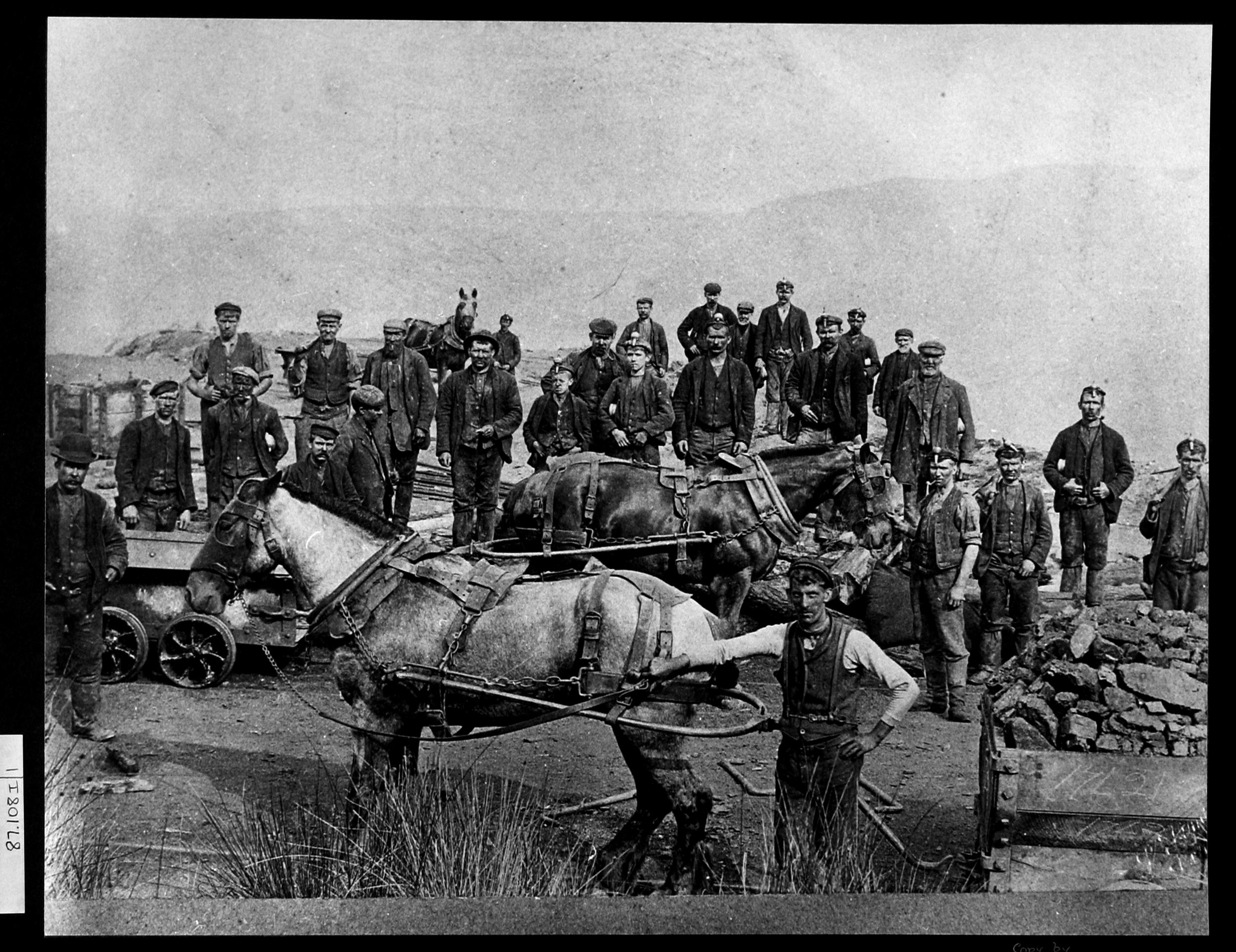
The mines of Ton Pentre

William Murphy his father of Irish stock had left the family farm in Ballynunnery, Co. Carlow as thousands of his countrymen died from starvation due to the great famine, he spent his days underground, as a coillery repairer in the mine founded by Davies. The Pentre village primary school opened its doors in 1874 and by 1917 as the sky was full of German led James Patrick Murphy sat in the classrom and on his break James Patrick Murphy kicked the inflatable bladder (used as a football) in the school yard.

Within nine years as Wales were winning their third British Home Championship the boy fom Treharne Street was wearing his country colours in a youth game against England. It was 1924 and that same year unemployment among coalminers rose from 2% to a high of 28.5% in August 1925; the village of Ton Pentre would like many other places in Wales be affected. The decline in the demand in coal was caused by the high exchange rate of sterling and increased coal production elsewhere, while the loss of European markets such as Germany who were paying reparations in coal after the great war ended did not help.

All this would be exacerbated by the Wall Street Crash of 1929 which would lead Wales to become one of the most depressed countries in the world with 42.8% of males unemployed. A year before the crash James Patrick Murphy would leave the valley of Ton Pentre for the black country, he was seventeen and West Bromwich Albion football club beckoned.

The longest serving manager in English football history Fred Everiss signed the young Welsh teenager, Everiss had began life at the Hawthorns in 1902 and would remain as secretary-manager of the club until 1948. West Brom had been founded in 1878 by local workers from the George Salter’s spring works and Everiss had led them to their first and only topflight title to date in the first season after the great war in 1919-20.

As young Jimmy signed on the dotted line West Brom were now in the second division after being relegated in 1927. He would join a team which included Jimmy Cookson, who started life with Salford Boys Club, notching up thirty-eight goals in season 1927-28 as West Brom finished eight. Murphy would have to bide his time with only sporadic game time in that glorious season of 1930-31 for the Throstles as the club would win promotion only the goal scoring exploits of legendary Dixie Dean and Everton stopping them finishing top of division two.

James Patrick Murphy would watch on at Wembley as the Welsh Guards band struck up God Save The Queen as ‘Ginger’ Richardson would write himself into black country folklore with a Wembley brace defeating midland rivals Birmingham City 2-1 in the FA Cup Final of 1931 – Richardson had started life on the buses in Hartlepool playing for the United Bus Company.

Within four years and before he had reached his mid twenties James Patrick Murphy would stand on the hallowed turf of Wembley stadium in front of 93,204 as Bert Frogg blew his whistle for the start of the 1935 FA Cup Final. This time there would be no silverware for the baggies as Sheffield Wednesday’s Ellis Rimmer scored twice late on to break black country hearts as the owls ran out 4-2 victors. Rimmer had scored in every FA Cup round prior to the final and joined the Hillsborough outift in 1928 heavily influencing their ‘Great Escape’ that year as they picked up seventeen points out of possible twenty to remain in division one.

On the international front James Patrick Murphy made his bow at half back for Wales in the annual home championship at the Racecourse ground in Wrexham on November 16th, 1932, against England. One of his teamamates that day was Dai Astley who would go on to manage Inter Milan to second place in Serie A in 1948; Guiseppe ‘Peppino’ Meazza who the San Siro stadium is named after had departed as manager that year. Murphy would be part of the first Welsh team to venture across the channel playing France on European soil in May 1933; the game was played in the Stade de Colombes in Paris, which would stage the 1938 World Cup Final. Tom Griffiths opened the scoring for Wales and in the side was Murphy’s Albion teammate Walter Robbins, who as a teenager, while working in the local brewery, had netted 70 goals for Ely United in the Cardiff district league a record to this day. A famous victory would be denied when Jean Nicolas equalised with ten minutes remaining, Nicolas would make twenty-five appearnaces for France scoring twenty-one times and would net twice for France in the 1938 World Cup.

On St. Patrick’s Day 1937 in Wrexham, William and Florence Murphy would sit in the stands of the Racecourse ground and watch James Patrick Murphy win the British Home Championship for Wales. The men from the valleys had defeated England 2-1 at Ninian Park, Cardiff in their first game with Seymour Morris, who would go on to work in a tool factory in Crickhowell after hanging up his boots, scoring the winner. Pat Glover scored a brace at Dens Park, Dundee in the second game as Scotland were defeated on home soil by the same scoreline. This meant a victory over Ireland would give Murphy and his teammates a clean sweep, Glover again scored twice followed up with goals by Bryn Jones and Fred Warren. Alex Stephenson (still the only man capped by the FAI as a senior international to ever line out for Glasgow Rangers) scored a consolation goal for Ireland in a 4-1 demolition.

It was only the second time the British Home Championship trophy was lifted, it had come into being in 1935 constructed in celebration of King George the V’s silver jubilee, up until then players received engraved pocket watches.

War would eventually bring an end to Murphy’s playing career before he reached his thirtieth birthday, he would make more than 200 appearances for West Brom, leaving the Hawthorns for Swindon Town as the world braced itself for conflict. Like many others James Patrick Murphy would join the war effort in the face of fascism, as a seargent based in Bari, Italy organising troops sports games and coaching clinics.

On one occasion Matt Busby who had been offered the Manchester United job after the war witnessed the Welsh man give a passionate and rousing speech on football and tactics to the young troops. Busby was from the Scottish mining town of Belshill at the age of six he had lost his father to a sniper’s bullet in Arras, France in 1916 – he like Jimmy arrived into the world in 1910. During the second world war his service required him to coach in the Army Physical Training Corps, spending six years as an army P.E. conductor.

From 1946 – 1976 both men worked alongside each other forming one of the greatest ever partnerships in football transforming Manchester United from mediocracy to one of most dominant teams domestically and in Europe. In James Patrick Murphy, Busby had a man who developed a youth structure that included Edwards, Whelan, Taylor, Hamilton, Charlton, Best and many others – a conveyor belt that would bring glory and delight to every Stretford Ender. It would also be tinged with tragedy as the Munich Air Disaster destroyed a team full of fervour and youth; a team that was ready to conquer all.

In 1956 James Patrick Murphy became manager of Wales he would lead his country to the World Cup with names such as Charles, Allchurch and Jones starring on the road to Sweden ’58. On the 5th of February 1958 Wales played Israel as Manchester United went to Belgrade to face Red Star in the European Cup; on this occasion James Patrick Murphy would not sit beside Matt Busby on the plane or have the hotel room next to him like on every previous away trip.

Instead in the cauldron of Ninian Park with ‘bread of heaven’ in his ears being sang by 38,000 Welsh souls, Murphy would watch on as Ivor Allchurch opened the scoring in the 76th minute while Cliff Jones added a second four minutes later. That night Wales would qualify for the World Cup and James Patrick Murphy would become immortalised in Welsh football history. The next day he would leave Cardiff by train for Manchester carrying a box of oranges a present from the Israeli team; on arriving at Picadilly station James Patrick Murphy would take a taxi to Old Trafford.

On arrival at the stadium Murphy would make his way to the boardroom all around there was silence, in front of him stood Matt Busby’s secretary Alma George with tears in her eyes; uttering the words ‘The plane has crashed. A lot of people have died, Jimmy’. James Patrick Murphy went to his office and James Patrick Murphy cried his eyes out.

The next day James Patrick Murphy flew to Munich witnessing at firsthand the suffering and the heartbreak; listening as Duncan Edwards mumbled ‘Oh it’s you Jimmy? Is the kick-off three o’clock? And looking on as his great friend Matt Busby lay in an oxygen tent.

James Patrick Murphy returned to Manchester with survivors Harry Gregg and Bill Foulkes with the words ‘Keep the Flag Flying’ in his ears. In utilising youth team players, he had been nurturing through the central league augmented with only two new signings; James Patrick Murphy stabilised a club that was on its knees.

Under his guidance Manchester United would reach an FA Cup final and the semi-final of the European Cup, all this while he came to terms with the loss of men, he had nurtured on the football fields of England. ‘It needed someone who, though feeling the heartbreak of the situation, could still keep his head and keep the job going. Jimmy was that man.’ Sir Matt Busby. For many years Nick and Paul Muphy have walked to Old Trafford passing the holy trinity and the Munich clock, but nothing of their relation.

In May 2021 with campaigning by six Manchester United supporters’ groups and endorsed by James Patrick Murphy’s family – the football club James Patrick Murphy saved from the brink agreed in principle to construct a statue in his honour.

Jimmy Murphy’s sons with other Manchester United supporters

The whistle of Langenus

In the summer of 2018 as the elated French champions cavorted and the Croatian players lay prone and disconsolate a group of men in fluorescent light-blue jerseys went to the podium to collect their medals, they were referee Néstor Pitana and his team of officials. This was surely the sporting pinnacle for Pitana, who had celebrated his 43rd birthday just a month before and had begun his career refereeing in the Argentine second tier back in 2006.

But Néstor Pitana is but the latest link in a chain that stretches back almost 90 years to John Langenus, the Belgian official who had refereed the chaotic first World Cup final in 1930, as well as games in the 1934 and ’38 tournaments and the 1928 Olympics. Such was Langenus’s international reputation that he was in high demand for club games outside of his native Belgium, and it is here that the Irish connection appears, because just three months before he refereed in the Amsterdam Olympics of 1928 and two years before the World Cup final, he was in Dalymount Park for the Free State Cup Final between Bohemians and Drumcondra.

Bohs won that Cup final 2-1 in front of a crowd of over 25,000 on St. Patrick’s Day, 1928 to secure a clean sweep of all four domestic competitions that season. Their goals came from Jimmy White and Billy Dennis which cancelled out John Keogh’s opener for Drums. Match reports record that the Bohs were deserved winners with Drumcondra offering little in attack after their opening goal. Of the referee’s role The Irish Times noted that “while feelings ran high at intervals, the referee, Mr. Langenus of Belgium, handled the game splendidly and that nothing unseemly occurred to mar the enjoyment of the huge crowd”.

Langenus was something of a Pierluigi Collina of his day, well-known, popular and well-respected throughout the sporting world as well as being visually arresting, as a tall figure with slicked back hair who took to the field in a shirt, tie, jacket and a pair of plus-fours. It was this reputation that led him to Dalymount Park in 1928. Then as now there were constant debates about the quality of referees and plenty of criticism was aimed at the men in the middle during the early years of the League of Ireland. This meant that for high profile games such as Cup finals the FAI had established the practice of bringing in referees from outside of Ireland.

Usually this meant an English referee, Ireland still looked to England as a bastion of the game and it made sense to use an English speaking referee. For example, in 1927  J.T. Howcroft from Bolton had taken charge of his second FAI Cup Final. A prominent English referee, Howcroft had also officiated the 1920 FA Cup final between Aston Villa and Huddersfield. However, John Langenus had two things in his favour, he was a fluent English-speaker and in addition to his native Flemish he also spoke French, German, Spanish and Italian. The second reason that it should not be such a surprise that he refereed the Cup Final was that a year earlier he had been in Lansdowne Road to referee the Ireland v Italy international which Italy had won 2-1 thanks to two goals from Juventus striker Federico Munerati.

At a banquet following that Ireland match held in the Hibernian Hotel on Dawson Street where John Langenus and his wife were guests, the Honourary Secretary of the Association John S. Murphy toasted Langenus and described him as “one of the best referees they had ever seen in Dublin”. This surely helped with his appointment to the following year’s Cup final.

The paths of the Irish national team and John Langenus would cross on several further occasions, he took charge of Irish matches against Spain, the Netherlands, Hungary, Switzerland and finally against Czechoslovakia in 1938. Langenus himself had many happy memories of his trips to Dublin. He committed some of these to record in one of his memoirs Whistling through the world printed in 1942.

In his book he recalls witnessing the St. Patrick’s day parade on the morning of the FAI Cup Final,  as well as his chats with Lord Mayor of Dublin Alfie Byrne, and his visits to the main tourist attractions; Dublin Zoo, the Botanic Gardens and St. Michan’s Church where he saw the famous preserved bodies in the church crypt. But his main memories are of Irish social culture, and Irish drink! John Langenus took a particular interest in Irish whiskey and would go directly to the distilleries to buy 90 and 100 year old bottles that wouldn’t usually be found on general sale, these he would keep as special gifts for friends (and perhaps a couple for his own collection). He was lucky on one occasion that he managed to bluff his was through English customs checks with two bottles of vintage whiskey in his suitcase.

Similarly he remembered the good humour of the after-match banquets, once again his beloved Irish whiskey makes an appearance though he mentioned that the only way he could tell his Irish hosts were getting a little drunk was that they tended to sing more. In winning or losing he recalls the good mood of his hosts remained the same.

Not all of Langenus’s sporting engagements were to be as enjoyable. His most famous role, that of World Cup Final referee was as far from the relaxed surroundings of a Dublin banquet as was possible. As the great Brian Glanville wrote of Langenus during that final match in Montevideo’s Estadio Centenario “The prospects of dealing with twenty-two players, each of whom was capable of disputing any and every decision, to say nothing of the nearly 100,000 spectators who, once they had paid their money, felt entitled to behave as they pleased, would have daunted men of lesser experience and courage than Langenus”.

Doubtless that Langenus was experienced and courageous but he was also pragmatic, he would no doubt have heard the chants and songs thousands of passionate Argentine fans as they streamed from their ferries across the River Plate and into the stadium hours before kick-off, he would have heard their Uruguayan counterparts fanatically chanting their own calls to arms, including the ominous “Victory or death!”. Who’s death exactly? In such cases often it’s the referee in the firing line and Langenus had sought assurances from the Montevideo police that a swift, armed escort, direct to their ship should be arranged right after the match for him and his team of officials should this be required.

Although the match was intense and undoubtedly passionate Langenus escaped the ire of either set of supporters, in fact he was involved in solving the biggest point of conflict even before kick-off. With both sides insisting that a football manufactured in their own country be used, Solomon-like, Langenus agreed that a ball from Argentina would be used in the first half and a ball from Uruguay in the second.

On that day, as Uruguay celebrated victory in the maiden World Cup, in front of their own home fans, John Langenus must have realised he had reached the apex of his refereeing career. He would return again to officiate in the next two World Cups, signing off his last World Cup match officiating the 3rd place play-off in 1938 which saw Brazil claim bronze, defeating Sweden 4-2.  While he continued to referee international games for another year the outbreak of World War Two effectively ended his career as an international referee though he continued to referee matches in the Belgian League throughout the War until finally the league was suspended for the 1944-45 season. By that stage Langenus was 53 years of age.

According to one source, as a teenager he had played youth football for AS Anversoise but was already a referee in the Belgian top flight since at least 1912, refereeing his first international match in 1923 aged just 31. Throughout his career he was a committed amateur. He worked as a public servant in his home city of Antwerp for his whole working life and was also an occasional sports journalist. While on international duty only his expenses were paid and he refused any fees to referee games though often in such instances medals, cut glass, watches or decorative cups were given as mementos. He also had the perk of  being able to bring back the likes of whiskey from Ireland or cigars from Spain. His positively Corinthian idealism is evident even just by looking at him with august bearing and almost formal attire.

His talent for writing was something that he put to good use in his retirement, writing a memoirs and two other football related books. He passed away in his native Belgium in 1952 aged 60.

With thanks to the people behind @WC1930blogger and @RefereeingBooks for their assistance.

Get your Crosses in

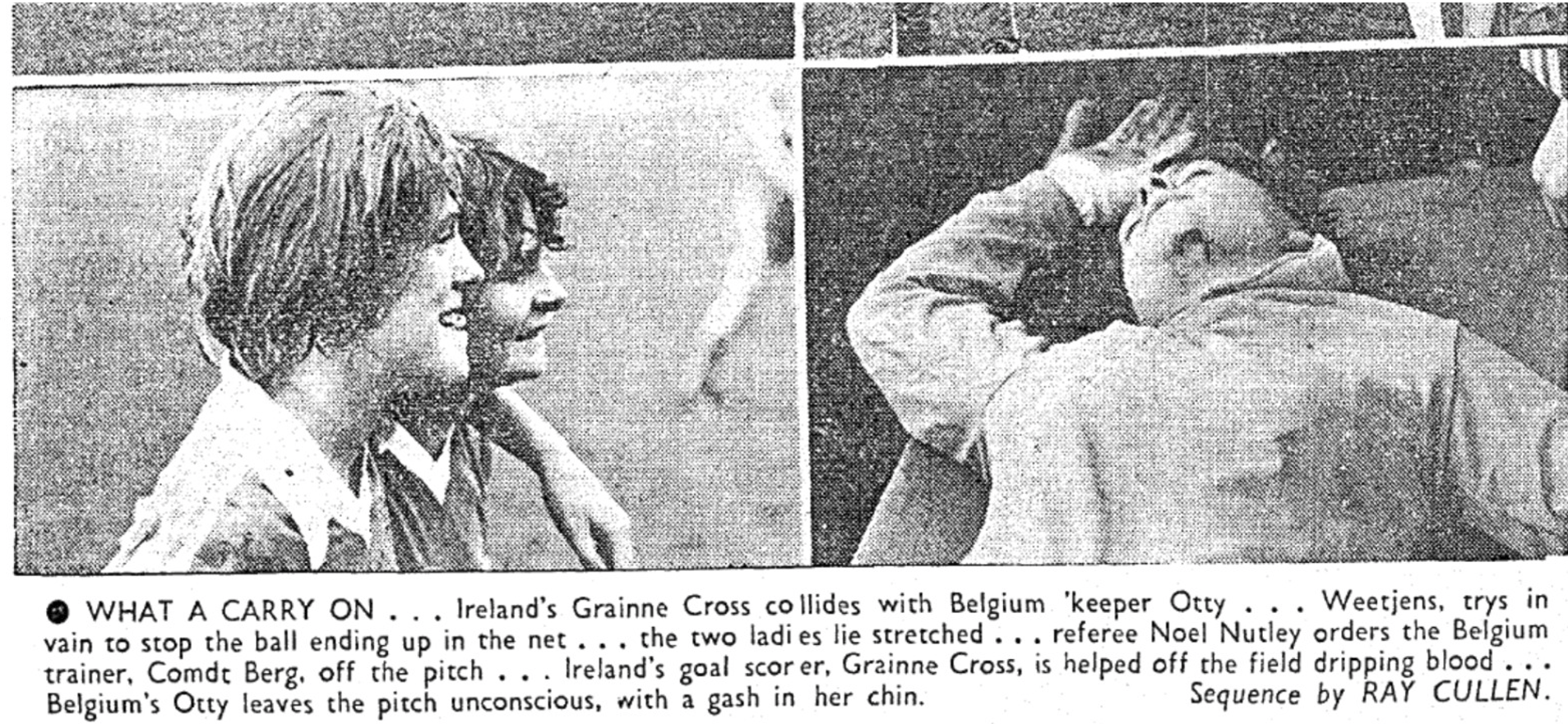
On a cold day in October 1980 a teenaged Grainne Cross, a versatile midfielder, was sent on as a substitute to try and break the deadlock in an international friendly against Belgium at Dalymount Park. With 15 minutes gone in the second half and the score still tied at 0-0 a ball was lofted into the box, Cross got onto the end of it and scored with a beautiful header but was crashing into by the onrushing Belgian goalkeeper. Both players were taken by ambulance to be treated for their injuries and it was only later that Grainne learned she had in fact scored the winning goal of the game. For, Grainne it was one of her, surprisingly, favourite memories from a sporting career that included a move to Italy, playing in Wembley and starting at scrum half for Ireland in a Rugby World Cup!

Grainne was born into a large, sports mad, Limerick family, her father had been a good rugby player and hurler, and her brothers all played rugby as well. However, Grainne and her sisters really excelled at football, Grainne, Tracy and Rose would all be capped by Ireland during their sporting careers.

Grainne began playing in her teens and her talent was quickly spotted, women’s football in the area was mostly focused around factory teams and Grainne appeared for De Beers in Shannon where her mother and sister worked, as well as lining out for other factory teams like Krupp’s and regularly guesting for other sides such as Green Park.

Grainne was talented, (she won her first cap as a 15 year old) and she grabbed the attention of American Colleges who were interested in offering sports scholarships but Grainne followed a different path. Inspired by the success of Anne O’Brien in Italy she contacted the Italian Federation stating her interest in playing in Italy. Amazingly, this paid dividends, what Grainne thought was going to be week-long trial with ASD Fiammamonza in the city Monza, near Milan, turned into a contract offer and chance to pit her wits against the likes of Anne O’Brien, Rose Reilly and Carolina Morace, all gracing the Italian game at the time.

Cross in action as a teenager during an international friendly against Belgium in Dalymount Park

Grainne recalls the professionalism she encountered in Italy, simple things like good playing surfaces, bigger stadiums with crowds of up to 10,000, and not having to wash her own kit. She also remembers the step up in quality as she faced the some of the best players in Europe. Ultimately homesickness ended her stay in Italy after a season, she had initially had to live with her coach and his family, and expecting only to be on a trial hadn’t had a chance to learn much Italian before she left for Monza.

Her career continued with Ireland and she got the chance to play in Wembley in 1988, where as part of the Football League Centenary celebrations she played against her English League counterparts and remembers bumping into the likes of Bryan Robson and Paul McGrath who were playing for Manchester United in the centenary celebrations that day. While Grainne continued to play football her work commitments, including spells working in England and the United States limited her availability for Ireland matches.

In her late 20s as Rugby became more accessible to women Grainne began playing for Old Crescent helping the club to considerable successes, so much so, that she was selected as part of the squad that represented Ireland at the 1998 Rugby World Cup, starting as a scrum half against the Netherlands before an injury limited her participation in the tournament. She’s even been known to dabble occasionally in the GAA codes, a real sporting all-rounder.

To this day Grainne remains an enthusiastic supporter of both football and rugby and is hopeful for the future of the Irish national team.

With thanks to Grainne Cross for taking the time for this interview which first featured in the Irish international match programmes.

The Dawning of the cup

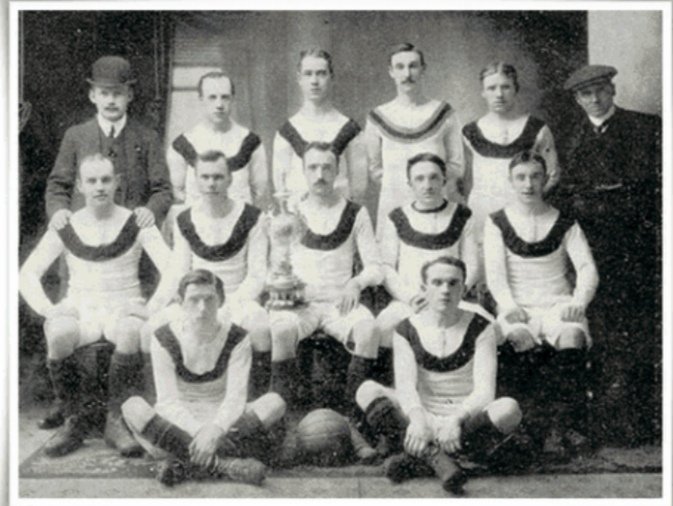
Sean O’Casey’s Juno and the Paycock debuted on the Abbey Theatre stage in 1924 with the focus of the drama set in the city of Dublin after the outbreak of the Civil War just a couple of years earlier in 1922. The “Paycock” of the title, the feckless Captain Jack Doyle, became identified by the malapropism which he exclaimed repeatedly through the play, “the whole world is in a terrible state o’ chassis”. And indeed it was. If we take it that Captain Jack meant by “chassis” that the world was in a state of chaos and change then certainly his final drunken quip was accurate. Maybe he’d been at the first ever Free State cup final a few months earlier?

By the dawn of 1922 the truce in bloody War of Independence was’t yet six months old, the Anglo-Irish Treaty had only been signed in December of 1921 which allowed for the creation of a 26 county Free State by the end of 1922. But before that would happen 1922 would also witness the beginnings of the Irish Civil War. A state of chassis indeed.

In the middle of this chaos the Football Association of Ireland had been formed after a split from the Belfast-based IFA and a brand new league and cup competition were begun before the Irish Free State had even officially come into being. While that first season can be viewed as a success from a footballing perspective, it was not to be without incident or drama. Befittingly, it was the cup final that witnessed some of the most dramatic scenes.

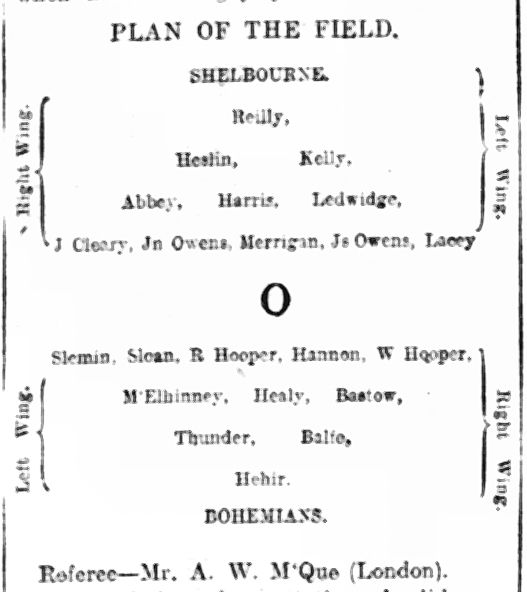
The first season of the league had kicked off in September 1921, it only featured eight teams in total and all of them were from Dublin. Of those eight only two are still involved in League of Ireland football today, Shelbourne and Bohemians. The cup however, was slightly more diverse, featuring the likes of Athlone Town, who would join the league the following season, as well as West Ham. The West Ham from Belfast that is.

West Ham were a team in the Falls and District League in Belfast. When the split from the IFA occurred these clubs chose to affiliate with the FAI and in West Ham’s case their new cup competition. This wasn’t to be the only occasion that something like this happened, the following season the cup winners were Alton United, previously a junior club in Belfast they shocked Shelbourne in the final with a 1-0 win. The relative success of junior clubs from Belfast was likely to have drawn some condescending looks from the IFA in relation to the standard of football south of the border. But it should be noted that at the time due to the political turmoil in Belfast one the foremost clubs on the island; Belfast Celtic had withdrawn from the league and many of their players were active for sides in the FAI affiliated Falls and District league.

This would change when by the end of 1923 the FAI was admitted to FIFA. One of the conditions of acceptance being that only clubs from the 26-county Free State could be members of the Association. This meant an end to the involvement of northern clubs until Derry City joined the league in 1985. West Ham were not to have much of a cup run. Their highlight was holding Shelbourne to a scoreless draw before they were knocked out in a replay.

While the West Ham versus Shelbourne game may have been tight there were a few hammerings in the early rounds of the cup. In the opening round Dublin United beat their league rivals Frankfort 8-1. While Dublin United would drift out of football over the following few years Frankfort, from the Raheny area of Dublin are still active locally, playing their matches in St. Anne’s Park.

Despite their convincing win in the opening round Dublin United were dumped out in the following tie by Shamrock Rovers, then a Leinster Senior League side. Rovers had already had a long cup campaign before the met Dublin United. Not being a league club they had to negotiate a number of qualifying rounds which had their own fair share of drama. A comfortable win over UCD was followed by a trip to Tipp to take on Tipperary Wanderers. Despite the recent prominence of Shane Long we don’t often think of Tipperary as a soccer stronghold but the local side were good enough to beat Rovers 1-0. The men from Ringsend however, made a formal protest because of the poor quality of the pitch that they were forced to play on. A ruling was made that the match had to be replayed and this time Rovers emerged victorious.

Further victories followed over St. James’s Gates “B” side and Shelbourne United (a club who also had their origins in Ringsend but not to be confused with Shelbourne F.C.) which meant that Rovers were through to the first round proper of the cup against Free State league side Olympia. A 3-1 win there and the 5-1 hammering of Dublin United saw them drawn in the semi-finals against Bohemians.

Bohs being the more well established side went into the games as favourites. They enjoyed home advantage as both semi-finals were to be played in Dalymount Park, they’d finished a close second to St. James’s Gate in the inaugural league season and they’d demolished Athlone Town 7-1 in the previous round. But it was Rovers who emerged victorious thanks to a lone strike by John Joe Flood. The result was somewhat of a shock, accounts at the time describe Bohs enjoying the better of the play but failing to take their chances, ultimately the more direct, physical approach taken by Rovers paid dividends.

The scorer of the winning goal, John Joe Flood was one of the team’s early stars. A Ringsend local, he was the son of John Flood, a bottle blower at the nearby glass bottle works. He had previously played for Shelbourne but was very much a Shamrock Rovers man. He even spent some of his youth living on Shamrock Terrace, the road that gave Rovers their name. In all he had four spells at the club, while also trying his luck on two occasions in England, a short spell with Leeds United and later sojourn at Crystal Palace.

He was known as tough and pacey inside forward and was occasionally referred to by the nickname “Slasher” which makes him sound like a fairly formidable opponent. In Rovers’ colours he’d end up collecting four League of Ireland medals and six cup winners medals and later became part of the famous “Four F’s” forward line along with Billy “Juicy” Farrell, Jack “Kruger” Fagan and Bob Fullam. He would also be capped five times by Ireland, scoring four goals, including a hat-trick in a 4-0 victory over Belgium.

Victory over Bohs had secured Rovers’ place in the final, due to take place on St. Patrick’s Day 1922 but they would have to wait a while before the identity of their opponents was confirmed. The other semi-final had gone to a replay, St. James’s Gate versus Shelbourne had finished scoreless in their first meeting and there was a gap of more than two weeks before the game was replayed. The victors on that day were St. James’s Gate and they were confirmed as the side to face Rovers in the final on St. Patrick’s Day.

St. James’s Gate at the time were based around grounds in Dolphin’s Barn that were rented by the Guinness brewery which gave them their name.  Guinness were known for the paternalistic attitude they took towards their workers and a job at the brewery offered a level of security and benefits that were not often found in other workplaces around Dublin. The James’s Gate players were nominally amateurs, five players from the team would be part of the amateur squad that competed for Ireland in the football tournament at the 1924 Olympics, but even by the time of the Cup final there were a quota of non-Guinness players allowed play for the team.

Some of those who weren’t Guinness employees included Ernie MacKay, the son of a Scottish soldier, Ernie worked for at the GPO for decades while also remaining involved with James’s Gate as a player and administrator well into the 1940’s. His team-mate at inside-left was Charlie Dowdall who had worked for Guinness briefly but spent most of his career working at the Inchicore railway works. Still they would have had access to the superior sporting facilities of the Guinness workers, pitches, gymnasiums and medical experts. Such was the prestige of the club at the time that many star players who did work at the brewery were excused from more taxing work to make sure they were fit and healthy for upcoming matches.

This approach had brought impressive results. In the 1919-20 season St. James’s Gate had won the Leinster Senior Cup, the Leinster Senior League, the Metropolitan Cup and the Irish Intermediate Cup. By the time the cup final rolled around on St. Patrick’s Day 1922 the Gate had already become the inaugural Free State league champions and Leinster Senior Cup winners, an FAI Cup win would seal a treble.

The Gate were favourites, despite the fact that they were technically viewed as an amateur “works” team whereas Rovers (still a Leinster Senior League side) were paying players between 20-30 shillings a game. The Gate possessed the league’s top scorer, Jack Kelly in their ranks, and while Rovers had a certain reputation for toughness and aggression (especially men like Bob Fullam, Dinny Doyle and William “Sacky” Glen) St. James’s were no push-overs in this regard.

Their midfield half-back line of Frank Heaney, Ernie MacKay and Bob Carter were tough, tall, physically imposing men. Heaney, a veteran at this stage, had won amateur caps for the IFA, while MacKay, Dowdall and the versatile Paddy “Dirty” Duncan would also all represent Ireland at the 1924 Olympics. They were certainly a side with pedigree.

What was described as a “fine holiday crowd” numbering up to 15,000 were in attendance in Dalymount Park that St. Patrick’s Day for the final. Despite the fact that the Gate midfield was physically bigger the Rovers half-backs were dominant in the opening half, but their forward-line, though “aggressive” missed a succession of chances and five minutes before the break Jack Kelly rose highest to power home a header from a Johnny Gargan corner kick to give St. James’s Gate a half-time lead.

Ten minutes into the second half Rovers restored parity, Paddy Coleman, the Gate keeper failing to clear a ball from an in-swinging corner meant an easy finish for the Rovers winger Charlie Campbell. Rovers rallied and had some good chances before the end of the game but their earlier slack finishing persisted and they failed to make their pressure count. The Irish Times used the standard parlance (then, as now) referring to the match as a “typical cup tie”, it was hard fought, but they complained that much of the play was “crude”.  A replay was set of the 8th of April and there was even greater drama to come.

The crowd wasn’t quite as sizable for the replayed game, perhaps due to the fact that the Irish Rugby team were playing France that same day in Lansdowne Road and enjoying a rare will over Les Blues. The 10,000 or so who were there in Dalymount Park were in full voice, and the Gate’s Charlie Dowdall later described the atmosphere as “electric”, and remembered the “intense fanaticism between the supporters” before ominously noting that “those were the troubled days, and there were a few guns lying around in supporters’ pockets, though it all ended happily”. As we’ll see later at least one supporters’ gun didn’t end up staying in his pocket!

As the game kicked off with Rovers captain Bob Fullam winning the toss and deciding to play into the wind in the opening half, this didn’t seem to hamper Rovers who had the better of the play and created most of the chances, however, as in the previous game, they couldn’t make possession and territorial advantage count. Rovers errant finishing would cost them as a minute before the interval Johnny Gargan nicked the ball from Joe “Buller” Byrne (later a groundsman at Milltown) and squared for Jack Kelly who beat Bill Nagle in the Rovers goal with a fierce, low strike. Despite Rovers continuing to have the better of the play in the second half it would remain the only goal of the game as Paddy Coleman put in a display described as “miraculous” between the sticks for the James’s Gate.

The final whistle was met with a pitch invasion from some of the Rovers support who headed straight for the James’s Gate players. They were soon joined by several of the Rovers players. Two tough teams had obviously gotten under each others skin and Dowdall and Fullam in particular had been having something of a running battle throughout the match.

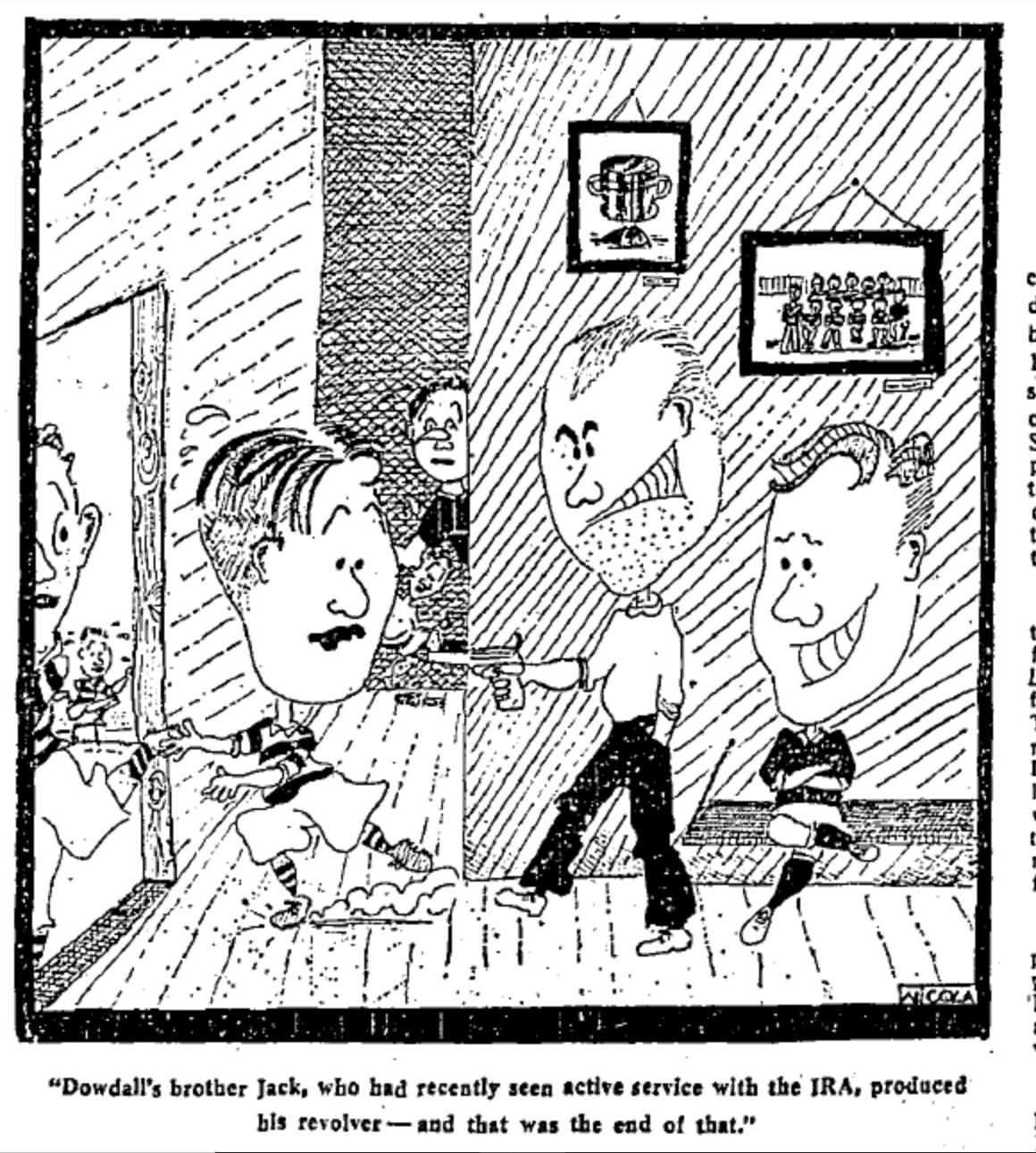
As the St. James’s Gate players made for the dressing rooms at pace they were chased from the pitch by the invading fans and three Rovers players. Bob Fullam, allegedly joined by Dinny Doyle and John Joe Flood, pursued the Gate players inside where Fullam advanced on the object of his ire, Charlie Dowdall. It all seemed set to kick-off when Jack Dowdall, Charlie’s younger brother and an IRA volunteer stepped forward and produced a pistol. Fullam and his Rovers teammates were outnumbered, and now out-gunned and they sensibly beat a retreat from the changing rooms. Fullam, along with Doyle and Flood ended up receiving  bans from the FAI for their part in the disturbances.

Dowdall brother cartoon

Fullam wouldn’t be banned for long and ended up scoring 27 times in the league for Rovers the following year. Most with his howitzer-like left foot. While his first cup final may have ended is defeat he would retire from the game with four winners medals to his credit, to go with the four league titles he’d collected. So central did he become to Rovers success that the popular refrain among their support whenever the team were lacking inspiration on the pitch was “Give it to Bob”, a phrase that entered widespread use through Dublin in the subsequent decades.

Fullam also has an important footnote in Irish international football history. After the 1924 Olympics few international matches were forthcoming and the FAI had to wait until 1926 to secure a full international fixture, in this case a game against Italy in Turin with a return game in Dublin also agreed. Fullam and Frank Brady of Fordsons were the only players to play in both of those early games. The Italians ran out comfortable 3-0 winners in Turin but performed better in Lansdowne Road the following year with Ireland taking the lead through a powerful strike from none other than Bob Fullam. It was counted as the first goal in International football for a FAI national team. Indeed he nearly grabbed a second shortly after from a free-kick, the power of which meant that Mario Zanelli, the Italian full-back was stretchered off after he blocked the fierce shot with his head. Despite the performance that was to be Fullam’s last cap for Ireland, he was by then into his 30’s and Rovers were to be the main focus of his footballing exploits.

That inaugural season of Free State football belonged to St. James’s Gate who finished with three trophies, while Paddy Duncan, Charlie Dowdall and Ernie MacKay would all go on to represent the nascent international team in the following years. Despite the chaos of the cup final replay over 25,000 spectators had paid in to watch the two games, bringing in gate receipts of over £1,000 which were crucial to the FAI’s finances in those early days.

Less than a week after the replay anti-treaty IRA volunteers, led by Rory O’Connor occupied the Four Courts in Dublin city. Tensions mounted and in the early hours of June 28th the Free State army began shelling the Four Courts from their positions south of the Liffey. The Civil War had begun, the nation was convulsed by almost a year of violence that would leave thousands dead. By the time a cessation to the violence arrived in May 1923, amid the turmoil, lawlessness and death somehow an entire football league season and cup competition had been played out. Circumstances that seem so utterly bizarre and unreal today. Shamrock Rovers, newly elected to the Free State league had won it at their first attempt. With Bob Fullam, returned from his ban, as top scorer. In the cup Alton United enjoyed their brief moment in the sun by winning the cup, a Belfast side triumphing in the Free State blue ribbon competition. A tragic, dramatic, scarcely believable, terrible state o’ chassis indeed.

From Jarrow to Carter and McGrory – In a Time of Hunger

By Fergus Dowd

As the dark clouds hovered above, they carried the coffin passed the shrubbery towards the church door as inside the old mixed with the young. It was Friday September 20th, 2003, and the town of Jarrow was saying a ‘farewell’ to Cornelius Whalen the last of the Jarrow Marchers, aged 93.

Whalen was one of two hundred men to walk from the town’s cobbled streets to London in October 1936 to lobby those in Westminster for work – at the time of industrial decline and poverty there was eighty percent unemployment in the town. Palmer’s shipyard was established in 1851 and was the biggest employer in the area, it built its first carrier within one year of opening and within five years it had turned its attentions to the lucrative market of warships. The founder of the shipyard Sir Charles Palmer, a Liberal Democrat MP from 1874 to 1885, had little interest in the conditions which his workers’ lived in.

Local MP Ellen Wilkinson who marched with Whalen and his comrades quotes a local scribe from the time: “There is a prevailing blackness about the neighbourhood. The houses are black, the ships are black, the sky is black, and if you go there for an hour or two, reader, you will be black”. Following the Great Depression, the National Unemployed Workers Movement began organising what the British Press coined ‘Hunger Marches’ across Britain, the 25-day Jarrow Crusade would arrive in London a week before the Sixth Hunger March. On the 4th of November 1936 Ellen Wilkinson presented the Jarrow petition to the House of Commons, it had been carried in an oak box with gold lettering, signed by 11,000 locals.
As a brief discussion followed in parliament about the Crusade, the marchers returned by train to a hero’s welcome in the Northeast; sadly, it would take the savagery of war to refuel employment in the town.

That September 1936 as Con Whalen was practicing walking along the hills of Northumberland the locals were bemoaning admission prices for a Sunderland v Celtic match at Roker Park; dubbed ‘The Unofficial Championship of Britain’. ‘Supporters from both districts will find it an expensive afternoon’s entertainment, with nothing being at stake.’ A fan wrote in his letter to the local press editor.
Horatio ‘Raich’ Stratton Carter at the tender age of twenty-three had led his hometown club Sunderland to the Championship title that April of 1936, midlanders Derby County finished runners up eight points in arrears.

A confident inside forward is how his fellow English teammate Stanley Matthews saw him: “Bewilderingly clever, constructive, lethal in front of goal, yet unselfish.” Like many from Jarrow, Carter would also join the war effort in 1939 becoming a pilot in the RAF stationed in Loughborough. Carter was considered a terrific competitor in school and presented with a gold watch, on leaving, for outstanding performances in football and cricket. George Medley a local scout had promised Carter a trial with Leicester City on reaching age seventeen, following a game with Sunderland a trial was arranged.

On a heavy pitch a couple of days after Christmas Day 1931, Carter was deemed too small for professional football by then Leicester manager Willie Orr; Orr had led Celtic to a league and cup double in 1906/07.
Carter was offered amateur terms initially by Sunderland and would become an electrician earning 45p a week; he would eventually go part time earning £3 a week training two nights a week with the Wearsiders.

Within five years the one they said was ‘too small’ would be joint top scorer for Sunderland that championship winning season and carry the trophy around Roker Park.
A few months after the Celtic match Carter would receive a benefit cheque of £650 for five years of service at Sunderland, despite a long career at the club and leading the club to the FA Cup in 1937, he would never receive another benefit.

By 1953 in the twilight of his career Carter found himself in southern Ireland lining out for Cork Athletic; it was said he was paid £50 per match plus £20 expenses, this enabled him to fly from Hull to the Emerald Isle for matches. Carter had become manager of Hull City but a rift with Chairman Harold Needler led to his departure in January of that year, he left football to run a sweet shop. However, within one month Cork Athletic Secretary Donie Forde and director Dan Fitzgibbon had performed a miracle tempting Carter to Leeside.

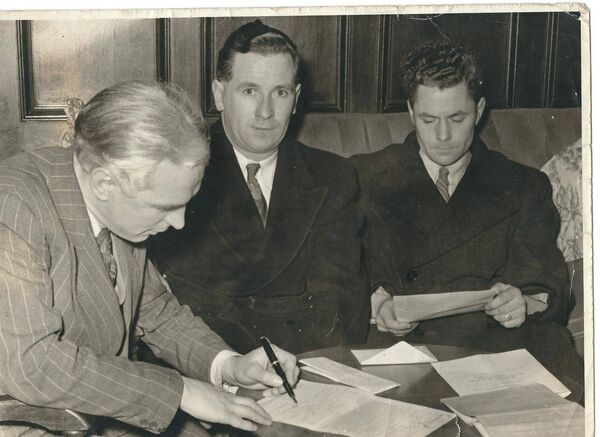
Raich Carter signing for Cork

It proved an inspirational signing, after making his league debut versus Waterford, Carter and Cork would face Drumcondra. The Dublin club would make an objection regarding Raich’s residency in Éire, he had landed only two weeks previously, his match fee was earned as he scored the victorious goal at Tolka Park. Raich Carter would go on to win an FAI Cup winners medal with Athletic that season and play for a League of Ireland XI versus an England league select.

Glasgow Celtic arrived in Sunderland in the autumn of 1936 after winning the Scottish Championship a few months earlier, Aberdeen and Rangers finished tied for second place five points a drift.
In that winnig team was the ‘human torpedo’ Jimmy McGrory who was coming towards the end of his career, by December 1937 he would take the hot seat at Kilmarnock. McGrory was born in Garngad in North Glasgow a place commonly known as ‘Little Ireland’ given the ethnic idenities of many of the habitants. The atmosphere in the area was corroded with incessant smoke and fumes from the Tharsis Sulphur & Copper Works and the Milburn Chemical Works; in 1904 as wee Jimmy was taking his first breath on this earth the Provan Gas works was opened by Glasgow Corporation. It did nothing to improve the environment and only added to the breathing problems and illness for those in Garngad.

In 1921 then Celtic manager Willie Maley signed James Edward McGrory as an inside right from junior side St. Roch it would take him two years to make his debut against Third Lanark in January 1923; he had been loaned to Clydebank intially. Jimmy would be top scorer for the hoops twelve seasons in a row, and the season of 1935/36 would see him top of the European charts after netting fifty times; he was also European top scorer nearly a decade earlier scoring forty-nine times. In 1928 the Arsenal of North London offered £10,000 to make him the highest paid player in Britain. A true Celt Jimmy refused to leave Parkhead; the Celtic board hoping his departure would boost the clubs accounts were furious at his decision. So, much so they secretly paid him less wages than his fellow teammates for the rest of his career. Jimmy to the delight of the Sunderland defence was omitted from the Celtic team that Autumnal day. After notching up 472 goals in 445 league & cup appearances McGrory would retire a year after the Jarrow Crusade. Like Carter he would go on to be a manager leading to Celtic to a 7-1 victory over Rangers, a British record in a domestic cup final – ‘Hampden in the Sun’ they call it!!

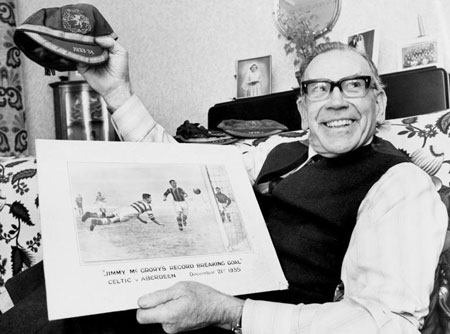
Jimmy McGrory in later life

On September 16th, 1936, seventeen thousand paid in at Roker Park to watch Sunderland take on Glasgow Celtic, that same day in a sign of things to come Antonio de Oliveria Salazar’s right-wing dictatorship in Portugal unveiled the Portugeuse Legion a paramiltary state organisation setup to ‘defend the spiritual heritage of Portugal”. In goal for Sunderland that day was Johnny Mapson, he replaced Jimmy Thorpe. Thorpe was netminder for Sunderland from 1930 to 1936, on his one hundred and twenty third appearance against Chelsea in February 1936 he was kicked in the head and chest but played on.
After arriving back home Thorpe collapsed and four days later in hospital, he took his last breath.

His widow was presented with his 1935/36 championship medal and the FA rules changed stopping players kicking the ball out of goalkeepers’ arms. Mapson would concede only one goal, on the hour mark to Malky MacDonald who like McGrory had started life at St. Roch’s.

Raich Carter had opened the scoring for the Black Cats on the twentieth minute and referee Harry Nattrass who had officiated the FA Cup final of 1936 drew the afternoon’s proceedings to an end.
As the Jarrow marchers arrived in the Yorkshire town of Wakefield a month later on the 14th of October, Nattrass was refereeing at Hampden Park as the Nazi emblem flew alongside the St. Andrew’s Cross.
The teams would meet again a fortnight later at Parkhead, the green and white would win out three to two this time, thirteen thousand would witness McGrory netting twice.

Today in England there are no hunger marches, although you will find foodbanks at most league grounds on a Saturday; In Sunderland Raich Carter is eulogised in written word and art, while the name McGrory rolls off the tongue easily around Parkhead.
In Jarrow there is a statue dedicated to those who walked to London and if you care to have a pint in one of the locals, an Old Cornelius should be ordered in honour of a great man.

In the ring at Dalymount

Boxing is Ireland’s most successful Olympic Sport and Dublin has produced fighters of international renown and witnessed world title fights but the city has also had a somewhat ambivalent relationship with the sport, happy to cheer on successes but often young fighters had to venture beyond our city for recognition. For more than sixty years Dalymount Park was an important venue for both amateur and professional bouts attracting big name fighters while also giving a platform for up-and-coming Irish boxers.

Dalymount Park was staging boxing matches since at least 1920 when the Irish Amateur Boxing Association (IABA) hosted an All-Ireland boxing competition there. Tickets ranged in cost from 2 shillings up to 5 shillings for ringside seats. The tournament was a great success though the closing bouts were hampered somewhat by an unseasonal July downpour which made it difficult for fighters to keep their balance on the slippery canvas.

Contests continued to be held in Dalymount through the 1920s as Bohemian Football Club made gradual improvements to the stadium. In 1928 an Irish Amateur boxing team faced off against their Danish counterparts in an international exhibition tournament ahead of the Olympics. By 1932 after some further improvements to Dalymount by renowned architect Archibald Leitch, the stadium was to hold one of its biggest ever fights, an exhibition match by the “Ambling Alp”, Primo Carnera. The giant Italian was one of the biggest names in Boxing and was just a year away from becoming heavyweight champion of the world when he defeated Jack Sharkey in Madison Square Garden in 1933.
Carnera was the headline name on a bill that included various weight divisions and fighters from all over Britain and Ireland. The 6’6”, 20 stone Carnera fought exhibition bouts against English heavyweights Bert Ikin and Cyril Woods and entertained a crowd reported to be almost 20,000. The Irish Independent called him as “light as a bantam” on his feet, and the rest of the Irish media were similarly impressed with Carnera’s boxing skills and amiable personality. Carnera, it was explained was learning his English from “the talkies” and had enjoyed the trip to Ireland apart from the crossing of the Irish Sea, berths aboard ship were not suited to a man of his size and he had found it very difficult to get to sleep. Carnera would ultimately lose his title to Max Baer in 1934, this fight features prominently in the Jim Braddock biopic The Cinderella Man which starred Russell Crowe.

Primo Carnera

The 1930s was a busy decade for boxing in Dalymount, there were more of the amateur international contests against the likes of England and Italy’s finest fighters, while more big-name professionals were brought there to fight after the success of Carnera’s visit. Boxing Hall-of-famer Freddie Miller fought the Welsh Champion Stan Jehu in Dalymount in 1935. Miller was the National Boxing Association (NBA) World featherweight titleholder at the time and had embarked on an extensive tour of Europe defending his title against all-comers. Three thousand spectators, including Government minister Frank Aiken and American Ambassador Alvin Owsley, watched Miller stop Jehu after four rounds. The same year Dalymount hosted Irish professional title fights which saw George Kelly become Irish lightweight title holder and Mossy Condon win the welterweight title.

Freddie Miller

The Irish Press writing about the bouts in Dalymount praised promoter Gerald Egan for his excellent promotional work and for arranging attractive bouts and headliners, declaring that “Professional boxing, dead as the proverbial doornail for so many years in Dublin, is sitting up and taking nourishment again – and this time it’s the right kind of nourishment”.

George Kelly, a Dubliner who had competed in the 1928 Olympics as an amateur, became a star attraction for the Dublin boxing public. Seven thousand people paid to see his title defence against Eddie Dunne in Dalymount, and there were scenes approaching pandemonium as Dunne, born in Skerries but raised in New York and fighting only his second fight outside of the United States, floored Kelly in the sixth round. The crowd yelled that Dunne had felled Kelly with a low blow as the defending champion squirmed in agony on the canvas. The crowd then stormed the ring and it took the intervention of An Garda Siochána before the final fight of the bill could proceed.

The outbreak of the Second World War created obvious difficulties in arranging international fights and bringing over top class professional boxers to Dublin. It also meant that it was more difficult for an impressive generation of young Irish fighters to hone their skills against elite level opponents. Despite this there were a number of high-profile matches. Chris “Con” Cole became the Irish heavyweight champion in Dalymount Park in 1942 when he defeated Jim Cully, flooring him seven times during the course of the fight. “Tiny” Cully was one of the tallest fighters in boxing history, conservatively measured at 7’2” he would enjoy a short, and ultimately unsuccessful boxing career, he found his greatest popularity during his couple of fights in the United States after appearing three times in Dalymount. Cully also seems to have enjoyed some popularity as a wrestler after he hung up his gloves. There is some great footage of the Dalymount fight here.

The following year would see one of the biggest fights in Dalymount history, but also one of its most disappointing. Cole was the opponent for the return of the “Gorgeous Gael” – Jack Doyle, almost four years after his last fight in London against Eddie Phillips. Doyle was a larger-than-life character, standing 6’5” he was a boxer, singer, actor, racehorse owner (he had a disagreement with former Bohs captain, and bloodstock agent Bert Kerr over a horse which ended up in a court case) and socialite. Doyle claimed that in terms of boxing he was the next Jack Dempsey and in singing he was the next John McCormack, he married the movie star Movita Casteneda in Westland Row church in Dublin in 1939 and stopped traffic in the city as the locals craned their necks to see a man who had packed out theatres with his singing and brought 90,000 to White City for his fight with Jack Petersen.

Jack Doyle

Sadly, by the time his fight in Dalymount rolled around Doyle was a shadow of himself. He was descending into alcoholism and had become a caricature of himself, reportedly heavily indulging in liberal amounts of brandy before previous bouts. For his fight with Cole he had “Cyclone” Billy Warren as his cornerman, a veteran black, American (or possible Australian) boxer, Warren had claimed to have fought Jack Johnson in his prime. Whatever the truth of this Warren had ended up in Dublin in 1909 and had later become Irish heavyweight champion. But all of his experience couldn’t help Jack Doyle. His fight against Cole was over within a round, Doyle managed only two and half minutes of “boxing” which he mostly spent clinging to the ropes as Cole pummelled him. The referee stepped in to stop the fight as it seemed that Doyle was unable to defend himself. What many Dubliners (and the media) had hyped up to be the “fight of the century” was finished and almost 20,000 disappointed fight fans left Dalymount in shock.

Jack Doyle bill at Dalymount

It is perhaps testament to the appeal of Doyle that even after his defeat to Cole thousands returned to Dalymount only two months later when Doyle once again topped the bill, this time they witnessed three rounds of boxing with Doyle emerging victorious over Cork heavyweight Butcher Howell. It was to be Doyle’s last professional fight, though he would later appear as a wrestler in Tolka Park. Doyle later ended up in penury, holding down work as a nightclub bouncer. His wife Movita, tired of his womanising and violent abuse, left him, she later married Marlon Brando. Jack Doyle, arguably the most famous Irishman in the world at one stage died in 1978.

While Doyle’s career might have come to an end in Dalymount others were only approaching their zenith. The Dublin sporting public became enthralled by the developing sporting rivalry between John “Spike” McCormack and Jimmy Ingle. Both fighters were familiar to each other from the amateur ranks. Ingle had gone on to win gold at the European Amateur Championships which were held in Dublin in 1939 while Spike had enlisted in the British Army early in the War. After being invalided out Spike went pro in 1942, as did Ingle. Spike making his Dalymount debut a year later. In 1944 both fighters would face off in Dalymount Park for their first meeting as professionals and would renew a long-standing sporting rivalry from their amateur days. Spike would win that fiercely contested bout on points but the great spectacle created a demand to see the pair in action again.

Spike McCormack v Jimmy Ingle advertisement

As Ciarán Murray notes, the “men would fight each other a further four times in the space of three years, twice for the Irish middleweight title. Spike would win both of these fights, before fighting to a draw in a bout in Dalymount in June 1945, and Spike losing to Ingle in May 1947 in Tolka Park”. That drawn fight in June of 1945 would etch itself into the city’s sporting memory. Writing almost forty-five years later the Bohemian F.C. board member and club historian Phil Howlin would recall;

“there was a 15 round, middleweight contest between two really good fighters from Dublin, John (Spike) McCormack and Jimmy Ingle. 15 rounds of one of the fiercest fights we had ever to witness, they virtually threw everything short of the kitchen sink at each other. It ended in a draw to the rapturous applause of a big crowd. Faith had been restored in Professional Boxing in a big way.”

Spike McCormack, as well as being a boxer, British Army commando and Dock labourer also worked for Des Kelly carpets for many years. He and Ingle remained good friends outside the ring. The Ingle name would become synonymous with boxing, a younger brother, John Ingle also fought in Dalymount on the same bill as his brother in 1945. He later became Irish lightweight champion. Perhaps the most famous Ingle was Brendan, another younger brother in a family of sixteen children. While he boxed as a middleweight in the 1960s and 70s he became much better known as the man who trained four world champions including Prince Naseem Hamed.

With the end of the Second World War there was also an opportunity to bring in more fighters from outside of Ireland – in 1946 Jimmy Ingle fought French boxer Robert Charron while on the same bill the light heavyweight Pat O’Connor defeated Ben Valentine, a fighter from Fiji who would later spend time as a bodyguard for screen idol Mae West during her tour of Britain.

The biggest draw in those post war years was undoubtedly the arrival of Lee Savold – the “Battling Bartender” of St. Paul, Minnesota, in 1949. Savold was already a household name for any boxing fan, and a year later he would defeat Bruce Woodcock in White City to claim the European Boxing Union’s version of the World Heavyweight title. His final fights in 1951 and 1952 were to be less successful, losing to the great Joe Louis before bowing out against a 28 year old from Brockton, Massachusetts named Rocky Marciano.

During his exhibition fight in Dalymount, Savold took on Irish heavyweight champion Gerry McDermott for four rounds as well as two rounds with Canadian champ Don Mogard. Newspaper reports describe how Savold “toyed with them like a good-natured bear”. Though the crowds were there to see an exhibition by Savold the fight of the night was lightweight contest between Paddy Dowdall and the Canadian, Jewish fighter Solly Cantor which ended in a draw.

Lee Savold

The days of world-famous names gracing Dalymount became less frequent in subsequent years but there were still occasional big draws for the fistic arts. Perhaps the most famous was in 1981 when Charlie Nash defended his European lightweight boxing title at the Phibsborough venue. Nash was from Derry and had represented Ireland at the 1972 Olympics but was knocked out of the competition in a quarterfinal by the eventual winner, Jan Szczpanski of Poland. That he had fought at all is testament to his character as the Games came just months after his brother Willie, was shot dead, and his father, Alex, was shot and wounded during the Bloody Sunday massacre. The horrible task of identifying his 19-year old brother’s body fell to Charlie. As he later told the Derry Journal; “Had there been no Olympic Games that year, I would’ve probably ended up in the IRA.”

Nash had hoped that the successful defence of his European title in Dalymount against Giuseppe Gibilisco might propel him to another shot at the World lightweight title, but it was not to be, Gibilisco made Nash endure six punishing rounds before the brave Derryman was knocked out. Such was the concern for Nash’s health that he recalled “I had to be rushed by ambulance to hospital. I can remember the sirens blasting as it sped through the streets of Dublin. They had to examine me and I had a concussion. I was expected to beat Gibilisco but he was a strong featherweight. It was outdoors in Dalymount Park and it was a cold, cold night for me.”

Charlie Nash at Free Derry corner

While Charlie Nash might have been coming towards the end of his career another young fighter made his professional debut on the undercard that night, 20-year-old Barry McGuigan defeated Selvin Bell by TKO in two rounds, little did we know the heights that his career would reach.

It’s important to remember that while Dalymount is synonymous with football that for many years a variety of sports were played there, everything from tennis, to croquet, Rugby league to skittle bowling, and a significant part of that history is caught up with boxing. It has been some time since a fight of note has been hosted at the ground. Roddy Collins was apparently involved in trying to secure Dalymount as a venue for a proposed fight between his brother Stephen and Roy Jones Jnr. and an honorable mention should go to Dave Scully and all who raised money back in 2013 for Bohemians during the Dalymount Fight Night. Perhaps with a redeveloped stadium Dalymount may once again witness the exponents of the sweet science do battle.

Do you remember the first time?

The 17th of September marks another landmark moment in the history of Bohemian Football Club, and indeed the League of Ireland as a whole. On that date one hundred years ago the League of Ireland kicked off, and Bohemians played our first League of Ireland fixture against the YMCA. While Bohemians (along with Shelbourne) had been among the very few clubs from outside of Ulster to compete in the Irish League, there had been a significant gap between 1915 to 1920 when football was regionalised due to the War. In June of 1921, the Leinster Football Association, after several disagreements with the IFA, including over venues for Irish Cup matches, formally decided to split from the IFA and later that year they would form the FAI.

It is a testament to how swiftly things were changing that a new League and Cup were arranged so by September, though all of the eight teams in that initial season were Dublin based, most having formed part of the Leinster Senior League prior to the split from the IFA. Alongside recognisable names like Bohemians and Shelbourne, were St. James’s Gate, Dublin United, Jacobs, Frankfort, Olympia and YMCA.

The fixtures on that opening day were Bohemians v YMCA; Shelbourne v Frankfort; and St James’s Gate v Dublin United. The other fixture due to take place had been between Olympia and Jacobs in Donnybrook but this match was postponed at relatively short notice.

The Bohs v YMCA game was the first to kick off, in what was described as a “poorly filled” Dalymount, those who did turn out though witness a masterclass from Bohemians. The Bohemians XI for that first league game was as follows – George Wilson, Tom Parslow, Albert Kelly, Mike Stafford, Tom O’Sullivan, Billy Otto, James Marken, Edward Pollock, Frank Haine, Harry Willitts, Johnny Murray. An eclectic bunch, Parslow was an Irish hockey international, Willitts was a WWI veteran who was originally from Middlesborough, while Billy Otto had been born in the Leper Colony on Robben Island off the coast of South Africa.

It was Haine (a former IFA amateur international) who opened the scoring in the first half after some sustained Bohemian pressure, as a result becoming the first goal-scorer in League of Ireland history. YMCA then gave away two penalties in quick succession for a foul on Pollock and later a handball. Marken duly dispatched both to give Bohs a 3-0 lead. Johnny Murray and Harry Willitts rounded out the scoring to give Bohemians a 5-0 win on the season’s opening day.

Bohs would ultimately finish that season in second place, two points behind inaugural St. James’s Gate who would go on to do the double by beating Shamrock Rovers (then a Leinster Senior League side) in a replayed FAI Cup final. As for YMCA, they finished bottom in what was their only season in the League of Ireland.

First published in the Bohemian FC v Maynooth Town match programme.

The 1908 Irish Cup run

“Cup tie fever! Who is it who has not been affected with it at some period of another? It is an epidemic which always occurs in a virulent form about the same time each year… Its principle characteristics are a blind, unfaltering belief in the capacity of one’s own team to win “The Cup”… I am afraid the supporters of the Bohemian Club are in no way immune from the ravages of this disease”

These words were written by Dudley Hussey, a founder member of Bohemian Football Club in one of the first histories of the club. Though this history was written some 110 years ago the words remain true to this day, indeed his references to epidemics and disease carry an additional significance!

By the time of writing Hussey had seen a club he helped found prosper from humble beginnings in the Phoenix Park to residents of Dalymount and become serial Leinster Senior Cup champions. However, the prize that they most desired was the Irish Cup.

Bohs had been members of the Irish League since the 1902-03 season, the first Dublin club to join, and also regularly competed in the Irish Cup, becoming the first Dublin side to make the final in 1894-95. However, that cup final was to be a bitter disappointment with Bohs incurring a record 10-1 defeat to Linfield. Bohs would reach the final twice more in subsequent years, a narrow, controversial defeat to Cliftonville 2-1 in 1900 and a 3-1 defeat to Distillery in Dalymount Park in 1903. In 1906 Shelbourne became the first Dublin side to lift the trophy, defeating Belfast Celtic 2-0 in the final in Dalymount Park, surely the Cup couldn’t elude Bohs for much longer?

As an amateur side Bohs were often at a disadvantage against the big Belfast clubs who could afford professional players or who could give their stars cushy sinecures with companies connected with the side. Bohemians often travelled north with many of their best players unavailable due to work commitments and league form was patchy at this time. However, they believed that when they could field their strongest XI they were more than a match for any team in Ireland. The 1907-08 cup campaign would prove just that.

As a member of the Irish League; Bohs were exempt from the first round of the cup and were drawn to face Glentoran in the Oval in the second round. Leading 2-1 with minutes remaining in Belfast, the Glens were awarded a late penalty to secure a replay in Dalymount. A week later Bohs made no mistake, running out easy 4-1 winners with Dick Hooper scoring a hat-trick.

The next round pitted Bohs against league champions Linfield in Windsor Park, again a lead was squandered, Bohs being pegged back from 2-0 in driving rain and sleet to be held for a 2-2 draw after another penalty award, and so to another Dublin replay. In a close and hard-fought match in Dalymount Bohs won out 2-1 and were through to the semi-finals of the Cup.

Lying in wait were Belfast Celtic, and once again Bohemians were drawn away, necessitating another trip north to Belfast. In a thrilling game Bohs were 2-0 down inside the first half after giving away yet another penalty, however, an amazing feat of dribbling by Dinny Hannon where he ran the length of the pitch to score, followed by a second half penalty by Willie Hooper secured a replay in Shelbourne Park. The Belfast Celtic performance was far below their standard of the previous week and Bohs ran out easy 2-0 winners. The final was set – for the first time ever two Dublin clubs, Bohemians and Shelbourne would fight it out for the Cup.

On the 21st of March 1908 the first final took place in Dalymount. First final? Because of course even the final would go to a replay after 1-1 draw. Bohemians goalkeeper Jack Hehir was the hero of this match, producing the “most brilliant display of goalkeeping ever seen in Dublin” by saving two penalties over the course of the game.

The following Saturday was to be the 8th and final match of Bohs epic Cup quest. This was a talented Shelbourne side, among their starting XI were the likes of Billy Lacey and captain, Val Harris both of whom would be lining out for Everton as they finished runners up in the English first division the following season. Bohs were not to be overawed however, and tore into Shels from the outset, Hehir was once again impressive in goals but it was the Hooper brothers who ran riot, Dick Hooper scoring after only eight minutes before grabbing a second on the half hour while just before the interval Jack Slemin played in Willie Hooper to put Bohs 3-0 up.

Shels rallied in the second half, putting in some rough tackles and as a result several Shelbourne players were cautioned, one such tackle forced Bohs captain Jimmy Balfe from the pitch for treatment and while Bohs were reduced to 10 men John Owens scored a consolation goal for Shelbourne. But it was to be Balfe’s day, returning to the pitch after treatment it was he who would life the Cup for Bohemians and fulfil what could only have been a distant dream of Hussey and the other founders when the met in the Phoenix Park in 1890.

Teams as shown in the Dublin Daily Express on March 30th

Bohemians Cup Final XI:

Jack Hehir, Jimmy Balfe, P.J. Thunder, William Bastow, Tom Healy, Mick McIlhenney, William Hooper, Dinny Hannon, Dick Hooper, Harold Sloan, Jack Slemin

Originally published in the Bohemian FC match programme in 2021.