A legal alien? – “Foreign” Footballers in early 20th Century Britain

“The Ministry of Labour states that professional foreign footballers are not to be allowed to play for English teams. This ruling has been promulgated in the view of the unemployment throughout the country.” – these were the words of a 1930 English newspaper report. A modern reader might be surprised to learn that not only did the Football Association not have a problem with this ruling by Labour Minister, Margaret Bondfield (Britain’s first ever female cabinet minister); they positively endorsed it. The Council of the F.A. stated they were “not in favour of granting permission to alien players to be brought into this country” and a year later in 1931, the International Football Association Board (IFAB), the effective rule-makers of the game, went even further and wrote this point into law.

This august body made up of representatives of the four “Home Nation” associations as well as FIFA stated that “a professional player who is not a British born subject is not eligible to take part in any competition under the jurisdiction of the Association unless he possesses two years residential qualification within the jurisdiction of this Association”.

This approach was not unique to football. The UK had introduced immigration legislation as early as 1905, in what was known as the ‘Aliens Act’. This act was in part a response to immigration from the Russian Empire into the UK, specifically into areas around London’s East End. Much of this immigration was from Jewish communities fleeing the upheaval in Tsarist Russian that followed the assassination of Tsar Alexander II in 1881. This political assassination triggered waves of anti-Semitic pogroms and saw a large number of Jewish people flee their homelands, escaping potential violence but also searching for new opportunities and a better standard of living. By 1901 the British census recorded 95,425 Russian and Polish Jews as being settled in Britain. Further pogroms followed in Russia in the early years of the 20th Century which in turn prompted further westward migration.

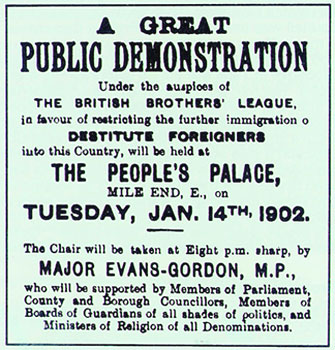
In response to this new pattern of migration, the Alien Act of 1905 was instituted after pressure from the likes of the British Brothers League (BBL), an anti-immigration group with links to some prominent Conservative MPs. They campaigned for restrictions on immigration with the slogan ‘England for the English’.  The BBL had launched itself with a 1,000-strong rally in London’s East End in May 1901 and by 1902, even the future Archbishop of Canterbury, Cosmo Gordon Lang,  then still a Bishop in Stepney, London, accused immigrants of “swamping whole areas once populated by English people”.

Anti-Semitism was very visible, especially in parts of the East End, as the Russian and Polish Jews became a prominent immigrant community, but there were also many Germans, Romanians, Austrians, Dutch and Chinese immigrants arriving during the latter years of the 19th Century and the early decades of the 20th Century.

Germans

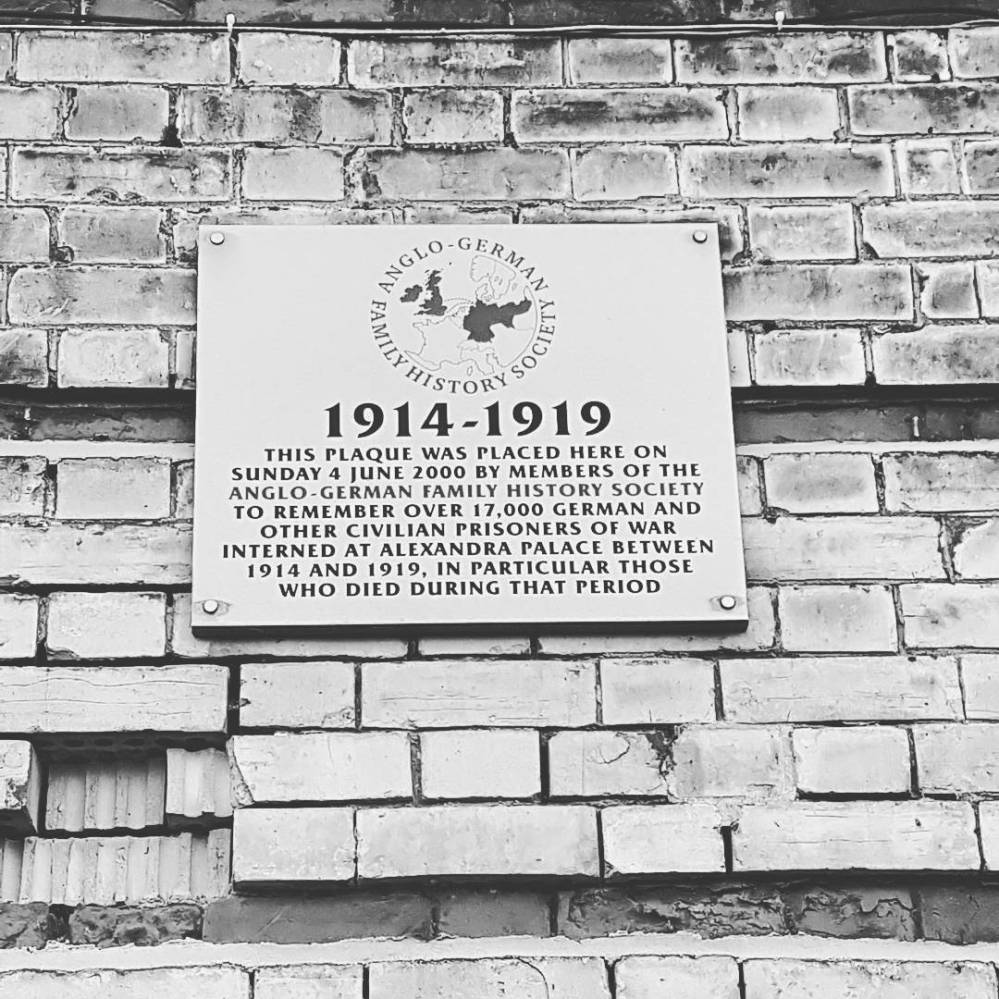
Plaque at the Alexandra Palace

By 1930 when the FA and the department of Labour were effectively banning the transfer of foreign players, the Alien Act of 1905 had been superceded by the Aliens Restriction Act 1914 and the Aliens Restriction (Amendment) Act 1919. The 1914 Act was brought in after the outbreak of World War I and obliged “foreign nationals to register with the police, enabled their deportation, and restricted where they could live“. This act was used to deal with those members of British Society deemed “enemy aliens” and in a somewhat grotesque twist of fate some 17,000 German, Austrian and other civilians were imprisoned during the course of the war in the grounds of the Alexandra Palace, the so-called “People’s Palace” managed under a Public Trust for the free use and recreation of the London public.

The 1919 Act extended these wartime conditions into peacetime and further restricted employment rights of foreign residents in Britain, barring them from certain jobs while targeting those viewed as criminals, the destitute and so-called ‘undesirables’. Under this legislation, British women lost their British citizenship upon marriage to a foreign citizen, even if the woman in question did not acquire her husband’s nationality. For children born outside Britain or its dominions, citizenship relied on descent through the legitimate male line only, and was limited to one generation. This provides some context to the actions of the FA and the IFAB. Rather than being seen as aberration from the norm, their position should be viewed as part of the wider establishment viewpoint.

BritishBrothersLeaguePoster(1902)

A British Brothers’ League poster

The player who sparked these restrictive actions was Rudolf “Rudi” Hiden, the Austrian international goalkeeper. Hiden had starred for the Austrian national team in a 0-0 draw with England in May 1930, which likely piqued the interest of Arsenal manager Herbert Chapman. The reports of the game, played in front of some 55,000 spectators in Vienna, heaped praise on Hiden for his agility, reactions, his exceptional talent for long throw-outs, and even his good looks. The same papers did however, note that Hiden tended to use his feet too much and was unused to the British habit of barging the goalkeeper, which was considered a foul on the Continent, but not in Britain. He was also praised for his very British style of sportsmanship; upon leaving his goal to help an injured England player to the touchline for treatment.

However, despite Chapman’s interest and a fee of £2,500 being agreed with Hiden’s club Weiner AC, the transfer never went through. On three separate occasions, Hiden was turned back by immigration officials at the port of Dover after they consulted their counterparts in the Department of Labour, who determined that Hiden had no right to work to Britain. Hiden had been a baker by trade in his native Vienna, and apparently Arsenal had gone so far as to arrange a job for him as a chef in London while also being paid on the books at Arsenal. This, however, cut no ice with the immigration officials, and his move to Arsenal never materialised.

Hiden did however get his move abroad, winning a league and cup with French side Racing Club de Paris in the 30’s. He was also part of the Austrian side that trounced Scotland 5-0 in Vienna less than a year after the Arsenal debacle.

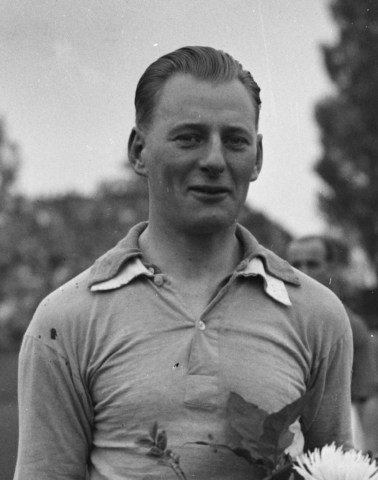
The goalkeeping options available to Arsenal in 1930 present an instructive window into the views towards “foreign players” at the time. The 1930-31 season saw Arsenal frustrated in their attempts to sign Hiden, but they were successful in signing Dutchman Gerrit Keizer from Margate. Keizer had kept goal as an amateur with Ajax before moving to London where he worked as a greengrocer while playing on the weekends for Margate, where he was spotted by Arsenal’s scouts. Keizer was initially signed as a professional but after the issues with Hiden, the Ministry of Labour forced Keizer to continue as an amateur, first at Arsenal and later at Charlton Athletic and Queens Park Rangers.

Gerrit_Keizer_(1946)

Gerrit Keizer in 1946 (source  Nationaal Archief Fotocollectie Anefo )


Arsenal featured two other keepers around this time, one being Charlie Preedy, born in Neemuch, India in 1900 as the son of a British Army Artillery officer. Preedy spent the first seven years of his life in India before his family returned to England. Their final keeper was Bill Harper, a Scottish international who re-joined Arsenal in 1930, having spent the previous three years playing professionally in the United States.

The double standards were clear, Hiden was not allowed into the country and the fear was expressed that this would set a precedent for foreign players coming to Britain to take the jobs of British workers in the direct aftermath of the Wall Street crash and the Great Depression. Keizer was forced to play as an amateur and earn his living as a greengrocer. However those British players who chose to play abroad professionally as other professional leagues began to emerge (in the USA, in France and elsewhere) were free to travel and return home when it suited them.

The same went for coaches. Hiden’s international coach with Austria was Jimmy Hogan. During a hugely influential and peripatetic career, Hogan had coached club and national sides throughout Europe, from the Netherlands and Germany to Hungary and France.  This Lancashire-born son of Irish immigrants perhaps did more to spread the gospel of football around the continent of Europe than any other Englishman.

Hogan was not alone in this work as a footballing missionary, other English coaches were hugely influential in developing organised football throughout Europe and beyond, bringing through new generations of local coaches and players. Men like Fred Pentland in Spain, Ted Duckworth in Switzerland, Vic Buckingham in Spain, Greece and the Netherlands or William Garbutt in Italy. Britain helped give football to the world but some didn’t want the footballers of the world to come to the home of the game. The place that they had heard so much about from their illustrious teachers and viewed with such reverence.

Rudi Hiden of course was not the first foreign born footballer to try to play in Britain. There were a number of players born outside Britain who had managed to make appearances in League football. In the 1890’s there was Walter Bowman from Waterloo, Canada, who twice toured Britain as part of a North American selection and was signed by Accrington (then of the first division) in 1892 before later signing for Ardwick F.C., subsequently renamed Manchester City, where he played alongside the likes of Billy Meredith.

As an infant Max Seeburg was one of those thousands who made that journey west across Europe to London in the 1880’s. Born in Leipzig, Germany he made a solitary appearance for Tottenham Hotspur in 1908 before enjoying short spells with Burnley and Grimsby Town.

The early recruitment of foreign players was haphazard, and one couldn’t identify anything approaching modern scouting or indeed any sort of systematic approach to recruitment. A player like Bowman was selected because he’d impressed on a tour to Britain. It was a similar story that led to Liverpool signing three players from a touring South African side in 1924. One of those players, Gordon Hodgson, would score 233 league goals for Liverpool (including a still-standing club record 17 hat-tricks) during his 11 years at Anfield, before being signed by Aston Villa at the age of 32 for £3,000. Hodgson was a boiler-maker from the Transvaal who was the son of English immigrants and, despite arriving in the UK as a player for a South African national team, he would end up lining-out three times for his new homeland.

As with Rudi Hiden, players were also recruited after performing well in international matches or tournaments. Nils Middleboe impressed for Denmark against England in both the 1908 and 1912 Olympics, and became the first foreign international to ever play for Chelsea. He worked in a London bank for the entireity of his career at Chelsea.

By the time of the 1930 ruling, there had even been a couple of Egyptian players appearing in the Football League. Hassan Hegazi had played against British soldiers as a teenager in Egypt, and moved to London in 1911 to study engineering.  He joined non-league Dulwich Hamlet where he starred as a stylish and gifted forward, he made a single appearance for Fulham (when he scored) but decided his loyalties lay with the Hamlet in non-league football. Tewfik Abdullah had a longer league career in both England and Scotland after appearing for Egypt in the 1920 Olympics. He signed for Derby County and was referred to by one publication on it’s cover as “Derby’s Dusky Dribbler” before spending time north of the border at Cowdenbeath in the Scottish Second Division.

Either because of their status as amateurs, their parentage, or perhaps because their careers were not very high profile the players mentioned above managed to operate in British football prior to the Hiden ban.  The fact that Hiden was a high-profile international, and as an Austrian a wartime enemy just over ten years before, may have impacted on his application. However, his proposed transfer spurred the Home Office into action. Among their other targets were Aberdeen, Rangers and Hearts who were all contacted by the Home Office in 1930 about the presence in their ranks of a number of Canadians and Americans, the clubs were however able to point out in each case, that although the men involved had lived in North America they were born in Scotland and had at no point taken on any other citizenship.

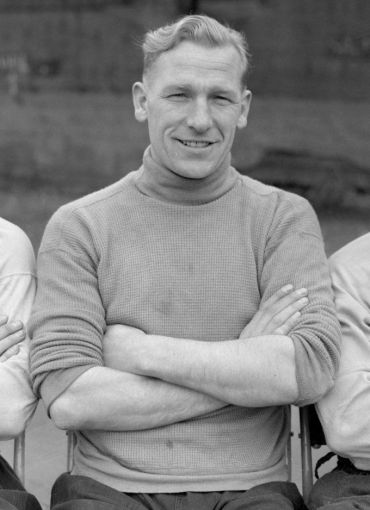
A player who succeeded where Rudi Hiden had failed was Bert Trautmann. Like Hiden he was a goalkeeper and like Hiden he was a former wartime enemy of Britain. In Trautmann’s case literally so. Raised in Bremen, Germany, Trautmann was an exceptional athlete from his earliest days as well as being a fervently devoted member of the Hitler Youth from the age of 10. He was a paratrooper during the Second World War and served on the Eastern Front where he witnessed the mass murder of civilians by one of the infamous Einsatzgruppen death squads. After later being transferred to the Western Front he was captured shortly after the Normandy invasions.

Trautmann eventually ended up in a prison of war camp in Cheshire and was rated as a category “C”  prisoner which identified him as an ideologically committed Nazi rather than simply a soldier drafted into the German war machine against their will or despite their ideological beliefs. Trautmann gradually began a new life in England, slowly rejecting his earlier beliefs and surprisingly befriending an Jewish Army Sergeant, Hermann Bloch for who he acted as a driver, and eventually marrying an English woman named Margaret Friar. During this time he was also keeping goal as an amateur for St. Helen’s F.C., where he was spotted by a Manchester City scout and was signed by the club in 1949. As he’d been resident in Britain for more than two years and had been playing as an amateur this Iron Cross winning, Nazi paratrooper had managed to circumvent the restrictions on foreign players.

44132-1crop

Bert Trautmann at Manchester City

Despite a protest from over 20,000 Manchester City supporters, Trautmann quickly won them, and the wider footballing public, over with a string of impressive displays. In 1956 he was named Footballer of the Year, the same year he played a famous role in City’s cup final victory when he continued playing for the final 15 minutes of the game with a broken neck after making a save from Birmingham’s Peter Murphy. In the space of a little over six years Trautmann had gone from a prisoner of war pariah into a hero and icon of the English game.

Despite occasional cases like that of Bert Trautmann, the effective ban on foreign players in England would remain in place until 1978, though Scotland took a more relaxed attitude in the 1960s, which saw a small influx of Scandanavian players immediately thereafter. The English football authorities were found to be in breach of the rule on free movement required by the European Community (EC), which Britain had joined in 1973. This EC ruling came only seven years after the UK had further amended it’s laws with the 1971 Immigration Act which meant that British Commonwealth citizens lost their automatic right to remain in the UK, and they now faced the same restrictions as those from other nations. Commonwealth citizens would in future only be allowed to remain in UK after they had lived and worked there for five years.

1978 became a watershed year for football transfers: Tottenham Hotspur signed Ossie Ardiles and Ricardo Villa, though the recently appointed PFA Chairman Gordon Taylor noted that this meant there “could already be two players out of a job at Tottenham.” Sheffield United brought in their own Argentinian in Alex Sabella, while Manchester City brought in Polish World Cup star Kazimierz Deyna.

This late 70s trickle of foreign players, however, did not turn into a flood. The rhetoric used by the likes of Gordon Taylor and PFA Secretary Cliff Lloyd was still very much language evocative of the 1930s and the Depression, and that every foreign player meant the loss of work for a British player. Lloyd warned that what started as a “trickle could finish in a deluge”, and that every “foreign player of standing in our league represents a denial to a UK player of a place in the first team”.

The FA, while complying with the European Community requirements, put in a number of qualifications: work permits would only be issued to “overseas players of established international reputation who have a distinctive contribution to make to the nation’s game”. It was, however, well into the Premier League era and the concurrent removal of player nationality restrictions in European competition before that large scale movement of international players to Britain would begin.

As Brexit approaches and certain ‘hard Brexiteers’ insist on a revocation of free movement that forms a core tenet of the European Union, there could be an opportunity to return to a type of footballing ‘Alien Act’. However, unlike the situation in the 1930s, it is unlikely that the FA, the leagues, or the clubs would welcome this. They could not so harmoniously support such regulations being imposed by government departments in the way their predecessors had. Despite almost 50 years of forced insularity, the English top-flight is now global in not only its players, but its fanbase, coaches, ownership and sources of revenue, probably more so than any other professional sporting league in the world.

It strikes me that some highly vocal advocates for a hard Brexit and the removal of free movement would feel more at home in 1930, sending a Austrian baker away at the port of Dover or insisting that a Dutch greengrocer living in London couldn’t earn money playing football. But Football has moved on from those times even if others haven’t. Britain helped bring football to the world, and looking at English football today you could say that football, in all its multifarious forms and wonderfully unusual manifestations has finally been allowed to come home.


This article first appeared in the Football Pink. The headline photo is from the mural that commemorates the Battle of Cable Street in London’s East End.


It could happen to a Bishop – John Curtis in faith and football

A Bohemian history of the 20th Century: An examination as to whether it is possible to write about the key events of the last century through reference only to those people who played for Bohemian Football Club of Dublin. A difficult task but the more I read and research, perhaps not an impossible one. Thus far there are Bohemian connections to the 1916 Rising, the War of Independence and the Civil War in Irish history, and in a wider context there were the global conflicts of World War I and II which I have mentioned in previous posts. But how about Chinese missionaries and the rise of the Maoist interpretation of Communism? Well to tell that story we have to go back to Dublin in 1880.

John Curtis was born in 1880, as the eldest son of Thomas Hewson Curtis and Margaret Curtis. Thomas was a clerk and later a manager in the corn exchange near to Christchurch Cathedral but as a youngster John lived with his family on Montpellier Hill its steep incline rising to the North Circular Road gate of the Phoenix Park where Bohemian F.C. would be founded in 1890 by a group of men only a few years senior to young John. By that time the growing Curtis family had moved the short distance to Blackhall Street, residing in a house next to the Law Society buildings at Blackhall Place which were then occupied by the King’s Hospital school. Eventually the family moved to Hollybrook Road in Clontarf as Thomas’ career continued to progress. The young John was educated not in King’s Hospital but at Benson’s Grammar School in Rathmines which was founded by Rev. Charles William Benson on the lower Rathmines Road, the school also educated the likes of George Russell (AE) and members of the Bewley family.  John then graduated to study in Trinity College Dublin.

It was around this time that a teenage John Curtis first made an appearance for Bohemians. He appears in the first team in the 1897-98 season. He played most of his games for the club at inside-left, and in that first season his partner at outside-left was none other than Oliver St. John Gogarty. The pair starred together as Bohemians won the 1897-98 Leinster Senior Cup final, defeating Shelbourne 3-1 while also progressing to the semi-finals of the Irish Cup.

The following season showed a similar pattern, another Leinster Senior Cup win and another lost Irish Cup semi-final (this time to Linfield) for the Bohs and John Curtis. Though not yet 20 Curtis was already a star player, in the 18 games he played that season he scored an astonishing 21 goals. Bohemians wouldn’t join the Irish league until the 1902-03 season so Cup competitions such as the Leinster Senior Cup and the Irish Cup, as well as the Leinster Senior League, would have taken precedent at the time and Bohemians were clearly the strongest side outside of Ulster at that juncture.

The 1899-1900 season saw further progress in the Irish Cup, this time Bohs got all the way to the final. John Curtis was instrumental in getting them there, scoring a vital equalising goal in the semi-final against Belfast Celtic before Herbert Pratt scored the winner in a match played in the Jones Road sports ground, now better known as Croke Park. John lined out against Cliftonville in the final in Grosvenor Park in Belfast in front of 5,500 spectators. Alas it didn’t turn out to be a first cup win for Bohemians.

Bohs had made it to the cup final once before in 1895 when they were hammered 10-1  by Linfield, but the 1900 final was to be a much closer affair with Bohs being defeated 2-1 with George Sheehan getting the goal for the Dublin side. The newspaper reports described a tight game with Bohs deemed to have been highly unlucky to lose, indeed many observers thought that Cliftonville’s second goal was a clear offside. Matters weren’t helped by four Bohemian players picking up knocks during the course of the match.

On a personal note for John Curtis it seemed that just a week prior to the Irish Cup final  he might be honoured with an international cap. A first ever international game was to be staged in Dublin’s Lansdowne Road and Andrew Gara, the Roscommon born, Preston North End forward was earmarked for a spot in the Irish attack, however just days before the game Gara was injured and the Irish Independent reported that his place was to be awarded to John Curtis. This didn’t come to pass however, the sole Dubliner in the line-up was John’s team-mate George Sheehan who was given the honour of captaining Ireland in a 2-0 defeat to England. The closest John would come to an international cap would be representing Leinster in an inter-provincial game that season against an Ulster selection.

While John Curtis would continue to line out for Bohemians his appearances were reduced in number over the coming years, he had sporting commitments with Trinity College as well, representing them in as a footballer in the Irish Cup while also enjoying games of Rugby.

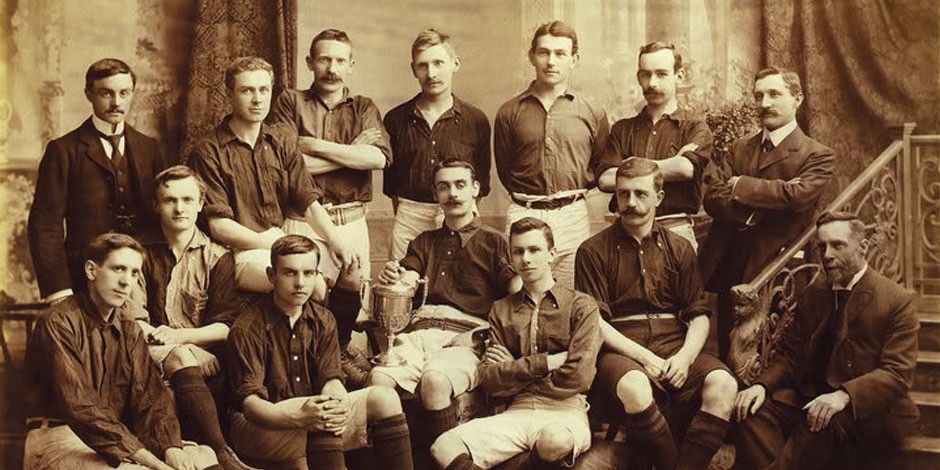
Bohs with Sloan Crozier

John Curtis is the big bloke with the moustache and his arms folded in the back row.

He features in a team photo from the 1902 Leinster Senior Cup winning photo but lined out for the club less frequently, he did appear in a couple of prestigious friendly matches in the early years of the century however, when Bohemians were keen to invite the cream of British football to their new home in Dalymount Park. John played against Celtic in 1901 and against Bolton Wanderers the following year.

By 1903 John had finished his studies in Trinity College and was ordained as a Reverend, his first parish being that of Leeson Park in Ballsbridge. By this stage his two younger brothers Edward (Ned) and Harry were both playing for Bohemians, though with less distinction than their older brother.

While his footballing life might have been coming to somewhat of an early close the even more remarkable parts of John Curtis’ story were only beginning. After only three years in his Dublin parish John Curtis was setting sail for missionary work in China and embarking on a whole new chapter in his life.

John was bound for the Chinese province of Fujian on the southwest coast of the country. The first Protestant missionaries had only begun working in China in 1807 and among the early missionaries was another Irishman, William Armstrong Russell who arrived in China in the 1840’s. Despite these earlier arrivals John’s journey was still very much a leap into the unknown and certainly a long way from leafy south- Dublin parish work.

John arrived in Fujian in 1906 and later, while working there met fellow missionary Eda Stanley Bryan-Brown, she had been born the daughter of a clergyman in Australia, and in 1914 they were married. In 1916, – perhaps out of a sense of duty? – John returned to Europe in the midst of War, this meant separation from his wife and his missionary work. Curtis joined the British Army Chaplains and shared the dangers of the combat troops in trenches and on battlefields. He spent time in Greece and also would have ministered to members of the Royal Dublin Fusiliers during his service. As one journalist who knew him well observed of his character “one cannot picture him holding back from that cataclysm”. Indeed despite his obvious religious devotion most descriptions of John Curtis focus strongly on his energy and fearlessness, whether on the sports ground, or the battlefield or in his missionary work.

Luckily John survived the War and in 1919 received the Victory medal, however he swiftly returned to his work in China. Since arriving in China in 1906 John had witnessed crowning of the child emperor Puyi in 1908 as well as his forced abdication, the end of Imperial rule, and the founding of the Republic of China just a few years later. His post-war return witnessed further upheaval. In 1927 John and his missionaries would no doubt have been aware of the first major engagements of the Chinese Civil War between the Kuomintang (or KMT, the major political party of the Republic) and the Red Army of the Chinese Communist Party. There was a major battle for control of the city Nanchang in the neighbouring province of Jiangxi which ultimately saw the Communist forces flee in defeat, many of their surviving troops marched hundreds of miles to take refuge in Fujian, the province where John and his family were living.

By this stage John and Eda had become parents to a son, John Guy Curtis in 1919, Arthur Bryan Curtis in 1924 and followed by a sister, Joan. It was a restless time to have a new family but there was further change for John as in 1929 he became Bishop of Zhejiang, replacing his fellow Dubliner Herbert Moloney. This meant that John and Eda moved to the beautiful city of Hangzhou, referred to by some at the time as the “Venice of the east” due to its location on the Grand Canal of China and sections of the Yangtze river delta. By this stage Eda had brought the children to England in 1927 to live with one of her brothers though both parents visited every year up until the outbreak of the Second World War. In their young lives the children had witnessed a great deal of violence. Joan recalled as a four year old hearing “soldier and their cannon” from the Missionary school. On another occasion in 1922 Eda and her two young children were obliged to undertake a long journey up river, during the course of which her oldest son John  by then only three years old at the time developed laryngeal diphtheria. When it looked like he might succumb to his illness she was forced to perform a tracheotomy, her only instruments being a pen-knife and some hair-pins. It was perhaps not surprising that the calm of rural England would seem a better place for the children to grow up.

Drama and upheaval followed the Curtis family to this new setting of Hangzhou  and as Christmas 1937 approached so too did the forces of Imperial Japan. The Second Sino-Japanese war had broken out that summer and on Christmas day 90,000 Japanese troops entered Hangzhou after fierce fighting. A week earlier the Japanese had advised all foreign consuls to evacuate any of their citizens from the area due to the danger of the fighting, in all there were only 31 foreigners in Hangzhou in 1937 and John Curtis was the only Irishman.

Journalist and Church of Ireland priest, Patrick Comerford notes that “living conditions deteriorated in the city, Curtis constantly visited the hospitals, medical camps and refugees, his overcoat pockets bulging with bottles of milk for the children. On what he called his ‘milk rounds,’ he also shepherded large numbers of frightened women and children to the safety of the refugee camps.”

He continued to administer to his Church’s followers throughout his vast diocese despite the restrictions caused by the Japanese invasion, and the subsequent outbreak of World War II.  By September 1942 more than nine months after the Japanese attack at Pearl Harbour many missionaries were called in for questioning. John Curtis was arrested in November and taken to the Haipong Road Camp in Shanghai and then held in Stanley Internment Camp, Hong Kong. Comerford writes that on one occasion, “the Japanese threatened to shoot him if he continued to criticise their treatment of his fellow prisoners, but it was said that in internment he was a great asset to the morale of the camp.”

The Curtis’s would remain in prison of war camps for the remainder of the War, it was in such a camp that they would learn of the death of their oldest son John, in January 1943. John, whose life Eda had saved as a toddler, was only 23 when he died in a flying accident while on service as an RAF pilot. When finally released from the camp at the end of the war both John and Eda were in their 60’s and had suffered cruelly during their captivity. Eda had continued her medical work, helping other prisoners inside the  camp and her thoughts were about returning to Hangzhou to continue her work at the mission hospital, which they managed to do with support from the Red Cross. After the war more missionaries did come out to China from Ireland and Britain however their work was made increasingly difficult under the rule of Chairman Mao Zedong. Eventually in 1950 John and Eda left China for the last time and returned to England.

John became a vicar in the small village of Wilden, north east of Stourport-on-Severn in Worcestershire before he eventually retired to Leamington in 1957 at the age of 77. Although struggling with arthritis it was noted that he remained in good spirits when in conversation with his old friends, and he kept in contact with his many old acquaintances and was eager for news from Dublin, indeed he had continued to visit Dublin regularly even while working in China. John was highly thought of as a  missionary and often during his returns to Dublin he was asked to speak about his work and travels. And despite the passing of time his reputation as one of the best Irish footballers of his generation lived on for decades as well.

John passed away suddenly in 1962 and Eda died just 18 months later. They had truly lived full, dramatic and difficult lives. Their daughter Joan got married and ended up living in Sligo while their surviving son Arthur Bryan Curtis, who had studied at Oxford and also served in World War II ended up emigrating to Rhodesia (now Zimbabwe) to become a school headmaster.

The sporting connection begun with John Curtis all those years ago for Bohemians continued with his son. John had been a handy Rugby player in his Trinity days and Arthur Bryan also excelled with the oval ball, playing for Oxford University and London Irish. In 1950 he won three Irish international caps as a flanker. Arthur’s son David also represented Ireland at Rugby, winning 13 caps and appearing as a centre during the 1991 Rugby World Cup, David was also a useful cricket player and represented Oxford University in that sport. Continuing a family tradition David’s sons Angus and Graham are currently playing Rugby with Ulster and Angus has already been capped for Ireland  at under-20 level.

But however exceptional the sporting careers of the younger Curtis men might be it cannot match the drama of their ancestor, the famous Bohemian John Curtis, or his wife the fearless Doctor, Eda Stanley Curtis.

Many thanks to Stephen Burke for providing information on John Curtis’s playing career. Also for more on Irish missionaries in China check out Patrick Comerford’s blog.

The tail-gunner at full-back

Bohs during the War years

At the outbreak of the Second World War League football ceased in Britain almost immediately, the 1939-40 League season was only three games old when it was suspended and a full league season wouldn’t be completed until the end of the 1946-47 season. This robbed many talented players of the peak years of their careers. However, in neutral Ireland football continued as usual, or as usual as possible in the midst of a bloody and truly global conflict. There may have been food and petrol rationing but the early and mid-40’s gave the League of Ireland one of it’s most dominant ever sides, Cork United, who won the league five times between 1940 and 1946.

For Bohemian F.C. the 40’s weren’t to be their most successful era, victory in the League of Ireland Shield in 1939 and an Inter-city cup win in 1945 were pretty much all that the era provided in terms of silverware but as always the club was developing players who would rise to prominence elsewhere. While I’ve written previously about the likes of the famous O’Flanagan brothers perhaps a less well known story is of Paddy Ratcliffe, a talented full-back for Bohemians who enjoyed a good career in the English League, but by even having a career at all he had cheated death and defied the odds.

From the printers to Dalymount

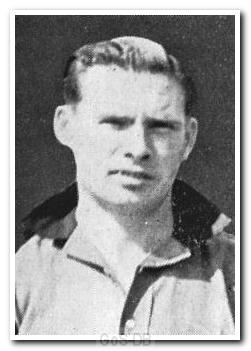
Patrick Christopher Ratcliffe, better known simply as Paddy Ratcliffe was born in Dublin on New Years Eve 1919. Paddy was the son of Bernard and Bridget Ratcliffe. Bernard was a postman but he had also served in the British Army, joining at the age of 18 in 1904 and serving in the Royal Artillery. He later rejoined to serve during World War I.

Patrick first appears on the footballing radar as a player for Hely’s F.C. which was likely the works team of Hely’s stationers and printers of Dame Street. Hely’s were a large and prominent business in Dublin at the time and as well as selling stationery they also had a line in sporting goods, so you could buy a tennis racquet or fishing rod along with your pens and ink. Hely’s is also mentioned in Ulysses as a former place of employment for Leopold Bloom.

Paddy Ratcliffe is mentioned as having left Hely’s F.C. to sign for Bohemians in August 1939, he made his first team debut the following month in a 2-1 win over Jacob’s in the Leinster Senior Cup. The League season began in November of 1939 and Paddy was an ever-present as Bohs playing all 22 games at left-back games as Bohs finished eighth that year. He was also part of the Bohemians side that defeated Sligo Rovers to win the league of Ireland Shield for 1939-40. The following season saw significant improvement in the league with Bohemians finishing third, Paddy played 25 games across all competitions but only 10 in the league, the reason for this fall in appearance numbers had nothing to do with a loss of form however, because in 1941 Paddy Radcliffe joined the RAF to fight in the Second World War. Newspaper reports announced in April 1941 that Paddy had played his last game for Bohemians, and like his father before him he was off into the violent theatre of global conflict.


Paddy the POW

Paddy joined the RAF and became the tail gunner on a Lancaster bomber, Paddy’s role as a tail-gunner saw him sit in an exposed turret at the very rear of the plane, operating four heavy machine guns which would play a crucial role in the defence of these heavy bomber planes. It was also an incredibly dangerous job, the tail-gunner was a particularly vulnerable target to lighter, more maneuverable, fighter plans, there were risks of frostbite from flying at such high altitude often with open panels, and the small, cramped rear turret could be awkward to escape from in the event of an emergency.

Lancaster_tail_gunner_IWM_CH_12776

A tail-gun turret from a Lancaster bomber (source wikipedia)

Not everyone came home from the Lancaster bombing raids over Germany,  for example the Lancaster was the main bomber used in the famed Dambusters attacks of Operation Chastise in May 1943. Of the 19 Lancaster bombers deployed eight were shot down over Germany. A similar fate befell Flight Sergeant Paddy Ratcliffe during one of those bomber missions when his plane was shot down over Germany. Paddy was lucky to survive as he had two Nazi bullets in his leg but he was destined to see out the War as a POW in Stalag 357 in North-western Germany. In these particular POW camps over 30,000 prisoners (the vast majority of them Soviet prisoners) died over the course of the War.

Irish newspaper reports from September 1943 even went so far as to express remorse at his death as it must likely have been assumed that Paddy and his crew had perished over Germany.  We don’t know if even his family knew he had survived. But thankfully Paddy did survive the war and after hostilities had ceased he was straight back into the Bohemians team for the 1945-46 season. While playing usually in the position of left-back he also lined out as both an inside left and scored his only goals for Bohemians in a Shield game from that position.

Lancaster_VR-A

A Lancaster Bomber ( source wikipedia)

A return to football

Ratcliffe’s performances in the early part of the season were impressive enough to secure a move across the water to Notts County as they prepared for a return to post war football. Notts County’s manager was Major Frank Buckley who had known Ratcliffe’s first manager at Bohemians, George Lax. Like Ratcliffe, Lax had also joined the RAF during the War. Perhaps it was on the recommendation of George Lax that Ratcliffe was signed? Paddy may also have come to their attention from playing wartime matches as there are reports of him lining out for the likes of Rochdale during 1942.

Either way, his spell with Notts County was short, by the time the first full, post-war league season was underway in 1946-47 Paddy had signed for Wolverhampton Wanderers. He joined Wolves as part of a deal that also brought forward Jesse Pye to Moulineux for a combined fee of £10,000. Pye would enjoy great success at Wolves scoring 90 times for them, including a brace in the FA Cup final which brought the cup to the black country. He was even capped for England in the famous Goodison Park game when they were defeated 2-0 by Ireland. Paddy, however, would only make two appearances in the English top flight before moving to Plymouth for the 1947-48 season.

This meant that Paddy had to drop down to Division Two to ensure more first team football. He made his Plymouth debut on the opening day of the season in August 1947 against Newcastle in front of a crowd of more than 50,000 in St. James’s Park. Paddy’s first two seasons were ones of mixed fortunes, he played only 25 league games in his first two years, and while he got a better run of games in the 1949-50 season (playing 21 games) Plymouth finished second bottom of the Second Division and were relegated to Division Three South.

Success and a first taste of the Big Apple

Despite the relegation the following seasons were some of Paddy’s best, he became the undisputed first choice as a right-back and began to contribute goals as well, becoming a regular penalty taker for the side. In the 1951-52 season Plymouth Argyle finished as Champions in Division Three South and kept clear of relegation when back in the Second Division. In fact Plymouth came fourth in the second tier in 1952-53 with Paddy as a regular. This remains Plymouth’s best ever league finish.

In the 1953-54 season there were greater challenges for Plymouth, they finished in 19th place in Division Two, only three points clear of relegation but they did take part in an ambitious end of season tour to eight cities across the the USA. Paddy boarded the Ile de France at Southampton on the 27th April 1954 and set sail for New York. The Plymouth Argyle tour would see them face local sides like Simpkins of St. Louis, the Chicago Falcons and various “All-Star” teams, as well as randomly playing two games against Borussia Dortmund in Chicago and then Los Angeles. The games against Dortmund were the only games which Plymouth lost on their tour where they racked up easy wins including a 16-2 trouncing of a supposed “All-Star” team in Denver. The tour ran through to the beginning of June when the Argyle signed off their visit with a 1-0 win over a New York All-Stars team in Astoria, Queens.

A short quote from “Irish soccer player” Paddy Ratcliffe appeared in the Big Spring Daily Herald of West Texas in June of 1954 where he asked what his impressions were of the United States. A somewhat wide-eyed Paddy described his experiences as follows: “Every city I’ve seen is like London at rush hour. Life here is a bit too strenuous for me. You Americans don’t take holidays. You don’t relax and lounge around. But you seem to have more fun. At home we’re in bed by 11. That’s when you people are going out”.  An interesting first impression as we’ll later see.

The 1954-55 season was another tough one for Plymouth. They escaped the drop by a single place. The 1955-56 season was to be Paddy’s last in English football, he had been a regular up until this point but by the start of the season he was 35 years old and new manager Jack Rowley (a superstar as a player in his time with Manchester United) preferred others in the full-back berths. Paddy would only make 8 appearances that season as Plymouth were again relegated from Division Two. In all he had made 246 appearances and scored 10 goals for the Pilgrims.

Despite spending most of his career playing at a decent standard Paddy was never selected for Ireland, this is especially surprising given his versatility in either full back position. There were some suggestions that he should be called up aired in the newspapers, in the Dublin Evening Mail in 1953 and from “Socaro” the football correspondent in the Evening Press.  The Irish selectors had the chance to watch Paddy in the flesh when he lined out one final time for Bohemians in May 1952. He was playing in a memorial match for the Jimmy Dunne, the legendary Irish striker who died suddenly in 1949. Dunne had played and coached Shamrock Rovers but had also been Paddy’s coach during his last spell with Bohs in 1945.  A Rovers XI played a Bohs XI in Dalymount just before a national squad was picked for the upcoming game against Spain but Paddy never got a call up. Guesting for that Bohs XI were the likes of Tom “Bud” Aherne and goalkeeper Jimmy O’Neill who did feature in the heavy 6-0 defeat to Spain just two weeks later.

In America

While he may never have gotten that cap for Ireland and his career in England had come to an end with Plymouth this wasn’t the final act in Paddy’s footballing career. The tour of the United States had obviously made a big enough impact on Paddy and he decided to up sticks and move to the United States with his young family. Paddy had married a Dublin woman named Olive Privett in 1946 and they set off for a new life in Los Angeles in 1957. They moved to the Lawndale area of Los Angeles with their four children (two girls and two boys) and Paddy began a career in the printing business, becoming print foreman of Palos Verdes newspapers and occasionally penning articles in its pages about the beautiful game. Paddy also continued playing for a Los Angeles Danish side well after his 40th birthday, only hanging up his boots in 1962. He was also involved in coaching young American talent in football of the association variety. He even took time to catch up with former professional colleagues when they visited the United States, entertaining his old adversary Stanley Matthews when he was on a tour of America.

paddy-as-california-danes.png

Paddy going for a header on the soccer pitches of Los Angeles

Despite being somewhat of an evangelist for soccer in the States, Paddy’s son Paul shone as a varsity American football player, lining out as a quarter back for his high school. When quizzed about the American variant of the sport, Paddy described it as “a daffy game –  they call it football but a specialist comes on to kick it maybe ten times in a 60 minute game. How can they call it football?”

Paddy passed away in October 1986 at the age of 66 and was buried in Los Angeles. He had begun his career with Bohs before the War, lived a perilous existence as a rear-gunner on an Allied Bomber, survived the deprivations as a prisoner-of-war in Nazi Germany and returned to have a successful footballing career in Britain, despite having a pair of German bullets in his left leg. Even after his playing career had ended he began a new life and trade in the United States believing it presented the best opportunities for his young family but never forgetting where he came from or the sport he loved.


Once more, thanks to Stephen Burke for his assistance on Paddy’s early life and Bohs career, and for more on Paddy’s career at Plymouth check out the excellent Vital Argyle website. Featured image is from the profile of Paddy in the Greensonscreen website.


Paddy – bottom right in the Bohemian team

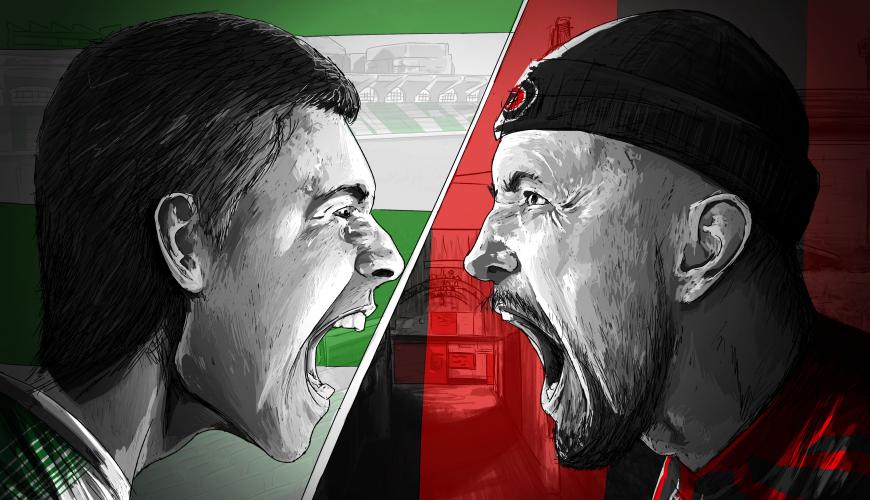
Bohs v Rovers: The biggest rivalry of them all

Bohs versus Rovers, what was the first flashpoint that turned a local game into one of the biggest rivalries in Irish sport? Well to understand we need to travel back almost a century.  Over the course of the month of April 1923 Bohemian F.C. and Shamrock Rovers played each other four times in various cup competitions. As the old saying goes “familiarity breeds contempt” and the final of these matches almost ended in violence after two Bohemians players had to be stretchered from the field due to rough tackling by Rovers. At the final whistle, the Bohemians’ half-back Ernie Crawford removed his jersey and challenged Rovers star forward Bob Fullam to a fist-fight. Crawford was born in Belfast and was the full-back and Captain of the Irish Rugby Team, he was also a decorated World War One veteran. Not a man to be taken lightly.

Fullam himself was no shrinking violet, as well as being an accomplished footballer who was capped twice by Ireland he supplemented his income as a docker in Dublin Port. He had finished the 1922 FAI Cup final amid a mass brawl after Rovers were beaten by St. James Gate. The fighting only ceased when the brother of the Gate’s Charlie Dowdall reportedly confronted Fullam with a pistol.

Could we perhaps trace the beginnings of perhaps the fiercest rivalry in Irish football back to these events in 1920’s?

In the early decades of football in Ireland the Dublin Derby were the games contested between Bohemians and Shelbourne. Both clubs had been founded in the 1890’s with Bohemians finally settling into their permanent home in Dalymount Park in 1901. Shelbourne had their beginnings in what is now Slattery’s Pub at the junction of South Lotts Road, Bath Avenue and Shelbourne Road in 1895. Founded by a group of dock workers from the local Ringsend/Sandymount area, their name was reportedly decided upon by a coin toss between the names of the various nearby streets. It was these two clubs who would have the great north -south city rivalry of the city.

By the 1904-05 season Shelbourne and Bohs were the only Dublin-based clubs who were competing in the Ulster dominated Irish League and they faced off against each other in the final of the 1908 Irish Cup which Bohs won in a replay. This was the first time the final had been contested by two Dublin sides.

Bohs didn’t even face Rovers in competitive games until 1915. In a Leinster Senior Cup first round tie on the 9th January 1915, Bohs won 3-1 thanks to a hat-trick by forward Ned Brooks. Later that same year the Rovers were elected to the top division of the Leinster senior league, their second game at this level was against Bohs where they again lost 3-1. This game came just two weeks after Rovers young centre-back James Sims died tragically in a shipping accident in Dublin Bay. At this time Bohs great rivals were still very much Shelbourne F.C.

By the early 20’s the FAI had split from the Belfast based IFA and founded a new league for the clubs in the nascent Irish Free State. Shamrock Rovers didn’t compete in the League in that first season but they made their mark, reaching the Cup final against eventual double winners St. James Gate. The following season they were elected to the league and finished as Champions.

The 20’s would begin an era of fierce competition for Bohs and Rovers, before the decade was out both clubs would have 3 league titles apiece to their names. Rovers would have also begun a run which would establish their reputation as “Cup kings” by winning the FAI Cup five years in a row. The first of those five-in-a-row titles would begin with victory over the holders Bohemians in the 1928-29 final in Dalymount Park. The initial game finished 0-0 but in the replay Rovers ran out 3-0 winners, with two goals coming from John Joe “Slasher” Flood and another from that man again Bob Fullam.

On 22nd April 1945, almost exactly 22 years since the tussle between Ernie Crawford and Bob Fullam and 16 years since their last cup final meeting Bohs and Rovers met again in Dalymount Park in the final. To date it is the last cup final meeting of the pair and remains the biggest attendance ever for an FAI Cup Final. Depending on which estimate you read there were anything from between 39,000 and 45,000 packed into the famous old ground that Sunday afternoon. Among Bohs ranks was the Irish international Kevin O’Flanagan, newly qualified as a doctor. He had an untypically poor game that day, perhaps due to the fact that he’d failed to diagnose himself with the flu and had played the game with a 103 degree temperature! Podge Gregg, the Rovers centre-forward broke Bohemian hearts in the second half as he converted from a Mickey Delaney cross to score the game’s only goal. On the Rovers bench that day as coach was a man well familiar with the fixture, Bob Fullam.

By the time of that final Bohs star was already on the wane. Their strictly amateur status meant that they tended to bring through and develop players before losing them to other Irish or cross channel clubs who were prepared to offer professional terms. As just one example the following year Rovers lost the FAI Cup final with four former-Bohemians in their line-up; Frank Glennon, Noel Kelly, Charlie Byrne and goalkeeper Jimmy Collins. The team that defeated Rovers in that 1946 final was Drumcondra F.C. For the next two decades as Bohemians drifted towards the lower reaches of the league table the great north-south Dublin rivalry would be between Drumcondra and Rovers in what many view as the competitive peak of the League of Ireland.

Between the end of the 40’s and the early 60’s Drumcondra would see players of exceptional quality grace Tolka Park. Among them future Ireland legends Con Martin, Eoin Hand and Alan Kelly Snr. as well as the likes of Tommy Rowe, “Kit” Lawlor, Christopher “Bunny” Fullam, Ray Keogh, Dessie Glynn, and Jimmy Morrissey to name but a few. They would win five league titles and another two cups. In Europe, they would knock out Danish side Odense from the Fairs Cup and also face the likes of Atletico Madrid and Bayern Munich.

Rovers would claim three more titles in the 50’s. This was the era of player-manager Paddy Coad and his exiting young side that became known as Coad’s Colts and featured the likes of Liam Touhy, Paddy Ambrose and Ronnie Nolan. The matches between Drums and Rovers, whether in Tolka Park or at Milltown were huge fixtures in the sporting calendar. Well before TV coverage became the norm and when direct experience of British football was through occasional newsreels and the odd pre-season friendly or player guest appearance, the Rovers/Drums rivalry capturing the sporting imaginations of the Dublin sporting public in a way that has happened seldom since in relation to the League of Ireland.

As this great rivalry played out during the 50’s and into the 60’s Bohs were very much in the back seat. However, in the early 1960’s they experienced a turnaround in fortunes thanks in no small part to their new manager Seán Thomas. He was the man who had just led Rovers to the 1963-64 league title but quit after a bust up with the club’s owner’s, the Cunningham family. His next port of call was Dalymount Park where he helped revive the fortunes of the struggling Bohemian club. In his first season Bohs finished an impressive 3rd place, a huge improvement on 12th the year before.

By the end of the 60’s the Bohemian membership had decided to make the biggest change in their history. They were going to scrap their amateur status and begin paying players. The policy quickly began to pay dividends. Only a year later Bohs would win their first major trophy in almost 35 years when they defeated Sligo Rovers in a 2nd replay of the FAI Cup final. Among the Bohs XI were a number of seasoned pros, which included  several names more than familiar to the Rovers faithful, among them Ronnie Nolan, Johnny Fullam and the first professional Bohemian, Tony O’Connell.

Over the course of the next decade Bohemians would win another two league titles and another cup during a relatively fallow period for Rovers. Despite bringing in Johnny Giles as player-manager (and a certain Eamon Dunphy as player-coach) and signing Irish international Ray Treacy a solitary FAI Cup was all their reward. Things would change by the beginning of the 1980’s. Manager Jim McLaughlin, backed by the finances of the Kilcoyne family brought unprecedented success to Milltown and in some ways the basis for a lot of the modern enmity with Bohs crystallised in these years.

By the early 70’s Drumcondra were on the wane before their League spot was eventually taken over by Home Farm. With the disappearance of Drums from League football so went over 20 decades of a great footballing rivalry. A resurgent Bohemians in the 1970’s meant a rekindling of an old enmity that had never truly disappeared. While as we’ve seen earlier players swapping the red and black of Bohs for the green and white hoops of Rovers has never been particularly uncommon many Bohemians supporters with longer memories still clearly recollect the movement of several significant players from Dalymount to Milltown. From the 70’s, 80’s and into the 90’s many prominent players such as Pat Byrne, Terry Eviston, Paul Doolin and Alan Byrne all made that journey southside which tended to create a certain amount of rancour amongst Bohs supporters.

It should be mentioned that the movement wasn’t totally one-way, and that (whisper it) even the legendary Jackie Jameson began his footballing career at Shamrock Rovers before making his name at Dalymount in the 1980’s.

Despite the success of the Jim McLaughlin era the 80’s were also a time of disharmony for Rovers. Owner Louis Kilcoyne decided to sell the club’s home ground of Glenmalure Park in Milltown which would then be developed for houses and apartments. Glenmalure had been home to Rovers since the 20’s and the fans acted swiftly by forming the pressure group KRAM (Keep Rovers at Milltown). Their actions however couldn’t halt the sale of the ground and the by the late 80’s Rovers had migrated northside, first to Tolka Park and then, for two seasons to Dalymount Park, home of arch-rivals Bohemians. No doubt a galling episode for the small group of supporters who chose to attend games in the Phibsborough venue, tenants to their great adversaries.

The 90’s were to be fallow years for the Hoops, a solitary league title in the 1993-94 season, when the club were playing their games in the RDS was the sole silverware of note. The club had plans to relocate to a permanent new home in the south Dublin suburb of Tallaght as far back as the mid-1990’s but it was to be almost another 15 years of wandering before Rovers would kick a ball at a completed Tallaght stadium. In the meantime, the intervening period contained more lows than highs, including examinership and a first ever relegation in the 2005 season. But there were a couple of notable victories against their old rivals Bohemians, perhaps the most pleasing would have been Rovers 1-0 win thanks to a Sean Francis goal in Dalymount in 2001. That victory sent Rovers briefly to the top of the league but it also meant that they had defeated their great rivals in their own back yard on the 100th anniversary of the opening of Dalymount Park. Rovers may have viewed that as some form of revenge for a result earlier that year which has gone down as one of the most storied in League of Ireland history.

That particular game took place on the 28th January 2001 in the then-home of Shamrock Rovers, Morton Stadium, Santry. Rovers then managed by Damien Richardson swept into a commanding 4-1 lead by half-time having got their first goal through Tony Grant only two minutes into the game. At half-time Bohs manager Roddy Collins gave a rousing team-talk, exhorting his charges to go out and “win the second half” what followed has gone down in legend for Bohemians supporters.

Five second half goals followed unanswered from Alex Nesovic, Dave Morrison, Mark Rutherford and a brace from Glen Crowe. Bohs left the pitch 6-4 winners and on a roll. Many players from that side have credited that result as part of the impetus that would see Bohemians haul back league leaders Shelbourne and finish up winning the double by the season’s end.

Today whenever the two sides meet they is likely to be action and drama and plenty of colour and pageantry in the stands. There have been times when footballing passions have spilled over as happened all those years ago with Crawford and Fullam. In 2003 Rovers were forced to move from their then-base of Richmond Park in Inchicore after crowd trouble during a match against Bohemians. A year later at a match in Dalymount former Hoops Tony Grant and James Keddy who had just signed for Bohemians were greeted with a torrent of abuse, then pig’s feet and finally a large pig’s head was thrown onto the pitch. A not so subtle message from the Rovers faithful about what they thought of Grant and Keddy’s move cross-city. Grant, interviewed by the Sun newspaper several years after the event described the Derby games in this way,

That game, it’s a religion to the supporters, it’s a cult, it’s what they live for. It’s the same for both sets of fans.

The noughties did nothing to diminish the rivalry between the two. The move to Tallaght stadium was to revitalise Rovers who took the title in 2010. Despite being in the ascendance and Bohs encountering financial troubles of their own the Derby games have remained wildly unpredictable. While recent seasons have been dominated by exceptional Dundalk and Cork City sides the Bohs v Rovers rivalry remains the biggest game in the Irish football calendar.

This article first appeared on the SSE Aitricity League website and in the “Greatest League in the World” magazine, issue one with artwork by Barry Masterson.

The method in the miracle

The German city of Kaiserslautern sits only a short distance from the French border and close to the edge of the vast Palatinate forest. It’s a city whose history of settlement stretches back into prehistory but after the end of the Second World War the city lay in ruins with as much as 60% of its buildings having been reduced to rubble by aerial bombardment in late 1944. When American troops reached the city in 1945 they faced little resistance. The area around the city later became home to thousands of occupying American and French troops, a legacy that continues to this day in the US air force base at Ramstein. It would not be dismissive to say that for all the other qualities the city of 100,000 possesses it is probably best known for it’s football team 1. FC Kaiserslautern. A side that have been German champions on four occasions and provided the backbone of Germany’s most iconic national teams.

Plenty of notable players have turned out for the Red Devils in the past, among them Youri Djorkaeff, Michael Ballack, Andy Brehme, and a name familiar to English fans, Stefan Kuntz. But head and shoulders above all these players stands Fritz Walter, captain of the Kaiserslautern side that won two league titles in the 1950’s and who, along with four of his club teammates helped an emergent West Germany lift the 1954 World Cup after the famous “Miracle of Berne” victory over the Hungarians.

Miracle is an often overused word in sporting parlance, every mildly unexpected result tends to be recast as some sort of David and Goliath struggle but even competing at the World Cup was an achievement for the West German side.

Kaiserslautern being so badly damaged by the end of the war was not an uncommon fate for many German cities directly after the war. By 1954 the new state of Rhineland-Palatinate where Kaiserslautern were based had only existed for eight years having as part of French Occupied Germany. The neighbouring state of Saarland was still a separate entity under French direction and was on course to be established as an independent state. In the otherworldly post war landscape the West Germans had even played against Saarland (formerly one of their constituent parts) as opponents in their qualifying group. The pace of rebuilding was slow in Germany and subject to the caprices of the various occupying powers. Millions of displaced, ethnic Germans had fled into West Germany from what is today Poland and the Czech Republic seeking homes, jobs, even the bare minimum of food and warmth. Multiple families crowded into cellars, the last habitable remains of a decimated building stock in the ruins of German cities. The civilian death rate in the immediate post war period was several times what it had been in the late 30’s immediately before the war. Those prominent German footballers who had escaped the war relatively unscathed quickly went back to the game (when permitted by the various occupying allied forces) competing in numerous friendlies with local sides in exchange for foodstuffs, coal and even fabric for jerseys. Teams without proper kit often found themselves draped in red and white shirts as they tailored discarded Nazi flags and banners into football shirts.

By the end of the 1940’s there was something approaching a return to league football in Germany but not in the form of the Bundesliga that we would recognise today. Football in Germany was still regional with the best teams of the five West German regional top-level divisions qualifying to play off for the German championship. Full professionalism was still prohibited, players had to have a day job and be able to demonstrate that this was their primary labour, not football.

The ’54 World Cup was being held in Switzerland because it was one of the few countries that had escaped the horrors of war relatively unscathed, it was safe and prosperous enough to host a World Cup. Fritz Walter had been a soldier in that war, his coach Sepp Herberger had tried to protect him and his teammates as best he could, he thought that an Air Force regiment would offer the best protection for his star player. It was commanded by a Major Graf, a football lover who appreciated Herberger’s desire to protect a key player like Walter. For the most part Herberger was right, Fritz Walter played more than 20 wartime international games for Germany while with the armed forces, however as the war progressed and the Germans losses mounted Fritz and his colleagues were pressed into more active service.

It was while on active duty with the air force that he contracted malaria, then later towards the very end of the war he was captured and faced the very real possibility of being transported to a Soviet labour camp in Siberia. It was only the intercession of a football loving guard who recognised Fritz during an impromptu kick-about which saw his name removed from a list of those bound for the Soviet camp. His footballing prowess had saved his life.

Also on the pitch that day in Berne was Fritz’s brother Ottmar, or “Otte” as he was affectionately known. He had finished the Second World War with shrapnel throughout his body, but particularly in his right knee. He was lucky even to be alive, as a member of the Navy his ship was sunk near Cherbourg and only 11 of the more than 130 crew survived. The worsening condition of Otte’s ruined knee would end his career in 1956. Apart from the brothers Walter, three further Kaiserslautern players took to the field in the final. Though dominant in the early 50’s they had shocked the German football public when they were hammered 5-1 in the final of the German football championship by the unfancied Hannover 96.

Fritz’s malarial blood didn’t like the heat of the central European summer so the cooler, wetter weather of the final was a blessing, the type of weather when he could play his type of game, to try and dictate the flow of play much as the roving Nandor Hidegkuti did for the opposition. Some to this day call it Fritz Walter weather.

Apart from Toni Turek, his goalkeeper, Fritz was the oldest man on the pitch, it was nearly seventeen years since his debut for his hometown team, FC Kaiserslautern as a naive 17 year old. His sole focus was football, to the absence of all else, despite his natural talent he thought about football so much that he drove himself to a form of obsession; highly-sensitive he fixated on defeats, personal mistakes and guilt for opportunities missed.

The Kaiserslautern players that made up almost half the national team had to prove themselves again, prove their mettle, show that the wouldn’t bottle it on the big occasion as they’d done only weeks earlier against Hannover. They’d achieved respectability to an extent by even getting to the final against the Hungarians. They’d done so in some style, dispatching a good Yugoslavian side before comfortably beating the Austrians 6-1 in the semi-final, Fritz and Otto had split four of the goals in that game between them. In the Yugoslavia game Fritz Walter’s room-mate Helmut Rahn had returned to the starting XI and gotten on the score-sheet, he too would start the final. That Rahn was Fritz’s roommate was no accident, he was eight years junior to Fritz, as a laid-back, humorous and fun-loving character he was chosen to act as an antidote to the stoic, pensive and neurotic Walter. His brother Ottmar recalled that Fritz would emerge to the team breakfast each morning with tears in his eyes from the laughter caused by Rahn’s latest jokes.

Memorial to the Kaiserslautern players who appeared in the 1954 World Cup (source wikipedia)

Rahn like all his team-mates had to have a day job. He enjoyed driving and worked as a chauffeur for a time before later becoming a rep for a confectionery company. Otte Walter ran a petrol station. Fritz Walter ended up working as a sales representative for sports giant Adidas. The founder of the famous company, Adi Dassler (who’s name was the origin of the brand) was on the German bench at the World Cup alongside Herberger, his pioneering use of replaceable screw-in studs of differing lengths to suit changing conditions gave the Germans a slight advantage on the wet, heavy turf of the Wankdorf stadium in Berne.

Thousands of words have been written, dramas and documentaries have been made on the final itself. Suffice to say that no team is unbeatable. While the Hungarians had demolished the Germans 8-3 in a group game Herberger had learned from that defeat. Helmut Rahn had scored one of the Germans three goals and Herberger had noticed how much space Rahn had been afforded by the Hungarian defence. Despite being an outside right Rahn also had a strong left foot shot and often cut inside with devastating effect.

Many theories still swirl about why the game played out as it did. Hungarian complacency after going 2-0 up early on? That the great Ferenc Puskas lacked full fitness having been cynically targeted by Werner Liebrich in the previous meeting of the sides? Even that the Germans were given injections of amphetamines to make them play at a more intense level. The Germans always claimed that they were only given vitamin C injections and several players later developed jaundice due to a dirty needle being used.

Whatever the precise truth the Germans bounced back from an early 2-0 deficit to triumph 3-2 thanks to two goals from Helmut Rahn and one from Max Morlock. Perhaps of greater impact was what happened next. In footballing terms little changed for the next decade. Herberger had been pressing the German FA for a proper nationwide league but his very success in 1954 undermined that. If a regionalised league with semi-professional players could win the World Cup then why would the West German FA change something that wasn’t broken? Or so went the logic. The establishment of the Bundesliga wouldn’t arrive until 1963. In the meantime professional clubs in Spain, France and Italy offered lucrative contracts to the heroes of Berne but to a man they rejected them.

Moving away from Germany would have meant removal from the national team, generally players were “rewarded” with sinecures with sportswear concerns or car companies. A trend that continued for years after with the likes of Uwe Seeler turning down lucrative moves to Italy and Spain to stay with Hamburg.

Politically the ’54 victory has been recast as a foundational moment in modern German history. One German historian credited Sepp Herberger as being one of the three father’s of the emerging West German state along with Konrad Adenauer, the country’s Chancellor and Ludwig Erhard, the Government minister most credited with the German economic miracle of the 1950’s and 60’s. The credit attributed to that maiden World Cup victory’s role in the German economic recovery has tended towards the hyperbolic. While it’s clear that there were massive obstacles to German success to suggest that footballing success spurred economic growth is somewhat far-fetched.

Despite the levels of devastation documented above the German economy was already beginning a period of unlikely, yet stunning growth. The large, young displaced German populations of Poland and Czechoslovakia provided a willing workforce. The deepening of the Cold War prompted the Allied powers to relax restrictions of German industry. A strong West Germany was seen as a necessary bulwark against Soviet expansion eastward. All while the largesse of the Marshall plan provided economic capital to help rebuild German industry.

If anything the World Cup victory provided a rare moment of national pride for a nation that was shamed for their wartime murder and brutality. During the denazification processes instigated immediately after the war it was noted that only two in ten Germans were willing to bear any personal responsibility for the war and the crimes of the Nazis. They were viewed as terrible events that were due to the actions of others. The unexpected triumph in Berne however offered an opportunity to display national pride in the supposedly safe, non-bellicose arena of a sporting rather than a military victory.

Despite this some elements of German society offended the global sporting public with the singing of the infamous opening verse of Deutschland Uber Alles rather than the benign third verse. At a celebratory dinner the German football president, in the alcohol clouded fug of a beer-hall started talking about German superiority and the importance of the Fuhrer principle in German sport. These events were an embarrassment to the overall celebrations and were widely reported at the time but the majority of the celebrations seemed not to tend towards the violent nationalism of the previous decade.

While the ruling regimes of Brazil in 1970 and Argentina in 1978 had sought make political capital out of a World Cup triumph (and how Hitler had used the 1936 Olympics for his Ayrian propoganda) the heads of government in West Germany eschewed the celebrations. Those other fathers of the nation; Adenauer and Erhard avoided the official homecoming celebrations in Berlin. This after all was just football, there were issues of real importance to be dealt with. Neither Adenauer nor Erhard were football fans, the Chancellor preferring the game of bocce (an Italian variant of boules). Not until Helmut Kohl took over the office of Chancellor in 1982 could it be said that there was a true football fan in charge of West Germany.

Kohl had grown up in what is now the state of Rhineland-Palatinate, as a youngster he idolised Fritz Walter and became a lifelong Kaiserslautern fan. He was even Club President for a time. When he became regional governor Kohl awarded Fritz Walter with the Freedom of the State in front of a packed football stadium in 1970. By that stage a new golden age of German football was emerging.

The Bundesliga was by then established as a national league. Within the next five years the West German national team would win the European Championships in some style before shocking the world yet again with an underdog triumph in the World Cup final against the majesty of the Total Football era Dutch team. In that same year of 1974 the second division of the Bundesliga was established while Bayern Munich won the first of their three-in-a-row European Cups. It was an unparalleled time of success at club and international level but for all these triumphs the German nation would never again capture the euphoria of that debut victory.

This piece originally featured in the Football Pink issue 20 World Cup edition.

A Dublin pub crawl with a token distraction

Last week I was invited out for a pub crawl to find out more about the betting tokens public houses used during a time when betting was made illegal I went to find out more about how Irish publicans found a loophole in legislation to allow their customers enjoy a not so legal pastime.

In the 1840’s and 1850’s the social ills caused by gambling preoccupied the minds of many in the Westminster parliament. They decided to legislate for the issue, outlawing most forms of gambling apart from things like on-track betting at race meetings which was where the wealthy and influential liked to mingle and place the occasional wager on a horse.

One item that was made illegal was the practice of using licenced premises for gambling of any kind, but in order to provide amenities for their customers, many publicans had tables for bagatelle and other games. As official coins could not be used for gaming, specially minted tokens were issued which could also be used for buying drinks. Very much an Irish solution for an Irish problem.

Many of these tokens still exist and a small collection of them are in the care of collectors from the Numismatic Society of Ireland (coin collectors to you and me) and thankfully many of the pubs that issued their own, early form of crypto-currency are still with us today. So on a warm July afternoon I was invited to join them in recreating a short pub crawl first done some 50 years earlier by society members in 1968.

A pub crawl with a difference

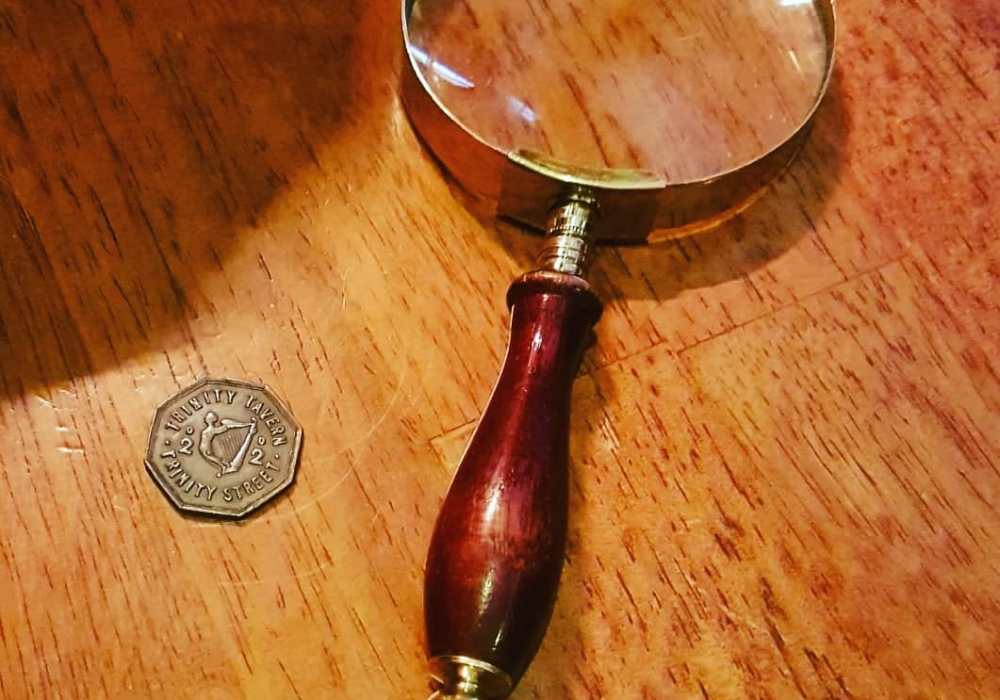
Our first port of call was the Bankers Bar on the corner of Trinity Street and Dame Lane, I’ve written about the history of the Bankers before, and in the 1860’s when it was minting it’s tokens it was known as the Trinity Tavern. Bankers coin2The one shown below was minted in Dublin by John C. Parkes of The Coombe and he was responsible for striking most of the pub gambling tokens.

After our start in the Bankers we made the short journey around the corner and up Grafton Street before turning onto Duke Street and stopping at the Bailey. As it was a warm bright day the famous bar’s outdoor seating area was packed with punters enjoying the fine weather. The Bailey Bar took its name from its former proprietor, Nicholas Bailey who ran the pub (with minor interruption) from 1852 until 1880.

While the Bankers and the Bailey are still with us today some of the pubs that were minting their own coins have disappeared with the passage of time. One of these number George Flood’s once stood at 28 Grafton Street, a site now occupied by the Victoria’s Secret store. No trace of Flood’s pub remains although the tokens that he minted, like the regular coins of the day, featured the head of the reigning British monarch on the reverse, in this case it was Victoria appearing on the back of some Secret currency.

Victoria reverseWhile Grafton Street isn’t too well known for pubs today the Duke Pub, back on Duke Street is named after the 2nd Duke of Grafton Charles Fitzroy. Originally opened in 1822 the Duke Pub was run by a James Holland when they first started issuing their own tokens in the 1860’s. Since that time the pub has expanded and has taken over premises that once housed the famous Dive Oyster Bar and part of the hotel building that was operated by Kitty Kiernan and her family. It was for a time known as Tobin’s pub but has since reverted back to the original name of the Duke Bar. After a chat and a drink with David, the bar manager we were due to head onto our final watering-hole, north of the river this time to Brannigan’s of Cathedral Street.
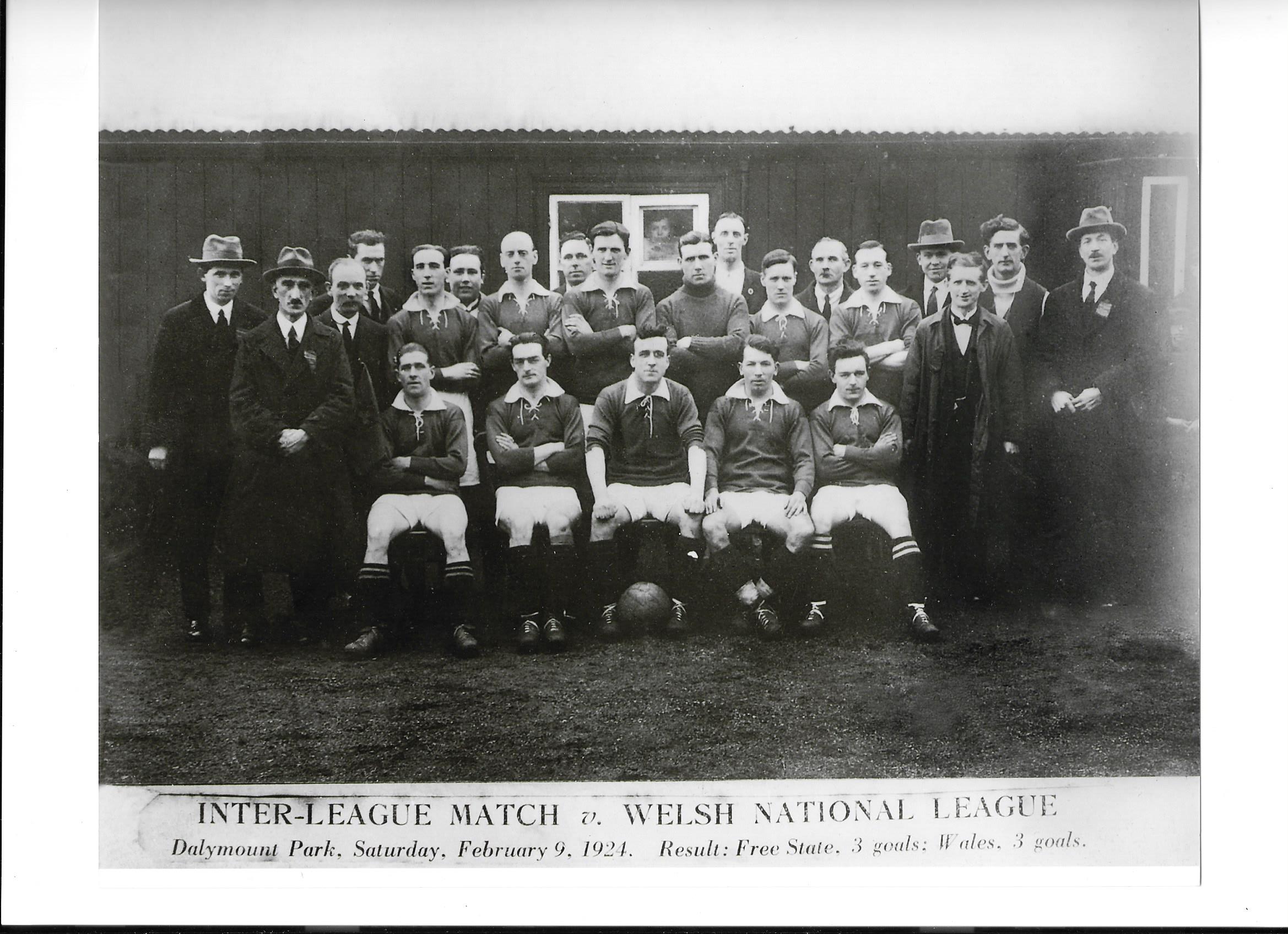
En route there was a slight detour at the Westin Hotel, as the site of a major branch of Provincial Bank of Ireland the banking and coinage themes run through the hotel and this is apparent in the names of function rooms like the Banking Hall, or the Mint Bar. They also display many historic coins and notes on the walls of the hotel so keep an eye out next time you drop by.

Elephant Lane
And finally onto Brannigan’s on Cathedral Street. The pub is named after the (in)famous Garda Jim “Lugs” Branigan but has previously been known as “The Goalpost” and “The Thomas Moore”. When it was minting tokens back in the 1860’s it was run by James Kenny and was known as the General Post Office Tavern. It also wasn’t called Cathedral Street but at time was known elusively as Elephant Lane. One theory as to the street’s unusual name was offered by our generous host, publican Padraig McCormack who suggested that the Elephant that was accidentally killed in a fire just off Essex Street in 1681 had been housed in buildings on off the street which gave rise to it’s name.

Padraig was presented with of a framed farthing tavern from the old “General Post Office tavern” days that will hopefully find a home on the wall’s of Brannigan’s along with the extensive array of memorabilia they display.

First featured on DublinTown.ie in July 2018

The Lost Clubs – Jacob’s F.C.

The industrial revolution as experienced in the heartlands of Lancashire; in its mill and mining towns had for the most part bypassed Ireland apart from the area around Belfast in the north west. In Belfast the linen industry had thrived, shipbuilding was king and whiskey distillers prospered. It is not much of a surprise that in these growing towns, full of young men, now with a small amount of disposable income and a half day on a Saturday should see the early growth of football in Ireland and Britain. As football professionalised it was Lancashire clubs like Preston North End and Blackburn Rovers who were early pacesetters in the 1880’s. In Ireland in the 1880’s it was clubs around industrial Belfast the led the way, including the likes of Linfield formed in 1886 by workers at the Ulster Spinning Company’s Linfield Mill.

In a city where regular employment could be in pretty perilous supply, a steady, decent paying job in Dublin in the early decades of the 20th Century was a very valuable commodity. The city did not have the same industrial base as its northern neighbour and the city regularly suffered from high rates of unemployment and an over-reliance on unsteady casual labour such as unreliable work around Dublin Port.

Dublin was an administrative centre and from the late 19th century onward had a growing number of white collar workers, many operating in the civil service and the legal profession. What large scale industry did exist was often derisively referred to as a “beer and biscuits” economy based around the St. James’s Gate brewery and the Jacob’s biscuit factory. Such were the connections between the two firms that many female relatives of Guinness employees were found employment in Jacob’s.

I’ve written elsewhere about the football team that the brewery produced but this piece focuses on the Biscuitmen of Jacob’s Football Club. The Jacob’s factory began life in 1851 in Waterford before setting up base at Peter’s Row off Bishop Street (now occupied by part of the DIT campus) in Dublin soon afterwards. It was initially run by brothers William and Robert Jacob who were later joined in 1864 by William Frederick Bewley of Bewley’s Cafe who invested into the firm. The Bewley’s and the Jacob’s were just a number of prominent Quaker families who had established successful business in the city around this time.

When at its zenith Jacob’s had thousands of Irish men and women working at its factory in Dublin, and many more in it’s UK factories and warehouses. A workforce of this size meant that the company enjoyed many outlets for its workers, including social clubs, swimming pools and of course, football.

Such outlets were important as the life of a factory worker was a tough one, Jim Larkin himself described the conditions for the biscuit makers as ‘sending them from this earth 20 years before their time’. Indeed the factory workers went on strike on several occasions such as in 1909 (led by Rosie Hackett) and again in 1913 in support of the Lock-out workers. The factory was occupied by the rebels during the 1916 Rising under the command of Thomas MacDonagh and John MacBride, both of whom were executed in the weeks afterwards. Jacob’s also lost many men to the front during the First World War with 388 workers from the factory enlisting between 1914 and 1918, of this number 26 were killed and many more were wounded.

However, despite the upheaval of this time period this was when Jacob’s started to reach greater prominence as a football team. During and immediately after the First World War Jacob’s F.C. were playing in the Leinster Senior League. In the 1916-17 season they were runners-up in the IFA Junior Cup and just four years later they were part of the first Free State League season following the split from the Belfast-based IFA.

The club played their fixtures on the company sports grounds at Rutland Avenue in Crumlin and one of their local rivals, Olympia, were also part of that inaugural Free State League season. Olympia were based nearby, in the area around the Coombe and in the season before the formation of the Free State league they had had something of a run-in with Jacob’s in a Leinster Senior Cup game played in April 1920.

It is worth remembering that this game took place in the midst of the Irish War of Independence and apparently during the game the Olympia team, who included active IRA volunteers, taunted the Jacob’s team for the presence in their ranks of the number of former British soldiers.

The Jacob’s players invaded the opposing team’s dressing room at the end of the game and just weeks later the Leinster Football Association issued bans to three players involved in the fracas. A six month ban was issued to Jacob’s defender Stephen Boyne while his brother Edward got a three month ban. Olympia forward Michael Chadwick was also banned for six months. When not banging in goals for Olympia Chadwick was also the Vice – commander of the 6th Battalion of the Dublin Brigade of the IRA. In later life he would also campaign politically for Seán MacBride, son of John MacBride who had been part of the unit that had occupied the Jacob’s factory in 1916.

The Jacob’s team from that era were often known as the Red necks which was not due to a rural origin, but more down to the fact that many of the men literally had red necks from carrying heavy bags of biscuit flour over their shoulders. During the early years of the League of Ireland several Jacob’s players reached positions of prominence through football. Striker Patrick Smith was the second highest scorer in the inaugural league season and just a few years later Jacob’s were to have three players appearing for the League of Ireland XI that took on the Welsh League in the first even inter-league game since the split with the IFA. Representing the League for Jacob’s was Frank Collins in goal, Stephen Boyne in defence and Hugh James Harvey among the forward line. The League drew that 1924 encounter 3-3.

League of Ireland 1924 001

The League of Ireland XI featuring three Jacob’s players

Stephen Boyne we already met above after he had stormed the Olympia dressing room. Frank Collins had returned to Jacob’s after a short sojourn in Scotland with Celtic, he won two caps for the Free State international team in two of their earliest internationals as well as being picked by the Northern selectors in 1922 and keeping goal for Northern Ireland on a single occasion.

As for Hugh James Harvey, he was better known as Jimmy Harvey and was born in Dublin in 1897. He had been a physical instructor in the British Army during World War I and had played for Shelbourne on his return to Dublin, featuring in the 1923 FAI Cup final where Shels had surprisingly lost to Belfast side Alton United, Harvey had the unlucky distiction of being the first player to ever miss a penalty in a FAI Cup final in that game. Harvey was useful in several positions across the forward line but found a new lease of life after his sporting career. During his time as a Jacob’s player records list him as a labourer. However, his father (also Hugh) was a “Variety artist” and the younger Hugh, decided to follow his father into show businesses. He excelled as a comedian as part of a comedy troupe known as the “Happy Gang” who performed in many theatres around Dublin and was also an accomplished singer, dancer and actor.

Jacob’s best league finish would be in the 1923-34 season when they came a respectable third but three consecutive last place finishes saw them fail to be re-elected to the league at the end of the 1931-32 season.

Despite dropping out of the league the Jacob’s team continued on as a football club at Leinster Senior League level, winning that league on four occasions from the early 1950’s to the late 1960’s. In the 1949-50 season the club also won the Intermediate Cup beating St. Patrick’s Athletic in the final just a year before Pat’s moved up a level and joined the League of Ireland. They also made regular trips to England to play matches in Aintree, against a team from the Liverpool Jacob’s factory.

The team continued in existence well into the 1960’s, though the factory’s move away from the city centre and out to Tallaght in the 1970’s probably meant a certain disconnection from their traditional area around the south inner city and Crumlin. There were occasional surprise results against sides in the FAI Cup but the glory days of the team were certainly in the early years of the League when the works teams of the city had such a huge presence in the early Free State League.

First published on the SSE Airtricity League website


It’s called the World Cup for a reason

The World Cup is only in its second day but already there has been plenty of comment from people identifying as journalists about the teams that aren’t even there. This is mainly because a tidy, if ineffectual Saudi Arabian team were well beaten by Russia which prompted several of the blue-ticked Twitterati to exclaim how unfair and unjust it was that the USA, the Netherlands, Italy or Chile were not at the World Cup but that Saudi Arabia were.

This was then broadened out by other users of the social media platform to mention teams like Morocco or Iran or Tunisia. Do you see a trend here?

First of all lets point out that this is in fact a WORLD CUP, not a Europe and South American cup with a couple of others we deem worthy thrown in Cup. The first World Cup in 1930 was an open invitation competition, most European nations didn’t even bother turning up. The English national team didn’t bother entering the tournament until 1950, when they qualified they were beaten by Spain and also 1-0 by the United States thanks to a goal scored by a Haitian student in a team captained by a Scottish journeyman. But then that’s the joy of the World Cup, the underdog beating the heavily-favoured, football aristocrat.

Egypt played in the 1934 World Cup, while the Dutch East Indies (now Indonesia) played in 1938 but representatives from Africa and Asia were rare. In 1966 every team in the African confederation boycotted qualifying for the World Cup because they were offered only half a place at the World Cup. Effectively one African side would have to play-off against the winners of the Asia/Oceania group for a place in England. This boycott meant that North Korea qualified and went on to famously beat Italy 1-0 and drew with Chile which saw them through to the Quarter-finals.

In that quarter final the North Koreans took a surprise 3-0 lead before being eventually overhauled by the personal brilliance of Eusébio who scored four of the Portugal’s five goals in a memorable comeback. Eusébio was of course born in Mozambique, (still a Portuguese colony in 1966), as were team captain Mário Coluna and central defender Vincente.

Things did gradually begin to change however, the FIFA President Stanley Rous ran for re-election in 1974 but was roundly defeated by João Havelange, mainly because Havelange has actively canvassed the support of the AFC and CAF with the promises of greater access to the World Cup tournament.

Whatever one says about Havelange and his debatable legacy, he did follow through on his promise and expanded the World Cup to 24 teams in 1982. With each nation having an equal vote Rous’s reluctance to campaign, coupled with his support for keeping apartheid South Africa as a member of FIFA (he famously said if “South Africa applies segregation in soccer, that is its own concern”) meant that his Eurocentric viewpoint was never going to see him elected to another term and practically guaranteed Havelange victory. Havelange was of course later succeeded by his protege Sepp Blatter, perhaps if Stanley Rous had taken the African and Asian confederations more seriously then FIFA wouldn’t have been defined by the hyper-commercial forces that Havelange and Blatter unleashed? It’s just a thought.

’82 saw steady progress for African sides, Cameroon were unlucky to be eliminated having not lost a game, while Algeria, despite impressive performances were also knocked out after the Disgrace of Gijón when Austria and West Germany conspired to play out a mutually beneficial 1-0 win for the Germans which saw both sides progress.

Subsequent tournaments saw further progress and African and Asian sides created several stand-out performances, in my own lifetime I can think of Cameroon in 1990, Nigeria in 1994, South Korea in 2002, Ghana in 2010 as campaigns from African and Asian sides with a special resonance. South Korea got as far as the semi-finals in 2002, which helps show that a regular high standard of competition can indeed help develop football performance of a nation and indeed a Continent.

Due to a number of factors, historic, colonial and industrial among them, European nations developed a football culture, and crucially professionalised and formalised the sport early, this gave them a certain advantage that subsequent generations of men like Rous fought to preserve.

If a World Cup is to be worthy of it’s name it should of course be about crowning the greatest national side on the planet but it should also be a way to celebrate and grow the game globally. That means competitive football for teams from all corners of the world. Representation is important, younger generations seeing their nation compete, even if and when they lose have something to aspire to. Ireland enjoyed a participation boom in football after Euro 88 and Italia 90 which helped embed the sport in areas which previously might have been a cold house for the Association game. It’s also worth noting that Ireland were dismissed and even derided as England’s “B” team by sections of the football media at both tournaments. No doubt if Twitter had existed users would have bemoaned our qualification for a World Cup ahead of the likes of France or Portugal?

And finally the true mark of a great team, one who deserves to lift the World Cup is that they win games, African and Asian teams who participate this year won their qualification matches, often going through arduous groups and play-offs to get to the World Cup. Saudi Arabia finished higher than Australia, who beat Honduras in a play-off to qualify. Honduras in turn finished higher than the USA in qualifying, though you won’t hear many US pundits mention that.

If people want to see Italy or the Netherlands at the World Cup that’s understandable, but those teams also need to, you know, win matches to get there.

My United States of first ever

Back in 2000 the then Enterprise Minister Mary Harney told a gathering of the American Bar Association that Ireland was “a lot closer to Boston than Berlin”. At the time that statement provoked plenty of debate and whatever your views its accuracy it held a certain truth in the very early days of the FAI. There was certainly a greater footballing closeness with the Americans than with our near neighbours in Britain. When the Football Association of Ireland formed out of the split from the Belfast-based IFA they entered a very inhospitable footballing climate. They were no longer part of the British Championship and their requests for fixtures with neighbouring Associations were rebuffed. Looking further afield international recognition came from FIFA in 1923 and the following summer the FAI sent an amateur international side to compete in the Paris Olympics in what was to be the nascent Association’s first foray into International football.

A victory over Bulgaria in the opening round, followed by a quarter final exit after extra time to the Dutch was a credible performance for a new and poorly funded side. But there was little on the horizon in terms of a home international. Here however enter the Americans; another side who had likewise been knocked out in the Olympic quarter finals would be heading Ireland’s way shortly after.

The USA had been knocked out by eventual winners Uruguay and had taken the opportunity to play a couple of friendly games before the long journey back across the Atlantic. After defeating Poland 3-2 in Warsaw on June 10th the Americans were swiftly on a boat to Cork and then by train to Dublin to play the Irish on June 14th 1924 in Dalymount Park.

It was a game of many firsts. It was a first home match for the FAI, indeed it was the first Irish international to be held in Dublin since 1913. It was one of the first football matches to feature the playing of Amhrán na bhFiann as the national anthem (an official decision had not been made on a post-Independence anthem and other songs such as Let Erin Remember had been used before), and it recorded the first hat-trick for the young Free State side as the Irish ran out 3-1 winners.

The side that had travelled to the Olympics had been all amateur but there were to be some changes ahead of the American game. St. James’s Gate’s Charlie Dowdall for one was unavailable. He had gone to visit relatives in England on his was back from Paris!

In goal Frank Collins joined the side. Collins has spent a season as a professional with Glasgow Celtic and had already been capped by the IFA but he was back working as a baker in Dublin in 1924 and playing for his employers Jacob’s in the League of Ireland. Another who was making a debut appearance was the hat-trick hero Ned Brooks of Bohemians, like Collins he had also been previously capped by the IFA.

The USA game was to be his only appearance for Ireland which means he has an enviable goals per game ratio. He started at centre-forward which meant that Paddy Duncan of St. James’s Gate was withdrawn into the midfield which seemed to have the desired affect against the Americans. The side in this first home international was captained by Brooks’ Bohemian team-mate Bertie Kerr.

Brooks ad

Ned Brooks featuring in an advertisement

Most of the USA players were active in the American Soccer League (ASL), an early professional soccer league based mainly around the states of New York, New Jersey and Pennsylvania. Many of the participating clubs would have found similarities with the likes of Jacobs and James’s Gate as they too were works teams. The side’s star player on the day was their goalkeeper, Jimmy Douglas who would have a relatively long international career with the USA, featuring for them in the semi-final of the inaugural World Cup in 1930 (see banner pic). A goal from James Rhody of Harrison F.C. and that fine performance for Douglas in goal was as good as it got for the USA on the day.

Pathé newsreel footage of the game can be seen here.

There was also an Irish connection with the USA party, their Association President Peter J. Peel was in Dalymount Park in 1924 and it was sure to have been a familiar sight. Peel had been born in Dublin and moved to Chicago as a young man. He was a sporting all-rounder, prominent in the fields of golf and tennis in his home city. Such was his devotion to football that he was convinced that it would outstrip baseball in the competition for American sporting affections within five years. Peel obviously had the Irish gift of the gab matched with an American sense of indefatigable optimism though with the continued growth of the MLS who is to say that the predictions of a Dubliner some 94 years ago may yet come to pass?


This article first appeared in the June 2018 match programme for the Republic of Ireland v USA international friendly match.

A Bohemian life – through the eyes of Mick Morgan

As a goalkeeper little is more important that being in the right place at the right time. No one wants to be all at sea, watching helplessly as a ball arches overhead and into the goal. The ball nestling accusingly in the back of the net, the criticisms of the crowd ringing in a ‘keeper’s ears, whether its his fault or not the keeper bears the brunt. However, when you’re in the right place at the right time, the slightest tip of a gloved finger sending the ball over the bar and away from danger the keeper becomes the hero, the last line of defence, the glory, fleetingly, is theirs.

At Bohemians we pride ourselves on being a bit different, the clue is in the name. In the reductive dictionary description a Bohemian (noun) is described as a “socially unconventional person”. Through this blog I’ve tried at times to demonstrate this unconventionality through the stories of some significant individuals from the past. And surely the most Bohemian, most unconventional of players is the goalkeeper? Jonathan Wilson in his wonderful examination of the goalkeeper’s lot named his book The Outsider, taking inspiration not only from the keeper’s role on the pitch but from the title of the Albert Camus’ novel. Camus grew up in North Africa, the son of a Spanish mother and a French father and was himself a useful goalkeeper.

Bohs have been lucky over the years to have been blessed with a great array of goalkeepers, recognised not only for their sporting talents but their big personalities. We have a truly impressive collection of great “Outsiders” dating back to the likes of Jack Hehir an Irish international whose Bohs career was interrupted after a mysterious summons for an “important appointment” to the War Office in 1915 through to the likes of Mick Smyth, Mick O’Brien (of crossbar destruction fame) Dermot O’Neill, Dave Henderson, one-season-wonder Ashley Bayes, Brian Murphy and on down to present day Shane Supple. And then of course there is Mick Morgan, a man, depending on how you look at it either in the right place at the right time or the wrong place at the wrong time.

For you see you can’t really tell the story of Mick Morgan, a Bohemian F.C. goalkeeper between 1930 and 1936 without also telling the story of Harry Cannon as Mick’s fortunes were so much intertwined with the peaks and troughs of perhaps Bohemians greatest ever goalkeeper, Captain Harry Cannon. That Morgan was a talented ‘keeper and spent six years at Bohemians yet managed to make only around 50 first team appearances due to the prominence of Cannon in the Bohemian goal tells its own story. However, it was due to Cannon’s success as an all-round sportsman and administrator that presented the opportunity for Morgan to make the bulk of those appearances, including a number of games against quality European opposition.

Cannon was an Irish Army officer who made his Bohemian debut in 1924 at the age of 27 and wouldn’t make his final appearance for Bohs until after his 40th birthday. During this time he was also capped twice by Ireland, against Italy in 1926 and in a 4-2 win against Belgium in 1928 when Cannon saved a penalty. At club level he would win four league titles and two FAI Cups for the Bohs.

Being the understudy to one of the most dominant and consistent goalkeepers in the league couldn’t have been an easy task, especially at what was then an amateur club. Several men filled this role in the more than a decade of Cannon’s dominance but one of the most talented and interesting is Mick “Boysie” Morgan who got the chance to make his mark for Bohemians due to the extra-Bohemian sporting activities of Captain Cannon.

The North Circular, the Lock-out and early sporting passions

Michael Morgan was born in November 1910 to Joseph and Mary Morgan at 35 Avondale Avenue just off the North Circular Road and only a short distance from Dalymount. Both of Michael’s parents were originally from County Meath. Joseph worked as a tram conductor and was one of those transport workers who suffered the deprivations of the 1913 Dublin Lock-out before passing away in December 1916 of tuberculosis at the age of just 33. Michael’s mother Mary was greatly affected by her husband’s early death and her son was sent to live with relatives in Dunboyne.

It was while living in Dunboyne that Michael first rose to sporting prominence, somewhat surprisingly as a Meath hurler. As a 14 year old he was part of the 1924 Dunboyne team that won the Meath Junior hurling title. Included among his hurling teammates was John Oxx Senior who would go on to find greater fame as a racehorse trainer.

Mick’s time as a hurler was short lived however, he had a passion for sports beyond Gaelic Games and fell foul of the infamous GAA Rule 27 which prohibited the playing or watching of “foreign games” like rugby, association football, cricket and hockey. By 1929 when Mick would have been 19 he was double jobbing as a hurler for Dunboyne while playing in goal for Leinster Senior League side Strandville F.C.

Strandville took their name from Strandville Avenue off Dublin’s North Strand and were a team of some prominence. For example Oscar Traynor who achieved fame and on-field success as a goalkeeper for Belfast Celtic had played for Strandville pre-1910. Traynor  became a prominent Republican during the War of Independence as a Brigadier in the Dublin Brigade of the IRA. He would later become a government Minister and was President of the FAI for almost thirty years until he passed away in 1977.

Morgan developed a sufficient profile for Strandville to be signed up by Bohemians, joining the club in March of 1930. According to his son, also Michae,l his signing for Bohs was somewhat fortuitous. As an ambitious young keeper, always eager to improve aspects of his game Mick Morgan used to go to the Connaught Street entrance mid-week to watch Bohemians train. He was there so often that one of the officials asked him what he was doing. Mick simply told them he wanted to watch and learn because he was a football player and that he already played in goal. On one of these mid-week visits Bohs were short a goalkeeper and the trainer asked Mick to fill in and he obviously impressed enough that he was asked if he wanted to join the club.

By this stage however, his GAA career was over. Displeased by the Associations attitude towards his playing soccer he focused his sole sporting attentions on the “garrison game”. Even years later Morgan refused to attend GAA matches and carried a certain resentment towards the organisation due to its attitude.

Morgan had joined Bohemians at a time of success, they were league Champions for the 1929-30 season and secure as first choice keeper was Captain Harry Cannon. Like his young understudy Cannon had also started out as a GAA man, being a talented Gaelic footballer and hurler, however, like Morgan that side of his sporting life came to an end when he joined Bohemians in 1924. Due to Cannon’s prominence Morgan was confined to appearances for the Bohemian “B” selection who competed in the Leinster Senior League and also appeared in competitions like the Metropolitan Cup. Bohs were victorious in that season’s Metropolitan Cup, beating Dolphin in the final 2-0 with Mick Morgan between the sticks.

Harry Cannon

Harry Cannon in action for Bohemian F.C.

Morgan was in good company in that side, featuring alongside the likes of Paddy Andrews (a future Irish international), Christy “Dicky” Giles (father of Irish football legend Johnny Giles), as well as veteran Ireland and Bohemians player Jack McCarthy. During the 1930-31 season the Bohs “B” side also finished runners-up in the Leinster Senior League division one with Mick Morgan as their regular keeper. This good form meant that in December 1930 he was given the chance to keep goal for the Bohs first XI in a league match against Dundalk. The reason this opportunity presented itself was the death of Harry Cannon’s father, Thomas, a carpenter, at the age of 64, a few days before the game. As a mark of respect to Cannon the flags were flown at half mast and the players wore black armbands.

Morgan performed well in this debut match as Bohs ran out 3-1 winners but it was to be his only appearance that season as Harry Cannon returned swiftly as the undisputed number one. Progress was also slow the following year despite Morgan continuing to impress for the Bohs “B” side who triumphed in the Leinster Senior League and in the Intermediate Cup during the 1931-32 season. However his first team appearances were limited to two games in the League of Ireland Shield, one of which ended in a heavy 5-0 defeat to Cork F.C.

How the Los Angeles Olympics sent Mick Morgan to France

There would however be something of a bonus for Mick Morgan towards the end of the year as he was chosen to be part of the travelling party that went to Paris for a series of friendly matches. By early 1932 Harry Cannon was well into his work in preparation for the Los Angeles Olympics taking place later that summer. Through his involvement with the Army Athletics Association and subsequently the Irish Amateur Boxing Association (IABA) he had demonstrated himself to be an able administrator. By the end of 1931 Cannon had found himself the Secretary of a Irish Olympic committee alongside Henry Brennan (Irish Amateur Swimming Association) as Treasurer and the infamous Eoin O’Duffy, Garda Commissioner, sports enthusiast, and future ally of Francisco Franco, as its President.

Cannon as secretary was heavily involved in the detailed preparation for the Los Angelus games and by June of 1932, as Tom Hunt has noted, Harry Cannon was “given an additional responsibility when he was appointed Chef de Mission of the Irish team. As such, he was effectively the team manager in Los Angeles and brought the experience of a still active competitive sportsman to the post for the only occasion in Irish Olympic history”. The Games were to go down in history as one of Ireland’s most successful with both Bob Tisdall (400 meter hurdles) and Dr. Pat O’Callaghan (Men’s hammer) winning gold on the same day, 1st August 1932.

These commitments prevented Cannon from travelling for the end of season tour to France in May of 1932 and gave Mick Morgan his opportunity to shine. Bohs took part in two scheduled games in France in what was an interesting time for football in that nation. The French league had up until that point been an amateur one but the upcoming 1932-33 season was to be professional with the 20 team league broken into two groups of ten with the winners of each group playing off in a final for the title. The ultimate winners would be Olympique Lillois who have since merged with another club to form Lille OSC that we know today.

In this context it is interesting that two of these newly professional clubs chose to play matches against Bohemians as preparation ahead of that first professional campaign. The two sides in question were Cercle Athlétique de Paris (CA Paris) and Club Français, both of whom used the Stade Buffalo in the suburb of Montrouge, Antony in Paris. The stadium got its somewhat unusual name due to the fact that an early incarnation of the ground had hosted the Wild West shows of Buffalo Bill Cody, and it would be here that Bohs would play both matches.

Both French sides had a certain pedigree, to even be accepted to the inaugural professional Ligue 1 season they had to demonstrate that they could sign at least eight professional players and had to have performed to a certain standard in the previous seasons.  CA Paris had been champions in the amateur era in the 1926-27 season while Club Français had been runners up in 1928-29 and also won the 1931 Coupe de France. Both clubs had players of international caliber as well . Lucien Laurent, the inside right for Club Français had appeared for France in the 1930 World Cup and had scored in their win over Mexico in that competition.  He had also gotten on the score-sheet when France played England a year later in Paris where the French emerged triumphant by a 5-2 scoreline. His club mate Robert Mercier scored twice in that game and would finish the inaugural professional season of Ligue 1 as its top scorer.

Lucien_Laurent

Lucien Laurent

Louis Finot of CA Paris also featured in that surprise, first-ever win over England in 1931. Such was the joy of the players in beating the English after six previous defeats that the French players asked to keep the English jerseys as souvenirs in one of the earliest examples of shirt-swapping in football history. Finot was also highly successful in other sporting fields as a champion sprinter.

The games against the two sides were scheduled back to back for a Sunday and Monday (15th & 16th May) to coincide with the public holiday around the feast day of Pentecost which gave the competition its name, the Tournois de Pentecôte . Mick Morgan, who had never been out of the country had to collect his passport on the 12th May, catch the ferry that same day and then travel by train and boat to Paris arriving with the team on the 14th, a day before the first game.

DZOb0EjW0AEPa4C

Michael Morgan’s passport, stamped on the day he arrived in France, 14 May 1932

While this may have been a maiden voyage beyond Irish shores for Mick it was not the first time a Bohs side had traveled abroad. In 1929 Bohemians had journeyed to Belgium to take part in the Aciéries d’Angleur tournament, which also featured Standard Liege and RFC Tilleur. Bohs won both games and the tournament as well as two other friendly matches during that tour and several of the side who took part would also be part of the travelling party to France such as Billy Dennis, Johnny McMahon and Jack McCarthy. In fact McCarthy had already been to Paris as part of the Irish football team that competed in the 1924 Olympics.

It was perhaps not surprising that Bohemians should be invited to tour, the late 20’s and early 30’s was a good period for Bohs results-wise and they may have had a certain prominence after their tour to Belgium in 1929 and other high profile games against English and Scottish sides.

DZOfNn2W0AEtHLx

Team photo from the trip to France with Mick Morgan in the centre

The opening game on Sunday 15th was against CA Paris and finished as a comfortable win for Bohemians. Irish internationals Fred Horlacher and Jimmy White scoring either side of a Parisian O.G. There was a clean sheet for Mick Morgan and the rest of the Bohemian XI that day.  The following day saw the game against Club Français which presented a tougher test.  They were led by player-coach Kaj Andrup, an interesting character, who as a player represented Danish side AB as well as Hamburg SV,  and as a coach would also enjoy spells with Amiens, FC Nancy and Strasbourg later in his career. He was still living in France when the Second World War broke out and despite being a Danish citizen quickly joined up with the French army, he was later captured by the Germans, imprisoned, escaped, and went on to continue his fight as part of the French Resistance.

From the match reports that survive it is not clear if Andrup played against Bohs but he would have been on the touchline to see his charges lose out 2-1. A Billy Dennis goal and a Johnny McMahon penalty making the difference on the day.  The team that day (likely the same XI as the earlier match) was Mick Morgan; King, Jack McCarthy; Paddy O’Kane, Johnny McMahon, Doherty; Plev Ellis, Billy Dennis, Ebbs, Fred Horlacher and Jimmy White. A crowd of 6,000 spectators watched the game which was played in poor conditions due to heavy downpours of rain. Despite the journalists bemoaning the impact of the weather on the quality of football the reports suggest it was still a fiercely contested game which was full of incident.

Two wins out of two and only a single goal conceded and victory in the Tournois de Pentecote proved to be a good return for Mick Morgan in his first trip outside the country. An even more impressive return when considered that both CA Paris and Club Français were professional clubs and founding members of the first professional season of Ligue 1. CA Paris would finish their group in 5th place in that debut season while Club Français would finish in the bottom three in their group and be relegated to the second tier despite the fact that centre-forward Robert Mercier finished as the league’s top scorer.

Bohemians must have made a favourable enough impression on the French footballing public as the following season, prominent amateur French side, Stade Français (not to be confused with Club Français) traveled to Dublin to take on Bohemians in another friendly match in which Mick Morgan also featured in goal as part of a 1-1 draw.

19330417 - Bohemian Stade Francais dinner at Metropole - large group

The Bohemian F.C. and Stade Français players and their partners in formal wear at a celebratory dinner in the Metropole Hotel after their 1-1 draw.

First team action and personal tragedy

That season (1932-33) was the most successful one in terms of appearances and personal achievements for Mick Morgan. Harry Cannon’s role in the organisation of Ireland’s participation in the Olympics meant that this dominated much of his time and gave an opportunity to his young understudy. The Los Angeles Olympics ran from July 30th to August 14th and also around the same time Captain Cannon was elected to the executive board of the Federation Internationale de Boxe Amateur (FIBA), the world governing body of amateur boxing.

While Cannon’s absence may have gifted Morgan his chance it was his ability that kept him in the team. Over the course of the season Morgan made 31 first team appearances, including starting in 14 out of 18 league games. Cannon, by contrast only made 10 appearances in total after his return from the Olympics. Such was the form of young Morgan that he was even selected to keep goal for the League of Ireland XI in a match against the Welsh League. The Irish Press lauded his selection after a series of “brilliant displays” in the league, they further commented that his “rise to fame is meteoric, as he got his place on the Bohemians team due to the absence of Capt. Cannon who was in Los Angeles when the season opened. Since then Morgan has maintained his place on sheer merit”.

Morgan played with “confidence and skill” and kept a clean sheet against the Welsh League as the League of Ireland notched up a 2-0 victory in Dalymount. Inter-league games were highly prestigious affairs at the time and shouldn’t be viewed as a mere friendly. At the time international matches were far less commonplace and the so-called “Home Nations” were still refusing to play an FAI selection after their split from the IFA. Inter-league matches offered Irish footballers and the sporting public the rare chance to compete against cross-channel opposition. Morgan’s form must have been impressive enough for him to be called up ahead of any other keepers in the league.

While there was inter-league action there was also inner-city action as Mick Morgan was chosen to represent Dublin’s Northside against the Southside in a fundraising match for the construction of Christ the King church in Cabra. Morgan was part of a side that contained other Bohemians players as well as representatives of Drumcondra and somewhat confusingly Bray Unknowns players against a selection from Shamrock Rovers, Shelbourne, Dolphin F.C. and St. James’s Gate. The southsiders would win that game one nil.

One game that did see a return to the side for Harry Cannon was a Shield game early in 1933. Much as the passing off Cannon’s father Thomas had given Morgan his first team opportunity so did the sudden passing of Mick’s mother Mary mean that Cannon was recalled to the Bohs side to face St. James’s Gate. Mary Morgan was only 51 when she passed away, she was described in the language at the time as a woman who “suffered from her nerves” and when her body was spotted floating in the Royal Canal on a cold January day it was presumed that she had taken her own life.

The coroner recorded a death by “asphixiation from immersion in the Royal Canal” on her death certificate. The family history tells that there was some salacious interest in her passing from journalists but such comment never made it to print partially due to the intervention of members of the Bohemian F.C. committee.

Harry’s return and Going Dutch

Despite Mick’s personal playing success and prominence over the course of the 1932-33 season Bohs finished a disappointing 9th out of 10 teams. With the veteran Harry Cannon back for the start of the following year Morgan’s contribution to the first team was greatly diminished. In all Mick Morgan would only make seven first team appearances, all in the Shield or in the Leinster Senior Cup while Cannon starred in the League as Bohs won their fourth title.

Bohemians ship to France

The Bohemian squad en route to the Netherlands

While not first choice for Bohs that season there was still the bonus of another end of season tour to the Continent and again Mick Morgan would be first choice. Perhaps this could be viewed as an early example of rotating keepers for European competition? In a later reminiscence in the Irish Independent Mick mentioned that Harry Cannon was “unable to travel” on the tour though the reason wasn’t mentioned.

The destination for this tour was the Netherlands, to compete in the Amsterdam International Tournament along with Go Ahead (now Go Ahead Eagles), Belgian side Cercle Bruges and Ajax. There are some tenuous connections between the sides; former Bohemians striker Dominic Foley ended up at Cercle Bruges in 2009 and helped them to a Belgian Cup final. With Ajax there was an early Bohs link, the first professional manager of Ajax in 1910 was Jack Kirwan an ex Irish international who had lined out for Everton and Tottenham Hotspur where he was part of the 1901 FA Cup winning side.

Kirwan took over an Ajax side in 1910 that were struggling in the 2nd tier of Dutch football but won the second division in his debut season which saw Ajax promoted to the top flight for the first time. It is even said that Kirwan was responsible for choosing the distinctive Ajax strip with its prominent central red stripe so as not to clash with the jersey of Sparta Rotterdam. With the outbreak of war on the horizon Kirwan returned to Dublin in 1914 and later became involved in coaching Bohemians before setting off again to coach Livorno in Italy in the 1920’s.

The trip to Holland wasn’t as successful as previous European outings to Belgium and France. The opening game against Go Ahead took place on 1st April 1934 and Bohs were made to look the fools, losing 6-2 against the side from Deventer. There was however a chance to improve the record the following day when Bohs faced Bruges. A comfortable 4-1 win in front of 13,000 fans in Amsterdam followed, with two goals from Billy Dennis and one each from Ray Rogers and Billy Jordan. In a somewhat unusual format, despite only having won one game each Ajax played Go Ahead in the tournament final with Ajax winning 2-0. Ajax never faced Bohemians in the tournament that they hosted.

Bohemians Netherlands

The Bohemians team on their tour to the Netherlands

There was one final match as part of Bohs tour, a friendly match in the Hague against a combined XI selected from the city’s clubs.  Bohs secured a 1-1 draw with Billy Dennis on the score-sheet for the third game in a row. This game was also a historic moment for Bohemians since it was the first game the club ever played under floodlights. In three games Bohs had a win, a loss and a draw and Mick Morgan had played 90 minutes in every game. That final match against the Hague XI had taken place on April 4th and most of the Bohs team would then have headed back to Dublin although Billy Jordan and Fred Horlacher remained behind on international duty.

The Netherlands had a World Cup qualifying fixture against Ireland in Amsterdam on the 8th of April and Jordan and Horlacher had been selected as part of the squad. Those with a more cynical view might suggest that the invitation to Bohemians was in fact a bit of a scouting exercise by the Dutch? Bohs were league champions and players like Paddy O’Kane, Paddy Andrews, Fred Horlacher and Billy Jordan were all present or future Irish internationals. Indeed Horlacher had featured for Ireland in 1932 against the Netherlands, a game which Ireland had won 2-0.

The Dutch FA certainly weren’t taking any chances this time around though, going so far as to ask the FAI for photos and fact-files on their main players under the premise of using this information for promotional material ahead of the game. The FAI duly obliged, with photos and details of Ireland’s star striker Paddy Moore appearing in Dutch newspapers ahead of the game. The Dutch had good reason to fear Moore, the Aberdeen player had scored four in the previous game, a 4-4 draw with Belgium and was seen as Ireland’s main attacking threat.

In the game against the Dutch Cork City’s Jim “Fox” Foley kept goal, he had just won the FAI Cup with Cork and was about to make a move to Celtic. Among the Bohs men in the squad Billy Jordan started the game but was injured in the first half and was replaced by his club-mate Horlacher just before half-time. This Bohemian for Bohemian swap meant that Horlacher made history by becoming the first substitute used by the FAI in an international match.

With the sides tied at 1-1 Paddy Moore scored a controversial goal just before the hour mark when he pushed the Dutch keeper Adri van Male over the goal line when he had the ball in his hands. This tactic of barging the keeper was not uncommon in Irish or British football at the time and was something that Mick Morgan and Harry Cannon would have encountered regularly but it was not something the amateur Dutch players had experienced before. The goal was awarded much to the dismay of the record crowd of almost 40,000 packed into the Olympic stadium in Amsterdam. Ireland were now 2-1 up with just over half an hour to play. A win would have sent them to their first ever World Cup.

Holland 1934

A record Dutch crowd at the 5-2 game in 1934. (source http://www.geheugenvannederland.nl )

But it wasn’t to be. The controversial goal spurred the a talented Dutch side into action, they scored four unanswered goals in 23 minutes to claim a 5-2 victory and qualify for the 1934 World Cup. Ireland would just go home.

For Mick Morgan the trip to Holland would prove to be something of a final hurrah for him at Bohemians. The following season (1934-35) Harry Cannon remained firmly Bohemians’ number 1. Morgan’s only first team appearance was in a 3-2 defeat to Drumcondra in the now-defunct Dublin City Cup. Even at the “B” team level his place was under threat from other keepers like Bill Nolan and Austin Norton.

Later life and career

The following season saw Mick keeping goal for the Bohemian “C” team. Slightly later in 1936 he was also tending goal for the Hospitals’ Trust side in the Leinster Senior League and during their successful run to victory in the Metropolitan Cup in May 1936. Around this time he left Bohemians for good as a player and it seems there may have been slightly more to it than just the lack of first team action.

Mick’s son Michael says that around that time things were a bit tight financially for the family, and to help out Mick was gifted some money. Michael says that this was the result of a collection by some concerned team-mates or perhaps another explanation may have been some money paid by Hospitals’ Trust by way of an appearance fee. Somehow the Bohemian board got wind of this and cancelled Mick’s membership, perhaps seeing this as a breach of the club’s strict adherence to it’s amateur ethos? Either way it was a deeply disappointing way for Mick to end his time as a player with Bohemians.

There was a very brief return to League of Ireland action at the beginning of the 1936-37 season when he signed for Shelbourne, however Mick’s time with Shels was brief to say the least, he played a single game in the Shield as Shels lost 4-1 to Dundalk.

Mick had always previously played as an amateur prior to his spell with Shels, his day job was with CIE. As a fifteen year-old he had apprenticed as a tinsmith with CIE for a period of five years before eventually he ended up as an engineer at the works at the Broadstone depot. He also grew to be a prominent individual within the trade union movement where he became treasurer of the Irish Sheet Metal Workers Union. According to his grandson, yet another Michael, he felt uncomfortable being paid as a semi-professional at Shels and decided such a role wasn’t for him and quickly left the club. In August of 1936 he had also gotten married to Mary Flynn from East Wall and soon afterward Mick and Mary became parents, these changes in life and the greater responsibility due to his position in the union would have also placed greater demands on Mick’s time, perhaps to the detriment of his sporting career?

It wasn’t to be his last involvement with the sport however, he continued to appear for the Hospitals’ Trust in the late 1930’s before lining out for Jacob’s F.C. in the Leinster Senior League. There was a family connection, Mick’s in-laws had previously worked in the Jacob’s factory off Bishop Street and their works team were competing at a good standard. He continued to line out in goal for the Biscuitment until the early 1940’s and on one occasion at least was even selected to represent a Leinster Senior League XI.

Leinster XI 1940

Mick Morgan keeping goal for a Leinster Senior League XI in 1940

In later years Mick Morgan also ran the line at League of Ireland matches and was even linesman during some prestige friendly matches, such as the occasion in 1952 when a Bohemians XI took on Glasgow Celtic in Dalymount Park. When asked by his son what was favourite memory from his time in football, he recalled not his trips to France or the Netherlands but rather the occasion when he saved a penalty taken by Shamrock Rovers defender and Irish international William “Sacky” Glen. That precious type of moment when the ‘keeper stands apart from others and can bask in rare glory.

In his personal life Mick and Mary moved to Drimnagh shortly after their wedding (perhaps another reason for representing Jacob’s?) but couldn’t settle in the newly built, south-side suburb, and then moved back to the northside settling in St. Eithne Road in Cabra, staying in close proximity to Mick’s beloved Dalymount. Whatever the nature of his departure, from the club he had remained good friends with several of his former Bohs team-mates, especially the likes of Billy Dennis and Plev Ellis with whom he had surely whiled away hours of boredom on those boat crossings to the Continent. Mick maintained a keen interest in football generally and Bohemians in particular, he regularly attended matches in Dalymount (standing on the Connaught Street side where he had watched Bohs train as an aspiring  goalkeeper) and introduced his grandson Michael to the club as a boy. The younger Michael followed in his grandfather’s footsteps lining out as a goalkeeper for the likes of Home Farm and Tolka Rovers, he also remains a Bohs supporter to this day and was the source for much of the information and excellent photos in this article.

Mick Morgan passed away suddenly in 1979 aged just 69. In a relatively short life he had seen and achieved a great deal. His life was buffeted by the ebbs and flows of wider social change, as a young child his family had been directly affected by the deprivations caused by the 1913 lock-out, had this perhaps informed Mick’s later career for the state-owned CIE and his own activism as a trade union official?

He had encountered first-hand the sporting exclusion of the GAA “ban” as a teenage hurler in the early years of the State, an experience which soured him towards Gaelic Games but perhaps ensured his focus remained on football. It was through football that he had opportunities to travel that were not afforded to many young men of his generation, to play in France and the Netherlands with and against players of international calibre in front of tens of thousands. Even under floodlights decades before the Dalymount pylons would help define the Dublin skyline. Though in all he made barely fifty first team appearances for Bohemians it is through this small sporting prism that we can view a life lived during decades of upheaval in a period that straddles the foundation of the State, exposing the issues of nationalism, worker’s rights and the day to day challenges that ordinary people faced when times were tough and life was too often cut short.

Mick’s story is one that opens a window into the life of an ordinary man in the Dublin of the 20’s and 30’s but one who had little bit more of a Bohemian, unconventional life.

With special thanks to Michael Kielty and his family for sharing their stories, photos and memories of Mick Morgan and as is often the case to Bohemian F.C. historian Stephen Burke.