Goodison and the New Republic
Taoiseach John A. Costello caught the Irish public somewhat unawares when he announced, while on an official visit to Canada in 1948, the planned repeal of the External Relations Act and the effective creation of a Republic. Some historians have suggested that the unexpected announcement was made by Costello in response to the behaviour of the Canada’s Governor General during the visit, but whatever the reason by the end of that year the Republic of Ireland act had been drafted before it was symbolically signed into law on the 33rd anniversary of the Easter Rising in 1949.
Ireland was no longer a member of the Commonwealth, and the British Monarch was no longer a symbol or figurehead. The British had to adopt their own legislation subsequently, while King George VI sent cordial greetings on the signing of the Bill to Costello. There seemed to be a diplomatic thaw on the football fields as well. The British Associations had recently rejoined FIFA and would compete in World Cup qualifying for the first time.
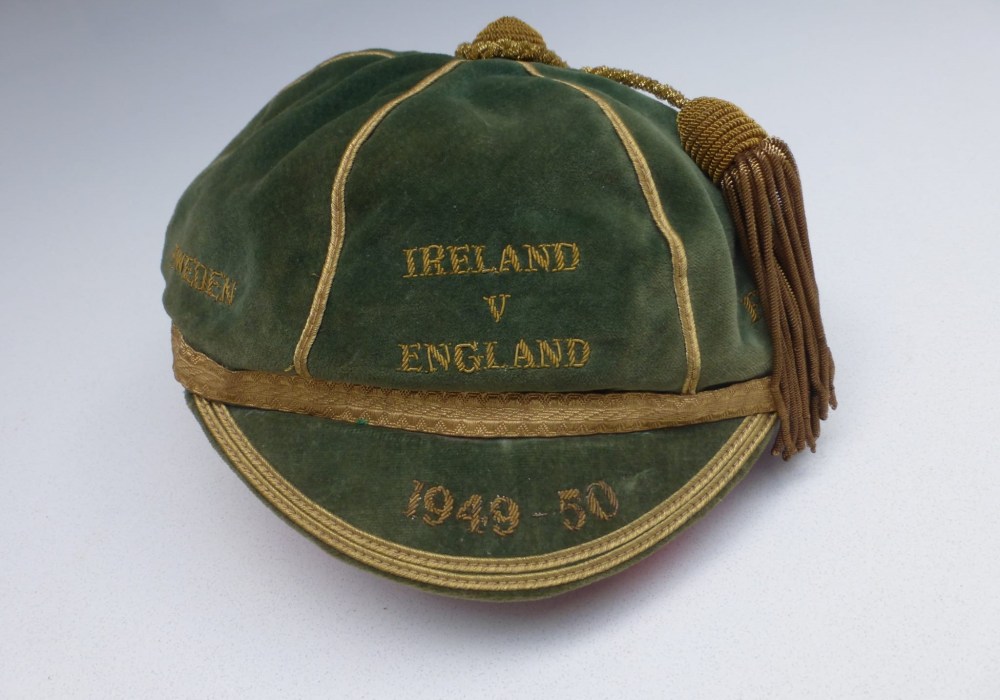
As part of the preparation for these games a friendly match was proposed by the FA between England and Ireland, to be held in Goodison Park in September 1949. FAI secretary Joe Wickam gladly accepted. Ireland had only played England once since the split from the IFA, a narrow 1-0 defeat in Dalymount Park in 1946, surely it was too much to expect to do any better on English soil?
England picked a strong side, Jessie Pye, who had starred as Wolves won the FA Cup a few months earlier made his debut at centre-forward, but otherwise it was a team of well-known stars like Bert Williams, Neil Franklin, Wilf Mannion and Billy Wright. All the players were from the top-flight of English football bar their star winger Tom Finney who was in the second division with his hometown side Preston North End.
Ireland were able to secure the release of most of their best players, seven of whom were playing in the English top-flight, while two were in the second division and another two, Tommy Godwin and Tommy O’Connor were playing with Shamrock Rovers. There was some discussion about the selection of O’Connor ahead of players like Tommy Eglington or Jackie O’Driscoll, with one suggestion that Rovers’ rep on the FAI selection committee, Captain Tom Scully had advocated for the selection of O’Connor to “put him in the shop window” so to speak. Regardless of the reason O’Connor would have an important role in the game.
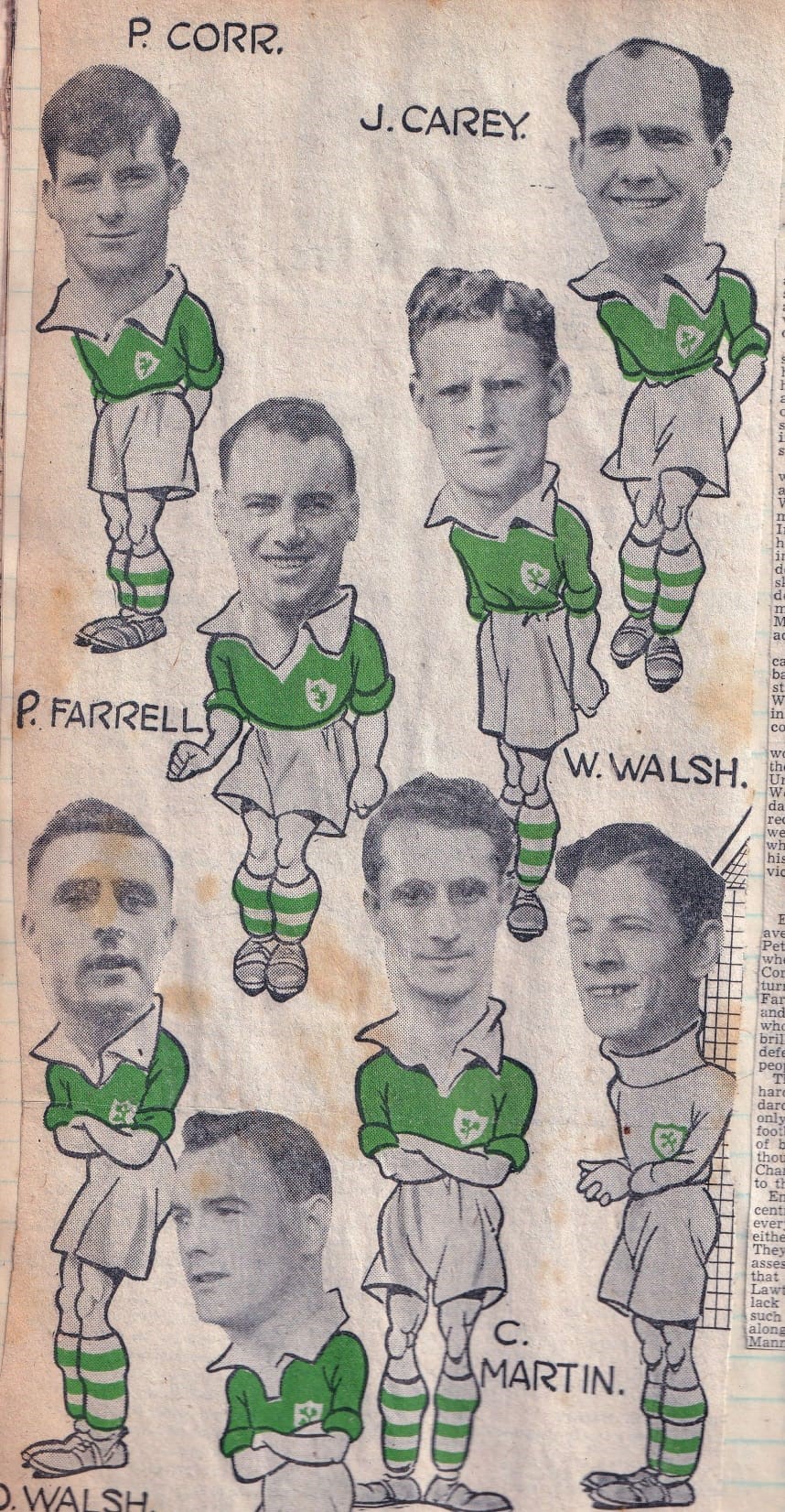
The Irish side trained at Everton’s training ground (well the seven who had arrived in time) while Peter Farrell and Peter Corr, both Evertonians were excused as they had trained there that morning for their club. However, team captain Johnny Carey had worked with both Farrell and Corr, who would occupy the right of the Irish midfield beforehand, working out a tactic to close down the English left back and left half, to isolate star winger Tom Finney and force him to survive off scraps and high balls. A tactic that worked brilliantly on the day with Carey being given no problems by Finney.
Many in the media thought an English victory was a foregone conclusion, with one paper referring to the game as a “social occasion” for Ireland, while odds of 10/1 were being given on an Irish victory. There were few takers but Peter Farrell did patriotically take bets from his Everton teammates on an Irish win.
Ireland started positively and dealt well with the numerous English attacks, with Carey, Ahearne and Willie Walsh doing especially well, Tommy Godwin in goals was in inspired form. Godwin
turned out to be the one in the shop window, signed by Leicester shortly after his starring performance. Things got better when Peter Desmond of Middlesboro ran into the England box to latch onto an O’Connor ball and was felled by Bert Mozley giving away a penalty that Con Martin blasted with such power that although Williams in the England goal got a hand to it he could do nothing to keep it out.
Ireland led 1-0 at half-time and managed to endure wave after wave of English attacks, winger Peter Harris hit the bar, Pye in his only England cap came close, but none could beat Godwin. And then with five minutes to go Peter Farrell, playing further forward than usual latched onto an O’Connor pass and calmly lobbed Williams from outside the box to make it 2-0 and secure the victory. Farrell later remarked that he “closed his eyes and banged it” but the shot showed fine technique! He’d won Ireland the game as well as the princely sum of £6 in bets from his Everton teammates.
Most importantly Ireland had made history, they became the first side apart from the Home Nations to beat an English international side on home soil. Before the Mighty Magyars, before Puskás and Hidegkuti, there were the Irish and Martin and Farrell.
This article appeared in the Ireland v England match programme.
 A Bohemian Sporting Life