
Jesus back in a tracksuit – from Carey to Pauw
By Fergus Dowd
‘The pride and self-respect of our country as well as our players will be on show for millions in the pre-match ceremonies at Wembley Stadium on Saturday and it is important that we present ourselves in the best way possible, in terms of both dress and conduct, on every occasion during our stay in England.’
It was April 1957 as Jack Carey uttered those words to the FAI committee ahead of two World Cup preliminary games, home and away, against England the following month. The first Irishman to lift the FA Cup as captain of Manchester United, felt it was a simple request but he considered it essential that the powers that be purchase a set of tracksuits for those who would wear the green of Éire in London.
Today, sports manufacturers fall over themselves to provide football teams with clothing from polo shirts to the neck-warming ‘snood’, but it always wasn’t so. In the case of the FAI tracksuits were recycled on so many occasions they became undeniably shabby only six years before Carey’s words officials were forced to purchase a set in the course of a shopping expedition in downtown Helsinki ahead of a World Cup game in Finland. Unfortunately for the cash-strapped FAI these items of unexpected expenditure were impounded by customs and excise on the team’s return to Dublin, it took government intervention to release the tracksuits without charge. The cost for a set of tracksuits for the English adventure amounted to less than £50 but the word ‘tracksuit’ had left a bitter taste.
In 1946 Carey captained Éire against England at Dalymount Park after an interval of thirty-four years the English FA had agreed to send a team to Dublin. It included Wilf Mannion, Raich Carter, Tommy Lawton and Frank Swift in goals, names that rolled off the tongue easily, Stanley Matthews had also been selected but had to bow out through injury and was replaced by a young Tom Finney. Alongside Carey the Irish lineup included Cornelius (Con) Martin, Tommy Eglington, Alexander Stevenson, Billy Gorman and Bud Aherne.
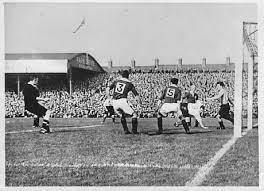
Carey, Gorman and Aherne had lined up for the Irish FA in Belfast only two days previously against the same opposition with Mannion finding the net three times with the ‘Special Victory Ball’ supplied by The Athletic Stores of Wellington Place, Belfast as England ran out 7-2 winners. Wilf Mannion became the first debutant for England to score a hat-trick since George Mills in October 1937, only the eleventh player ever to achieve this feat.
Ahead of this meeting in Belfast the English FA had written to the Irish FA requesting an assurance that only players born in the North of Ireland would play, it was an era when men from the four corners of Ireland represented both entities on the football pitch. At the Liverpool Conference of 1923 the IFA was given international status and the Éire Association (FAI) dominion status. Under this agreement the IFA had the right to select any Irish-born player attached to an English or Scottish club and the Eire Association was only permitted to call upon Éire-born players.

In the press box in Dalymount Park the Fleet Street scribes who had taken the boat to Dublin reported:
“In Dublin, the first-ever meeting between the two nations was played in persistent drizzle and the difficult pitch made life awkward for the players. Throughout the match, the Republic put up a terrific fight and made the England team fight all the way to gain their eventual undeserved win. Indeed, had it not been for the fact that Frank Swift was in inspired form, then the visitors could have been well beaten. With only nine minutes remaining England stole victory with a fine goal. Langton gave Mannion a through pass down the left. The ‘Boro man cut in and unleashed an angled shot which Breen could only parry. The ball ran loose and Finney dashed in to slot it home. England had won by the skin of their teeth.”
Before William E. Webb of Glasgow had blown the whistle to get formalities underway, Dr W.F. Hooper, president of the FAI, handed to the chairman of the FA, Mr W. Brooke-Hurst, a silver cup – a replica of the Ardagh Chalice – to commemorate the first meeting with England in the Silver Jubilee year of the Éire Association.
However, three years later Éire would have their revenge in Goodison Park, Liverpool. Carey’s team, against all the odds, recorded a gratifying two-nil victory, becoming the first foreign team to beat England on their home patch. Nine of the Irish players were with Football League clubs and two from Shamrock Rovers but all of them were born in Ireland.
On the 8th of May 1957 Jackie Carey watched his team warm up at Wembley in tracksuits, Tommy Taylor one of those who would perish in the Munich air disaster would steal the show with a hat trick, and Duncan Edwards another who would die from his injuries from the disaster also lined out for England. Both sides had defeated Denmark and only seventeen days later in the return fixture, forty-seven thousand six hundred patrons watched Ireland warm up in tracksuits. Alf Ringstead son of a jockey from the Curragh would net after three minutes following a move between Billy Whelan and Arthur Fitzsimons led to Joe Haverty crossing for Ringstead, the Dalymount roar was heard as far as the Howth pier, “little Éire” looked destined for their first World Cup in Sweden. However, with the last attack of the game came the last dramatic moment, the Preston plumber Finney set off on a mazy dribble down the right and from the byline produced a perfect centre for John Atyeo to head home.
For some, it was artistry for others heartbreak, the legendary Irish football radio commentator Philip Green summed it up by stating: ‘The pained silence here at Dalymount Park can be heard all the way back to Nelson Pillar’. There would be no Éire tracksuits at the World Cup.
Sixty years after Carey demanded tracksuits for his players fourteen Irish international female footballers hosted an extraordinary press conference in Dublin’s Liberty Hall, it was described as “a last resort” in their treatment by the Football Association of Ireland. The core issues revolved around financial payments and representation of the players, with the FAI withdrawing the previous €30 per diem payment during international camps and failing to cover the earnings lost by members of the squad who were then part-time. Players had requested their Union (PFAI) represent them in negotiations with the FAI but the association outlined they would only negotiate with the payers directly through the help of an independent mediator, leading to the PFAI describing the treatment of the Irish women’s international team as ‘a fifth class citizen’ never mind second.
One of the most astonishing revelations which came from captain Emma Byrne was that “players were forced to change in and out of team kit in airport toilets before and after away trips as the tracksuits are also worn by underage teams” – the tracksuit was back on the agenda.
The conference hit home and by April 2021 equality was the name of the game as it was announced by the FAI players representing the Republic of Ireland’s senior men’s and women’s football teams were to receive equal match fees with immediate effect. “The historic three-way agreement between the men’s and women’s squads and the FAI was brokered by FAI CEO Jonathan Hill and Ciaran Medlar, advisor to the male and female international players, alongside captains Katie McCabe and Seamus Coleman,” outlined the FAI statement. The deal would see male players reducing their fees, with the FAI matching their contribution to ensure that the pay received by the senior women’s team would be aligned with that of their male counterparts.
Only two years earlier 56-year-old Vera Pauw had arrived to take over as manager of the Irish women’s football team, capped eighty-nine times for her native Holland, Pauw had pedigree taking the Netherlands all the way to the 2009 European Championships semi-finals and South Africa to the Olympics in 2016. Her love affair with the beautiful game began like so many playing football on the streets with her brothers in Amsterdam, by the age of thirteen she was playing for the ladies’ youth team of v.v. Brederodes in Utrecht.
The Netherlands had seen women first trying to play football professionally in the 1890s, Sparta Rotterdam even tried to form their own women’s football team in 1896, but the Royal Netherlands Football Association (KNVB) banned them from doing so. The Dutch Ladies Football Association was formed in the 1950s and a women’s football league was established in 1955, which was subsequently banned by the KNVB.
Women’s football was played regionally until the 1970s when UEFA declared that all members would have to invest in women’s football. So, in 1973, the KNVB established the Hoofdklasse. The Hoofdklasse was a playoff competition between six regional champions, with the winner of the group crowned champions of the Netherlands.
The popularity of women’s football rose during the 1990s and, in an effort to stop the best Dutch players from leaving to go to countries with professional leagues, the KNVB established the Eredivisie Vrouwen in 2007. The Eredivisie formally opened on August 29, 2007, with six clubs participating in its first season: ADO Den Haag, AZ, SC Heerenveen, FC Twente, FC Utrecht and Willem II. Only four months after the FAI’s equality pay deal Ellen Fokkema made Dutch football history when she became the first woman to play for a senior men’s team in a league match.
Pauw worked her magic on the Irish women’s team leading them to a World Cup playoff meeting with Scotland at Hampden Park, pre-match Katie McCabe the Ireland captain led her side out in green tracksuits for a stroll around the famous old stadium where Baxter, Law and McGrain had sent fans home with treasured memories. It was the 11th of October 2022 and two thousand and sixteen days since the press conference in Liberty Hall and the Irish women’s football team was on the threshold of history.
In the 71st minute Denise O’Sullivan from Knocknaheeny in Cork who started her career playing with the boys of Nufarm Athletic up until the age of eleven, controlled the ball with her right foot with space in midfield she got her head up to see her colleague Amber Barrett making a run through the centre, with a precision right footed pass O’Sullivan found Barrett. As a nation held its breath Barrett took the ball with her left foot leaving the whole of Scotland in her wake and with her right foot she cooly slotted the ball passed the Scottish goalkeeper.
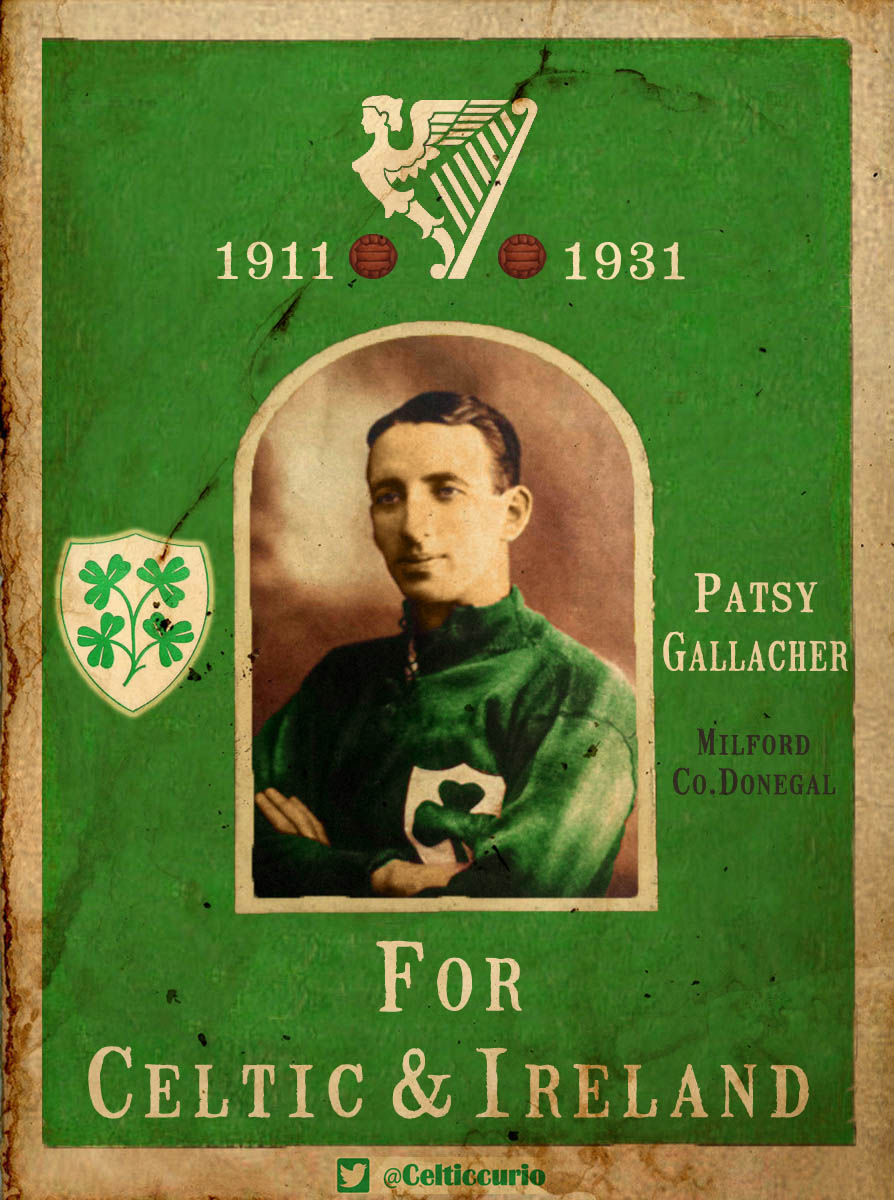
Amber Barrett celebrated on the same hallowed turf of Hampden Park where the ‘Mighty Atom’ Patsy Gallagher of Milford, Donegal fooled the best of defenders with his dribbling and feints winning four Scottish Cups and six league titles with Glasgow Celtic. Barrett hails from Milford, in 1891 the Poorhouse, which once stood on the outskirts of the town and saw its share of misery in the dark years of the Great Hunger, was where Patrick Gallagher was born his parents would soon leave the hills of Donegal for the shipyards of the Clyde.
In the darkness of the Glasgow night with the Hampden floodlights shining down on her, Amber Barrett kissed the black armband in memory of the ten victims of Creeslough, it was for them, it was for the community of Creeslough and the people of Donegal.
The Ireland women’s team would be part taking in their first World Cup, in her green Irish tracksuit pitchside Vera Pauw spoke to the press celebrating this historic moment with tears and mascara running down her face… Jack Carey would have been proud.


 A Bohemian Sporting Life