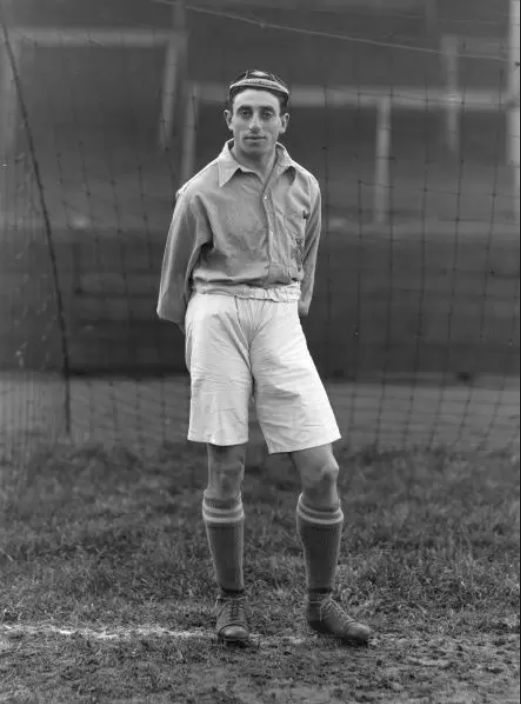
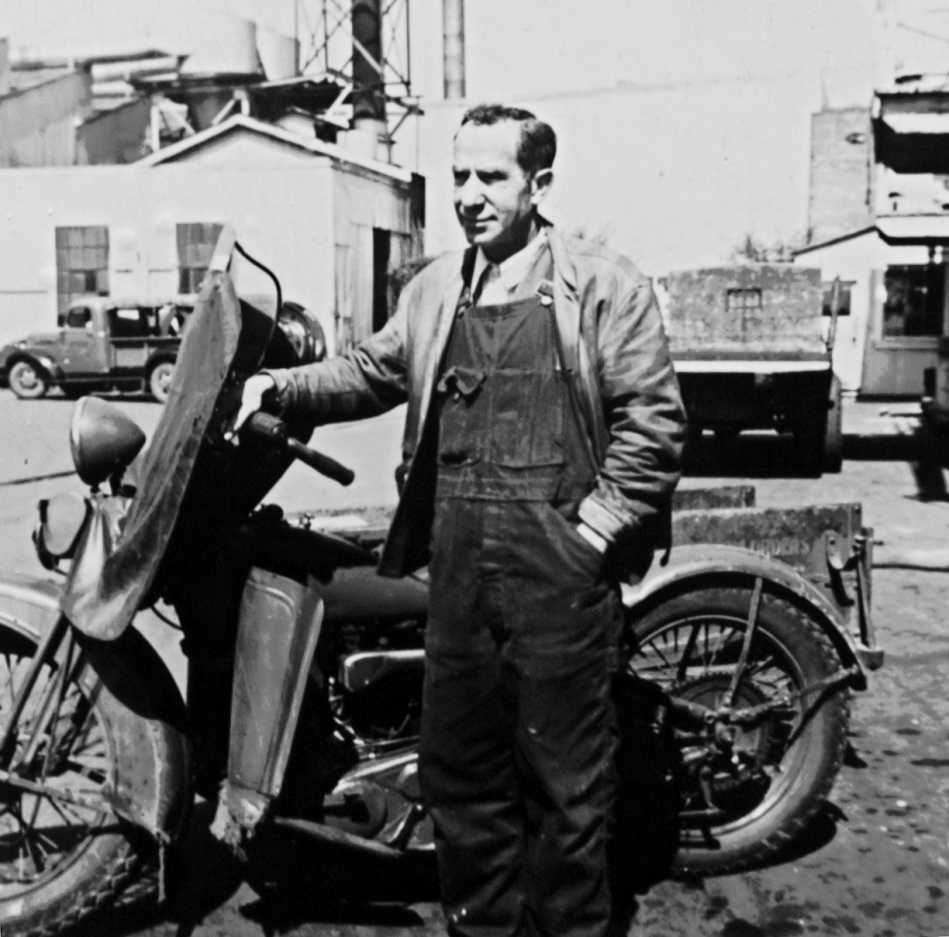
The Story of Stan Kobierski – From Dalymount Roar to Siberian Railtracks

by Fergus Dowd

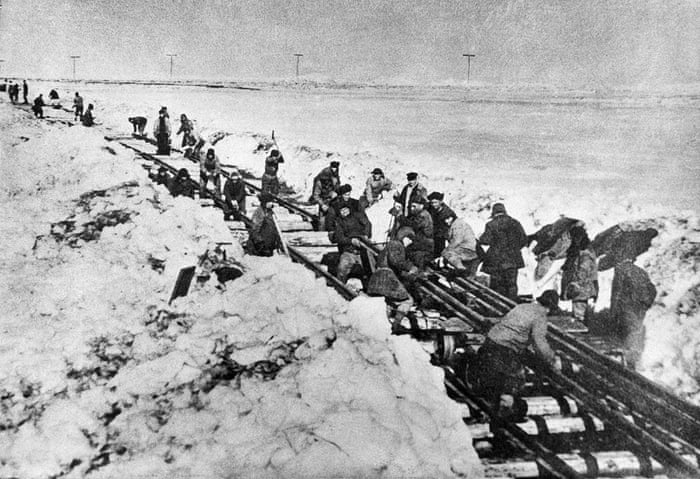
As the snow drifted up to his waist in the Siberian wilderness and the wind stung his face, the Gulag prisoner Stanislaus Kobierski dug, lay, and scraped. He would receive 200 grams of bread and a cup of water for his efforts while all around him bodies dropped dead; 300,000 would perish as temperatures plummeted to minus fifty.

The project was the Trans-Polar mainline, Joseph Stalin’s attempt to conquer the Arctic Circle.
An audacious scheme to link the eastern and western parts of Siberia by one thousand miles of railway track from the city of Inta via Salekhard to Igarka lying on the Yenisei River. The track that Kobierski lay had the acronym ZIS written into it – it stood for ‘Zavod Imeni Stalina’ factory – named after the Russian leader. Kobierski was part of the 501st labour camp which began work eastward towards Salekhard in 1947 under the supervision of Col. Vasily Barabanov, who would be decorated with the order of Lenin in 1952. All around the camp were watchtowers; any thoughts of escape would be met with the firing squad.
More than a decade earlier, Stanislaus Kobierski had landed in Balmoral Aerodrome on the outskirts of Dublin from Scotland; in his bag were his football boots. It was October 16th, 1936, and two days before Kobierski and his German teammates had given the Nazi salute to sixty thousand Scots at Ibrox stadium. The crowd cheered on seeing this unusual sight as ‘Deutschland Uber Alles’ was struck up as the Swastika flag fluttered in the wind alongside the Union Jack.

At half time a protest took place against the new wave German regime, two of the instigators were arrested and removed from the ground. The Scots ran out two-nil victors with Celtic’s Jimmy Delaney netting twice; Delaney would run out for Cork Athletic in the 1956 FAI Cup Final. Then aged 41, Delaney of Irish descent, who was reared in the Lanarkshire mining village of Cleland, would be denied the opportunity to obtain a unique collection of cup winners medals across the British Isles after winning the IFA Cup with Derry City in 1954, the Scottish Cup with Celtic in 1937 and the FA Cup with Manchester United in 1948.

As Kobierski and his colleagues disembarked from the plane which carried Nazi flags on the tailfin, President Eamon DeValera and Dublin’s Lord Mayor Alfie Byrne stepped forward to welcome the travelling party. The team stayed in the Gresham Hotel on O’Connell Street and were brought into town in a bus adorned with the ancient religious icon from the cultures of Eurasia. Like Ibrox before the playing of anthems, the Germans gave their infamous salute to the main stand at Dalymount Park as locals watched on.

In the 26th minute Kobierski, at the home of Irish football, scored, equalising for the Germans after Dundalk’s Joey Donnelly had netted a minute earlier for the Irish. That same year Kobierski had won the Gauliga Niederrhein with Fortuna Dusseldorf. They would become the most successful German side, winning five championships throughout the reign of the Third Reich. The league was one of sixteen top-flight divisions introduced by the Nazi sports office in 1933, replacing the Bezirksligas and Oberligas as the highest level of play in German football competitions.

Fortuna would reach the national league finals losing out to F.C. Nurnberg two-one after extra time; Kobierski’s colleague on that day in Dalymount, Andreas Munkert would lift the title in Berlin. However, there would be no glory in Dublin for Munkert as he and his defensive partners were run ragged by Paddy Moore and Donnelly, as a marauding Irish team ran out 5-2 winners. One of Schalke’s greatest ever players, Fritz Szepan, scored the German’s second goal. He won six championships and a cup final medal for Die Knappen and was voted on the greatest Schalke team of the century when the club celebrated its 100th anniversary in 2004.

Szepan played for Germany in the second World Cup in 1934, hosted in Italy; Kobierski would score Germany’s first-ever championship goal against Belgium as the Germans would finish a respectable third in the competition.
Both would feature in the ‘Unified German’ side, which would also include some of the great Austrian players from the iconic Wunderteam after the Anschluss.

The Austrians played their last match as an independent nation on the 3rd of April 1938 at the Prater Stadium in Vienna against Germany; dubbed ‘the homecoming match’, the Austrian side ran out two-nil winners.
Their star forward, Matthias Sindelar, known as ‘The Mozart of Football’, scored one of the goals that day. Karl Sesta got the second an audacious lob, which led to Sindelar dancing in front of the VIP box in celebration, which housed Nazi leaders and their Austrian satraps.

Sindelar was found dead in his flat within a year, alongside his girlfriend Camilla Castagnola, both asphyxiated by a gas leak. In Austria, they still wonder about the mysterious circumstances of the deaths – suicide, an accident, or murder? On that autumnal day at Dalymount, the joyous Irish public invaded the pitch at the end, even cheering the Germans off the pitch, some raising their arms in the salute they had witnessed earlier.

In 1941 after over a decade with his hometown club, Kobierski, whose parents hailed from Poznan, was ordered to line out for the SS & German police club in Warsaw for exhibition games. On the 1st of September 1939, Germany had invaded Poland from the West, while seventeen days later, the Soviets invaded from the East; by October, Poland was defeated. Unlike their German counterparts, the Soviets allowed league football to be played primarily in the city of Lwow, the birthplace of football in Poland.

One of the teams in East Poland was Junak Drohobycz, a side who were actively involved in the Polish resistance movement; the players all in their twenties were also soldiers helping people escape to Hungary across the Carpathians. The team were known as ‘The White Couriers’ and ended up playing matches in Hungary and Yugoslavia during the war. One of the ‘Couriers’ was goalkeeper Stanislaw Gerula, who played for Leyton Orient of London in 1948. Gerula would spend two years at Brisbane Road before turning out for non-league Walthamstow Avenue playing in nets against Arsenal at Highbury in the London FA Challenge in 1952. That same year, Gerula helped Walthamstow win the FA Amateur Cup at Wembley; he was 38 years young. Twelve months later, Gerula rolled back the years against a Manchester United team who had won the championship in 1952 captained by Jackie Carey; in the fourth round of the FA Cup, the amateur side would draw 1-1 at Old Trafford as the ‘Courier’ performed heroics in goals.

In mid-1942, Kobierski and his team faced Huragan Wolomin in Legionowo; the Christmas of 1941 had seen the start of the underground Warsaw District of Association Football league. The Germans banned the league, and most games were played in the suburbs, such as Wolomin, Góra Kalwaria, Brwinow, and Piaseczno, as it was too dangerous to play games in the city. Alfred Nowakowski founded the league an ex-Legia Warsaw player; he would be awarded the Golden Cross of Merit in 1946, a Polish civil state decoration.

On the 1st of August 1944, the Polish Home Army initiated the Warsaw uprising, a non-Communist underground resistance movement to liberate the city from Germany. Forty-five thousand members fought alongside another 2,500 soldiers from the National Armed Forces and the Communist People’s Army against the military might of the Germans. Only a quarter of the partizans had access to weapons. Alongside this came the ‘Red Army’ appearing along the east bank of the Vistula River, Kobierski would eventually be captured and sent to Siberia.

The uprising would last for sixty-three days and be suppressed by the Germans in Oct 1944; with civilians deported to concentration and labour camps, the intensive fighting would reduce Warsaw to ruins. Stanislaus Kobierski would remain in Siberia until 1949 and, on his release, return to live out his days in West Germany, passing away in 1972.
Before he took his final breath, Kobierski witnessed his beloved Fortuna finishing third in the Bundesliga and qualifying for European competition for the first time in the club’s history. Football was all he knew, but it took him from hell and back.

The story of Blyth Spartans – corner flags, mines and murals

By Fergus Dowd

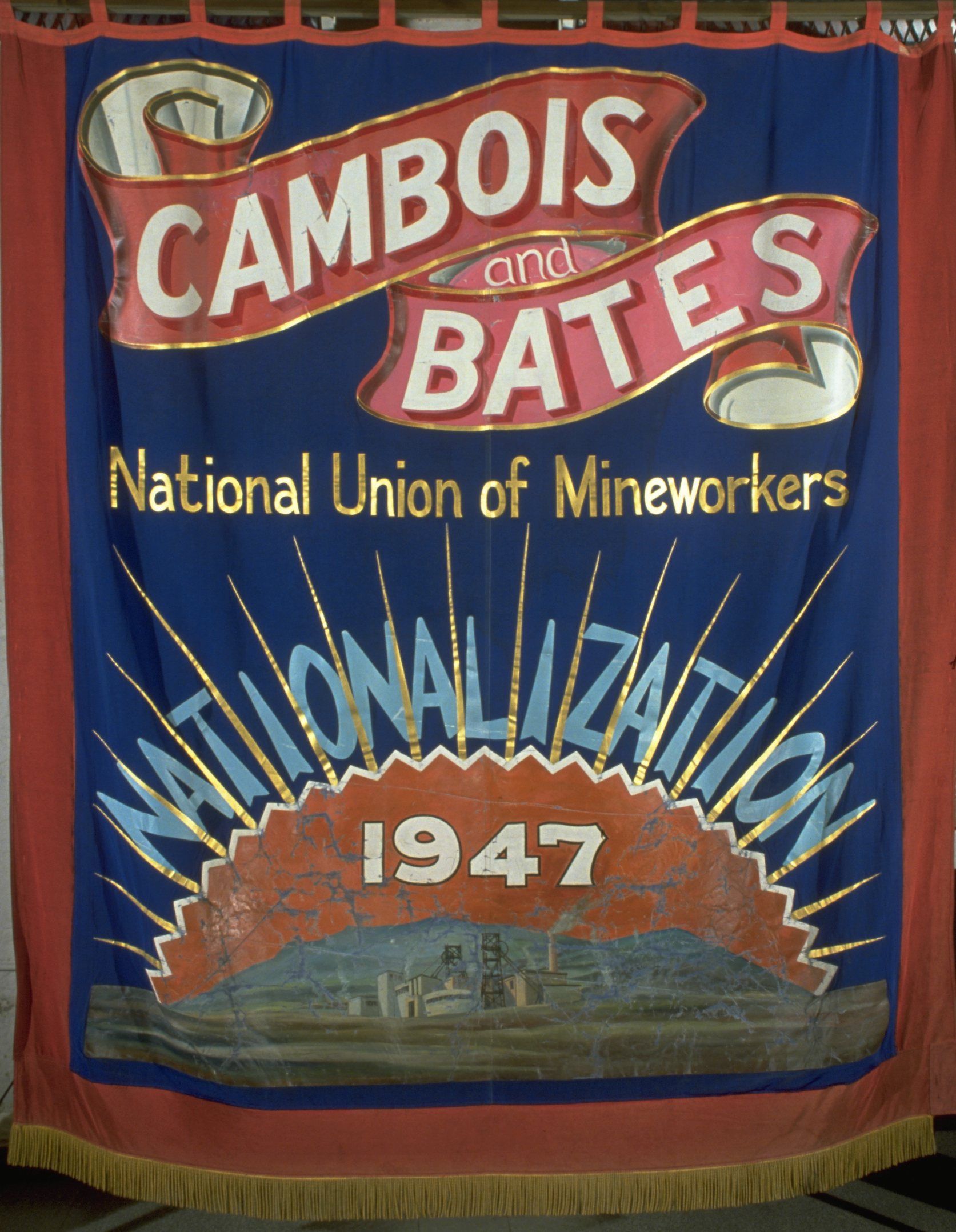
On the 7th of March 1986, John Ryman, MP for Blyth Valley, rose to his feet in the House of Commons ‘I wish to raise the decision of the National Coal Board to close Bates colliery in Blyth’ he stated. The 200-foot-high head gear had been part of the Northumberland landscape since 1935, employing eight hundred and ten people. By 1970 one thousand nine hundred and fifteen souls went down the pit with helmets, cap lamps, belts, and batteries to dig coal.

On that Spring day, Ryman laid out the facts to those listening ‘The colliery, in Northumberland, used to employ nearly two thousand men. That number was later reduced to one thousand seven hundred and then one thousand four hundred, and, by agreement with the NCB, it now employs eight hundred and eighty men. There are 29 million tonnes of high-quality workable reserves.’

The coal industry had been nationalised in 1947 with government investment, new equipment, and mining techniques coming to the fore. However, within a decade, with competition from oil and the middle east, collieries began to close.

On the 9th of January 1972, the miners went on strike in a significant dispute overpay; it was the first time the workers from the mines had taken such official action since 1926. The miners had not got a pay increase since 1960, and workers’ wages lagged well behind other industries. Ted Heath, the Conservative leader, caved in, and the miners received a rise returning to work on the 28th of February 1972. By the 1980s, the British mining industry was one of the safest and efficient globally, although Margaret Thatcher had other ideas.

The Conservative leader and her government were all about ‘cuts’ and slimming down industries which they believed were not profitable; British Telecom became the first service provider to be de-nationalised; the mines were soon to follow, ripping apart communities in the North of England. One of those communities was Blyth, about twelve miles north of Newcastle, the coastal town that Thatcher forgot to close down.

Six minutes from Bates Coillery via Cowpen Road and behind the rows and rows of pit worker houses is Croft Park, home to Blyth Spartans. In the clubhouse of a Saturday, you will find Geordies and Mackems mixing over a pint of Double Maxim or a Brown Ale as dotted around the walls are photos of historical battles on the football pitch.

Those battles started way back in 1899 when the club was founded by 21-year-old Fred Stoker, who would end up a Harley Street Doctor with a passion for horticulture. At his home at no. 13 Blyth Terrace is where the first meeting of Blyth Spartans Athletic Club took place, the name suggesting football was not the only sport the committee had an interest in. Stoker chose the name ‘Spartans’ after the Greek army, hoping those who would wear the shirt would give their all.

Spartans started life in the East Northumberland League in 1901; the record books show an early success, the team playing its games at the Spion Kop. The ground was named in memory of those local British soldiers who perished during the Boer War in 1900 trying to relieve the besieged city of Ladysmith.

It would be four further seasons before the Spartans would win the league again, at that stage Fred Stoker would leave the North East for new pastures. One of his last duties would see him make a presentation to captain George C. Robertson, who took up a position with the bank. After further league success in 1906-07, the club joined the Northern Alliance championships winning titles in 1908-09 and 1912/13, before they joined the semi-professional North Eastern League. The club had moved to Croft Park in 1909, playing Newcastle United Reserves on the 1st of September with 2nd Viscount Ridley starting the game punting the ball goalwards.

As the Great War began, football was suspended in England. On the evening of the 14th of April 1915 the town of Blyth was visited by the Zeppelin L-9, commanded by Kapitänleutnant Heinrich Mathy. Mathy had received permission to launch a raid over the North East; at 7:45 pm, the L-9 made landfall at Blyth.

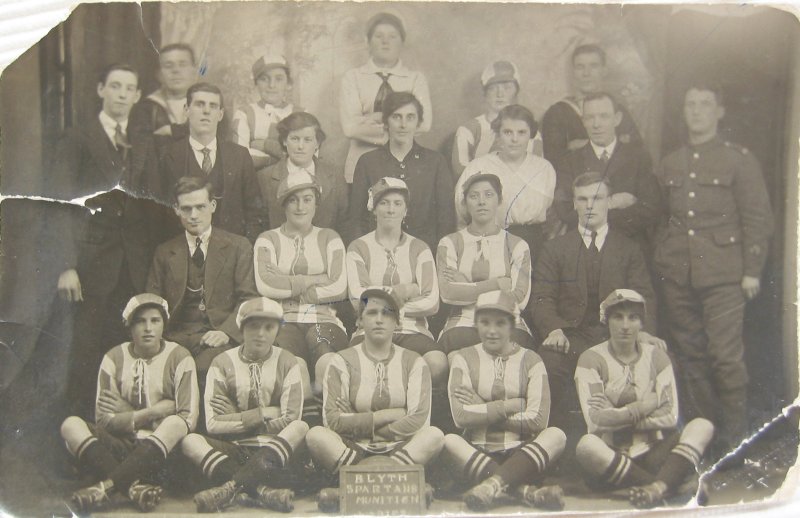
For only the second time in its history, bombs were dropped on England as Mathy unloaded some of his arsenal on the habitants of West Sleekburn, five miles from Blyth. As thousands of locals joined the war effort, most signing up to the Northumberland Fusiliers consisting of seven battalions, the voices of lady footballers could be heard around Croft Park. The team was the ‘Blyth Spartans Munitionettes’, who would lift the Alfred Wood Munition Girls Cup before women playing football was banned by the F.A. in 1921. Fearing that the women’s game would affect football league attendances after the Great War, the authorities felt compelled to act.

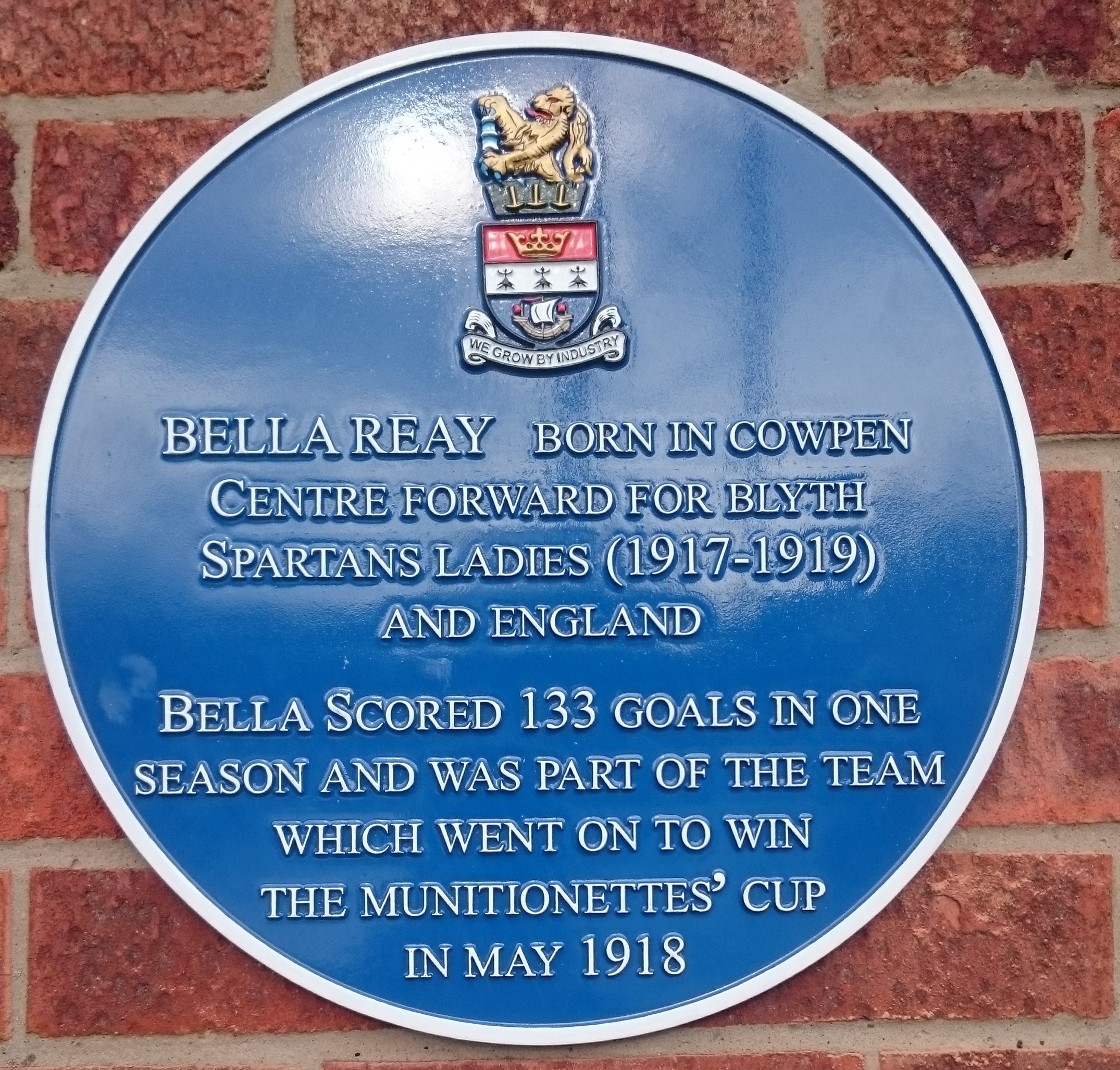
On the 9th of March 1918, as the 158th Infantry Brigade captured Tell ‘Asur in the Jordan Valley at St. James Park, the Spartans ladies took on Armstrong-Whitworth’s 57 Shell Shop. Annie Allen opened the scoring in front of 10,000 spectators; however, Ethel Wallace equalised for ’57 before the break. With five minutes remaining and a draw looking inevitable, the great Bella Reay struck with a solo goal for the Spartans, putting the team into the final. Reay, the daughter of a coal miner from Cowpen, would notch up one hundred and thirty-three goals in one season with Blyth.

Plaque commemorating Bella Reay

Bolckow, Vaughan & Co. of South Bank were the Spartans opponents; the game would go to a replay after an initial nil-nil draw at St. James Park, viewed by 15,000 spectators with the 3rd Battalion Northumberland Volunteers band travelling down on the train with the team. The replay was eventually played on the 14th of May at Ayresome Park, Middlesboro, in front of 22,000 spectators; Blyth would run riot, winning 5-0 with Reay and Mary Lyons starring.

It would take the men of Blyth seventeen years after the end of the Great War to win the North Eastern League in 1936/37; by 1958, the league had folded. After trying their luck in the Midland and Northern Counties Leagues, Blyth Spartans turned amateur joining the ranks of the Northern League in 1964.

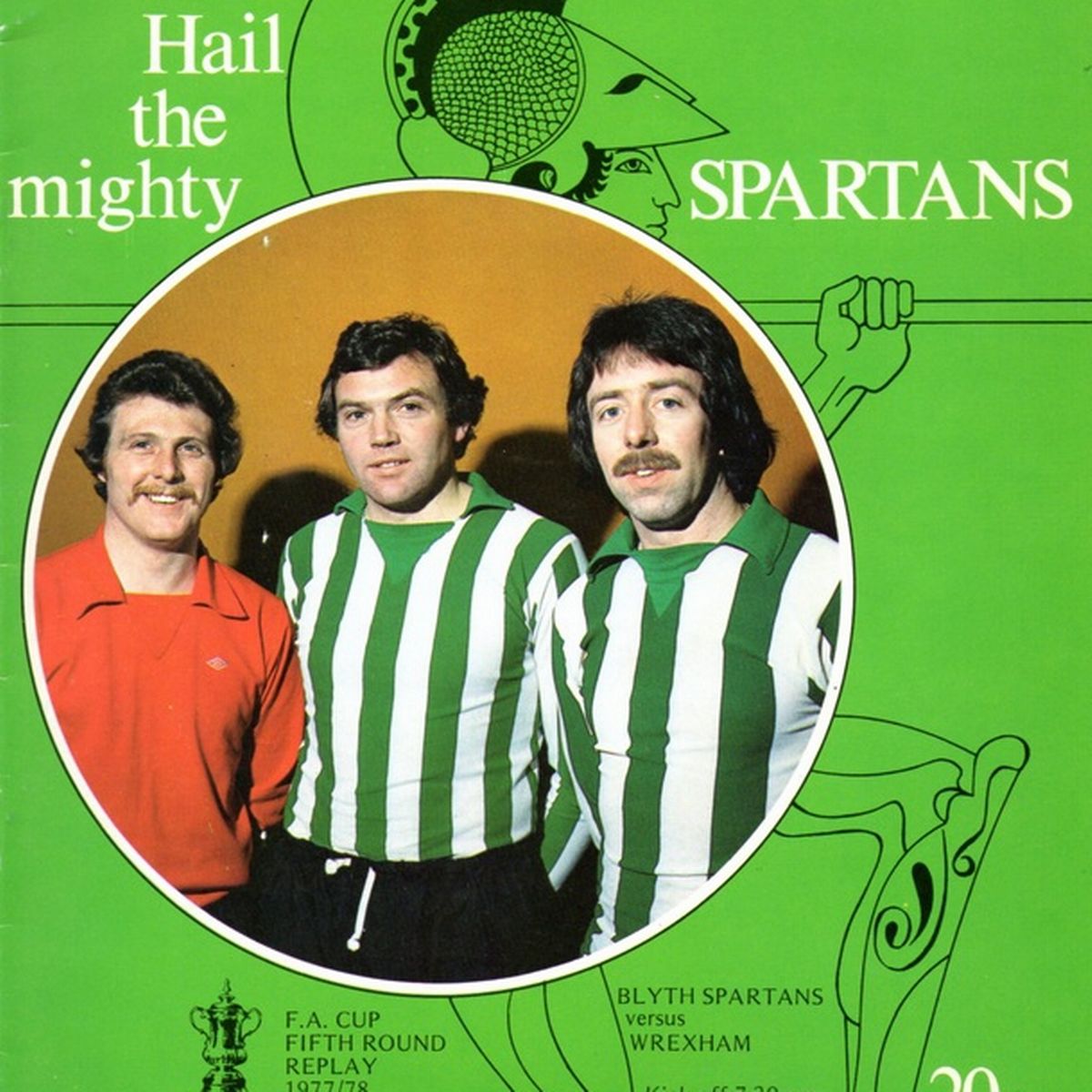
In 1977/78, as the Sex Pistols burst upon an astonished British public, Blyth Spartans would become the most famous non-league club in English football history through their displays in the oldest cup competition. It all started on the 7th of January; the same week, Johnny Rotten asked an American audience, ‘Ever get the feeling you’ve been cheated?’ Alan Shoulder, a miner, netted to eliminate Enfield and bring their 32-game unbeaten run to a thundering end in the F.A. Cup third round. The green and white hordes headed for the Potteries on the 6th of February in round four to face second division Stoke City; it was the third attempt to try and fulfill the fixture.

Fifty-two official coaches from the North East arrived at the Victoria Ground on January 28th with an hour to kick off the game was called off due to flooding; the elements continued to play havoc with a further cancellation on the 1st of February. However, on a damp Monday night, the Spartans ran out 3-2 winners with Shoulder’s partner Terry Johnson sending the Northumberland travelling army into raptures after twelve minutes with his fourteenth goal of the season stabbing the ball home after a calamatious error by Jones in the Stoke goal. Spartans incredibly led as the players went for their teatime break, a rejuvenated Stoke looked like they would spoil the party as Viv Busby equalised, and then future BBC analyst Garth Crooks gave Stoke a 2-1 lead. Sensationally Steve Carney, who would sign professionally for Newcastle United in 1979, reacted quickest to an Alan Shoulder header which had hit the post; incredibly, the tiring part-timers had found an equaliser.

As a replay at Croft Park loomed, Terry Johnson popped up to score, rifling a right-footed shot past the hapless Jones in front of a disbelieving Spartans faithful. In the fifth-round draw, Blyth Spartans would face local rivals Newcastle United or Wrexham. A dream tie at St. James Park was ruined when the Welshmen won a replay against the Magpies four to one; the green and white army would be heading to the valleys.

The game would be televised, and so Match of the Day viewers would witness how close the Spartans would come to immortality; coach Jackie Marks had proclaimed to the media that week the team’s secret ingredient ‘speed oil’ a pre-match drink to release matchday tension. Infatuated with manager Slane the teacher, Carney, an electrician, and Shoulder, the coal miner, the Spartans became both local and national heroes as the sports hacks tried to find out more about the giant-killers.

As a local supermarket invited the players to do their weekly shopping for free, in the build-up, twenty-year-old Steve Carney announced how he was due to get married and might have to delay it if Spartans were to achieve the impossible. The dream looked on when Terry Johnson opened the scoring in the Racecourse Ground nipping in after a poor backpass by Alan Hill on a bone-hard surface, placing the ball between Dai Davies legs. Blyth’s F.A. Cup journey began in September 1977 as 2,000/1 outsiders they were now leading one-nil and dreaming of the quarterfinals.

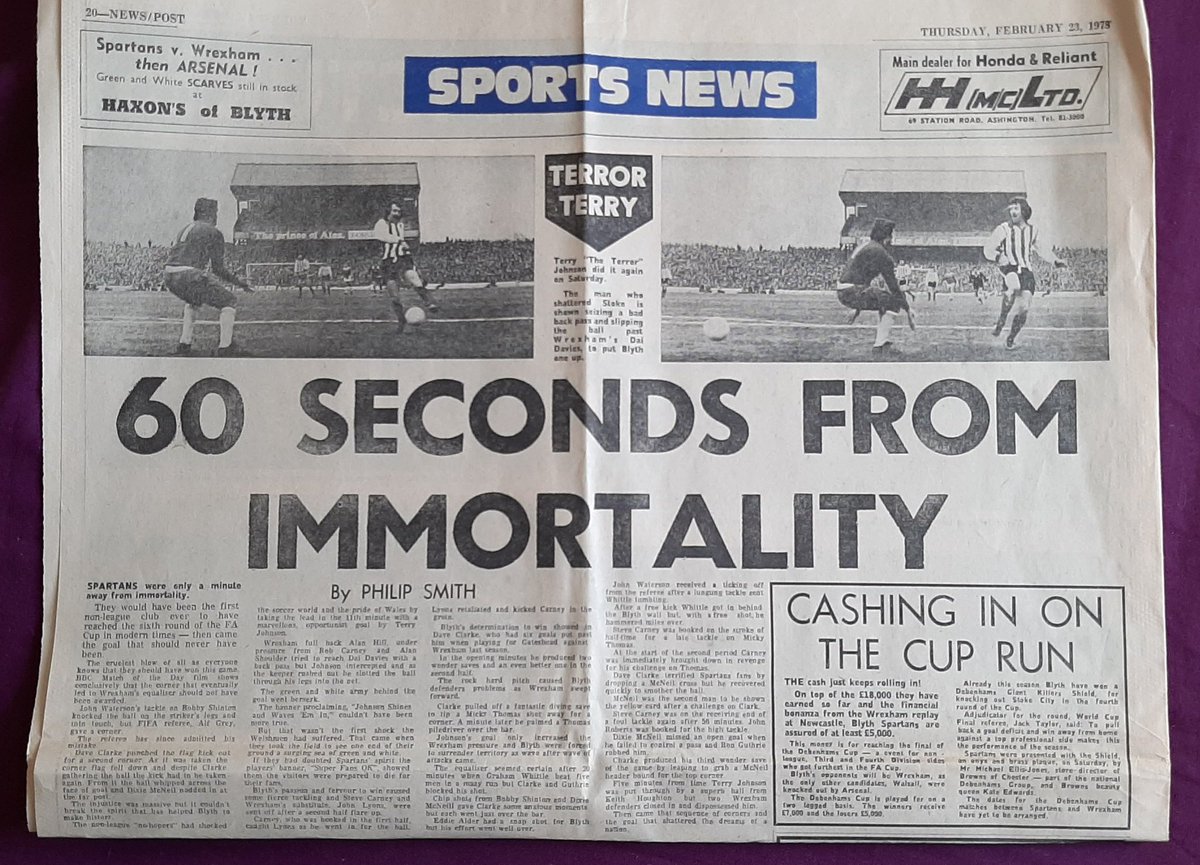
Incredibly the Spartans held out until the final play with Dave Clarke superb in goal; there was sixty seconds on the clock when John Waterson cleverly played the ball off Wrexham’s Shinton for a goal kick. As most in the ground expected Clarke to take the goal kick, referee Alf Grey inexplicably pointed for a Wrexham corner; as the corner flag leaned over like the Tower of Pisa, the referee went over sticking it into the frozen ground, so it stood correctly upright. Cartwright then sent over a curling right-footed corner which Clarke rose to punch away for another corner as the amateur whistles sounded out around the Racecourse. Again, Cartwright took the corner this time, Clarke rose nonchalantly to collect the ball; it seemed history was to be made not since Queens Park Rangers of the Southern League in 1914 had a non-league team reached the sixth round. Alas, Grey had spotted the corner flag lying on the ground when Cartwright took the corner and instructed it to be re-taken. This time Roberts rose with Clarke, and Dixie McNeil broke every heart in the North East.

The replay would take place at St. James Park 42,000 would turn up on the night, and thousands would be locked out, Spartans would succumb to a 2-1 defeat with Johnson netting once more. It was the end of the dream.

Reports of the Cup Run

In Blyth today, on the gable end of Gino’s Fish and Chip Shop, renowned Sunderland-based artist Frank Styles will create a mural of modern legend Robbie Dale. Dale spent fifteen years at Croft Pak wearing the green and white shirt 680 times and netting 212 goals. It is the brainchild of Simon Needham a Leeds fan who grew up in an era when the names Revie, Giles, and Bremner rolled easily off the Yorkshire tongue.

Like the Spartans founder Stoker, Needham is something of a horticulturist, a landscaper by day he cultivates gardens in Blyth and surrounding areas. He has recently gained a master’s from Sunderland University. On moving to Blyth, he became a regular at Croft Park while also travelling up the highways and byways in support of the non-league side. In an era of super leagues and billionaire foreign owners, Needham spearheaded a campaign to raise £5,000 to create the mural, amplifying the saying ‘football is nothing without fans.’

Around Blyth, the pits have been replaced by wind farms, but in the clubhouse, there is still talk of corner flags and women heroes in a place where football still has a soul.

Descendants of Abrahams?

Opening a Bookman

Louis Bookman, formerly Louis Buchalter, the Lithuanian-born, Irish international footballer and cricketer is a figure of huge sporting significance not only in Irish, but in world sporting history. He is likely the first Jewish footballer to play top-flight football in England, for Bradford City and West Bromwich Albion. He was also part of the Irish team that won the British Home Nations Championship for the first time in the 1913-14 season, and represented Ireland with distinction at cricket, including being part of an Irish team that defeated the West Indies.

Bookman had success as a young player with Adelaide, a local, mostly Jewish team from Dublin City’s southside, before moving north to the powerhouse that was Belfast Celtic in 1911 before eventually making the move to England. However, in my research it appears that there may have been another Jewish footballer lining out for Belfast Celtic more than a decade earlier. This same player seems to have also previously played at the highest level in Scotland. While I’m continuing in my attempts to find greater detail on his life and career, this is my early summary of the life and career of Joseph Abrahams, surely one of the first Jewish, top level footballers?

Louis Bookman, complete with Ireland cap, during his time with West Brom

Grasping the Thistle

Joseph Abrahams was born January 28th 1876 in Lanarkshire, Scotland, the son of Nathan Abrahams and his wife Annie (sometimes recorded as Fanny) née Solomon. His parents had been emigrants from Suwalki in the Russian Empire, a city in what is now modern-day Poland. The timing of their move to Britain would coincide with the beginning of large-scale immigration of Jewish citizens of the Russian Empire. Britain was seen as offering a chance for a better life and potentially an escape from rising anti-Semitism which developed into anti-Jewish pogroms in the 1880s. Joseph’s father Nathan was a tailor, and Joseph was the third of their ten children. His two older siblings (Kate and Samuel) had been born in England, most likely in London, while his younger siblings were all born in Glasgow. At the time of the 1881 and 1891 censuses the Abrahams family were living first on Norfolk Street, then in the later census on Robertson Street, both locations were very close to the River Clyde and the job opportunities that the river presented such as shipbuilding as well as large textile factories and warehouses.

As well as his father being a master tailor who had four people in his employment, Joseph’s older sister Kate was also a “tailoress”, while he and his brother Samuel trained to be machinists, with Joseph starting his apprenticeship in his early teens.

Joseph makes his first appearance as a footballer of note in May of 1897, when he would have been about 21 years of age. He was one of the players for Glasgow Perthshire F.C. who won the Glasgow Evening News Charity final cup with a 2-1 win over Ashfield. The game was played in Celtic Park and the Scottish Referee newspaper reported that “Abrahams was a great success on the right wing, where he was admirably backed up by Willie Spence. This young player once he gains confidence will be a great help to the Kelburn club.”

By September of that year the same newspaper was announcing the signing of Joseph Abrahams by Partick Thistle. This was to be the club’s first season in the top division of Scottish football. Founded in 1876 in the area of Partick, north Glasgow, they had won the Scottish Second Division in the 1896-97 season and been elected to promotion to the highest tier of football in the country where they would battle it out with Rangers, Hibernian, Hearts and eventual champions Celtic. Partick Thistle would ultimately finish eighth in the ten-team league, and Joe Abrahams had made a decent start, playing in at least six matches in the early months of the season.

In October 1897, just over a month after signing there was a comment in Scottish Referee that Abrahams, who had mostly been playing at outside right, was to be dropped for the game against St. Mirren. The report noted that “Partick Thistle are giving little Abrahams a rest to-morrow, but only because it is thought the metal opposed to him is too heavy.” From this we can surmise that Abrahams wasn’t the biggest of players and that perhaps the St. Mirren defenders were known for their size and robust play.

Joe Abrahams did return to the team for subsequent matches after that game, his final match for the Thistle seems to have been in November 1897 when they beat St. Bernard’s (a club from Edinburgh rather than a group of large dogs) 5-3 in front of a crowd of 2,000. However, despite this victory just days later it was announced in Scottish Referee that “Abrahams has not come up to expectations in the last few games” and that he had been dropped from the starting XI and was next listed as playing for the Thistle reserve side.

We next encounter Joseph Abrahams in the starting XI of Linthouse in April 1898. Linthouse were another Glasgow club from the Govan area who were playing then in the second division. Joe is recorded as getting on the scoresheet during a 7-1 victory for Linthouse over the hapless Renton and is still in the starting XI at the beginning of the following season (1898-99), however by the end of September he was dropped for a game against Dumbarton and there are no further mentions of an Abrahams in the starting teams for Linthouse who struggled that year, finishing second bottom of the second division.

Across the Irish Sea

It is almost a full year before Joe Abrahams reappears, in late September 1898 he is dropped by Linthouse and in August 1899 he appears on trial at Belfast Celtic. After impressing in training he features in the opening game against Cliftonville at the start of the Irish League season, once again Abrahams impressed in a scoreless draw, this time playing at inside-right and obviously does enough to secure a contract with Belfast Celtic.

Joe quickly became a regular in the Belfast Celtic side and within a couple of weeks he even playing an international of sorts. As Chris Bolsmann writes;

In September 1899 an association football team from Bloemfontein in the Orange Free State, South Africa, arrived in the United Kingdom. The team comprised 16 black South Africans who played under the auspices of the whites-only Orange Free State Football Association and was the first ever South African football team to tour abroad.

The 1899 Orange Free State football team tour of Europe: ‘Race’, imperial loyalty and sporting contest

This touring side from South Africa would play one match in Ireland against Belfast Celtic in front of “an enormous crowd of spectators”. An entertaining game would end with a 5-3 win for Belfast Celtic with Abrahams scoring Celtic’s fifth. Before the season was out Joe Abrahams would be selected to represent Antrim in a match against a selection of the best players from Co. Derry while a month later he would represent Distillery as a guest player in a high-profile friendly match against Blackburn Rovers.

Belfast Celtic in 1900 from John Kennedy’s book Belfast Celtic – thanks to Martin Moore for providing the image. Possibly Abrahams in the back row third from the left?

In fact, Joe’s first season in Ireland (1899-00) couldn’t have gone much better, he was one of the standout players of the Celtic forward line that won the club its first ever Irish League title which helped to establish the club as one of the emerging powers in the Irish game. Abrahams played 22 matches and scored six goals across all competitions that season. By 1901 Belfast Celtic had moved to their new ground at Celtic Park, but by that stage Joe Abrahams had moved on. In fact, by the opening game of the 1900-01 season Joe Abrahams was part of the Linfield team that defeated defending champions Belfast Celtic.

This was a huge move by Joe, Celtic and Linfield were already rivals, a rivalry that would only become more intense as Celtic continued to improve over the coming years. Elements of crowd violence and sectarianism were also already present in the game, it was even something that had been remarked upon during Joe’s first game for Celtic against Cliftonville with the Belfast Newsletter describing the “behaviour of several mobs on leaving the ground was brutal and savage.”

It is during his time at Linfield that there is reference to Joe, albeit not by name, as a professional, in Neal Garnham’s Association Football in pre-partition Ireland he notes that “The Linfield club registered eight players of known religions: three were Anglicans, three were Presbyterians, one a Congregationalist and one a Jew. None was Catholic.”

When examining the 1901 Census Joseph Abraham is easy to spot, he is living, appropriately enough given his upbringing on Lanark Street (now Lanark Way) in the Woodvale area of West Belfast, he is married and has a young son, also named Joseph. Both he and Joseph Junior list their religion as “Jew” while his wife, Fanny, is listed as a member of the Church of England. Joseph’s job is not however listed as professional footballer, a very uncommon designation to find in the Irish census at the time, but rather as “Ship Yard Labourer”.

As was the case with most footballers who were paid in Ireland at the time the amount they received was not sufficient to live on and was usually topping up wages received from more regular work. Payments to players in Ireland had only been allowed since 1894, a year after the practice had been permitted in Scotland and nine years after paying players had been allowed in English football. At the time of Abrahams’ spell in Ireland the number of paid players was still very low, and what could be described as “full time professionals” was even rarer still.

We can speculate that after leaving Linthouse there must have been some inducement to travel to Ireland for the trial with Belfast Celtic in August 1899, perhaps promise of the job in the shipyards, something Joe would have been familiar with from Clydeside, as well as a wage for playing football? We know that within two months of arriving in Belfast he had married Frances “Fanny” Kennon, a dressmaker from Lanark in Scotland who we must assume he had been engaged to before moving to Ireland.

Perhaps she knew Joseph through his tailor father? Or worked near him in one of the textile and garment factories in Glasgow? Fanny was the second child of five born William Kennon, a blacksmith and Sarah Kennon his English wife. They were married on October 5th 1899 in St. Anne’s, Belfast. Who knows if their families could attend from Scotland, this is perhaps unlikely as the witnesses were Charles Frederick Carson and his wife Lillie. Charles was also a shipyard worker and had perhaps become friendly with Joe through this connection after his recent move?

Less than a year later, on the sixteenth of July 1900, just months after Belfast Celtic had won their first ever title with Joe Abrahams in their team, Joseph Junior was born in the family home, which was then at 15 Crumlin Road, Belfast.

The season with Linfield was far less successful than the preceding one with Belfast Celtic. In a six-team league Linfield finished fifth and were knocked out of the Irish Cup at the semi-final stage by Dublin side Freebooters. However, Abrahams was once again selected to represent Antrim in the game against Derry, which they comfortably won 6-1. Despite this, by the beginning of 1901 there were some critical comments about Abraham and his “weak” play. During his time at Linfield he would have played with some high-profile players including a veteran Irish international Jack Peden, who had begun his career at Linfield in the 1880s before becoming one of the first high-profile Irish players to move to England, joining Newton Heath (subsequently renamed Manchester United) and later Sheffield United before returning to Belfast with Distillery and finally Linfield.

While the move from Belfast Celtic to Linfield might have been controversial, Joe Abrahams seemed not to care if he provoked a bit of a reaction. That’s why we perhaps shouldn’t be surprised when he appeared on a teamsheet for Glentoran in a charity cup game in April 1901 for Linfield’s great rivals in a match against Distillery. Glentoran lost the game and it is perhaps the only match that he played for them.

Later Life

According to historians at Partick Thistle around this time Joe Abrahams left Ireland and returned to Scotland where he played briefly for Ayr who were in the Scottish second division. There are reports that the family’s ultimate destination was New York and that Joseph died there many years later in 1965. However, with the help of Michael Kielty I have found that this is not accurate, rather than New York, Joseph would ultimately end up in California. Sadly his wife Fanny would not make it that far with him.

After the birth of their son Joseph there were a further two daughters for Joseph and Fanny but tragedy struck when she died in childbirth with daughter Polly in 1909. Polly was then raised by Fanny’s sister. Joseph later married Sarah Rosenburg, with the help of a matchmaker. Sarah was born on January 31, 1886, in Kaminets, Minsk, Belarus. She had one son from a previous relationship – Charlie, whose father had died during the political unrest in Russia.

When Joseph and Sarah married they had another son together – Maurice. The family moved to Melbourne, Australia in 1912 where they became farmers and as well as taking in some tailoring work. Moving again later in life they landed at Angel Island, San Francisco Bay on board the ship RMS Makura on Christmas Day, 1925 to start another new life in the United States. Joseph, it seems then began a career as a grocer selling vegetables which he added to his previous trades as shipyard worker, machinist, farmer, tailor and footballer.

The Abrahams/Abrams family in Australia

Sarah passed away in 1951 while Joseph died on May 4, 1961, in Alameda County, California, at the age of 85, and was buried in Oakland, California at “Home of Eternity Cemetery” his second wife Sarah is buried next to him. Despite being credited mostly in records and match reports as Abrahams and occasionally Abraham both of their names are spelled “Abrams” on their crypts.

What I believe is that this shows that more than a decade before Louis Bookman, there was a Jewish footballer playing top level football in Scotland and Ireland. During this time he was paid by Linfield and in all likelihood by Belfast Celtic and perhaps by Partick Thistle and Linthouse. While Bookman would ultimately have the more successful career, would play top level football in England, win important titles with Ireland and be paid as a full-time professional, I believe the career of Joseph Abrahams is worthy of note.

Joe Abrahams in later life in Oakland, California. The header photo of this article is of Joe and his first wife Fanny