
Victor Jara and The Ghosts of The Estadio Nacional
By Fergus Dowd
In the square, they sat and played in unison, a thousand guitars strummed in a musical tribute to Victor Jara as the September sun shone down on their faces. It was the 22nd of the month, 2018, nearly forty-five years to the day the Pinochet regime assassinated the iconic Chilean musician after the coup d’etat in 1973.
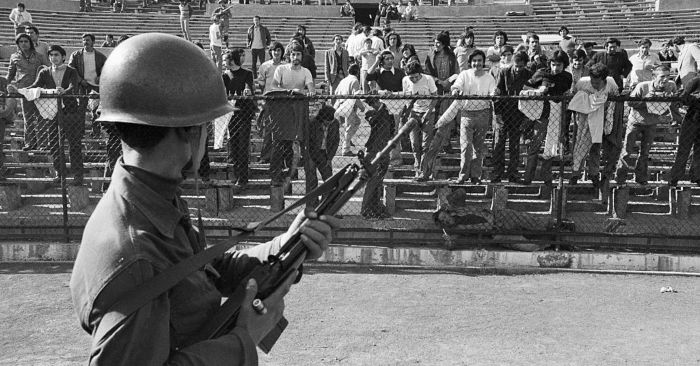
On that fateful September day, like so many others, Victor had been taken to the football stadium, all the prisoners stood in the raised, tiered rows of benches dotted around the stadium.
As volleys of machine gunfire were fired into the crowd, bodies tumbled down the inclines as fellow prisoners, who were starved, vomited in shock on their dead colleagues. Through his lyrics and singing, Victor tried to keep his comrades’ spirits up; unfortunately, he fell foul of the prison camp commander. Four guards held Victor as the commander ordered a table to be placed in the centre of the arena; the musician reluctantly spread his hands on it.
As the masses in the stands looked on, six thousand in total, the commander, took an axe with two swipes he severed Victor’s fingers on both hands. The guards began to strike Victor; as the blows reigned down on him, the commander shouted, ‘sing now you motherf***er’. By now trembling and bleeding, incredibly Victor stood and sang the anthem of the Unidad Poplar as his colleagues in the stands joined him – as he neared the end of the anthem, a shot was fired, and Jara took his last breath.
Only nine years earlier, football’s greatest showpiece had been held in Chile with the Estadio Nacional at the centre of the festivities. This all came on the backdrop of the most powerful earthquake in modern times ‘The Valdivia’ quake measured 9.5 on the Richter scale. In its wake, two million people were left homeless more than 3,000 were injured from the destruction while 1,655 souls perished.
The economic cost ran into the millions $550 to be precise, or 4.8 billion in today’s money; ‘We will do everything we can to rebuild’ was the rallying call. They were true to their word as the carnival of football began in the national stadium with English referee Kenneth Aston putting whistle to lips as Chile playing Switzerland tipped off proceedings.
With 65,000 in the same stadium that General Pinochet used as a detention centre, the great Leonal Sanchéz stole the show. Seen as one of Chile’s greatest ever players, Sanchez tormented the men from the Alps, scoring a brace in a 3-1 victory. He would end up the host’s top scorer in the tournament. A left-sided midfielder Sanchez was the son of a professional boxer who played with one of the country’s most successful clubs Universidad de Chile for seventeen years, part of the great Ballet Azul team, which won six championships between 1959 and ’69.
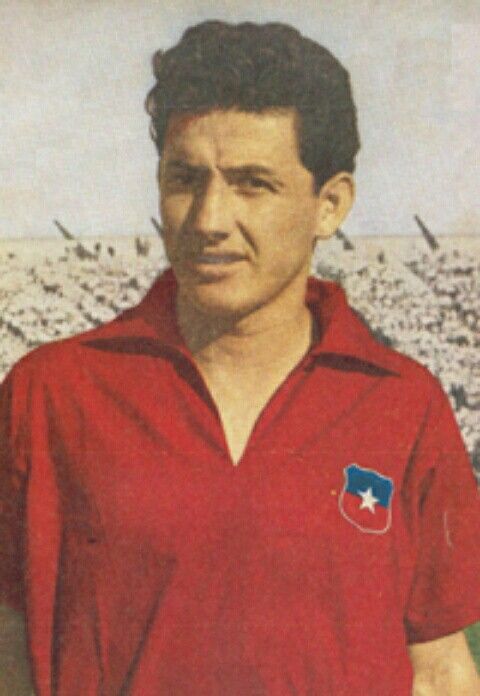
In a ferocious contest in the next game, Sanchez would land a left hook that his watching father would have been proud of, breaking the nose of Italian defender Humberto Maschio. Maschio, an Argentine who had won the Copa America in 1957 with the La Albiceleste, was then banned from playing for his country after joining Italian giants Inter Milan.
Through his Italian ancestry from Godiasco, in the province of Pavia, he would get a lifeline lining out for the Azzurri in Chile. In the Estadio Nacional, Chile would run out two-nil victors, with Jaime Ramirez opening the scoring in a turgid affair. Ramirez had played with Club Deportivo O’Higgins, also know as La Celeste, due to their choice of sky-blue jerseys like the Uruguayan national side. The club had only been founded in 1954 after a merger between Braden F.C. and the O’Higgins Institute and was named after the commander-in-chief who had freed Chile from Spanish rule.
Chile would come second in their group, losing out on the top spot to West Germany, who had been forced to withdraw their bid to host the tournament by FIFA. A boycott loomed by South American countries if another tournament was again held in Europe.
The Brazilians with the magic of the ‘little bird’ Garrincha and the great Pele by his side would top Group Two. The final group would see Hungary winning out minus the great Ferenc Puskas. Puskas, captain of the great Hungarian side who demolished England 6-3 and 7-1 in season 1953/54, fled his homeland in 1956 and lined out for Spain.
The Hungarian revolution of that year was instigated in a speech by Nikitta Khrushchev criticising Stalin and leading to the ‘Rebels’ winning the first phase of the revolution. A multiparty system was installed in the country, and Imre Nagy became premiere; as Puskas starred for the Los Blancos of Madrid, his homeland declared neutrality appealing for support from the United Nations. Their cries to the western powers fell on deaf ears, and within two years, the Soviet Union invaded Hungary as Nagy was executed for treason.
Sadly, for Spain and Puskas, they would finish bottom of their group while England would pip Argentina on goal difference to reach the quarter-final stages.
In the last eight, Chile would find themselves leaving Santiago for the port city of Arica, where they would defeat the Soviet Union with Sanchez again on the scoresheet with eighteen thousand cheering them on. Back in Santiago in the Estadio Nacional, Yugoslavia would reach a World Cup Semi-Final for the second time in their history, defeating the Germans one nil with a goal from Petar Radakovic. Radakovic, a Croatian, spent his whole career playing for NK Rijeka, helping them gain promotion from the third division to the top tier of Yugoslavian football by 1959.
A year after the World Cup, the hero of Santiago would begin to have heart problems on a ten-day tour of West Germany; within two years, he was warned he would need to take a break from football. Sadly, by the age of twenty-nine, Petar Radakovic died while training. He had returned to competitive football in 1967/68 and only lasted two matches.
The Brazilians, who were without the injured Pele for the quarter-final in Vina del Mar situated on the Pacific coast, snuffed out England’s chances of glory with a three-one victory. Garrincha’s ‘banana shot’ the outstanding goal of the game, and his wing play being commended by the English press, who likened him to Matthews and Finney.
In September 1973, American journalist Charles Horman took his friend Terry Simon to see the sights of Vin Del Mar they would find themselves stranded on the coast as the coup broke out. Both were surprised to hear how the US personnel on the ground gloated about the attack by General Pinochet’s men and the number of American warships cruising off the coast. Charles, like any good journalist, took notes of what he was hearing the pair would join Captain Ray Davies of the U.S. military group who gave them safe passage from the coastal city to the capital Santiago.
In secret President Richard Nixon and his sidekick Henry Kissenger were in favour of the coup and the toppling of the first ever Socialist Latin American President Salvador Allende. Allende had expropriated the U.S. copper companies in Chile without any compensation, which drew him to the attention of the authorities in America. A few days after returning from Vin Del Mar, Charles was taken from his home in Santiago by a dozen Chilean soldiers.
Like Victor Jara, he was taken to the Estadio Nacional and executed, his bullet-ridden body would be found in a wall in the stadium.
The first semi-final of the 1962 tournament would see the hosts pitted against the flamboyant Brazilians. As more than 76,000 watched Garrincha open the scoring in the ninth minute with a wicked left foot strike that flashed past Escutti in the goals. The lead was doubled with ‘the little bird’ again, netting this time rising highest to head from a corner. Toro pulled one back for the hosts in the second half, but one of Brazil’s greatest ever strikers, Vava, netted twice to condemn the Chileans to a 4-2 defeat.
Brazil would win the tournament outright, lifting the Jules Rimet trophy in the Estadio Nacional after defeating Czechoslovakia. Garrincha would be the player of the tournament finishing also as joint top scorer in later life; he would suffer from alcohol addiction and become a forgotten hero in his homeland.
Today in the Estadio Nacional, the authorities have set aside ‘Hatch no. 8’ in honor of the prisoners who were detained in the wooden bleachers. It is believed over 40,000 people spent time in the compound imprisoned by the junta regime.

In November 1973, as Chile were to face the USSR in the return leg of qualifying for World Cup 1974, the Russians refused to travel, stating it was a place of blood. On the day, the FIFA officials came to visit the stadium, Pinochet’s men took their prisoners below into the bowels of the dressing rooms, and at gunpoint, they were told to remain silent. Sir Stanley Rous, then chair of FIFA, deemed the stadium safe, but the Soviets refused to play, so Chile won by a walkover.
The Republic of Ireland became the first football team to play at the Estadio Nacional on the 12th of May 1974.

Former Manchester United youth Eamon Dunphy initally critical of the decision had handed out leaflets criticising the new regime in Chile at an Irish training session. Dunphy who intially was not picked was asked into the squad by then manager John Giles after injury befell some of the Irish players, the Millwall man swallowed his pride and travelled. The stadium had been freshly painted as the Irish ran out 2-1 winners, Eoin Hand and Jimmy Conway scoring to give the men in green victory.
Victor Jara’s only crime was that he supported Salvador Allende, a socialist politician who served as the 28th president of Chile from the 3rd of November 1970 until he committed suicide on the 11th of September 1973 as Pinochet’s troops stormed the presidential palace.
Not far from the Estadio Nacional, they play volleyball, basketball, and football in the indoor sports arena named after Victor Jara.
 A Bohemian Sporting Life