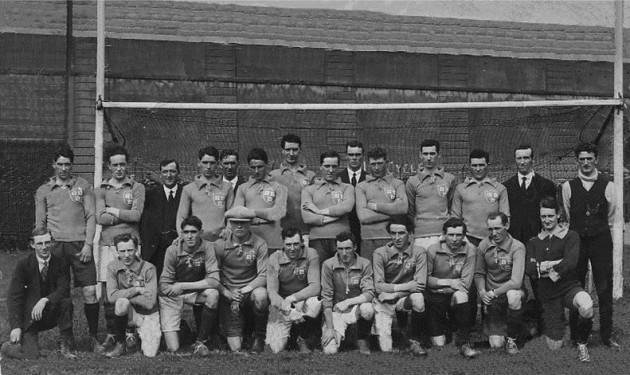
The FAI Cup quarter final versus Dundalk fell just a day shy of the 100th anniversary of Bloody Sunday, a day remembered in Irish history for actions that morning when Michael Collins’ “Squad”, supported by members of the Dublin Brigade carried out a series of assassinations across Dublin which helped to cripple the British Intelligence network in the city. It is also remembered for the brutal reprisal that took place in Croke Park later that day when a combined force of RIC, including the Black and Tans and Auxillaries along with British Army troops opened fire at a Gaelic Football match between Dublin & Tipperary in Croke Park, causing the deaths of thirteen spectators and Tipperary player Michael Hogan.
Though Dalymount Park sits only a short walk away from Croker any connections with Bohemians and the events of that day would appear remote or non-existent, though that is certainly not the case. Both in the streets of Dublin that morning and in Croke Park that afternoon there were men who were, or would become, players, coaches, administrators and supporters of Bohemians.
We’ll begin early that morning on the streets of the south inner city, Charlie Dalton the 17 year old Drumcondra native and IRA intelligence officer has been preparing the attack on 28 Pembroke Street, making arrangements with Maudie, a maid who worked in the house to gather intelligence on the six suspected British intelligence operatives residing there. At the appointed hour of 9am Dalton and several other Volunteers burst into the house. Dalton’s job was to ransack the house for documents and intelligence files. His colleagues were tasked with the other work. Lieutenant Dowling and Captain Price were shot to death in their beds. Four other British officers were also shot in a volley of bullets in the hallway, Colonel Montgomery was killed and though the other officers were badly wounded they survived. Dalton was a member of Bohemians and an occasional player for the lower Bohs sides. His older brother Emmet, a British military veteran had also joined the IRA by this stage and was also a member of Bohemians, playing for the first team as an inside-forward and becoming club President in 1924. Be the end of the War of Independence Emmet had become the IRA’s head of training.

Teenaged Jeremiah “Sam” Robinson was acting was out that morning as a lookout for was his friend Vinny Byrne, one of Collins’ famed “12 Apostles”. Their destination was 28 Upper Mount Street, their targets British Lieutenants Aimes and Bennett. This was a late change to the plans due to a recent piece of intelligence received Charlie Dalton. Byrne and fellow Squad member Tom Ennis led the party and in Byrne’s witness statement he mentioned that they were a party of about ten men and that the operation did not go as smoothly as hoped. The sound of shooting aroused the attention of other British military personnel in the area and the men keeping an eye on the entrance to Mount Street came under fire. Most of the party fled to the river and rather than risk crossing any of the city bridges back to the north side where they could be intercepted. They crossed by a ferry and Sam and the others disappeared into the maze of streets and safe-houses of the north inner city. Robinson would later become a member of the “Squad” when it was reinforced in 1921.
While Sam, along with his brother Christy (another IRA Volunteer) would go on to enjoy a stellar career with Bohemians as part of the all-conquering 1927-28 side and would be capped twice by Ireland. His cousin William “Perry” Robinson would not escape Bloody Sunday unscathed. He was the second youngest victim in Croke Park, perched in a tree near the Canal end of Croke Park, he was struck by a bullet through the chest and would die in Jervis hospital. He was 11 years old.

On Ranelagh Road was Christopher “Todd” Andrews, a Bohemian fanatic, who would later become a senior civil servant and begin a political dynasty. His younger brother Paddy would enjoy success with Bohs in the 1930s, becoming club captain and would be capped for Ireland. However, for Todd his thoughts were with the headache caused by a clash of heads during a match for UCD the previous day as well as his duty that morning, the shooting of Lt. William Noble. As he later recalled:
C.S. “Todd” Andrews – Dublin Made Me
“I had increasing fears we might be surprised by the Tans. If that happened and we were captured, we would have been shot or hanged. It is not an agreeable prospect for a nineteen-year-old psychologically unattuned to assassination.”
In the end Andrews didn’t have to fire a shot, their target had escaped, Noble had left at 7am that morning. Andrews’ home was raided later than night, and his father, also Christopher, was lifted by the Black and Tans. Todd was forced into hiding, searching for a safe house in the south Dublin suburbs.
That afternoon in Croke Park, strange as it may seem, there was also a strong Bohs connection. Many of the Dublin side were taken from the O’Toole’s club from Seville Place in the North inner city, they would become the dominant club side of the 1920s in Dublin, winning seven county football championships over the course of the decade. Their trainer was Charlie Harris and he was also assisting the Dubs that day from the Croke Park touchline. A former athletics champion, Croke Park was familiar terrain for Harris, he had even raced against a horse there in 1912 (narrowly losing)! Harris had also been the trainer of Bohemians since 1916 and was involved with the club for over 30 years as an integral part of many successful Bohemians teams. He even coached the Irish national side on a number of occasions, including at the 1924 Olympics. Harris, like most of the Dublin team was likely among the group that was rounded up by the RIC and detained in the Croke Park dressing rooms before finally being released later that day.
One other Bohs connection was a steward at that day’s game, Joe Stynes. Already an IRA member Stynes was also an exceptional all round athlete, be it Gaelic Football, hurling or as a goal-scoring winger for Bohemians. Stynes would star for Bohs in the 1925-26 season (and would receive the first of a number of bans from the GAA for it) but back in 1920 he helped dispose of guns belonging to the Volunteers before escaping the ground, according to an account provided by his grand-nephew, the Aussie Rules footballer Jim Stynes.
A version of this piece appeared in the 2020 match programme for the Bohemian F.C. v Dundalk FAI Cup game.
 A Bohemian Sporting Life