Bohs and Bloody Sunday

The FAI Cup quarter final versus Dundalk fell just a day shy of the 100th anniversary of Bloody Sunday, a day remembered in Irish history for actions that morning when Michael Collins’ “Squad”, supported by members of the Dublin Brigade carried out a series of assassinations across Dublin which helped to cripple the British Intelligence network in the city. It is also remembered for the brutal reprisal that took place in Croke Park later that day when a combined force of RIC, including the Black and Tans and Auxillaries along with British Army troops opened fire at a Gaelic Football match between Dublin & Tipperary in Croke Park, causing the deaths of thirteen spectators and Tipperary player Michael Hogan.

Though Dalymount Park sits only a short walk away from Croker any connections with Bohemians and the events of that day would appear remote or non-existent, though that is certainly not the case. Both in the streets of Dublin that morning and in Croke Park that afternoon there were men who were, or would become, players, coaches, administrators and supporters of Bohemians.

We’ll begin early that morning on the streets of the south inner city, Charlie Dalton the 17 year old Drumcondra native and IRA intelligence officer has been preparing the attack on 28 Pembroke Street, making arrangements with Maudie, a maid who worked in the house to gather intelligence on the six suspected British intelligence operatives residing there. At the appointed hour of 9am Dalton and several other Volunteers burst into the house. Dalton’s job was to ransack the house for documents and intelligence files. His colleagues were tasked with the other work. Lieutenant Dowling and Captain Price were shot to death in their beds. Four other British officers were also shot in a volley of bullets in the hallway, Colonel Montgomery was killed and though the other officers were badly wounded they survived. Dalton was a member of Bohemians and an occasional player for the lower Bohs sides. His older brother Emmet, a British military veteran had also joined the IRA by this stage and was also a member of Bohemians, playing for the first team as an inside-forward and becoming club President in 1924. Be the end of the War of Independence Emmet had become the IRA’s head of training.

Emmet and Charles Dalton in their National Army uniforms

Teenaged Jeremiah “Sam” Robinson was acting was out that morning as a lookout for was his friend Vinny Byrne, one of Collins’ famed “12 Apostles”. Their destination was 28 Upper Mount Street, their targets British Lieutenants Aimes and Bennett. This was a late change to the plans due to a recent piece of intelligence received Charlie Dalton. Byrne and fellow Squad member Tom Ennis led the party and in Byrne’s witness statement he mentioned that they were a party of about ten men and that the operation did not go as smoothly as hoped. The sound of shooting aroused the attention of other British military personnel in the area and the men keeping an eye on the entrance to Mount Street came under fire. Most of the party fled to the river and rather than risk crossing any of the city bridges back to the north side where they could be intercepted. They crossed by a ferry and Sam and the others disappeared into the maze of streets and safe-houses of the north inner city. Robinson would later become a member of the “Squad” when it was reinforced in 1921.

While Sam, along with his brother Christy (another IRA Volunteer) would go on to enjoy a stellar career with Bohemians as part of the all-conquering 1927-28 side and would be capped twice by Ireland. His cousin William “Perry” Robinson would not escape Bloody Sunday unscathed. He was the second youngest victim in Croke Park, perched in a tree near the Canal end of Croke Park, he was struck by a bullet through the chest and would die in Jervis hospital. He was 11 years old.

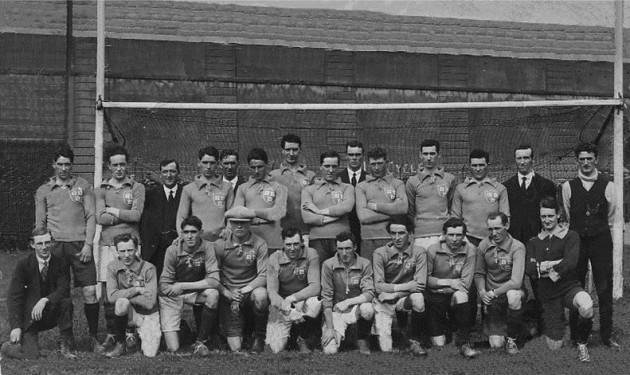
The all-conquering 1927-28 Bohemian FC team. Sam Robinson is in the front row immediately to the right of goalkeeper Harry Cannon

On Ranelagh Road was Christopher “Todd” Andrews, a Bohemian fanatic, who would later become a senior civil servant and begin a political dynasty. His younger brother Paddy would enjoy success with Bohs in the 1930s, becoming club captain and would be capped for Ireland. However, for Todd his thoughts were with the headache caused by a clash of heads during a match for UCD the previous day as well as his duty that morning, the shooting of Lt. William Noble. As he later recalled:


“I had increasing fears we might be surprised by the Tans. If that happened and we were captured, we would have been shot or hanged. It is not an agreeable prospect for a nineteen-year-old psychologically unattuned to assassination.”

C.S. “Todd” Andrews – Dublin Made Me

In the end Andrews didn’t have to fire a shot, their target had escaped, Noble had left at 7am that morning. Andrews’ home was raided later than night, and his father, also Christopher, was lifted by the Black and Tans. Todd was forced into hiding, searching for a safe house in the south Dublin suburbs.

That afternoon in Croke Park, strange as it may seem, there was also a strong Bohs connection. Many of the Dublin side were taken from the O’Toole’s club from Seville Place in the North inner city, they would become the dominant club side of the 1920s in Dublin, winning seven county football championships over the course of the decade. Their trainer was Charlie Harris and he was also assisting the Dubs that day from the Croke Park touchline. A former athletics champion, Croke Park was familiar terrain for Harris, he had even raced against a horse there in 1912 (narrowly losing)! Harris had also been the trainer of Bohemians since 1916 and was involved with the club for over 30 years as an integral part of many successful Bohemians teams. He even coached the Irish national side on a number of occasions, including at the 1924 Olympics. Harris, like most of the Dublin team was likely among the group that was rounded up by the RIC and detained in the Croke Park dressing rooms before finally being released later that day.

One other Bohs connection was a steward at that day’s game, Joe Stynes. Already an IRA member Stynes was also an exceptional all round athlete, be it Gaelic Football, hurling or as a goal-scoring winger for Bohemians. Stynes would star for Bohs in the 1925-26 season (and would receive the first of a number of bans from the GAA for it) but back in 1920 he helped dispose of guns belonging to the Volunteers before escaping the ground, according to an account provided by his grand-nephew, the Aussie Rules footballer Jim Stynes.

A version of this piece appeared in the 2020 match programme for the Bohemian F.C. v Dundalk FAI Cup game.
Luke Kelly takes the biscuit

Raised on songs & stories Heroes of renown/ 
The passing tales & glories that once was DublinTown

The opening lines of “Dublin in the rare ould times” are a distillation of nostalgia at its purest for many Dubliners. The Pete St. John song found fame on the ballad circuit of the 1970’s and for my money the definitive version of the song will always be the Dubliners’ version with Luke Kelly on lead vocals. This song appeared on The Dubliners 1979 release “Together Again”, it marked the return to the band of Ronnie Drew and it would be the last album to feature Luke Kelly who would pass away less than 5 years later.

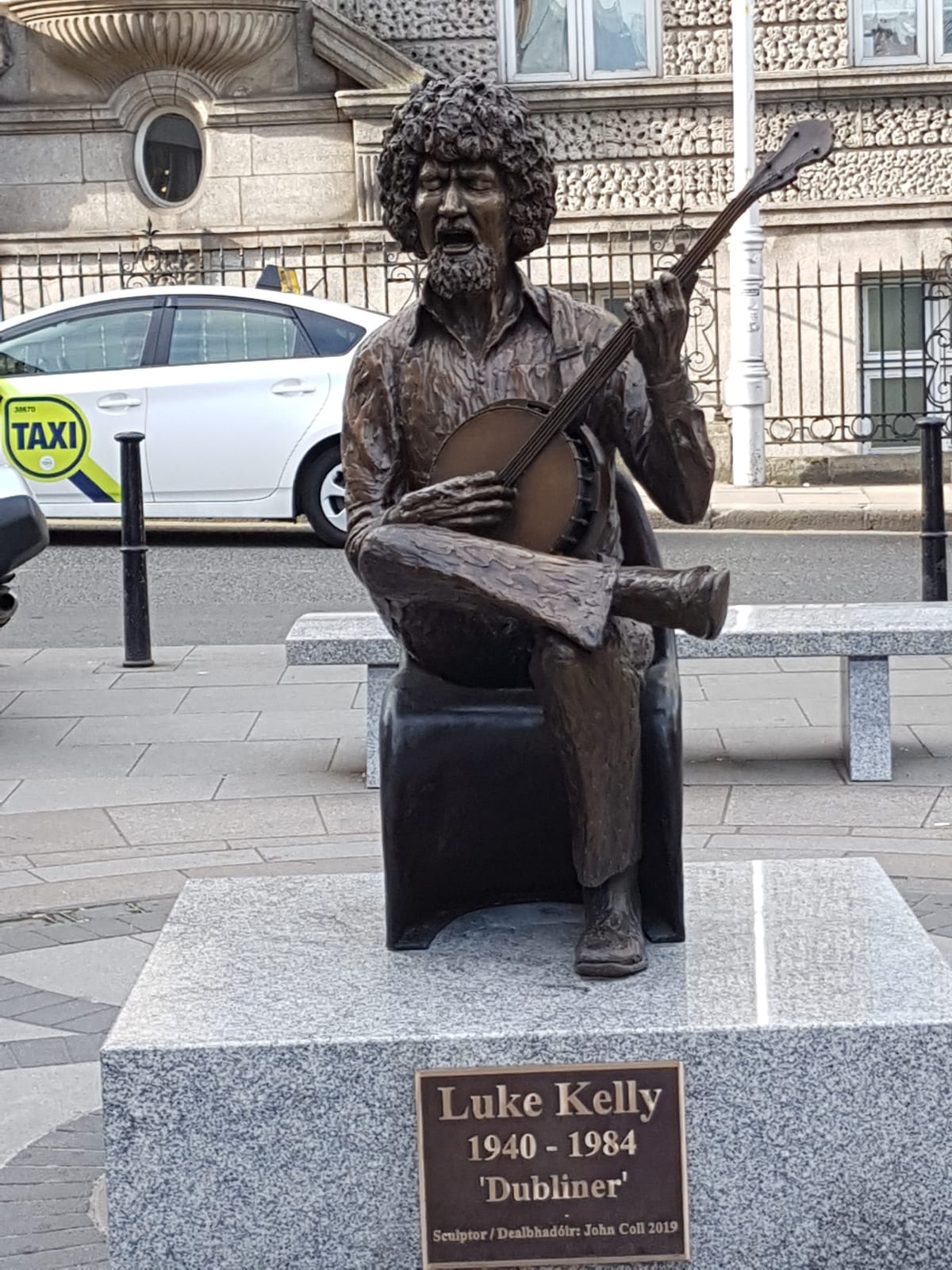
A rousing version of the song was performed in January of last year by Damien Dempsey accompanied by Kelly’s former bandmate John Sheahan on South King Street, a short walk from Grafton Street and Merrion Row and many venues that were home to performances by the Dubliners during the so-called “ballad boom”. This performance coincided with the 35th anniversary of Kelly’s death, aged just 43, but more positively it also announded the unveiling of a new bronze statue of the troubador and activist.

Statue

The unveiing of two pieces of public art celebrating the life and work of Luke Kelly provoked much fond reminiscence of him by friends and family, one area of his life that was discussed in detail was Luke’s love of football which was detailed in an excellent piece by David Sneyd in the Irish Mail on Sunday. The article had mentioned Kelly’s time as a schoolboy when he lined out for the famous Home Farm club, playing alongside future League of Ireland legend Billy Dixon.

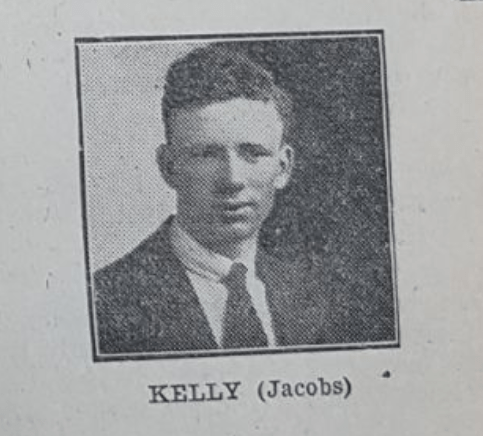
It also mentioned the playing career of his father, Luke Kelly Senior who played in the League of Ireland for Jacob’s F.C. In a piece for the “Lost Clubs” series on this website I focused on the history of Jacobs and in the course of my research had come across Luke Kelly Senior. A talented half-back or “pivot” in the Jacob’s teams of the late 1920’s.  Reports at the time describe him as a “tireless worker” , a “typical tackler and spoiler” and “most consistent”, though he was mentioned as being a shade on the small side. He was however, no brutal hatchet man, plenty of reports mention his range of passing and ability to switch the play and begin attacks.

The “pivot” role so commonly ascribed to him was one which had developed as part of the old 2-3-5 formation. The “centre-half” was not yet a central defender, but played in a more advanced role as an instigator of attacking play who could also drop back and assist in defensive areas. Hence he functioned as the “pivot” between defence and attack. This would change gradually over the 1920s, especially after Arsenal had success with withdrawing a centre-half into a more definsive position of a third defended, helping create what became known as the W-M formation.

Luke Senior was born on 1st September 1904 in Ryan’s Cottages on Marlborough Place in Dublin’s north inner-city. He was the son of Paddy and Christina Kelly who had been married nearby in Dublin’s Pro-Cathedral in 1898. Paddy Kelly had been born in Bealnamulla, Co. Roscommon just outside Athlone back in 1867, he in turn was the son of another Luke Kelly also from Bealnamulla. Luke Sr. married Julie Fleming in September of 1934 in St. Laurence O’Toole’s church which sits next to Sheriff Street, a part of the city to be forever associated with his son, Luke Kelly the singer who was born nearby in 1 Lattimore Cottages, Sheriff Street less than six years later.

Football was obviously deeply engrained in Luke Kelly Sr. from an early age, in an interview many years later when his son was at the height of his fame, he remembered playing football in Fairview Park when he and his pals spotted a brigade of the Scottish Borderers marching towards the city. Kelly recalled in the Irish Independent that he and his friends followed them all the way into the city, jeering at them and throwing stones.

What the young Kelly did not realise then was that the Scottish Borderers regiment had been called into the city centre on serious businesses. Earlier that day the Irish Volunteers had taken possession of a cache of weapons brough by boat into Howth harbour and which were en route to the city. The Dublin Metropolitan Police had been ordered to confront the Volunteers but many would have had sympathy with the Nationalist cause.

As prominent Irish Volunteer and IRB member Bulmer Hobson noted “A considerable number of the police did not move and disobeyed the order, while the remainder made a rush for the front Company of the Volunteers and a free fight ensued, in which clubbed rifles and batons were freely used. This fight lasted probably less than a minute, when the police withdrew to the footpath of their own accord and without orders.”

As a result the Borderers were sent to disarm the Volunteers, they also failed in this task and eventually a growing crowd stoned and jeered them as they marched back to Richmond Barracks along the Dublin quays. The troops opened fire on this taunting crowd on Bachelor’s Walk, killing three bystanders and injuring 37, including a 9 year old Luke Kelly as the youngest victim.

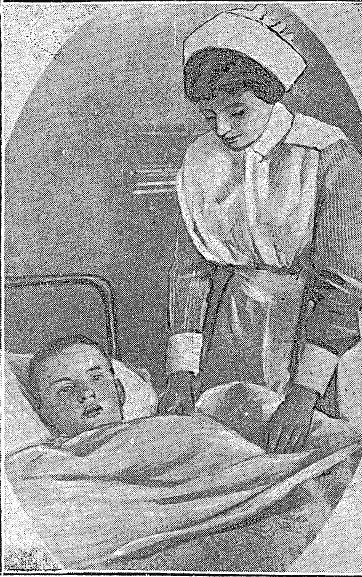
Kelly was shot in the back and a priest was called to administer to him as the staff in the nearby Jervis Hospital feared for his life. However Kelly was lucky and made a full recovery. A photo of him in his hospital bed even appeared in an edition of the Irish Independent a few days after the attack.

Indo hospital pic

Photo taken from the Irish Independent July 28th 1914: Luke Kelly, a little schoolboy, a victim of the Borderers fusilade, in a ward in Jervis Street hospital

Kelly joined the Jacobs factory as an employee at the age of 16 and continued working for them for 46 years, until his passing in 1966. During his time with Jacobs he was an accomplished athlete, he ultimately played seven seasons in the League of Ireland with Jacobs, and although at one stage he was linked with a move to Fordsons in Cork, he remained with the Biscuitmen as a player even after they dropped out of the League of Ireland and returned to the Leinster Senior League.

Though Jacobs struggled for much of Kelly’s time as a player there are numerous reports that mention Kelly as their stand-out individual performer. Such was the high regard in which he was held as a player he was also selected to play in a number of high profile friendly matches, such as a charity game in aid of St. Vincent de Paul at Christmas 1927 as well as being picked to play for Shelbourne as a guest in a benefit match against Linfield for their star player, the Irish international, Val Harris.

Jacobs were justifiably proud of the sporting achievements of their employees, apart from a football team they also constructed a swimming pool for employees, based on the example of a pool built by Heinz for their workers in Pittsburgh. Kelly was also an able swimmer, though it did get him into trouble on one occasion. In May 1932 Luke Kelly senior (then aged 27) was arrested by a Garda Burns and charged with attempted suicide by drowning in the River Liffey.

Kelly’s defence to this charge was that he had been out with friends for a drink on Sunday and after some significant alcohol consumption a bet was proposed as to whether Kelly could swim across the Liffey from Custom House Quay. As part of Kelly’s defence it was stated that he was an excellent swimmer as evidenced by the fact that although he was wearing a hat at the time it had remained dry throughout. The Judge at the hearing of the case let Kelly off on the condition that he took the pledge and kept the peace.

To return to the opening lines of this piece, the words of Pete St. John as sung by Luke Kelly, it always struck me that they apply equally well to how we hear about football and its players when we are young, father’s, olders siblings, relations and bar-room bores regaling youngsters about scarcely believeable feats of skill from years gone by. Luke Kelly Senior was a friend of John Giles’ father Dickie and one can imagine that both Luke and John heard many romanticised tales from their respective fathers about their exploits on and off the field.

Raised on songs & stories Heroes of renown/ 
The passing tales & glories…