Death in the Fifteen Acres

A hard tackle on a bare, wintry, public pitch and two players go down in a tangle of limbs. Both rising, angry words, then fists, are thrown – the referee intervenes and both players, one aged 17, the other 23, are sent from the pitch. Not the finest example of the beautiful game, but not exactly an uncommon occurrence across the parks and playing fields of Ireland. It is what happens afterwards, the minute or two of frenzied violence that is unusual and shocking, moments of chaos that leave a young man dead and will see three amateur footballers stand trial in a Dublin court for murder. This is the story of the death of Samuel O’Brien.

The Fifteen Acres

The Fifteen acres of the Phoenix Park has a legitimate claim to be the footballing heart of the city. Located in the expanse between the Magazine Fort and the Hibernian Military School (now St. Mary’s Hospital) it occupies land that were once the parade grounds and firing ranges of the British Army in Dublin. A short distance away at the North Circular Road gate-lodge the Bohemian Football club was founded in September 1890, there are reports that early members of the club included some from the Hibernian Military School among their number. Bohs first pitches were at the nearby Polo Grounds, on the other side of Chesterfield Avenue.

In 1901 the Commissioner for the Board of Public Works agreed to lay out a number of playing pitches in the area of the Fifteen Acres. Out of the thirty-one available pitches twenty-nine were used for soccer. This meant that clubs with limited means or without a pitch of their own had somewhere close to the city to play. Among those to host their early matches on the Phoenix Park pitches were St. Patrick’s Athletic from nearby Inchicore. The park pitches remain in almost constant use to this day, and their footballing significance has even made it into the public shorthand (perhaps unfairly) for poor or amateurish play, via the utterances of the likes of Eamon Dunphy declaring that “you wouldn’t see it in the Phoenix Park”.

Map held by the National Library of Ireland showing the layout of the park during the 1929 Centenary commemorations of Catholic emancipation.

This part of the park has also seen it’s share of violence. At the edge of the Fifteen acres close to Chesterfield Avenue and almost opposite to the Viceregal Lodge (now Áras an Uachtaráin) on a spot of ground now marked by a discreet commemorative cross, one of the most infamous murders in Irish history took place when, in 1882 The Invincibles murdered Lord Frederick Cavendish and Thomas Henry Burke with a set of surgical knives. Cavendish was the newly appointed Chief Secretary for Ireland, having arrived in Dublin just that day, while Burke was the Permanent Undersecretary, the most senior Irish civil servant.

During the 1916 Rising the Magazine Fort was targeted by the Irish Volunteers led by Paddy Daly. Hoping to sieze weapons and destroy British stocks of ammunition and explosives, the members of the Volunteers posed as a football team, passing a ball back and forth as a diversion, until they were close enough to rush the guards and secure the fort. One of the sentries of the fort suffered a bullet in the leg, while George Playfair Jnr. – son of the Commandant of the fort was killed by bullet wounds to the abdomen when he tried to raise the alarm. In more recent times the area just east of the fifteen acres near the Wellington monument was the site of one of the notorious GUBU murders carried out by Malcolm MacAthur when he bludgeoned to death a young nurse, Bridie Gargan, while she lay sunbathing on the grass on a summer afternoon in 1982.

The scene on matchday 1924

Returning to the match in question – a Leinster Junior Alliance division four match between Glenmore and Middleton, two Dublin teams, in the Phoenix Park. Middleton held their club meetings at 35 North Great George’s Street in the north inner city but featured several players from the southside of the inner city. Glenmore (sometimes styled as Glenmore United) were from south of the Liffey and used 30 Charlemont Street as their address.

The game took place on the 7th December 1924, on pitch 28 of the Fifteen acres, an area that remains a focal point for amateur football in Dublin City. It was a fine, dry day for the time of year, though there was a strong breeze blowing in from the west.
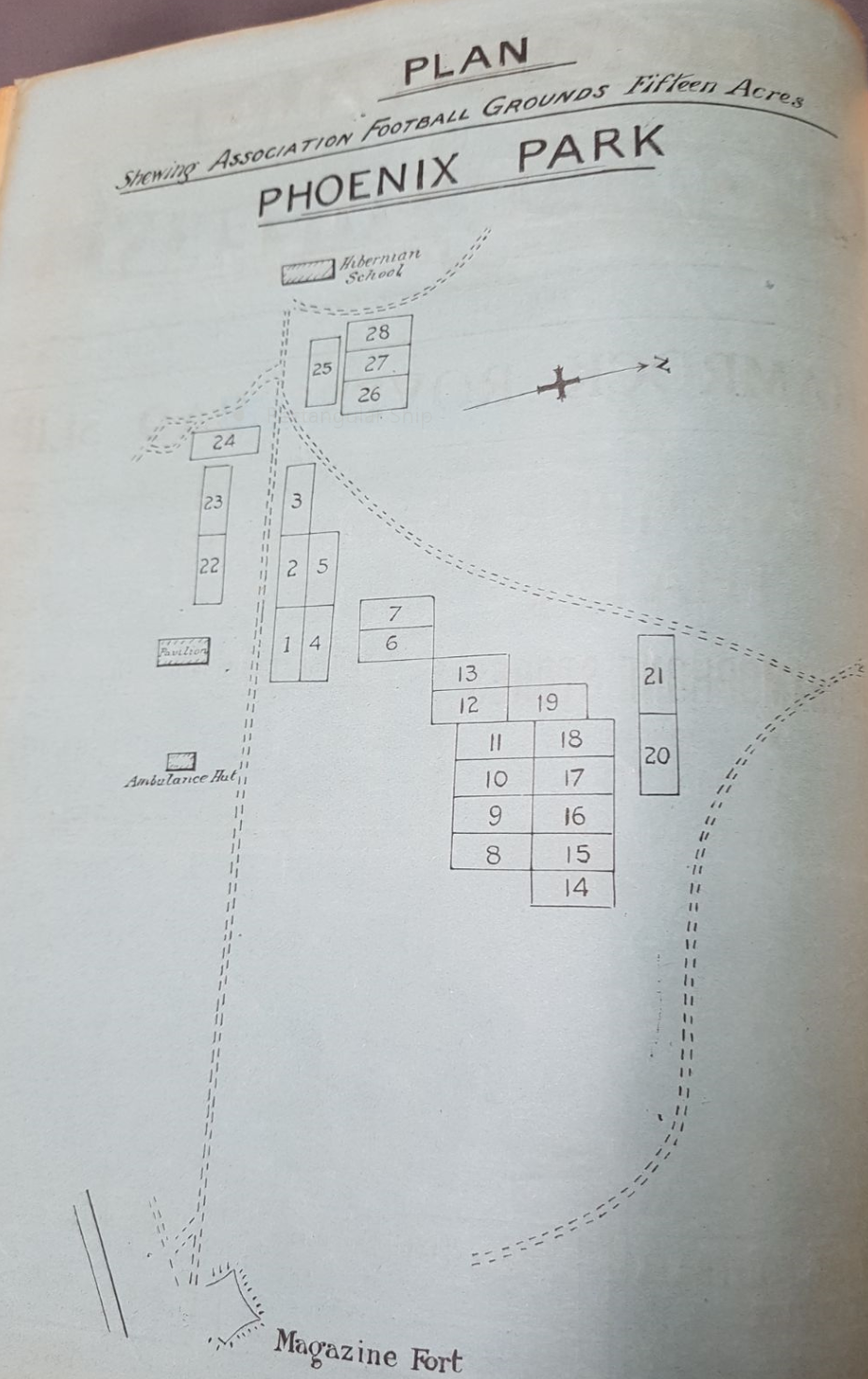
Taken from Football Sports Weekly this plan from the 1920s shows the pitch layout of the Fifteen acres as the Glenmore and Middleton players would have known it.

The game itself seems to have been proceeding relatively without incident when according to referee James Rocliffe, with a quarter of an hour remaining, Samuel O’Brien of Middleton was going through with the ball when he was tripped by Patrick Lynam of Glenmore. The referee called a foul and O’Brien, obviously aggreived at the challenge got up in “a fighting attitude” and he and Lynam rushed at each other, trading blows. At this point Rocliffe separated the pair, sent off both players and prepared to restart the game.

However, his action in sending off both players hadn’t eased tensions. The pitches of the Fifteen acres not being served with individual pitch-side dressing rooms both players went behind one of the goals after being sent from the field. Here, tempers flared again with Lynam and O’Brien trading punches and other players rushing from the pitch to intervene, just as Rocliffe was trying to restart the game.

The fatal blow?

What happened next becomes a matter for debate, one which I will try to tease out and present for the reader based on the court testimonies of those present on the day. The version of the story changes with each retelling and with each narrator. What seems to be generally agreed on is that as Lynam and O’Brien set at each other again after their sending off, other players joined the fray, ultimately O’Brien was knocked to the ground and it seems it was then that he was kicked in the head, or possibly struck his head heavily off the ground as he was knocked over. This according to the medical examiner was likely the cause of his death, aged just 23.

In the aftermath the referee retreated to the relative safety of the nearby pavillion, while Thomas Ralfe, a teammate of O’Brien, seeing that his friend was badly injured rushed to the nearby Hibernian School, then in use by the National Army, and sought help. He returned with two army officers who gave O’Brien first aid as they waited for the Dublin Corporation ambulance to arrive to take the stricken footballer the short journey to Dr. Steeven’s hospital.

The approximate location in the Phoenix Park where Samuel O’Brien was assaulted. The buildings behind the tree-line are St. Mary’s Hospital, formerly the Hibernian School.

Samuel O’Brien, arriving at the hospital unconscious, was met by the house surgeon Dr. W.A. Murphy just after 3pm that day. Murphy described O’Brien as being in a state of “profound collapse” and growing steadily worse. Despite medical intervention Murphy would pronounce O’Brien dead later that day at 7:45pm. In the post-mortem report the cause of death was identified as “paralysis of the respiratory centre caused by the compression of the brain by haemorrhage”. To the untrained eye O’Brien appeared to show just minor, superficial injuries; bruising to the right eyelid and a couple of minor abrasions around the same eye. There were no other obvious injuries or bruising to suggest trauma to major organs. It was only upon the opening of his skull that the violence he had suffered was laid plain. The entire of Samuel O’Brien’s brain was covered in blood. The haemorrhage that had killed him caused by significant trauma to the head.


Inquest

The following day, Monday, December 8th 1924 – Dr. Murphy had the opportunity to present his findings to an inquest held in Dr. Steevens’ Hospital chaired by City Coroner, Dr. Louis Byrne and a jury, to decide if the death of Samuel O’Brien should proceed to trial. When describing the injuries recieved by the deceased, Murphy stated that they could be caused by “a person being struck in the face and falling to the ground”.

Present at the inquest apart from Doctors Byrne and Murphy were a Mr. Clarke, representative of the Chief State Solicitors Department, Inspector Patrick Guinan of the Bridewell, Dublin Metropolitan Police and the three young men suspected of causing injury to Samuel O’Brien – they were Patrick Lynam, aged 17, a bookmakers clerk from St. Patrick’s Terrace off the North Strand, Michael Doyle, aged 18, at the time unemployed and living at 14 Richmond Cottages in Summerhill, and Thomas Lynam (no relation to Patrick), aged 17 from 2 Aberdeen Terrace, off the North Strand who worked in the printing business. At the inquest Patrick Lynam was at that stage the only one of the three with legal representation, in the form of a solicitor named Christopher Friery.
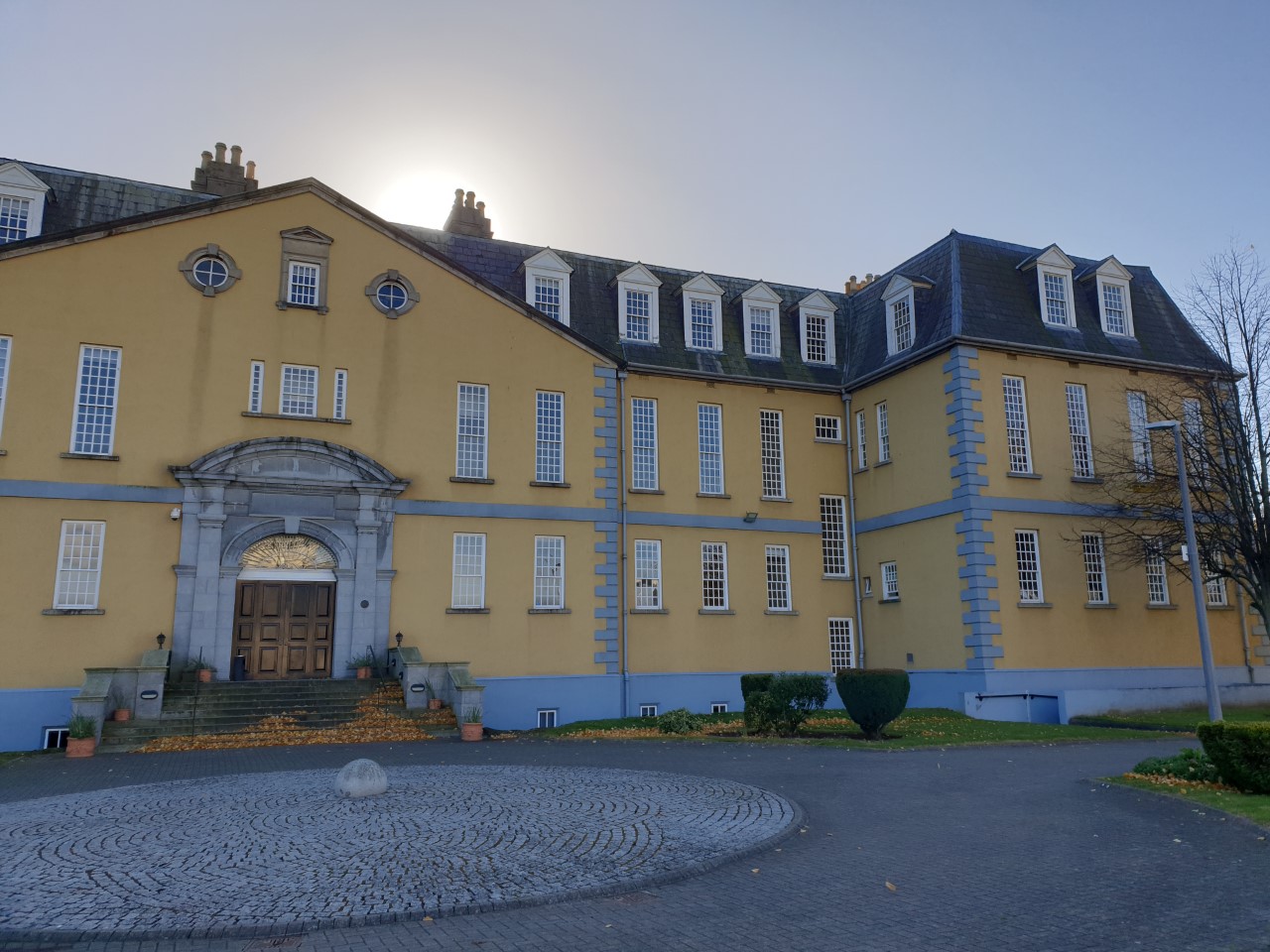
Dr. Steevens’ Hospital, site of the inquest

Also present at the inquest were a number of other witnesses including Samuel’s older brother William, the family member who had identified his brother’s body the previous day. He testified that Samuel had left in good health and spirits from the family home on Bride Street the previous day, which backed up the medical testimony which ruled out some underlying medical condition as being a possible cause for Samuel’s death. It was also at this point that Samuel’s profession was disclosed, he worked for the Irish Independent’s distribution section. Indeed their sister paper, the Evening Herald carried extensive coverage of the inquest that evening on its front page.

Other witnesses at the inquest included a number of O’Brien’s Middleton teammates; Thomas Ralph (24) and Edward Maguire (20) who as well as being fellow players were also neighbours of O’Brien on Bride Street, and Edward O’Dwyer of Palmerston Place, Broadstone, the self-described “inside-right” of the team. The other key witness was James Rocliffe (30) of 18 Summerhill, the referee on the day of the match.

It was Rocliffe who next gave evidence after William O’Brien. He noted how he knew neither team nor the men involved personally, he had merely been tasked with refereeing the game by the Association. He detailed the foul on O’Brien by Lynam and their subsequent fight which resulted in both players being sent off. Rocliffe then testified that as he was restarting the match he noticed several players rush off the field in the direction of O’Brien and Lynam, at this point he stopped the game and went to the nearby pavillion. Rocliffe testified that there was only one spectator and his two linesmen at the game that day. Rocliffe did not see further blows struck by either man and had not seen anyone else apart from Patrick Lynam strike Samuel O’Brien as by this stage he had retreated to the safety of the pavillion. When asked if he had seen blows struck like this before he replied:

I often saw rows and blows struck by men fighting on the street. It did not very often occur at football matches.

James Rocliffe quoted in the Evening Herald – 9th December 1924

It was the subsequent testimony from O’Brien’s teammates that was to be most incriminating, Thomas Ralph swore that upon seeing players running towards O’Brien and Lynam he witnessed two opposition players knock O’Brien to the ground and kick him. These two players were identified by Ralph as Thomas Lynam and Michael Doyle, and Ralph would later describe the accused issuing two “unmerciful kicks” to O’Brien, which he would state “were meant” intimating that they were deliberate, though both Lynam and Doyle denied this. Edward Maguire and Edward O’Dwyer confirmed that that they witnessed Michael Doyle kick O’Brien which Doyle strenuously denied at points during the inquest, loudly interjecting to profess his innocence and deny that he kicked O’Brien.

Summing up, the coroner Louis Byrne was moved to say that there had been no pre-existing animosity between the teams or individual players, and he looked upon Samuel O’Brien’s death as,

a tragic result of the blood of these boys “getting up” in the excitement of the game. He would be slow to attach any guilt to any party there on the evidence. His only regret was that when these young men went out to play football that they had not a better spirit of sportsmanship

Freeman’s Journal – December 10th 1924

The inquest jury found that the death of Samuel O’Brien was the result of injuries sustained on the football field. The case was referred to the Dublin District Court where Patrick Lynam, Thomas Lynam and Michael Doyle were to be charged with murder.

The courts

The initial hearing took place later that day with Justice George Cussen presiding, all three were charged with murder and placed on remand for a week with a substantial bail set in each case. All three young men denied the charges with Thomas Lynam saying “I never laid a hand or foot on him”.

When the case reconvened the following week similar evidence to the inquest was presented, however this time all three of the defendants had legal representation and Justice Cussen referred the murder case to the Dublin Circuit Court.

Irish Times headline 10th December, 1924

The Circuit Court hearing took place in February of 1925 with Justice Charles Drumgoole presiding. The state prosecution was entrusted to William Carrigan.

A prominent barrister from Tipperary – Carrigan was later made chair of the Government’s Committee on the Criminal Law Amendment and Juvenile Prostitution Acts – the Carrigan Committee for short. Carrigan was entrusted with examining the “moral condition” of the country and he heard testimony that highlighted issues such as child abuse, prostitution and the suggestions of their root causes; overcrowded tenements shared by large numbers of men, women and children with little privacy or security. Little of this made it into Carrigan’s report, though it’s findings were still too much for the Government to consider publish – the report was shelved by the Fianna Fáil Minister for Justice James Geoghegan.

But in February 1925 this was all still ahead of William Carrigan, his priority the three young men on trial for the alleged murder of Samuel O’Brien. Carrigan begins by questioning the character and attitude of the accused, stating that

The attitude of at least one of the prisoners was far from showing any regret… Their demeanour towards the court showed very little respect. It did not redound to their credit that they should meet the case with such levity as had been observed.

Cork Examiner – 26th February 1925

What “attitude” or “demeanour” was presented or how they were disrespectful is not specified. Once again the key witnesses examined were Dr. Murphy, house surgeon of Dr. Steevens’ Hosptial, the referee James Rocliffe and Middleton team-mates Thomas Ralph and Edward Maguire. Ralph and Maguire both stated that O’Brien had been kicked when on the ground, that O’Brien had tried to rise but collapsed into unconsciousness from which he would never awaken. And significantly both agreed that Michael Doyle had kicked O’Brien, while Ralph said that Thomas Lynam had also kicked him.

The focus of the defence was on medical evidence, honing in on the limited visible, superficial damage to the face of Samuel O’Brien, they asked Dr. Murphy whether it was possible that a fall after being struck in a “fair fight” could have caused the trauma which led to his death, rather than a kick to the head. Something Dr. Murphy agreed was possible.

Patrick Lynam testified that after being sent off he went up to offer O’Brien an apology and “make friends”, which O’Brien refused with the words “We’ll settle it here” before adopting a fighting stance, Lynam claimed this was the cause of the renewed row on the touchline behind the goal.

Michael Doyle claimed in his defence that he had gone to Patrick Lynam’s aid, wanting to take Lynam’s place as he felt that the, smaller Lynam, was “not a match” for O’Brien. Doyle strenuously denied kicking O’Brien but did recall being hit twice about the head by Thomas Ralph, claiming this dazed him and left him unable to remember anything for several minutes.

Ralph for his part admitted to hitting Doyle but claimed that he only did so in an attempt to protect O’Brien after he had been kicked, it was Ralph who then ran to the Hibernian School and returned with two National Army officers who administered First Aid to the unconscious Samuel O’Brien. It appears upon the realisation that O’Brien was seriously hurt, with the attendance of the Army officers and the calling of the ambulance the riotous scenes quickly dissipated. Thomas Lynam and Michael Doyle, perhaps suddenly realising the gravity of the situation even travelled in the ambulance with O’Brien and Ralph to the hospital.

Despite the earlier accusations made by William Carrigan about their demeanour the accused at both the circuit court trail and earlier had expressed their sorrow and commiserations on the death of Samuel O’Brien, and this was expressed by their Counsel in court. Carrigan, as prosecutor then decided to leave the case in the hand of the Judge rather than seek the verdict of a jury.

Judgement

This turn of events was one welcomed by Justice Dromgoole, saying that he was glad a jury had been “spared the necessity of trying to come to a conclusion in the case”, his judgement was reported as follows in the Irish Times:

These young men had no intention of inflicting any serious injury on the unfortunate young man, O’Brien; but at the same time, it was a pity that these games were not played in a little more sportsmanlike manner. These young men, he thought, had learned a lesson that would make them sportsmen and make them “play the game”. No one wanted to brand these young men as criminals, and it was greatly in their favour that two of them accompanied the deceased in the ambulance to hospital.

The three accused were bound to keep the peace by the judge and were charged the sum of £20 each, they were then discharged as free men.

A melancholy epilogue

Whether the family of Samuel O’Brien felt that they were served justice is unrecorded. We know that on the one year anniversary of his death Samuel’s family placed a remembrance notice to “our dear son, Samuel O’Brien… killed while playing football in Phoenix Park”, in the December 7th issue of the Evening Herald, their full notice readwhich reads:

Evening Herald – 7th December, 1925

A second notice appears beneath that of grieving parents Bridget and Samuel Snr. It is also in memory of Samuel and signed off “by his ever-affectionate Ann”, little other information is mentioned to help identify this likely girlfriend of Samuel’s but it contains a touching snippet of verse from “The Heart Bowed Down” taken from Michael William Balfe’s “The Bohemian Girl”.

Memory is the only friend,

That grief can call its own.

The O’Brien family had already suffered their fair share of tragedy by the time of Samuel’s death. His young cousin, Paul Ludlow, who also lived in the same Bride Street tenement building as the O’Brien family had died in February of 1924 of the pulmonary infection aged just 17. He was obviously particularly close to Samuel and Bridget O’Brien who continued placing notices in newspapers mourning their nephew years after his death.

OSI historical Map showing the section of Bride Street where the O’Brien family lived as it appeared in the early 20th Century

Further tragedy struck the family in later years, when, just after 10 o’clock of the morning of the 1st June, 1941, their home in 46 Bride Street collapsed with many of the O’Brien family still in their top floor flat at the house. Samuel O’Brien senior, by then 72 years of age and pensioned off from his job with Guinnesses was killed in the collapse by falling masonary. His wife Bridget and daughters Georgina and Elizabeth were also injured, and of the three only Elizabeth was well enough to attend her father’s funeral three days later.

Also killed in the house collapse were Bridget Lynskey and her six month old son Noel. Bridget’s husband Francis had applied several times to the Corporation for a new home, and in a cruel twist of fate the Lynskey family had just received keys to a new Corporation house on Cooley Road in Crumlin and were due to move there in the coming days.

Image of Bride Street from the Irish Times the day following the collapse

The story of the tenement collapse on Bride Street is perhaps less well remembered than similar events which occured on Church Street in 1913 or on Bolton Street and Fenian Street in 1963. Perhaps because the Bride Street collapse happened just a day after the bombing of the North Strand by the Luftwaffe which may have overshadowed events and dominated popular memory. Indeed the bombing of the North Strand and the impact of the Nazi bombs was cited as one possible cause for the collapse of the more than 100 year old buildings on Bride Street. Neighbouring buildings at 45 and 47 Bride Street were torn down by Dublin Corporation with many of the displaced residents moved to recently developed houses in Crumlin and Drimnagh, including the surviving O’Brien’s who eventually settled in Galtymore Road. An inquest extended sympathy to the relatives of the deceased and agreed that vibrations from the North Strand bombing coupled with the age of the house were the likely causes of the collapse, they found the landlords, the Boland family, not to have been at fault. The site of the collapsed tenement is now occupied by the National Archives building.

Almost 17 years apart Samuel O’Brien, father and son met their end in violent and unexpected circumstances, and cruel chance. One wonders if the O’Brien family having suffered so much felt they had experienced justice for their losses.

Tim Carey’s excellent book “Dublin since 1922” mentions both the Carrigan report and the Bride Street tenement collapse and is well worth a read. Michael Kielty was helpful as always in finding out details relating to Glenmore and Middleton football clubs. Thanks also to Andrew Lacey, and Amanda Lacey (née O’Brien) for further information on the O’Brien family. You can listen to this episode in podcast form here.

Who you calling scab? – Bohs, Shels and the 1913 lockout

I grew up always knowing never to cross a picket line. My father had been Chairman of a Trade Union, my mother had been a shop steward, they had both been involved in strikes during their working life, it was something I was instilled with from an early age and have always abided by. Which is why, when researching the history of Bohemian F.C. I was troubled by the accusations of scabbing levelled at players of the club during the momentous beginnings of the 1913 Lock-out. Despite this event occuring some 107 years ago the allegations still cast a small stain on the good name of the club and is invoked as an insult at regular enough intervals by supporters of rival teams, even to this day.

I did however, want to know more, who were the players involved? Could we speculate as to their circumstances? What happened to them afterwards? What had prompted Jim Larkin to call for action in a speech to the public during the early days of the lockout?

The more I researched these events, the harder it was to find definite answers to these questions, in fact, the more I researched the more confused things seemed to become. At this point it might be worth relating the story as conventionally told of the Bohs scabs accusations.

On Friday August 29th 1913, a day before Bohemians and Shelbourne were due to play a friendly match to inaugurate Shelbourne Park, James Larkin made a speech on Beresford Place to a crowd of almost 10,000 people, including many striking tram workers. Larkin had just learned that the proposed mass meeting scheduled for that Sunday (what would soon become known as one of Irish history’s many Bloody Sundays) had been banned by a Dublin Magistrate. Larkin burned the judge’s proclamation and in a lengthy speech, covering many topics he mentioned the upcoming football match with Bohs and Shels. Quoting Larkin the Evening Herald reported his words as follows;

Mr. Larkin said that Millar and Hastings of the Bohemians were scabs. “I want you” Mr. Larkin continued, “to assemble in O’Connell Street at twelve o’clock to-morrow, board the tram cars, go out as far as you can and pay no money. Then if they want to prosecute you give your name and address. Moral persuasion and pay no rents are our weapons”

There are other sources that report on this meeting and Larkin’s speeches, writing for the Come Here To Me blog, Donal Fallon shared the following extract from Arnold Wright’s first hand account of events in Disturbed Dublin ;

The opening scene, in what was to prove a prolonged and sanguinary drama, was enacted in the Ringsend district. In his speech on Friday night Mr. Larkin had referred to a football match which was to be played on Saturday on the Shelbourne Ground at Ringsend between two local clubs. ‘ There are ” scabs ” in one of the teams, and you will not be there except as pickets,’ he said, in language whose menacing character was understood by those who heard him. In obedience to the implied command, a large body of members of the Transport Workers’ Union gathered at the time announced for the match near the entrance to the grounds.

Arnold does not mention the players by name as the report in the Herald does and neither does it identify which team was accused of having scabs. After the meeting had ended there were clashes with those attending the rally and the Dublin Metropolitan Police which set an ominous tone for what was to unfold over the coming days.

Writing in his excellent and authoritative study of the Lock-out, Lock-out, Dublin 1913, Padraig Yeates writes the following, also citing the Irish Times,

The trouble began outside the new grounds of Shelbourne Football Club. About six thousand spectators had come to watch a match with Bohemians, the team that Larkin had accused of using ‘scabs’. A picket of about a hundred tramway men stood outside the gate and were jeered by some of the football crowd. The pickets retaliated in kind and were in joined by growing numbers of sympathetic locals. ‘The members of the Bohemian team, who pluckily drove to the scene of the match on outside cars through a hostile crowd of roughs were assailed with coarse epithets’, the Times reported.

The historian Neal Garnham in his history of football, Association Football and Society in Pre-partition Ireland, also mentions the match but sows the first real seeds of doubt as to the identity of the scabs and the teams they played for, he writes;

On 30 August 1913 the Irish Worker, the official newspaper of the Irish Transport and General Workers’ Union denounced two Dublin players – Jack Millar of the Bohemian club and Jack Lowry of Shelbourne – as scabs.

Here, for the first time we see mentioned the full names of the two supposed scabs, the Millar mentioned in the Herald report is revealed to be a Jack Millar while the other player is identified not as a Bohemians player, but as a Shelbourne one, Jack Lowry, there is no mention of a “Hastings”. Crucially Garnham also mentions a new source, the Irish Worker, the newspaper of the ITGWU, the Union that represented the tram workers, and a paper that Larkin had founded, edited and featured in regularly. Having read the relevant issues of the Irish Worker cover to cover (it’s Covid, what else would I be doing) I found the reference to Jack Lowry of Shelbourne in the edition of the 30th September and a mention of a Jack Millar in the edition on the 27th. Under the heading “Retail dept. O’Connell Street (scabs)” it includes among a list the name “Jack Millar, Phibsboro’ Bohemian AFC”.

Clipping for the Irish Worker on 30th August 1913 from a article entitled ‘scabs’ which identifies Jack Lowry of Shelbourne

It is important to note that Lowry is not mentioned as being a Shelbourne player, merely a “prominent member” while no further information is given on Millar other than the fact that he lives in Phibsboro. In-club trial matches were played by both Shelbourne and Bohemians a week before the game, and before any scabbing accusations – there is no mention of a Lowry nor Millar (or Hastings) among the forty-four players used by both clubs across these games, or in the final line-ups selected for the much anticipated game to inaugurate Shelbourne Park on Saturday August 30th 1913.

Shelbourne had become the first Dublin side to begin the practice of paying players, though the club was not full time and would have still featured amateur players and others who would have day jobs away from the football field. The new 1913-14 season had seen them invest heavily in cross-channel talent, signing defender Oscar Linkson from Manchester United, David Neave from Merthyr Town, Robert Carmichael from Clyde while Andrew Osbourne, a British soldier had signed up as their new centre forward. Osbourne was part of the 16th Queen’s Lancers who were then based in the Curragh.

Images from the game as published in the Irish Times

As Yeates noted in his account there was indeed trouble outside the ground, pickets were formed, and those on the pickets tried to force entry to the ground at one stage, and some even successfully gained entry and “hurled vile language” at the players. It was also claimed that incidents involving a crowd attacking trams was only brought to an end when “one of the passengers jumped from the tram, produced a revolver, and effectively dispersed the crowd.” as the Irish Times reported. A Sergeant Keane of the DMP spoke about crowds of perhaps 1,000 gathering in Ringsend who were “hostile to the club” in all reports in which Keane is interviewed the week following the riots there is no mention of Bohemians and the hostility is stated to be directed towards Shelbourne, or perhaps Keane not appreciating the nature of the game and just assumed this as they were the home team?

But who were the players subjected to this “vile language”? While I have introduced some of Shels new signings, English and Scottish professionals among them, there were of course no professionals in the Bohemians team as the club was at that point still strictly amateur. Could one of the Bohs players have been the Millar mentioned by Larkin, but merely called out under a mistaken name, could there still have been a scab?

The starting XIs for both Bohemians and Shelbourne as reported in the Freeman’s Journal on 30th August 1913

After much research I believe I have identified all the Bohemians players listed and their occupations, this is based on earlier research on players who served during World War I as well as reviews of the players listed at Bohemians in 1913 from their team line-ups. I have given them a quick biographical outline below:

Goalkeeper: J. Cooke – an interesting one to begin with as this is an alias, Cooke was the name of the Bohemian trainer, George Cooke, usually the trainer’s name would be used as a cover as Bohs players did on occasion miss work duties to play a match. Could this be the Millar that was mentioned by Larkin under an assumed name? This would be highly unlikely. Bohs two main goalkeepers at the time were Jack Hehir and Fred Chestnutt-Chesney. Hehir, who had won an international cap in 1910 and was club captain for 1913 and well established at Bohs, he worked as a Civil Service clerk in the estates office and later in 1915 was transferred to London to work in the War Office.

Fred Chestnutt-Chesney was a Trinity College student studying Divinity. He later became a Church of Ireland Reverend in Belfast and then London. Chestnutt-Chesney had also commanded a company at the battle of Passchendaele and reached the rank of Major. In 1920 when working in the parish of Ballymacarrett in East Belfast he helped organise volunteer groups to try and stop rioting and protect Catholic residents during the riots after the shooting of RIC Inspector Oswald Swanzy.

Full back: William George McConnell was a commercial traveller in the drapery trade at the time. He and his family established the McConnell’s advertising agency in 1916 which continued to trade up until 2010. McConnell won six international caps for Ireland and was an important part of the squad that won the Home Nations championship of 1914. McConnell also found significant success as an amateur golfer being successful enough to triumph in the 1925 and 1929 West of Ireland Amateur Championships.

Full back: Joseph Irons worked on the staff at the Viceregal Lodge (now Áras an Uachtaráin) and was a member of the Army reserve and on the outbreak of the First World War was called up. He didn’t go far initially, being was on guard duty at the Viceregal Lodge during Easter 1916 though he later served time in the Dardanelles campaign. He was also a useful cricket player.

Half back: Jocelyn Rowe was born in Kingston upon Thames in 1886, he had briefly played for Manchester United. He was a professional soldier and was a Sergeant in the 1st Battalion, East Surreys Regiment and was wounded in action during World War I.

Half back: Alfred J. Smith, born in Ireland, Smith was a professional soldier (rank of Sergeant Major) in the Army Service Corps and was wounded in action during World War I. He had been capped at amateur level by Ireland in a 3-2 win over England in 1912. He scored in that match along with his Bohs teammates Johnny McDonnell and Ted Seymour.

Centre back: Bartholomew “Battie” Brennan, was a railway clerk for the Great Southern & Western Railway. This means that Brennan is the only player with any connection to the transport industry. However, the Great Southern was a completely separate company to the Dublin United Tramway Company (DUTC) whose drivers and conductors were on strike. William Martin Murphy the owner of the DUTC used his own former drivers and office staff to fill the roles of the striking workers. Brennan’s name also bears no similarity to the names Millar or Hastings and is unlikely to be confused with them. Brennan was a high profile member of the Bohs squad, he had been a regular for the club since 1910 and had scored against Wales in a 3-2 win for Ireland in 1912. He later set up his own company, Dublin Wholesale Newsagency, who imported and sold newspapers, they were based on Abbey Street.

John Bartholomew “Battie” Brennan

Outside right: Thomas William Gerald Johnson, only 20 at the time of the match was a medical student from Rathmines. He was another fine sporting all-rounder with a talent for both cricket and golf. During the First World War Johnson became a Lieutenant in the 5th Connaught Rangers and later brought his professional talents to the Royal Army Medical Corps. He was awarded the Military Cross for his actions at Gallipoli. He received numerous citations for bravery, for example at the Battle of Lone Pine during the Gallipoli campaign the Battalion history notes “Second-Lieutenant T.W.G. Johnson behaved with great gallantry in holding an advanced trench during one of the counter-attacks. Twice he bound up men’s wounds under heavy fire, thereby saving their lives”. After the War he worked as a GP in both Ireland and England.

Inside right: Fred Morrow was born in Belfast but grew up in Sandymout, Dublin, one of the youngest men on the pitch at only 17. He was still at school and would later play for Shels while also briefly working as a clerk before joining the British Army (Royal Field Artillery) in 1915. Corporal Fred Morrow died of his wounds in France in October 1917 aged 21.

Centre forward: Johnny McDonnell, not the popular former St. Pat’s manager but the prolific centre-forward of Bohemians. McDonnell had won his fourth and final Irish cap in January of 1913. He also scored more than 150 goals for Bohemians during his career. He was originally from Athlone and was a talented Gaelic footballer and hurler for Westmeath. McDonnell worked for more than fifty years in the Post Office, transferring from Athlone to Dublin and later becoming Private Secretary to the Minister for Posts and Telegraphs and by 1926, after the formation of the Free State, he ended up in charge of programming for Raidió Éireann.

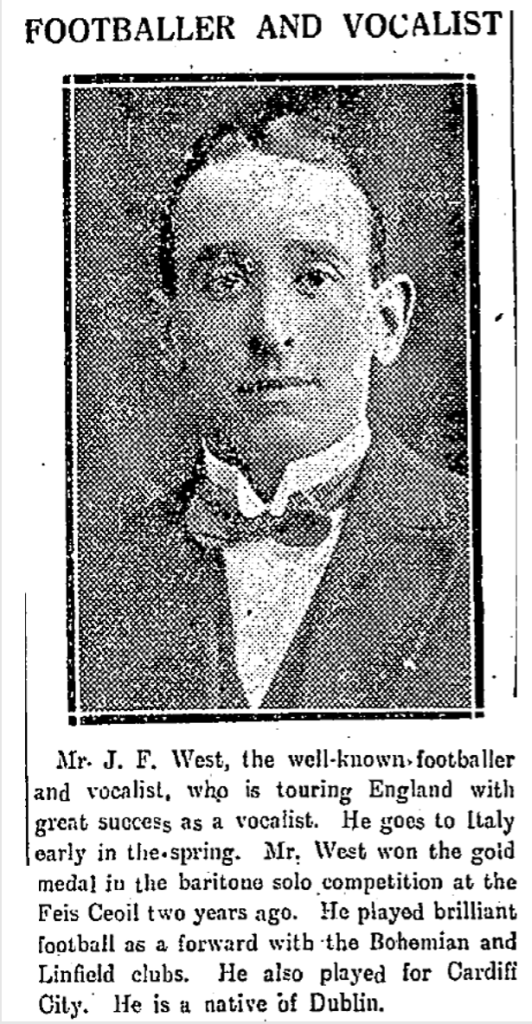
Inside left: Johnny “Dodger” West was 24 at the time of the match, he’d been playing for Bohemians since at least 1909. West was born in England, but grew up in Glasnevin, Dublin, his father was a Cork man who worked in the Ordnance survey and John followed in his father’s footsteps in this regard. In the 1911 Census his job is listed as an Ordnance Survey Temporary Civil Assistant Computer. In the early 1920s, owing to his fine baritone voice he pursued a singing career and would tour England and Italy while also featuring on the stage of major Dublin venues like the Theatre Royal.

A clipping of West from the Freeman’s Journal in January 1920

Outside left: Harry Willits was born in Middlesborough, England in 1889 but moved to Dublin in 1908 to take up a Civil Service post and quickly joined Bohemians, staying involved with the club as a player and administrator for decades. Willits initially worked in the Post Office stores before eventually moving to work in the Registry of Deeds where he stayed until retirement. For further reading on Willits see here.

A Bohemian FC team from the 1913-14 season

As is demonstrated there is no Millar and no Hastings in the Bohs first team, nor one in the wider squad either that played in the earlier trial game ahead of the season opening friendly match. There are no Millars or Millers or Hastings in the Bohs “B” team which played in the Leinster Senior League system that I could find either. Nor are there any Millar/Millers or Hastings listed in any senior management or committee role at the time with the club. Digging deeper and going back to the previous seasons the only mentions I could find are of two players (perhaps brothers) with the surname Millar occasionally playing for Bohemian “C” and “D” teams, though neither ever progressed higher than that level and are not recorded in any match report that I could find for the 1913-14 season even at “C” , “D” and “E” team level.

Each of the players who played that fateful day in Shelbourne Park was in another form of employment, mainly as clerks and civil servants with a couple of soldiers and students thrown in. None were in any role or profession that could lead them to being accused of scabbing during the tram strike.

Further mysteries then? Well, one more tantalising lead appears in the 20th September 1913 edition of the Irish Worker, some three weeks after the Bohs match, under the heading “Shelbourne Football Grounds”, this short article seems to be an attempt to explain, apologise or simply win back fans to Shelbourne games. No players are mentioned by name although the “engagement of players who were blacklegging” is mentioned. It further states that an “understanding has been arrived at, and we may state that Shelbourne Football Club were in no way to blame for what occurred.” No detail is given on what “understanding” was reached while the line stating that the club were in no way to blame is vague and unspecific.

Did this mean that Shels are denying that there were scabs on their team? This seems unlikely as they acknowledge that players were engaged “who were blacklegging” ? It perhaps seems more likely to be a move to show that the club was unaware of any players blacklegging/scabbing and to excuse themselves of any blame? The message is not signed off on behalf of any club director or member so its specific origin is unclear, though it ends with the rousing call to arms – “Comrades, assemble at all matches.”

Taken from the 20th September 1913 edition of the Irish Worker

The exact truth of what happened may never be known. Larkin and the ITGWU were, by the end of August 1913, already in a fierce battle with William Martin Murphy, and soon other major employers, the courts and the media, much of it controlled by Murphy himself. The pages of Murphy’s newspapers revelled in reports which painted pictures of full trams heading to the RDS for events around this time, staffed by scab labour and patronised by an apathetic Dublin populace. The Irish Worker fought back denouncing Murphy and anyone viewed to be in league with him, or sympathetic to him. Many of those who are accused of scabbing are not only named in his paper but given small pen-pics, with nicknames and personality traits being described in cutting detail.

All we know of the Jack Lowry that is mentioned is that he was a “member” of Shelbourne, and of Millar that he lived in Phibsboro, there is little biographical detail to work with. It should be noted that the Irish Worker did get things wrong, there are also retractions in the paper with individuals or businesses called out in the pages of the Worker that are later found to be fair employers or to have been unjustly labelled as scabs. Could this be the case here?

Was the mention of the football players as scabs perhaps part of a protest tactic by Larkin? Consider that he had just heard that a court proclamation had been issued preventing him from holding a meeting and he knew the following day that a major sport event, well-serviced by trams would be taking place. The opening of Shelbourne Park had been well publicised and thousands were expected. Was this Larkin seeing a clever way of creating a scene, of challenging the employers’ cabal by focusing on a large public event for maximum publicity. Did he create the scab footballers? Or perhaps exaggerate a claim or hearsay? Or were there people who were scabs associated with Bohemians and Shelbourne, perhaps not as first team players but prominent in some other way, members, former players, other well-known supporters?

We may never know but I would be interested to hear from any reader who has more information on this historic match and the tumultuous scenes that surrounded it. Despite these remaining uncertainties I hope I have done justice to the names of the eleven Bohemians who took the field over a hundred years ago, they may have been many things but scabs they were not.

My thanks to the following for their assistance in researching this piece, Donal Fallon, Ruaidhrí Croke, Stephen Burke and Aidan Geraghty. The work of Padraig Yeates has also been of significant benefit.

The life and career of Jimmy Dunne

The football highlights don’t do justice to the man but let’s recount them anyway. One of only three players in the history of the English top-flight to score 30+ league goals across three consecutive seasons, the most recent is Alan Shearer. The record for the longest scoring streak in English league football; scoring in 12 consecutive games, a league Champion with Arsenal, a League of Ireland and FAI Cup winner, national team record goal-scorer for 28 years. Not a bad football CV – it belongs to Jimmy Dunne.

But there is so much more to Dunne than  90-year-old scoring records. He was born on Cambridge Street in Ringsend in 1905 the son of Thomas and Catherine Dunne. Thomas was a bottle blower in the nearby glass bottle works. The Dunne family’s life was far from easy, of the eight children born to Catherine only four survived, with Jimmy being the youngest.

A further blow to the family occurred with the death of Thomas from tuberculosis when Jimmy was just two years of age. To make ends meet the newly widowed Catherine took in lodgers to their small, two-room tenement home, while Jimmy’s older brother Michael was working at the glass bottle works by the age of 14. Local stories record that Jimmy himself got a job for a local bakery as a delivery boy, bringing fresh bread, and occasionally secret IRA communications, on his bicycle around the city.

As a teenager his Republican sympathies continued, and along with his brother Christy he took the anti-Treaty side in the Civil War, eventually being interned in both Portlaoise and the Tintown camp in the Curragh after being arrested during the “Bridges Job” of August 1922 when anti-Treaty forces sabotaged various roads and bridges throughout Dublin. The association game proved popular in the internment camps and playing with rag-balls in tight confines no doubt honed Dunne’s touch and control. Upon his release in 1923 he played briefly for junior club Parkview before he joined Shamrock Rovers and made his debut for Rovers “B” against Pioneers in the Leinster Senior League in December of that year. While he was a Shield winner with Rovers an extended run in the first team was limited by the dominance and scoring prowess of Billy “Juicy” Farrell at centre forward.

Frustrated at the lack of opportunities Jimmy joined New Brighton (on Merseyside not to be confused with Brighton on the South Coast) in the old English Third Division North for the 1925-26 season.

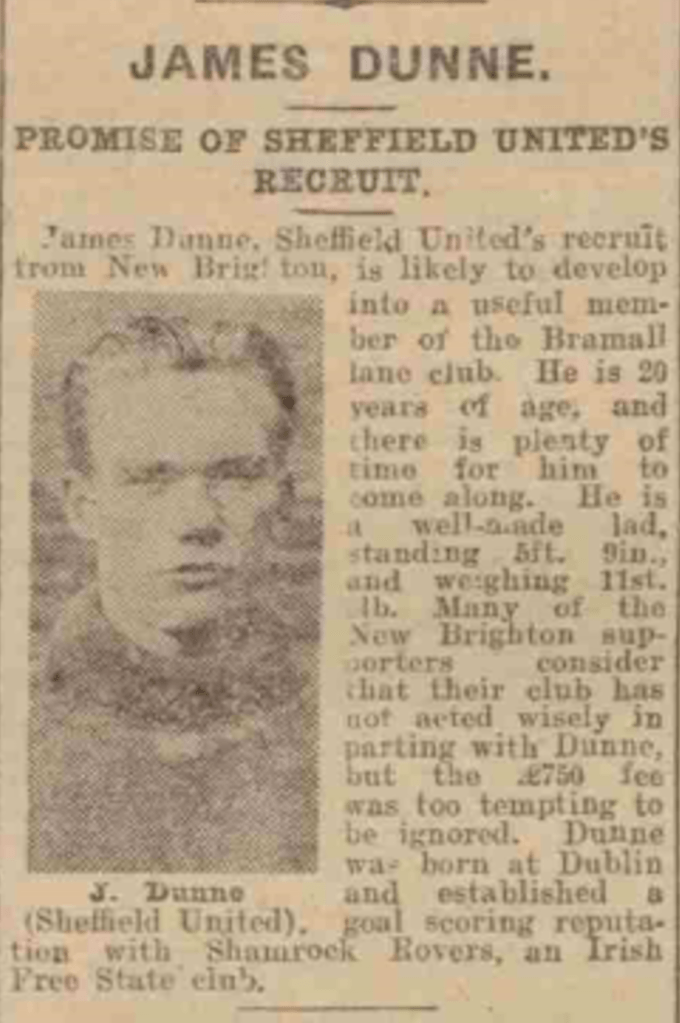
His time on Merseyside was brief however, he made an impressive start to his career, scoring on his debut against Rochdale and registering six goals in eight league games as well as scoring in the cup, this quickly brought him to the attention of Sheffield United’s secretary John Nicholson who signed him for a fee reported between £750 – £800. Apparently this swift turnaround for Dunne, who had gone from Leinster Senior League to the top of the English football pyramid in less than year, was completely unexpected and the modest Dunne had to be persuaded that his future lay in the First Division.

A young Jimmy Dunne after signing for Sheffield United – 1926

As before with “Juicy” Farrell the path to first team football was initially blocked, this time in the form of Harry Johnson. Dunne spent much of the next three seasons in the reserves, making only occasional appearances and at one stage was on the verge of being transfer listed. However, the 1929-30 season would be his breakthrough year, scoring 36 in 39 league games to keep Sheffield United clear of relegation by the old method of goal ratio. Dunne’s amazing run continued with the 1930-31 season being his best ever 41 goals in 41 league games (a record for an Irish player in the English top-flight) and 50 in all competitions. The following seasons brought more goals, significant improvements in United’s league positions and interest from other clubs, especially from Arsenal and their legendary manager Herbert Chapman.

Sheffield United rebuffed an initial approach of £10,000 as they wanted a record £12,000 for Dunne, however Chapman played the waiting game, and with the 1933-34 season underway United found themselves in financial trouble. Chapman boarded an early train and had Dunne signed up for a reduced fee of just over £8,000. Dunne went right into the team and helped Arsenal to the League title, though the manager who signed him, died suddenly in January 1934. Soon after Ted Drake arrived from Southampton, and it would be the goals of Drake, not Dunne that would propel the Gunners to the title again the following season. Drake’s excellent form effectively ended Dunne’s Arsenal career, and belatedly Jimmy Dunne would end up as Drake’s replacement by signing for a struggling Southampton for the 1936-37 season. He would be the club’s top scorer that season and helped them avoid relegation to the third tier.

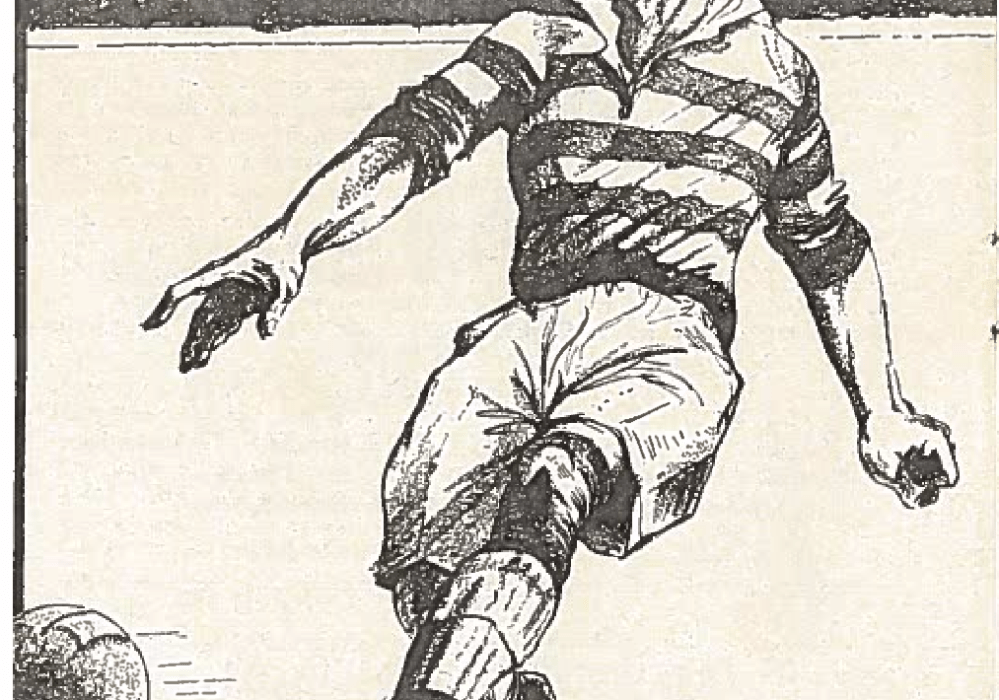
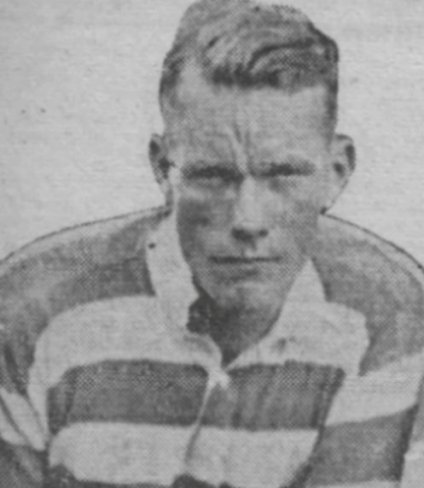
Dunne, from the numerous reports and descriptions of him as a player, and the very limited footage of him in action, appears as a complete centre forward, he had a good touch and ball control, no doubt honed as a teenager during times of confinement, he was strong and robust, quick off the mark and could shoot with power with either foot. He was versatile enough to drop deeper and play in the more creative role as an inside forward, however, all sources describe his greatest asset as his heading ability. Despite his height being listed as 5’10” the blonde head of Dunne struck fear into defences across Europe. He once scored a hat-trick of headers in a game for Sheffield United against Portsmouth and the innovative coach Jimmy Hogan (himself the son of Irish immigrants) chose Dunne as the player to demonstrate the skill of heading in an instructional coaching film that he made in the 1930s. In an interesting article with Dunne in the Sunday Pictorial while at Arsenal he even mentions having watched the famously skillful and scheming Austrian centre-forward Matthias Sindelar play, nothing the effectiveness of his “withdrawn striker” or “false 9” role as we would know it today. This demonstated Dunne’s keen eye for positioning and tactical possibilities.

While Dunne could have stayed an extra season at The Dell he chose to return home to Dublin and Shamrock Rovers as a player-coach. Though now into his 30s Dunne’s passion was undimmed and helped Rovers to back to back league titles as well as victory in the 1940 FAI Cup. Despite his advancing years these would be his most productive days in the Green of Ireland, in fact, Dunne won 14 of the 15 caps awarded to him by FAI after the age of 30. While Sheffield United released Dunne for seven IFA games during his time with them they very rarely released him for any FAI squads, this was mainly due to the fact that IFA matches coincided with the English national team game while FAI games had to work to other schedules that made English club reluctant to release players. Despite this Dunne amassed 15 caps and scored a record 13 goals which stood until broken by Noel Cantwell in 1967.

jimmydunne

One incident of note was that Dunne was released to the IFA by Sheffield United for a game against Scotland in Ibrox. The goalkeeper Tom Farquharson, born in Dublin, withdrew from the squad and wrote to the IFA stating that he only recognised the FAI as the representative Association for Ireland. Dublin-born Harry Duggan followed suit and there was some expectation that Dunne, another Dubliner would do likewise. Without any guidance from the FAI about whether he should play or not Dunne travelled to Scotland.  However, Dunne received a letter, sent to Ibrox from Belfast which called him a “traitor to his country” and threatened him with death for playing for an IFA selection. Dunne started the game and duly scored in a 3-1 defeat to the Scots.

If fixtures had been different or UEFA dictats that today require clubs to release players for internationals had existed magine what he could have achieved had he worn the jersey for Ireland in his goalscoring prime with Sheffield United? Perhaps he could have made the difference in qualifying for the 1934 World Cup? Dunne continued playing into the 1940s, although the War had put an end to his international career. His final game for Ireland being a controversial match against Germany in Bremen in May 1939. Dunne was injured in the game but returned to the pitch and had a huge influence as Ireland drew 1-1.

His playing career finished in slightly acrimonious fashion, when aged 37 he was pressured into not playing in a FAI Cup semi-final by the owners of Shamrock Rovers. Dunne, hung up his boots and left the club to take the reins as coach across the city at Bohemians in 1942. Dunne would improve the fortunes of the Gypsies and led them to victory in the Inter-City Cup in 1945, before eventually rifts were healed with Shamrock Rovers and he returned to them as coach in 1947. Dunne was now a full-time coach with Rovers and gave up his job with boiler manufacturers Babcock and Wilcox.

The Irish football world was plunged into mourning in November 1949 when Jimmy Dunne passed away suddenly. His day had been a usual one, and he even spent time watching the Swedish national team train in Dublin ahead of their match with Ireland. Dunne was keen to talk football with their English coach George Raynor before he passed away suddenly after returning to his home on the Tritonville Road and suffered a heart attack.

It is no exaggeration to say that his footballing legacy endured, whether at Rovers in the form of the likes of Paddy Coad who succeeded him, or with his own family with his sons Jimmy Jnr. and Tommy becoming footballers, as well as his nephews, another Tommy Dunne and Christy Doyle.

While almost always referenced as being quiet apart from occasionally accompanying teammates in a sing-song on his button-accordian, mild-mannered, and gentlemanly in demeanour Dunne, in his playing style was robust and fearless. It is worth remembering he had been part of a revolutionary movement in his youth, he was the man who roared “Remember Aughrim, Remember 1916!” to psyche up his teammates before that match in Bremen against Nazi Germany in 1939 and who left his beloved Rovers because of interference from the Cunningham family, he even defied death threats to play for the IFA selection against Scotland in 1931, he was certainly a man who knew his own mind and could stand up for himself. He should also be remembered as one of the greatest strikers this island has ever produced.

The cover of a match programme from a Jimmy Dunne memorial game in 1952 featuring the two teams that Dunne had coached (courtesy Ruairí Devlin)