World Cup of Hockey- Toronto 2016

If your old enough you might remember a bit of a fad in the early to mid 90’s for Ice Hockey in Ireland, well when I say Ice Hockey I really mean roller hockey; kids on roller-blades in oversized Chicago Blackhawks jerseys skating around suburban cul-de-sacs with hockey sticks. There were a few possible explanations for this fad, the growth in popularity of inline skates, the Mighty Ducks film franchise, as well as hockey cropping up in the likes of Wayne’s World, even that brief moment when super-baggy Ice Hockey jerseys were fashionable for about a month in 1995. For me the hook was the Sega mega-drive and the video game classic that is NHL 94, all Hockey Organ music and 16-bit power play bliss. The game was so popular it even crops up in the Vince Vaughan/Jon Favreau comedy Swingerwhere Vaughan’s character notes the exceptional video game talent of Chicago’s Jeremy Roenick.

Following actual live, non-sega based American sport was a bit harder for an Irish kid in the 90’s. There was the time difference, there was trying to find NHL or the NBA on television. For basketball there was sporadic coverage on Channel 4 and I seem to remember Eurosport(?) showing the NCAA Basketball championships for a couple of years. Dial-up internet wasn’t exactly ready for live streaming of sports so anything else tended to be going around to friends houses where they had good Sky Sport packages to see the odd game.

However I’d always kept a passing interest in the NHL and have been known to indulge in slightly boozy hockey conversations with Canadian tourists in some of Dublin’s finer hostelries. On that basis I had to try and catch a game on a recent trip to Toronto. It was mid September and most days were balmy mid 20’s so not exactly Ice Hockey weather and it was still a few weeks out from the start of the NHL season so no chance to see the Toronto Maple Leafs. The Maple Leafs are one of the “Original Six” founding members of the NHL and have 13 Stanley Cups to their name, though they haven’t won the title in the fifty years since the expansion of the League.

The Maple Leafs play their home games in the impressive indoor arena of the Air Canada Centre, located in downtown Toronto just behind Union Station. The arena also hosts Canada’s only existing NBA team, the Toronto Raptors. They can apparently change over from one sport to another in the space of just six hours. During my visit the Centre was also hosting the Ice Hockey World Cup, that’s the entire World Cup schedule, kind of like the idea for the Centenario in Montevideo for the first football World Cup in 1930.

a9f7051e-e55c-44e5-beb3-acdaffa6bf25

Toronto Maple Leafs hall of famers

The hockey World Cup isn’t really comparable with the current version of the FIFA World Cup however, it features only 8 sides for a starter, it occurs somewhat irregularly and features a couple of what you might term hybrid teams. This edition was the first World Cup held since 2004 and only the third ever overall. The World Cup itself was a successor to the invitational Canada Cup tournament that had been held from the 1970s onward. The idea is that in future the World Cup will be held regularly in four year cycles in the month of September. There are a few obvious advantages to this, the International Ice Hockey Federation’s (IIHF) annual World Championship tends to take place during the playoffs of the NHL season meaning that many top players are not released to take part. As the World Cup is organised by the NHL before their pre-season begins it will avoid this conflict and in theory ensure the best players can compete.

Those taking part in the tournament include International Hockey’s “Big Six” of the USA, Canada, Russia, Czech Republic, Sweden and Finland as well as “Europe” a team made up of the best of the rest European players from Austria, Denmark, France, Germany, Norway, Slovakia, Slovenia and Switzerland. The eighth side was North America, a Canada/USA selection of players aged 23 or under which also had the effect of making the individual Canadian and USA teams to be made up of players aged 24 and over.
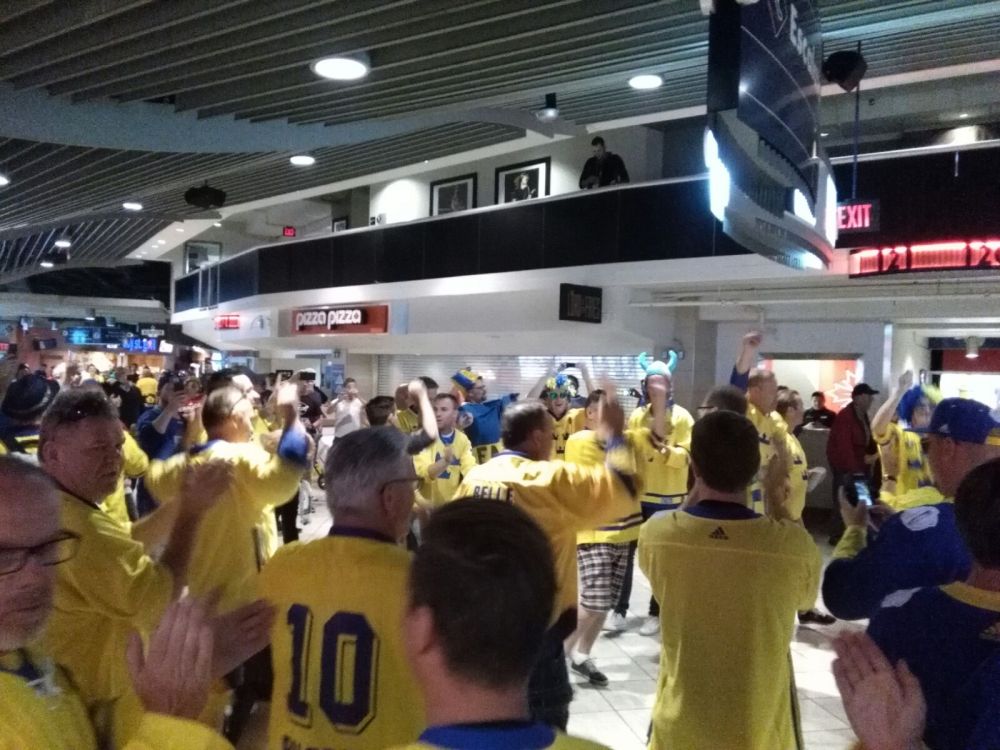
57e3baec-e727-4427-b69b-e877c81fee5a

Swedish fans singing before the game

It was refreshing to be in a North American city and experience something close to the atmosphere you might find in a European city ahead of a big qualifying game in football, if not quite a full-on tournament atmosphere. There were plenty of yellow and blue clad Swedish fans along with reds of the Czech Republic and the blues of Finland populating the bars and patios of downtown Toronto and they were in full voice. Any game involving Canada, the USA or indeed the North America side were all sold out but we did manage to get tickets for the nosebleed seats for the Sweden v Finland game.

79a5f077-2f20-4adb-9887-3999b92ad328

The puck drop was set for 3pm and it felt we were swamped with Swedish fans. This being a modern 20,000 seat venue in North America there were plenty of places to grab merchandise and a drink. They do of course allow you to supersize that, you could get a 25oz beer which is a close to about two pints I think.

As I said the arena capacity is just under 20,000 so it was disappointing that the crowd was only around the 12,000 mark. I’d blame the pricing, we’d been cheapskates and got tickets for about $30 each and the seats all around us were full with a fair few locals in among the Swedes and Finns. However the more expensive seats, in the $100+ price range remained mostly empty.

bb7f0f92-4217-40df-9657-6158a9e81446

Team line-ups

Both squads (apart from a couple of Russian based players in Finland’s party) were comprised of NHL based players. The most prominent probably being the Swedish twin brothers Henrik and Daniel Sedin who both play for the Vancouver Canucks and for Finland it would probably be Minnesota Wild captain Mikko Koivu or goaltender Tuukka Rask.  The Finns started the brighter and seemed to play the better hockey in the first period but we weren’t to be provided with a goal. We were kept interested with another round of beers and some chanting from the predominantly Swedish crowd.

In the second period the Swedes came into the game a bit more with the Sedin brothers combining to set up Anton Strålman for the first goal. While Finland came back into the game and forced Sweden’s goal-tender, Henrik Lundqvist of the New York Rangers into a number good saves. The Finns continued to press for an equaliser in the final period, even committing Rask their goalie forward only to be caught out by a very late Swedish counter-attack with Loui Eriksson of the Vancouver Canucks scoring into the open goal. The win guaranteed the Swede’s progression from the group stages while Finland needed a miracle, something their crestfallen fans seemed well aware of.

319dfca6-cfb0-4281-a2fd-d906406ede16

Some disappointed Finland fans

Sweden would be knocked out the semi-final be the Europe selection, who would be defeated in the final by the heavy favourites Canada. It gives a Canada some what of a clean sweep as they are now World Champions, World Cup winners and Olympic Gold medallists and clearly the most dominant hockey team in the World. If the World Cup does gain some traction and some manages to become a regular fixture and not just a glorified warm-up to the NHL season then it could be the international competition with the highest player quality levels.

While not quite a global festival of sport it was still a chance to see some of the best players of the sport in international competition. Watching and reading the media coverage of the tournament there did seem a genuine pride and indeed novelty for the players taking part, many of whom had previously had scant opportunity to represent their nations.

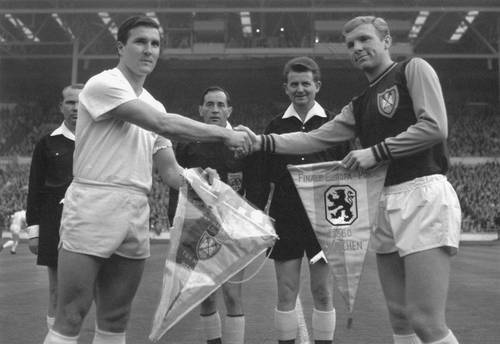
Before they were famous: Bayern Munich

One of Pep Guardiola’s last acts as manager of Bayern Munich was to lift the DFB Pokal trophy, it had already been announced that he was on his way to England and Manchester City but the delight on Guardiola’s face showed that he hadn’t checked out just yet. He was enjoying the occasion; he was, after all, a serial winner relishing his last trophy as manager of one of world’s biggest clubs. The league title had been wrapped up nearly two weeks earlier when the Bayern players raised the famous “salad bowl” trophy. This made it Guardiola’s second double of his Bayern tenure and marked a record breaking fourth consecutive Bundesliga title. Despite this unprecedented success there were some who felt the club should have won more; for some, only reaching three consecutive Champions League semi-finals meant they had fallen short. Under previous coach Jupp Heynckes they had enjoyed even greater success winning a treble of League, Cup and the European Cup.

Such is the dominance of the very elite clubs in various European Leagues it can feel that the league winners have been as good as decided before we even reach September. Perhaps this season will bring some surprises but in Italy, Juventus are heavy favourites to once again retain their title. Likewise, Paris Saint Germain in France and Bayern Munich in Germany. However, while Bayern’s dominance might seem preordained it was not always thus.

Formed in 1900 Bayern had enjoyed “early” successes, winning a couple of regional titles in the 1920’s before winning the last National title (1931-32) before the German sport system was taken over by the Third Reich. This maiden title for the club was contested in a knock-out format between the top two sides from each of the regional leagues and at the time, football in Germany was still technically an amateur sport. It would be over 35 years before the Bavarians would win another league title.

When the first Bundesliga season began in the late summer of 1963 Bayern Munich were not even among its member clubs. A decision had been made the year earlier to do away with regional leagues and to institute a proper, professional, national league and the winners of the Oberliga Sud (Bayern’s regional league), were their city neighbours TSV 1860 München. Although Bayern finished third that year which should have been enough to qualify them for the new national Bundesliga, the German FA did not want two teams from the same city represented so 1860 progressed at their neighbours’ expense.

moore-tsv

TSV 1860 München had been founded as a sports club, not as their name suggests in 1860, but as a gymnastics club in 1848. Due to a political decree during tumultuous times they were disbanded but officially reformed in 1860 with their football division beginning a year before Bayern in 1899. The club enjoyed great popularity in their debut season in the Bundesliga, averaging a respectable average attendance of 34,000 at the Grünwalder Stadion which they shared with Bayern. In fact, they had been Bayern’s landlords there from 1925 until the Second World War when the stadium was bombed and badly damaged in 1944. During the debut Bundesliga season, they would win the German Cup final against Eintracht Frankfurt and went on to contest the following year’s Cup Winner’s Cup final, losing 2-0 to West Ham.

Far from being one of Europe’s leading clubs Bayern at this stage were not even the biggest club in their city. They were eventually promoted to the top flight for the 1965-66 season and managed to win the German Cup that year while finishing a very respectable 3rd place in a league that was eventually won by their city rivals 1860. That Cup win was Bayern’s first major trophy in almost a decade. In the final they defeated Meidericher SV by 4 goals to 2, the fourth was scored by one of the club’s precocious young talents, a twenty-year-old by the name of Franz Beckenbauer.

Beckenbauer was not the only young star making waves for this upwardly mobile Bayern team. The club’s shrewd President Wilhelm Neudecker, a wealthy construction magnate had begun investing in the side to turn them from a regional yo-yo club into one that could deliver success. In 1963 the Croatian Zlatko “Čik” Čajkovski, who had starred as a player for Partizan Belgrade and Yugoslavia in the 40’s and 50’s, was brought in to coach the then second tier side. This represented something of a coup as Čajkovski had coached FC Köln to the title in 1962 yet here he was taking a step down to coach a side that hadn’t yet made the Bundesliga. But Bayern had some exceptional young talent coming through; Beckenbauer had joined as a youth in 1959 having stormed out of the youth ranks of 1860 after a row broke out during the final of an under-14’s tournament. A teenage keeper named Sepp Maier had made his debut the year before Cajkovski’s arrival and then in 1964 President Neudecker presented his new coach with his latest young prospect, an 18-year-old called Gerd Muller. To begin with Cajkovski was unimpressed, dismissing the somewhat tubby 5’9” striker with the following statement to his club President: “I’m not putting that little elephant in among my string of thoroughbreds”. The little elephant, however, knew where the goal was.

bayern75

During the late 60’s and into the early 70’s Bayern either developed or signed from lower the leagues players of the calibre of Beckenbauer, Muller, Maier, Paul Breitner, Franz Roth, Uli Hoeneß and Hans-Georg Schwarzenbeck. Not only would all of these players win multiple leagues, cups and European Cups but they would also help the West Germans defeat the great Dutch team in the World Cup final of 1974. They had hardly cost Bayern a penny in transfer fees.

After the success of their debut Bundesliga season Bayern had the added distraction of a first European campaign to deal with due to participation in the Cup Winners Cup. They managed to out-do the previous efforts of their neighbours 1860 by going on and winning the competition defeating Rangers in a tight final after extra time. The winner came in the 109th minute from 21-year-old midfielder Franz Roth who would develop a habit of getting crucial goals in major finals.

By the end of the 60’s Bayern were truly in the ascendancy, there were coaching changes with Cajkovski departing for Hannover and being replaced by Branko Zebec, his former Partizan and Yugoslavia teammate. Zebec had coached Dinamo Zagreb to victory in the Inter City Fairs Cup in 1966-67 and introduced a more structured defensive approach with Bayern. During Cajkovski’s last season in charge the club had scored an impressive 68 goals in 34 games but had conceded the worryingly high number of 58. In Zebec’s first season they scored 61 (30 coming from Muller) but conceded a miserly 31. They finished eight points clear of Alemannia Aachen to comfortably win the league title. They followed this up with a 2-1 Cup win over Schalke (two more goals from Muller) to win the first double in Bundesliga history. Zebec also made Beckenbauer captain that season and the young midfielder began experimenting with his distinctive sweeper type role with which he would become synonymous.

A three in a row run of league titles at the beginning of the 70s showed how this young group was maturing, they added to their ranks bringing in a young, attacking full-back named Paul Breitner, and in attack Uli Hoeneß, who would help shape the club on and off the pitch for the next five decades. But Europe was a learning curve for the young side. In the 1972-73 season, they were well beaten 5-2 on aggregate by eventual winners Ajax at the Quarter final stage. The following year they were almost eliminated in the first round by Swedish champions Åtvidaberg before narrowly beating East German champions Dynamo Dresden in the next stage. They met Spanish champions Atletico Madrid in Brussels in the final, which was forced to a replay after a nervy 1-1 draw. In the replay, however, Bayern showed a devastating competitive edge, hounding the Spaniards in possession, counter-attacking at pace with a frightening directness, with Muller and Hoeneß scoring two each.

Back at home in the Bundesliga, Bayern’s great rivals of the 1970s, Borussia Mönchengladbach, were the dominant team as Bayern struggled domestically, the demands of Europe taking their toll. In 74-75 when Bayern defeated Leeds in a controversy filled final the Bavarians finished a disappointing 10th. But midfielder Rainer Zobel described how, despite struggling to beat average Bundesliga sides, Bayern could raise their game in Europe. Leeds fans still feel aggrieved when the final of 1975 is mentioned, often highlighting the stunning Peter Lorimer strike that was disallowed as evidence of their bad luck. What is seldom mentioned is that Bayern lost two players to injury caused by rough tackles from Leeds players, defender Björn Andersson after two minutes and Uli Hoeneß just before half-time. Watching the footage back, an aging Leeds side had no answer to the stylish build-up to Roth’s goal in the 71st minute or when, ten minutes later, Müller got goal-side of his marker and scored at the near post from six yards out.


Having defeated first the champions of Spain and then the champions of England in their consecutive finals, Bayern then faced St. Etienne, the champions of France, and one of the finest sides in the history of the French League. Hampden Park was the venue in 1976, but there was to be no repeat of the 1960 final goal-fest. St. Etienne were unlucky with Bethanay hitting the cross-bar and Santini hitting the famous “square posts” of the Hampden goals. Bayern however, while not dominant, displayed the sort of mental toughness and doggedness that have become synonymous with German teams. Muller had a goal ruled out for offside, before Beckenbauer squared for Roth to score in his second consecutive final.

The bulk of these successes were won by a core group of players who had come through the club ranks as youngsters, however the club were not averse to splashing the cash when necessary; Jupp Kapellmann was brought in for a German transfer record from FC Köln in 1973, the same year the club snapped up Swedish international Conny Torstensson after he impressed against Bayern in the early rounds of the European Cup. Parallels with a modern Bayern can be seen with a locally developed core of players (Lahm, Thomas Muller, Alaba, and even a returning Mats Hummels) complemented by the best talent bought in from Germany and further afield.

Nowadays, Bayern are based in the ultra-modern Allianz arena which was initially shared and co-owed with neighbours 1860. However, in 2006 Bayern’s one-time landlords were forced to sell their share of the stadium rights to deal with their financial problems. While construction magnate Wilhelm Neudecker is long gone the Bayern boardroom is now filled with former players and blue-chip commercial partners; alongside Executive board members like Karl Heinz Rumminigge sit Triple A corporate representatives from Adidas, Audi and Allianz which helps explain the club’s rude financial health. The massive financial clout of Bayern and their ability to cherry-pick the best of their opponent’s players has meant that it is sometimes hard to envision a Bundesliga that was not the domain of the Bavarians, but thanks to strong support from an ambitious club president, excellent scouting networks, improvements in coaching and a once in a lifetime group of players Bayern went from the Second Division to European powerhouse within the course of a decade.

This post originally appeared on the Football Pink