Harry Willits – the Darling of Dalymount

Co-written with Brian Trench

When Harry Willits finished his first season as Bohemian captain in spring 1916 he had other major responsibilities on his mind. He had joined the Royal Dublin Fusiliers in late 1915 “for the duration of the war” and soon he would be sent to the western front in France during the Battle of the Somme.

He had followed his friends and several Bohemian colleagues in signing up for the army. His choice was the Commercial Battalion of the Dublin Fusiliers, established to cater for young men of the “commercial class” and farmers.

Willits was not the military type, according to his daughter Audrey, still living in the family home aged 93. But English-born and a civil servant, he moved in circles where enlisting for military service would have been regarded as a matter of duty.

He was promoted to corporal in February 1916, three months after enlisting. According to military records he became a sergeant in July 1916, though he was already identified in a June 1916 report of a cricket match between King’s Hospital and 10th Dublin Fusiliers as “Sgt Willetts”, bowled out for a duck.

He had a short period – three months – of active military service, yet he lived all his days with the consequences of it. In October or November 1916 he was wounded in the thigh, and he spent several months in hospital in southern England before returning to Dublin, and to Bohemians. His injury was serious enough for amputation to have been considered.

He missed all of the football season, 1916-17, as he recovered from his injury. The mark of the wound remained visible and the strain of playing in a weakened condition took its toll on his health in later life.

Harry Willits was born in Middlesborough in 1889 and already made a strong impression as a footballer in his teens, when he played for Middlesbrough Old Boys, Cambridge House and the famous South Bank club where a team-mate was later English international George Elliott.

Willits’s father was headmaster of Middlesborough High School when Harry and George were pupils there. But it was apparently in order to get away from his over-bearing father that Harry sat the civil service examinations and then, when he was admitted to the service, chose to take up a post in Dublin. He worked in the Post Office stores and later, over several decades, in the Registry of Deeds.

He joined Bohemians just after the club had captured the Irish Cup for the first time in 1908. He was a regular first-team player over the following years in the forward line, at inside-left or outside-left, alongside internationals Harold Sloan and Johnny McDonnell.


In spring 1916 he played football and cricket for the Dublin Fusiliers as well as captaining Bohemians. When he resumed service with Bohemians in late 1917, he was profiled in the Dublin weekly newspaper, Sport, as The Darling of Dalymount. The writer claimed there were many who came to Dalymount specifically to see Willits play.
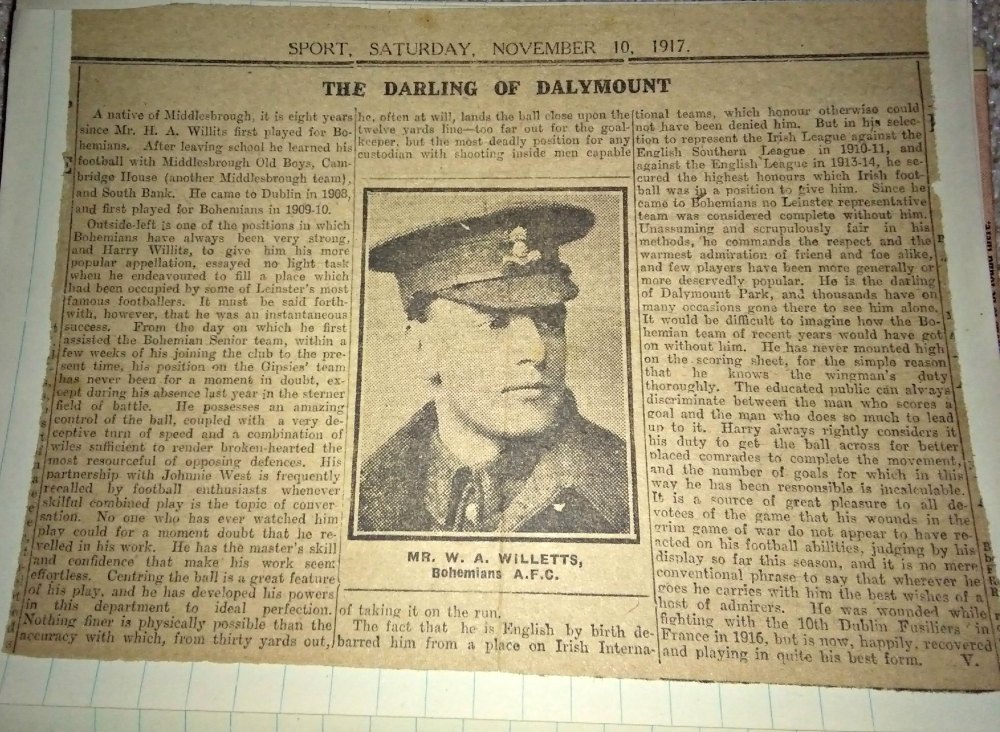
Willits army updated

A feature on Harry in a 1917 edition of Sport

Tall and prematurely balding, he was a striking figure. He was best-known as a skilful passer and crosser of the ball, but also contributed goals, including some from the penalty spot. Willits and Johnny West were a potent partnership at inside- and outside-left. (West was also a popular baritone singer, who performed at summer evening ‘promenades’ in Dalymount during the war years.)

Willits lived for a time near the Botanic Gardens with his mother, who had moved to Dublin following the death of Willits’s father. In 1919, however, Harry married Annie ‘Cis’ Wilson and with her inheritance they bought a house in Lindsay Road that remains in the family nearly a century later. The furniture includes a large dining-room sideboard that was a wedding gift to Harry and Cis from Bohemians, and a mark of the high esteem in which the club held him.

Willits was Bohemian captain again in 1920-21, when he was reported to have had a “new lease of life” as a footballer. Now in his thirties, he was prominent also in the Bohemian team that won their first League of Ireland title in 1923, and was selected with four other Bohemians for the new league in their first representative match against their Welsh counterparts in 1924. Willits played for club and league alongside Christy Robinson, who had a very different military record as a member of the IRA during the War of Independence.

Willits program final

Harry stars in the first ever inter-league game against the Welsh League

Some newspaper correspondents suggested that, but for his English birth, Willits might have been selected for Ireland. From 1925 onwards, he was playing with Bohemians’ second team and scored in a 4-0 win over Dublin University (Trinity College) in 1929, when he was 40. He featured in a short Bohemian’newsreel’ of 1930 as a “model Bohemian” who was “still going strong” and “a sportsman to the core”. Nearly fifty years old, in April 1938, he lined out for an Old Bohs team in a charity match in Dalymount against an Old Rovers side.

Even before his playing days with Bohemians finally ended, Willits became involved with the club’s Management Committee, also later the Selection Committee, and he served as Vice-President.

From the 1920s Harry Willits was a keen and competitive tennis player, being club champion in Drumcondra Tennis Club several times over the period 1923-33. He served also as club president and vice-president.

A man of routines, he always had two books on loan – one fiction, one non-fiction – from the Phibsborough Library. He dressed formally, in suit, tie and hat, and walked from his home to the Registry of Deeds in King’s Inns, responding to the frequent greetings of Bohemian fans in the streets. He practised calligraphy and did charcoal drawings.

His daughter Audrey and son Alec were both kicking footballs with their father in the family’s Glasnevin garden from early days. Alec played briefly for Bohemians first and second teams in the 1940s, but could not live up to what was expected of him as his father’s son. He later played for the Nomads.

Audrey applied her kicking skills to keeping goal for Pembroke Wanderers hockey teams for many years, appearing also for Leinster provincial teams and serving many years in the club’s committees.

From 1937, as Audrey recalls, Harry Willits developed asthma due to the strain of living with a war wound and this had a serious impact on his quality of life, also taking a financial toll. Harry had to reduce his work to half-time, which also meant half-pay, and Audrey remembers that the family often struggled to get by.

Despite this, Willits continued his involvement with Bohemians, as club officer and selector, and even – up to the age of 60 – as a coach. He was actively associated with Bohemians in one capacity or another for over forty years. He died in April 1960, aged 70, and is buried with his wife in Mount Jerome Cemetery.

This post originally appeared on the official Bohemian F.C. website in May 2016. Co-written and researched with Brian Trench as part of an ongoing series on Bohemians players from the First World War to the end of the Irish Civil War

A journey into non-league: Whyteleafe FC v Chatham Town

A couple of weeks ago a good friend of mine was running the London marathon for charity (it’s a very worth cause and you can donate here) and myself and my friend Andy decided to head over and do our bit to support him. Whenever I’m out of the country I try to catch a game while I’m away, or at the very least visit a local stadium or club museum. In England I’ve done the Premier League games before and on one of my last visits to London I caught a Championship game at the Valley between Charlton and Burnley where Charlie Austin scored a screamer. This time we went for something a bit further down the football pyramid, we wanted to check out a non-league game.

For the duration of our short stay we were based in Honor Oak. For those unacquainted with the southern extremities of Greater London that’s about midway between Peckham and Dulwich. For this reason our initial plan was to head to a Dulwich Hamlet game but as luck would have it the Hamlet were playing away so we needed another alternative.

d78b3cba-c2b4-449a-b302-b33e8d879512

View out to London from One Tree Hill in the middle of Honor Oak

In previous times we might have actually been forced to do some research, however thanks to the global interconnect-ability offered by Twitter Andy simply tweeted at one of the non-league twitter accounts and we were soon inundated with offers. One that caught our eyes offered us a warm welcome at a club near to where we were staying and the promise of some good beer in a rather unorthodox pub. We were sold, we were off to see Whyteleafe F.C. take on Chatham Town.

On a clear, chilly afternoon we set out at a leisurely pace and made our way out by train to Whytleleafe, a village in Surrey not far beyond Croydon. We were meeting Tim, our twitter contact and his mate Steve, in the Radius Arms for a pre-match pint before a classic 3pm Saturday kick-off. We arrived at the Radius ahead of a delayed Tim and could see why the “pub” is somewhat unorthodox, it’s housed in a converted “greasy-spoon” café and at most can seat about 20 people along its bar stools and tall benches. They do good beers and despite the somewhat early hour we went for two pints of ale followed by a couple of a very tasty local porters. Tim and his mate Steve had arrived by this stage, both local lads from the Croydon area. Tim somewhat surprisingly is a West Brom fan and a regular at the Hawthorns but attributes this to family connections to that part of the world. So far the pub and the warm welcome had been all that we’ve been promised so we’re looking forward to getting to the game.

The ground was within the Radius of the pub (sorry) and was located up a pleasant verdant pathway leading to a somewhat secluded entrance. Upon arriving in the car park what you first notice are the two modern full-size pitches. Directly ahead of us two schoolboy teams were in the middle of a game while to our right was the main pitch. Both surfaces were good quality 3G surfaces that are regularly hired out to local clubs and schools and would put a pitch like the one at Oriel Park to shame. We passed through the turnstiles, (£9 tickets, £2 a programme) which are an incongruous vivid red due to the fact that they were bought from Stoke City’s old Victoria Ground, most of pitch is shaded by high trees and at one end is the larger of the stands, built in 1999 for the club’s first round FA Cup match against Chester City, then a league side and to date the biggest gate in the club’s history.

It was the last game of the season and somewhat of a dead rubber, both Whyteleafe and the visitors, Chatham Town were safe in the Isthmian League Division One South but there was still a couple of hundred punters (later confirmed as 288) through the turnstiles.  Whyteleafe are celebrating their 70th anniversary this year, Chatham Town are considerably older having been formed way back in 1882. They also have somewhat of a giant-killing history having reached the quarter-finals of the FA Cup in the 1888-89 season, defeating Nottingham Forest along the way. Perhaps it was their Victorian era pedigree but Chatham started far quicker, their number 9, Luke Medley dominating proceedings from the get-go. Quick and powerful with a good touch Medley had Chatham 1-0 up after only three minutes. Whytleleafe were playing the better football, O’Leary at the back, Clayton and Lyle all looked good ball-players but Chatham had their game plan working; be combative and keeping looking to bring in the physique and pace of Medley up front.

It paid dividends again after 22 minutes, Medley getting in for his second although you were left with the feeling that the Whyteleafe keeper Adam Highsted could have done better, he looked ponderous in goal, unsure whether to try and close down Medley or hang back. Shawn Lyle got one back for Whyteleafe almost immediately and that was followed up by a goal from Sam Clayton only minutes later, we were back 2-2. But we went in at half-time with the hosts 4-2 down, Luke Medley completing his hat-trick from the penalty spot after 38 minutes before Austin Edwards scored for Chatham Town again just before the break. It was a clear penalty and it’s worth noting that although there were some tough calls including the penalty decision to be made the referee ran the game well and was a calm and authoritative presence on the pitch.

Now while the Radius had been a good spot for pints it hadn’t really been somewhere for food despite it’s status as a former café, this did however provide me with the opportunity for a personal footballing first. For you see, despite over 25 years of attending football matches I’ve never had a pie at a game. You don’t tend to find pies as a food option at League of Ireland games, burgers, chips, hot dogs (usually Denny jumbo sausages in buns) and even crepes a couple of times at Belfield but not pies. I went for a somewhat unappetising looking steak and kidney pie (the other option was a twix) and ordered a pint of ale in the clubhouse. The pie was actually surprisingly tasty and the pint was rather good too. The clubhouse atmosphere was jovial and welcoming despite the score, it had a well-stocked bar, some comfortable looking couches and a pool table, a set up that would be envied by a number of League of Ireland clubs I could name. It also had a fair amount of Crystal Palace memorabilia on the walls. Palace would be the main local club and Alan Pardew is probably Whyteleafe’s most prominent ex-player.

Having spent the first half leaning on the touch line railing we decided to move behind the goal for the second half. Almost immediately we got talking to two more senior gents who were Whyteleafe supporters and on hearing our accents introduced themselves as fellow Irishmen. One in particular professed his continuing interest in the League of Ireland despite being in England for over 40 years and started enquiring about Shamrock Rovers recent performances.

The second half was somewhat more subdued, apart from the six goals of the first we had one late-on to confirm Chatham Town’s victory and a penalty to Whyteleafe that was well dsaved. We moved back to the warmth of the clubhouse for a final pint and a discussion of Leicester’s chances in the last few games before catching our train back.

Having only previously experienced English football in the top two divisions I can see the growing appeal of non-league football, indeed it will strike a chord with many League of Ireland fans who will understand the draw of supporting a local team and know the warmth of supporting a club on a non-global scale. Although it is the eighth tier of English football was still of a decent standard with some nice touches of skill. And it still is in an overall pyramid and there is still that aspiration to progress and the ability to do so, just look at the progress of a club like Burton Albion from non-league to joining the Championship next year. There is always hope to dream. Whyteleafe are developing connections with bigger clubs up the football league and are apparently planning some big investments in their club with some committed local backer. We can only wish them all the best for the future.

Also a big thanks to Tim and Steve for their warm welcome and all those at Whyteleafe F.C. and at the Radius Arms.