Puskás, Di Stefano…Prati – the career of a Milan legend

Only three players have ever scored a hat-trick in a European Cup or Champions League final. Alfredo Di Stefano scored three in the famous Hampden Park final of 1960 when Real Madrid defeated Eintract Frankfurt 7-3, his team-mate Ferenc Puskás scored the other four in that game. Puskás would score a hat trick two years later but it was all to no avail as a Eusébio inspired Benfica retained the Cup beating Madrid 5-3. Puskás and Di Stefano, the attacking stars of one of the greatest club sides ever, the storied five in a row Real Madrid, men justifiably regarded as amongst the greatest players ever.

How many remember the third of this three-goal scoring triumvirate? The final member of the triptych was Italian international Pierino Prati who, in the 68-69 final, at the age of 22 scored three against the emerging force of Cruyff’s Ajax in a 4-1 victory for AC Milan. That hat-trick capped off an astonishing two year string of triumphs for Prati. From the beginning of the 1967-68 season to the end of 1969 season the young striker won a Serie A title, the Cup Winners Cup, the European Cup and the Intercontinental Cup for Milan, the 1968 European Championship for Italy as well as picking up the coveted Capocannoniere award for Serie A’s top scorer for the 1967-68 season.

What makes this run of successes all the more remarkable was that Prati had spent the previous season on loan at Serie B side Savona where, despite scoring 15 goals for the Ligurian side they were relegated to Serie C. It was only after the re-appointment of Nereo Rocco as coach of AC Milan that his prospects would change.

Prati was born in December 1946 in the small town of Cinisello Balsamo just north of Milan. He was on the radar of AC Milan at an early stage and played with various Milan youth teams. The then head coach Nils Liedholm was apparently alerted of his talents by another Milan player, Luigi Maldera who spotted the young striker’s talent in a youth tournament. Before he would make his Milan breakthrough though he had to begin his senior career in 1965-66 on loan with Serie C side Salernitana where he scored ten goals (despite suffering a serious injury) to help them attain promotion to Serie B. Prati returned to Milan but only made a couple of appearances before his loan move to Savona began. By this stage there was considerable change at managerial level leading to the appointment of Rocco, a man most synonymous with the defensive system of catenaccio.

prati78

Prati after suffering an injury playing for Salernitana

Rocco had achieved great success with Milan in the early 60’s winning both the league and the club’s first European Cup before leaving for Torino. His return signalled a revival in the fortunes of the club and would mark a turning point in Prati’s career. Not that it started out so smoothly. Rocco asked for the young forward to be recalled from Savona and he arrived at the club with long hair, jewellery and wearing a pair of flares. Rocco is reported to have reacted by saying “I asked for Pierino Prati the footballer, not Pierino Prati the pop singer”. By the end of his career he’d be known as “Prati the pest” due to his driven and persistent style of play.

Any concerns that Rocco may have had were allayed in that first full season when Prati became Serie A top scorer as Milan strolled to the title, nine points clear of second placed Napoli. Prati formed part of a formidable attack along with the Brazilian born Angelo Sormani, newly-arrived, experienced winger Kurt Hamrin and the legendary Gianni Rivera with whom he developed a close on-field partnership. Behind this array of attacking threat was a solid midfield based around the more defensively focused Giovanni Trappatoni and Giovanni Lodetti, a man whose style of play allowed Rivera freedom as the creative fulcrum of the side and led to him being known as Rivera’s “third lung”. Behind them was a defence that only conceded 24 times in 30 games with either Pier Angelo Belli or the newly arrived Fabio Cudicini in goal and German international Karl-Heinz Schnellinger in defence alongside the likes of Roberto Rosato, Saul Malatrasi and Angelo Anquilletti. Early on it was difficult to find a role for Prati. Sormani was the first choice centre-forward, but in one game the right-footed Prati was asked to fill in on the left side of the attack and given the no. 11 jersey, he scored in that game and didn’t stop thereafter. He’d found his place in the side.

ac milan 1969

By May 1968 Prati had added the Cup Winners Cup to his accomplishments, starting
the final in Rotterdam against the Hamburg of Uwe Seeler which was decided by two early goals from Kurt Hamrin. Such was the success of his breakthrough season that Prati was called up by the Italian national team for Euro 1968. The Azzurri had comfortably topped their Euro qualifying group without Prati’s help but his form ensured that he made his debut in the competition’s two legged quarter final against Bulgaria due to an injury to regular starter Luigi Riva. He impressed, scoring in both legs as Italy advance 4-3 winners on aggregate, securing their place at the four team tournament proper hosted on Italian home soil.

Prati1

Prati in action against SV Hamburg in 1968

The Italians were drawn against the Soviet Union in the semi-finals, a tough task as the Soviets had been the side to knock them out of the World Cup two years earlier. It was tight game and Italy were beset by injury problems, first Rivera was forced from the field for lengthy treatment. Then as the match entered injury time Giancarlo Bercelli also had to go off injured, and with no substitutions allowed Angelo Domenghini was withdrawn from the forward line to left back. Prati had a good chance to seal the win but shot wide and there was to be no separating the sides. In the days before penalty shoot-outs the game was to be decided on the toss of a coin. Team captains Giacinto Faccetti and Albert Shesternev joined the referee in his room inside the stadium and Faccetti correctly called tails. He sprinted out to his team-mates on the pitch, his celebrations confirming to all that they were through to the final.

Prati would retain his place for the final against a strong Yugoslavia side who had just defeated England and featured the exceptionally talented winger Dragan Džajić. As with the semi-final, the first final was a very close affair. Džajić had opened the scoring in the first half and Italy, without the injured Rivera were struggling to find a breakthrough. It looked as though Italy might lose the final in Rome’s own Stadio Olympico but ten minutes from the final whistle Angelo Domenghini of Inter thumped a free kick past Pantelic in the Yugoslav goal to secure a replay.

With two consecutive games going to extra time the Italy coach Ferruccio Valcareggi made significant changes to his side for the replay of the final. In came Mazzola and Di Sisti to the midfield while Sandro Salvadore started as a fifth defender. Crucially for Prati and for his whole future international career, his place in the attack was taken by fit-again Luigi Riva of Cagliari. It would prove a decisive change, Riva opened the scoring after only 12 minutes with one of his trademark powerful left-footed drives, on the half-hour Pietro Anastasi, much improved from the first final, notched a second. With Tarcisio Burgnich marking Džajić out of the game Yugoslavia were unable to find a way back in. Italy won Euro 68 in their Capital city. Riva was the hero, he could have scored a hat-trick in the game given the number of chances that fell to him.

For Pierino after his first full season in Serie A he was a League Champion, Cup Winner’s Cup winner and now a European Champion with Italy. However much of his subsequent international career would be lived in Gigi Riva’s shadow.

While 67-68 had been Prati’s breakthrough season when he finished as Capocannoniere this achievement was bookended by Riva’s scoring exploits as it was he who had finished as top scorer in 66-67 and would again in the 68-69 and 69-70 seasons. As a result Prati was left out of the starting line up for most of Italy’s World Cup 70 qualifying despite the fact that he had continued his excellent form into the 68-69 season. The one game he did play, a 2-2 away draw with East Germany saw Italy line-up with a front three of Riva-Mazzola-Prati with Rivera in behind. Riva scored both of Italy’s goals.

Despite a scoring record that showed 38 goals in 70 games over the previous two seasons, including the goals that won the 1969 European Cup, Prati was not in the original squad for the Mexico World Cup in 1970, it was only some locker room hijinks that got him on the plane to Mexico. The Juventus forward Pietro Anastasi, at that time the most expensive footballer in the world, was in the Italian pre- World Cup training camp, he was a bored 22 year old with too much energy and was spending his time winding up the team masseur Tresoldi. The masseur had had about enough of Pietro’s messing when he turned around swiftly and hit Anastasi square in the testicles. Anastasi hit the deck but it was only later that night when the pain became too much to bear that Anastasi realised something was seriously wrong. He was rushed to hospital for surgery, his World Cup was over before it began.

The Italian coach Valcareggi had been pinning his hopes for success on the perfect strike combination of Anastasi and Riva, but with this unexpected injury he called up two forwards to replace one; Roberto Boninsegna of Inter and Prati, while he sent home Prati’s team-mate and Rivera’s “third lung” Giovanni Lodetti to make room. While Boninsegna would have a major impact on the finals, scoring against Germany in the semi-final, providing an assist for Rivera in the same game as well as scoring Italy’s consolation goal against Brazil in the final. Prati meanwhile spent the entire tournament either on the bench or in the stands. Despite the physical demands on the rest of the squad of the Mexican altitude, the heat, and the semi-final against Germany going to extra time Valcareggi kept faith with a core group of players with no space for Prati.

prati7

Prati as a spectator at a show in Mexico

It was Prati’s misfortune that his international career overlapped with that of Riva, a man whose national team goalscoring record (35 goals in 42 games) has remained unbroken for over 40 years. Riva was a true star of the European game, he had propelled little Cagliari to their only ever league title in 1969-70, the same year he finished second for the Ballon d’Or behind his international team-mate Rivera. Even despite Prati’s exceptional form it was also an injury to Riva that gave Prati his first starts for Italy, his return to the Azzurri jersey after the disappointment of the 70 World Cup also coincided with Riva suffering a serious leg injury while playing in a friendly which caused him to miss much of the 1970-71 season. In his absence Prati helped Italy top their qualifying group for Euro 72, scoring in both of their games versus Ireland, as well as netting against Austria, however he was dropped for the quarter-final games against Belgium when Italy were knocked out.

By the 72-73 season Prati’s time at Milan was coming to an end. Milan had just won back to back Coppa Italia’s and while Prati had been central to their success throughout 72 where played regularly through to the final he wasn’t involved at all in the 1973 edition of the cup. There was increased competition at Milan from the likes of Romeo Benetti, Alberto Bigon and the latest arrival, Luciano Chiarugi who would score 22 in his first season. The following year, after 209 appearances and 102 goals for Milan in all competitions, Prati was on the move. He was on his way to the capital to join his old coach Nils Liedholm at Roma.

At Roma Prati become the focal point of their attack and would be the club’s top scorer for each of the next two seasons as they steadily improved; finishing 8th and then 3rd, but as the 70s progressed and Prati entered his 30s, games were harder to come by and niggling injuries began to take their toll. He joined Fiorentina for the 77-78 season but played only eight times without finding the net. It was to be his last year in top flight Italian football. He would spend the rest of his career (apart from a short spell in the NASL with the Rochester Lancers) with one of his earliest clubs, Savona, by then lining out in Serie C2. He retired in 1981 having made 458 appearances for his various clubs, scoring 205 goals, for Italy he won just 14 caps, scoring seven times.

In a league noted for the miserly nature of its defences, especially during the heyday of catenaccio as espoused by the likes of Rocco and the Inter Milan sides of Helenio Herrera, the scoring exploits of Prati are worthy of praise. He was a versatile forward, capable of playing through the middle and on either wing. At just shy of six foot and blessed with a powerful leap he was a handful in the air while possessing a formidable right foot which saw him score his fair share of goals from distance, including a certain speciality with thunderous free kicks. It was noted that at the time that it was common for Italian strikers to drop deep, afraid of being isolated further up the pitch or being caught on the counter-attack, Prati went against this completely and played a high line, always looking to get forward. in his style of play he was likened to the great striker of the 30s and 40s Silvio Piola by no less an authority than the infamous Gianni Brera.

And of course he is the last man to score a hat-trick in a European Cup final. His set of skills were demonstrated ably by the three goals he scored. His first on seven minutes a powerful head from ten yards out as he meets a Sormani cross. The second and third goals showing his intelligence, positioning and most of all his on-field connection with Rivera. The second shows Rivera in possession with Prati feinting as if to head for the left touchline, before quickly changing direction, losing his nominal marker Barry Hulshoff to take possession off a delicious Rivera back-heel. Now finding himself in acres of space 20 yards from goal he lets fly with a right foot rocket into the Ajax net just before the end of the half. The final goal sees Rivera in possession again, sending Ajax defenders one way and the other as he waits for support to arrive, charging through the centre comes Prati, Rivera deftly chips in a cross right onto his forehead as he heads home from six yards to seal a 4-1 victory over a side that will dominate the early 70s.
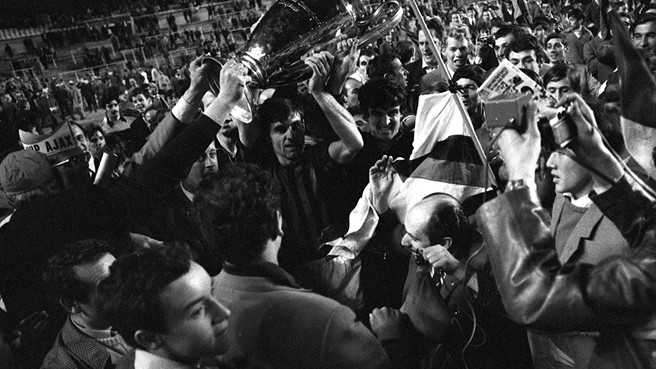
Prati EC 1969

Milan celebrate their European Cup victory in 1969

On an island in the sun – UD Lanzarote

As any League of Ireland fan knows we have one of the longest football off-seasons anywhere in Europe. The last game of the season was the FAI Cup Final won by Dundalk FC on the 8th November 2015 and the new season won’t kick off again until March 4th 2016. It’s a long gap between live football matches, especially as a I missed a few of Bohs later fixtures last year.

This lacuna in live football got me to reminiscing about this time last year when I was able to get away for some winter sun in the Canary Islands, specifically Lanzarote. It was the first time I’d gone away to the sun at that time of year but I’d heartily recommend it. It was something to look forward to after the inevitable post-Christmas comedown and it broke up the drudgery of bleak, dark January evenings.

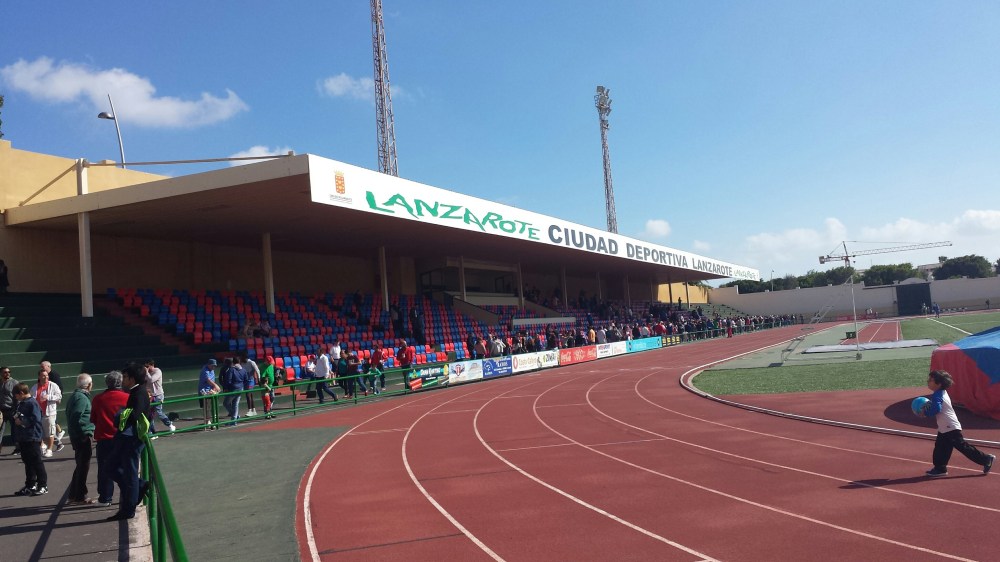
Any time I get away I try to catch a game, or if it’s the off season even just visit the local stadium. I dropped by to see a game between UD Lanzarote and UD Telde from the neighbouring island of Gran Canaria. Both teams play in the regionalised Tercera division which is officially the fourth tier of the Spanish football pyramid and is split into 18 different regional groups. The Canary Island teams feature in Group 12.

The match was played in the local municipal sports ground, the Ciudad Deportiva de Lanzarote in the main city of Arrecife. In keeping with the rest of the architecture on the island it is low-rise and whitewashed collection of buildings, and has a running track surrounding the pitch. The capacity is listed at around 6,000 with most accommodated in a main stand opposite the primary entrance to the ground. The entrance fee was a modest €5.

20150125_135957_resized

On the day there were may 700-800 supporters present, I was trying to get a handle on the make-up of the support, there seemed to be a few tourists like myself, some ex-pat British and Irish who’d probably retired to the sun and a fair number of local Canarians, one of whom, a somewhat older, man was highly vocal and had a habit of banging the advertising hoarding for the slightest of reasons. I know that a lot of the marketing and promotion of the club is done by an English ex-pat named Ian Lane and he was to be found running the Lanzarote club shop at half-time. This consisted of a patio table selling jerseys, scarves and other souvenirs along by the track (there is a good interview with Ian in issue 6 of the Football Pink by the way). Nearby was a red food and drinks kiosk that did up some tasty fried pork sandwiches and some ice cold beer, which thankfully you could take back to the shade of the stand. Despite this generous concession there was no mass drunken uproar in the stands for the beginning of the second half, just a thought.

20150125_140133_resized

As for the level of football, that’s a hard call. It reminded me quite a bit of League of Ireland standard, a certain mix of players, some obviously playing at the very height of their ability and the handful of players of certain quality probably wondering how they ended up playing at this level. However, there were some serious defensive lapses and the quality of goalkeeping from both sides was especially poor.  There was a midfielder lining out for Lanzarote who particularly looked the part, a constant attacking threat, he was hard to miss with his Fellaini-like mop of hair. The game ended 2-2 and there were some lovely moments of skill and two cracking goals from distance.

It’s now the middle of January, the heat is on in the house, there’s ice on the ground and no live senior football in Dublin. This year I’ll be off to the home island of UD Telde, Gran Canaria, and hopefully to catch a La Liga game featuring the islands’ only top flight side Las Palmas. I can’t wait.

The pubs of 1916 and beyond

During the long history of various Irish independence movements the Dublin Pub has always been a focal point for public meetings, clandestine gatherings and developing networks. Michael Collins’ knowledge of Dublin pubs and network of helpful publicans is legendary. Several famous bars in the city even still bear the scars of bullet and shell from the days of the Rising. Below is a short list of Dublin pubs with connections to the independence movement.


Davy Byrne’s

Davy-Byrnes

Situated just off Grafton Street this pub is famously associated with Joyce’s famous character Leopold Bloom who drops in for a bite of lunch but during the War of Independence and Civil War the premises was visited regularly by Michael Collins and Arthur Griffith. Davy Byrne’s nationalist sympathies were evident, permitting as he did the upstairs room to be used for meetings of the Irish Republican Brotherhood (IRB) and the outlawed Provisional Cabinet of the State, of which Collins was Minister for Finance. On one occasion, an officious barman clearing the premises at closing called: “Time, gentlemen please,” to which one customer replied, “Time be damned! The Government is sitting upstairs.”


The Duke

The-Duke

The Duke has a long association with Home Rule and Republican politics. As far back as the 19th Century when Charles Stewart Parnell, the leader of the Home Rule party tended to spend his Dublin sojourns in a hotel on nearby Dawson Street. Many of his Parnellite followers used to meet and socialise in the tavern then run by the Kennedy brothers at 9 Duke Street. From 1900 onward, and just next door to the pub the famous Dive Oyster Bar operated and in 1904 it was taken over by the Kiernan family of Granard, Co. Longford. Their daughter Kitty would famously become the fiancé of Michael Collins and the pub would become one of Collins’ many safe houses in the city.


The Grand Central Bar

The-Grand-Central

Although its only been a licensed premises since 2003 when the former branch of AIB became the latest addition to the Louis Fitzgerald Group, this fine and impressive building dates all the way back to the early 19th Century and was very much in the middle of the action in Easter 1916. The building at no. 10 Sackville Street (now O’Connell Street) was owned by Alderman William McCarthy, a Unionist politician on Dublin City Council, and during Easter week 1916 the building was heavily damaged by the many shells fired by the Royal Navy gunboat the Helga II into the Sackville Street and Abbey Street vicinity. After the Rising the building was so thoroughly repaired that by the following year Aldreman McCarthy was in a position to sell no. 10 and 11 to the Munster and Leinster bank which would later become part of AIB.


The Old Stand

The-Old-Stand

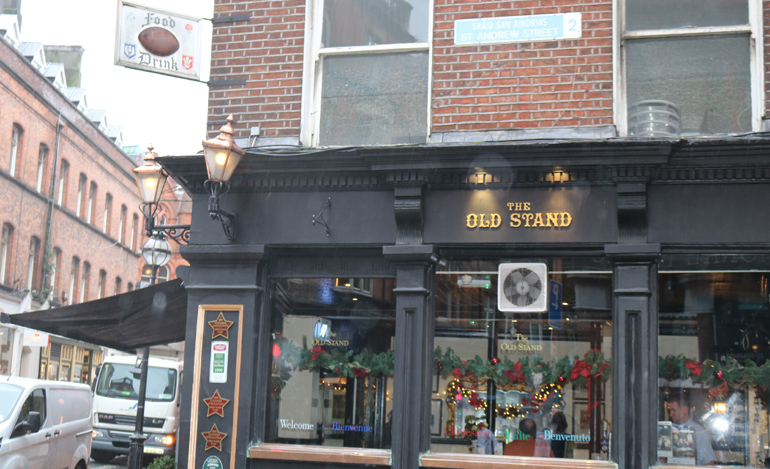
During the War of Independence, the premises was frequently visited by Michael Collins, who had an office nearby at 3, St Andrew Street (now the Trocadero Restaurant). From time to time, Collins held informal meetings of the outlawed I.R.B. (Irish Republican Brotherhood) in the premises and in true Collins tradition, he was less conspicuous while in the midst of the public. A handsome commemorative plaque and a portrait of “the Big Fella” hang in the pub to remind modern customers of these clandestine meetings.


The Swan

The-Swan-Bar

The Swan pub on Aungier Street, then owned by Tipperary man John Maher was occupied during Easter 1916 as it sat close to the Jacob’s biscuit factory (now part of the National Archives) which was captured by the rebels under the command of Thomas MacDonagh. Numbered among the ranks of the Volunteers was Peadar Kearney who would later write the words for the Irish national anthem. One of the last garrisons to surrender when the rebels were making their escape and Michael Molloy, a Volunteer stated

“Orders were also given that we were to burrow through from Jacob’s to a public house at the corner facing Aungier Street. We had two masons in our party and the burrowing was made easy. Strict instructions were given that no Volunteer was to take any drink from the public house. And although I am not a drinking man myself I must say that this order was strictly obeyed”

The pockmarks of artillery fire were still visible for many years on the walls of the premises.


The Oval

The-Oval-Bar

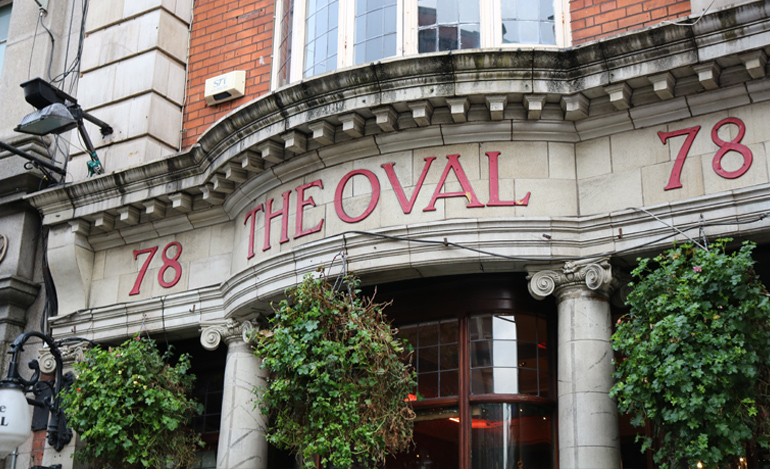
In the years leading up to 1916 this pub found favour with more that the members of the fourth estate from the nearby Irish Independent offices. Uniformed members of the Irish Citizen Army and the Irish Volunteers frequently dropped in to The Oval after manoeuvres while waiting for trams. A busy pub in a busy city centre was the perfect meeting place for members of the I.R.B., who blended in with a swelling clientèle.

Easter Monday, April 24th seemed a day like any other at The Oval until the Irish Volunteers captured the nearby GPO and proclaimed the Irish Republic. The week that followed would bring chaos, devastation, death and destruction both to the city of Dublin and to The Oval. By Wednesday the HMS Helga II had sailed up the Liffey and commenced shelling Liberty Hall and the GPO. At precisely 10am on Thursday April 27th the fate of The Oval was sealed. New trajectories were set on the Helga and the GPO and surrounding buildings were all hit. Fires blazed in Sackville Street and Abbey Street. Before long an inferno had engulfed the city centre. The Oval and surrounding buildings were destroyed. Abbey Street and Sackville Street smouldered for days as ruin and rubble scattered the pavements.

The pub’s owner John Egan set about rebuilding the pub and it was able to re-open its doors for business in 1922. It is this pub that customers see when they visit today but a brass plaque at the entrance commemorates the pubs historic destruction.


The Confession Box

Confession-Box

The reason for the name of the pub dates back all the way to the Irish War of Independence (1919-1921). During that conflict the last know excommunications from the Catholic Church in Ireland took place and were directed against the men involved in the ongoing rebellion. At the forefront of issuing these excommunications was Bishop Daniel Cohalan of Cork and it was rumoured that many of those who were excommunicated, including that famous Corkonian Michael Collins, would drop into what was then the “Maid of Erin” pub and would receive Communion and Confession from sympathetic priests from the nearby Pro-Cathedral. Thus the pub earned the nickname of “The Confession Box”.


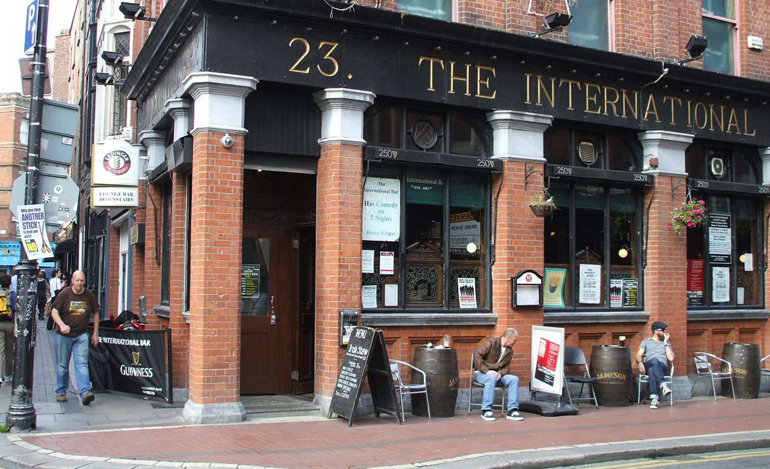
The International Bar

The-International-Bar

The International was another of Michael Collins’ many haunts and has played host to many authors, musicians and artists over the years. It has also been in the possession of the O’Donohoe family since way back in the 1880’s! I’ve left this to the last on the list as it has a very modern connection with 1916 in that the International, at the corner of Wicklow Street and Andrew Street is the meeting point for the hugely popular 1916 Rebellion Walking tours which run seven days a week.

Originally published for DublinTown in January 2016


Football, revolutionaries and my great-grandfather – 1916 and all that

We’ve only begun the year of commemorations and there has already been a great deal written about the various organisations, groupings and competing actors around the dramatic events of Easter 1916.  In much of nationalist history there is a huge role played by sport in the recruitment and training of the Volunteers, this is something often celebrated by the GAA and is born testament to in the naming of stadiums and club teams around the county.

This involvement with the nationalist cause was not limited only to the sphere of Gaelic games. Despite its occasional portrayal as a “Garrison Game” many individuals who were actively involved with football clubs also became key players in the struggle for independence. Among them were family members of my own.

In doing some family tree research I’ve started looking into the history and background of some of the relatives on my Da’s side of the family, people I was vaguely aware of but who by and large had died before I was born. This trail has brought me to a few individuals, my great-grandfather Thomas Kieran (occasionally spelled Kiernan) his sister Brigid and her husband , my great-uncle, Peadar Halpin.

At this point I must state that I do indeed have some non-Dublin blood in my veins, not much mind, but both Thomas and Peadar were from Co. Louth. Peadar would come to prominence due to his association with Dundalk FC and the FAI. He was a founder member of the club and spent decades on the management committee of Dundalk FC and was also club President. He also served as Chairman of the FAI’s international affairs committee and President of the League of Ireland and also Chairman of the FAI Council.

Football in Dundalk, in a somewhat disorganised fashion could be found as far back as the late 19th Century and some of the impetus given to the game in the early 20th Century can be traced back to a Dundalk architect named Vincent J. O’Connell. He had played for scratch teams in the town in his youth and had been a member of Bohemian FC between 1902 and 1907 during a sojourn in Dublin. Upon his return north he set about working with others to bring some structure to the playing of the association game in the town.  The club we know today as Dundalk FC began life as Dundalk GNR, the GNR standing for Great Northern Railway, and they spent a number of years in junior football before being elected to the League of Ireland in the 1926-27 season. The campaign for election to the league as well as the eventual re-branding of the club to Dundalk FC was apparently the result of the machinations of a group of local football enthusiasts comprised of Peadar Halpin, Paddy McCarthy, Jack Logan, Paddy Markey and Gerry Hannon. According to a report in the Irish Times the decision to change the club’s colours from black and amber to white and black was made by one Barney O’Hanlon-Kennedy who promised his silver watch as a raffle prize for a fundraiser for the club. As he was the one putting forward the funds he was given the honour of selecting the team’s colours.

That Dundalk should be so connected with the railway shouldn’t be that surprising, then as now, Dundalk was a major station between Dublin and Belfast, even if the creation of the border did cause disruption. My great-grandfather Thomas Kieran (born in 1889, son of Patrick and Annie Kieran) was a worker for the railway, at the time of the 1911 census when he was 22 years old and residing in the family home of 14 Vincent Avenue in Dundalk (five minutes from the train station). He was listed as being an “engine fitter”, while his father Patrick was a carpenter for the railway as well. Later reports show that Patrick was also involved with the union (the Irish Vehicle builders and Woodworkers Union) and was among the workers representatives when a strike was threatened in 1932. The census also reveals that of the family of five both Thomas and his sister Brigid spoke Irish.

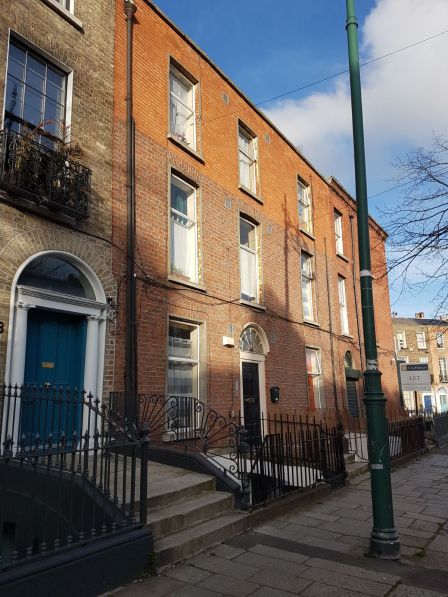
Vincent Avenue

House in Vincent Avenue today, they were build c.1880

Republican roots, what the records say…

When searching through the Bureau of Military history records I came across a number of references to the Kieran family. One referred to the family as a “Volunteer family….railway people”. This came from the witness statement of Muriel MacSwiney, the wife of future TD and Lord Mayor of Cork, Terence MacSwiney who stayed with the Kieran family during one of Terence’s frequent bouts of imprisonment. This is confirmed by the witness statement of another local Volunteer James McGuill who referred directly to Brigid saying that Muriel MacSwiney “stayed in Dundalk with Miss Kieran now Mrs. Peadar Halpin.”

78-1926-08-15-Muriel-MacSwiney-1920

Muriel MacSwiney

On a slight digression Muriel MacSwiney was a fascinating woman, born Muriel Murphy, her family owned the Midleton Distillery and they were firmly against her marriage to Terence MacSwiney and even tried to get the Bishop of Cork to intervene to delay it. As a footnote that will become relevant later, the best man at their wedding was Richard Mulcahy the future Chief of Staff of the IRA, Minister for Defence during the Civil War and later still, leader of Fine Gael. Terence was in and out of various gaols during the course of his short marriage with Muriel, he would be dead by 1920 at the age of just 41, wasting away on hunger strike in Brixton Jail. The impact his death had on the wider world is probably comparable to that of Bobby Sands six decades later. MacSwiney was viewed by many as a martyr in a fight against Imperialism and was cited as an influence by  Mahatma Gandhi as well as India’s first Prime Minister Jawaharlal Nehru.

Apart from providing lodgings for Muriel MacSwiney it’s worth looking at what else the Halpins and Kieran’s were up to at this turbulent time. Thomas Kieran is mentioned again the the Bureau of Military History. In the witness statement of Patrick McHugh, Operational Commander and Lieutenant of the Irish Volunteers in Dundalk during Easter week 1916 listed Thomas Kieran among those “who served Easter Sunday 23rd April 1916, remained with company that day and, volunteered to return home when uncertainty of position was explained to them. Some returning Sunday night, others Monday morning or as Stated.”  Interestingly Thomas is already listed as living in Dublin by this stage while most of those mentioned were still living in Dundalk. Peter Kieran (a possible relation?) another Dundalk based Volunteer declared in his witness statement that Thomas Kieran was among a group of Volunteers who had arranged to meet on the night of Thursday 20th April with plans to make their way to Dublin to join the rest of the Volunteers in the Rising. They had elaborate plans to get there via motor boat but were warned that the Royal Navy had vessels patrolling the area.

The plans for the Thursday journey to Dublin was called off and the group met again on Friday and Saturday night, however word came that the Rising was off, probably a reference to Eoin MacNeill’s order cancelling the Rising, which obviously had a significant impact on the numbers of those who arrived in Dublin. Peter Kieran went on to state that about the second week in May arrests were made in the town by the RIC. The family version of the story that I’ve been told was that Thomas was one of those arrested while cycling his bike with a rifle on his back and that he was later interned!

Peter Kieran in his statement also noted that “Those who served 23rd, 24th and 25th April 1916 and became disconnected, were ordered home on account of age, infirmity or as stated. [included] Peter Halpenny or Halpin [of] Byrnes Row Dundalk”  Although it is hard to be absolutely certain this Peter Halpin could well be our Peadar Halpin, he was listed as Peter on the earlier census return. There is also a record of a P. Halpin from Byrne’s Row who was arrested a couple of weeks after the Rising and sent to Stafford Detention Barracks in England on 8 May 1916. There are other references in other sources to a P. Halpin of Byrne’s/Burn’s Row being arrested and sent to Stafford.

In searching the medal rolls for this issued the 1917-21 Service Medal both Peadar and Brigid appear. Both were issued the medal, Brigid in 1943 and Peadar in 1951. Her deposition states that Brigid was a member of Cumann na mBan from before the Rising. She was involved in dispatch work, fundraising for the purchase of arms, did election work for local candidates and visited republican prisoners. Peadar in his deposition states he was a member of “A” company of the 4th Northern Division of the IRA and that his involvement also predated the Rising, going back to 1915. It doesn’t however, detail individual operations of which he was part.

Patrick McHugh (who we encountered above) managed to escape arrest although he was interrogated by RIC men just after the Rising. He then moved up to Dublin to stay with his sister on Iona Road for a short time until he “got in touch with friends Tom Kieran and his wife [the granny Kiernan], who had a room in Mountjoy Street.” It seems that Thomas Kieran had moved to Dublin sometime between 1911 and 1916. I know he ended up working in the CIE engineering works in Inchicore for many more years. He obviously met Jane Brennan (2 years his junior) when he moved to Dublin, she had been living on Dominick Street Upper at the time.

Blessington St1

The house at 27 Blessington Street, just off Mountjoy Street, where the Kierans lived.

Peadar was born in 1895 and grew up in Stockwell Lane, Drogheda. He trained as a cooper, (the trade of his father John) before moving to Dundalk to work in the Macardle Moore Brewery where he later became the foreman cooper. It is interesting to note that his wife Brigid was 12 years his senior. He came from something of a Republican family and a street (Halpin Terrace) in Drogheda bears the family name. This street has something of a tragic history to it as it was named after Peadar’s younger brother Thomas, who was killed there by the Black and Tans in February 1921. At the time Thomas was an Alderman of the local Corporation representing the Sinn Féin party. Thomas Halpin, along with another man, John Moran were abducted from their homes and brought to the local West Gate barracks where they were brutally beaten. They were then dragged to a third man`s home, that of a Thomas Grogan whose house was also raided but fortunately Grogan had been tipped off and had made his escape before the Tans arrival. It was at this spot that Thomas Halpin and John Moran were murdered, their bloodied bodies being discovered there the following morning. Each year the local Council commemorates this event and a monument now stands at the site of the men’s murder.

IRA memorial

Commemorations for Alderman Thomas Halpin & Captain John Moran in 2014


Footballing connections; all roads lead to Bohs

Thomas, is something of a family name, Peader’s brother Thomas was tragically killed and Peadar would name a son of his as Thomas, perhaps in tribute to his murdered sibling. Thomas Kieran would also have a son named Thomas and there is an interesting football overlap as both of these men named Thomas would have a part to play in the history of Bohemian FC.

Peadar’s son Tom lined out for Dundalk in the early 40s before moving to Bohemians in 1947. He featured prominently in Bohs run to that season’s FAI Cup Final where he was part of a team that defeated Drumcondra FC, Shelbourne in the semi-final (where Halpin scored a penalty) and took on a highly talented Cork United side in the final. Cork United had been the dominant team of the 1940s and had already won five league titles by the time they took on Bohemians in front of over 20,000 fans at Dalymount Park on April 20th 1947. The Leesiders were the strong favourites. Bohs were at an added disadvantage as two of their key, experienced defenders (Snell and Richardson) were out injured. Halpin was playing at right half and spent most of his time trying to counteract the attacking threat of Cork’s forward line which included Irish internationals like Tommy Moroney and Owen Madden.

Bohs 1947

The Bohemian team from the 1947 final

Bohs were already 2-0 down before 30 minutes were on the clock but Mick O’Flanagan managed to pull one back before Halpin scored a penalty after Frank Morris was fouled in the box. The game finished 2-2 and went to a replay four days later. In a howling gale and lashing rain Bohs lost out in the replay in front of barely 5,500 people with the Munstermen winning 2-0.

Tom Kieran’s connection with Bohemians was a very long one, a referee for decades, including at League of Ireland level in the 1960s. The uncle Tom was a member of Bohemians since 1969 and was Vice-President of the club from 1985 to 2000 and was later made an Honorary Vice-President for life. Tom’s daughter Susan and her husband Dominic are of course still very familiar faces down at Dalymount to this day.

the uncle Tom

The uncle Tom as photographed for an Evening Herald profile in Dalymount Park

There are further remarkable connections with the Halpin family and with Dundalk and Bohemians as Thomas Halpin’s grandson; Peter was the Commercial Manager at both Dundalk FC and Bohemian FC as well as having a spell with Belfast club Glentoran.

Despite these many connections with the beautiful game the strongest and most influential roles in Irish football were undoubtedly held by Peadar Halpin. He was on the committee of Dundalk FC since at least 1926 and had two spells as Club Chairman from 1928-1941 and 1951-1965 and in 1966 he was appointed Club President, a position he was re-elected to in 1973. He also held a number of roles for the FAI, he was Chairman from 1956-1958 and had many years previous experience on various FAI committees and had made an unsuccessful attempt at arranging UEFA mediation to help resolve the long-running schism between the FAI and the IFA. At the age of 70 he was elected as President of the League of Ireland, it was a role he hadn’t been expecting to fill but after the Dundalk rep Joe McGrath became ill Peadar was the only member of the Dundalk committee with sufficient experience to take on the role. While the FAI and League of Ireland have (with good reason) been seen as conservative and at times backward there were a number of advances that took place during his tenure. It was the Dundalk committee that suggested the introduction of the B division which would eventually lead to the creation of the First Division as well as overseeing the admittance of new clubs to the League of Ireland. On a local level he was crucially involved with the development of Dundalk FC as a force within the League of Ireland, at present they are the second most successful side in Irish club football with 11 League titles and 10 FAI Cups. He claimed that of the many successful years that Dundalk enjoyed his favourite was 1942 when Dundalk beat Cork United 3-1 in the FAI Cup final and Shamrock Rovers 1-0 in the Inter City Cup.

Dundalkimage

Mattie Clarke in action for Dundalk in the 1950s as featured in the Irish Times

A potential politician?

Despite this extremely long connection with Dundalk FC the earliest reference to his involvement was in 1926. Prior to that we know that he was working as a foreman cooper in the Macardle Moore Brewery but in March 1923 his name appears in a debate in Dáil Éireann when his local TD Cathal O’Shannon raised a question on his behalf with the then Minister for Defence, General Richard Mulcahy. This is the same Richard Mulcahy who had performed best man duties at the wedding of Terence MacSwiney and Muriel Murphy who the Halpin’s would later shelter. It is testament to the divisiveness of the Civil War that such former allies could be so opposed.

O’Shannon had been elected TD for Louth-Meath in 1922 as a member of the Labour Party and was a supporter of the Treaty of 1921 which had officially led to the partition of Ireland. Mulcahy as Minster for Defence was a highly controversial figure for some as it was he who gave the order for 77 executions during the Civil War. The content of O’Shannon’s query was a request for an update on the status of Peadar Halpin and the likelihood of his release from Newbridge Barracks where he had been held since August 1922. Mulcahy replied that “Mr. Halpin was arrested for aiding and abetting Irregulars during the time of their occupation of Dundalk. It is not considered advisable to release him at present”, he further added that Peadar was not to be allowed send or receive letters.

As for what “aiding and abetting the Irregulars” referred to, the most likely answer given the fact that Peadar was arrested in August 1922 in Dundalk was that he was involved in assisting the anti-Treaty IRA (or “Irregulars”) in their attack on Dundalk on August 16th 1922. During this attack, led by future Tánaiste Frank Aiken, the anti- Treaty forces captured the town, freed over 200 prisoners held in the barracks and also took over 400 rifles. Rather than try to hold their position the town was re-taken the following day by Free State forces. In all the attack on Dundalk cost the lives of six Free State soldiers and one officer as well as the lives of two of the “Irregulars”. It is not clear what assistance Peadar provided during this time but it was obviously significant enough to warrant him being held in gaol for months without charge.

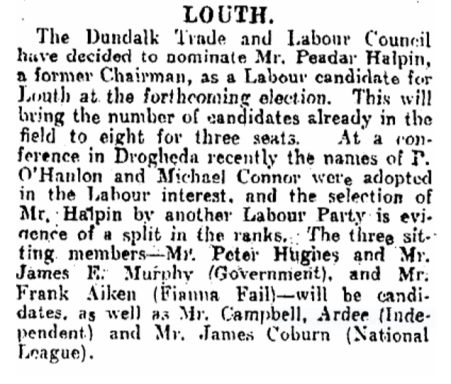
Family recollections of Jane Kieran née Brennan, the wife of Thomas Kieran are fairly clear on her views on Mulcahy and Cumann na nGaedheal, she put it bluntly and succinctly, saying “they cut the old age pension and they shot them in pairs”. It was not to be the last connection between Peadar and Cathal O’Shannon or Frank Aiken for that matter as the below excerpt shows.

Peadar Labour snip

From the Irish Times April 29th 1927


Cathal O’Shannon stood in the new Meath constituency in the first general election of 1927 and in his absence as the Labour candidate it was proposed that Peadar should run. Among his competition would have been the man he likely assisted during the Civil War, Frank Aiken. However as is the cross that left-wing politics must bear, there was a split, those who proposed Peadar as a candidate were not successful in securing his nomination and Thomas O’Hanlon and Michael Connor ran, unsuccessfully, for the Labour Party. As another of my many side notes, Cathal O’Shannon was unsuccessful in gaining election in 1927 however he later became the first Secretary of the Congress of Irish Unions in 1945, the last president of this Congress was one Terence Farrell, head of the Irish Bookbinders and Allied Trades Union. His nephew Gerard, after whom I’m named, married Nancy Kieran which brings together the Farrell and Kieran clans. Their eldest son was my Da, Leo and as many in the family will know he played for Bohs in the early 60s.

Anyone who has read this blog regularly will know that I often try to look at life and history through the prism of football. Of particular interest is the role that “soccer men” played in the Rising and subsequent War of Independence and Civil War. This is probably the most personal post as I’ve tried to do the same with my own family and their involvement with the nationalist movement. There are many stories that I would love to include but haven’t but would appreciate any feedback or additional information from family members. I hope that this could be the first in a series of posts that might be of interest or maybe just a first draft of something more extensive, there were certainly enough stories told at uncle Joe’s funeral to fill a book, but I hope this might be a start.


With a special thanks to Jim Murphy, Dundalk FC historian for his assistance with some of the research for this piece.