The Magyar martyr- the killing of Sándor Szűcs

There are certain teams that occupy a space in the popular imagination of the football fan not because of the trophies that they’ve won but due to their style of play and to an extent the romanticism of their glorious failure. The two that most readily spring to mind are the Dutch side of 1974 and the Hungarian side of 1954, both beaten by West German teams in the World Cup Final.

Even more than 60 years later there is a certain mystique around the Hungarian side of the 50s, the Magical Magyars or the Aranycsapat (Golden Team) as they were know in Hungary. Foremost in the minds of football fans surely are names like Ferenc Puskás, the goalscoring “Galloping Major” who would later star for Real Madrid and score 4 goals in the 1960 European Cup final. Other key figures included the wing half József Bozsik after whom the stadium of Honvéd is named, or Nándor Hidegkuti who revolutionised attacking play in his role as a deep lying centre-forward which gave free reign for the exceptional talents of inside-forwards Puskás and Sándor Kocsis to raid forward to devastating effect.

Despite losing the 1954 final in surprising (and according to plenty of Hungarians, controversial circumstances) the modern reputation of the Golden Team lies with their numerous other achievements, not least their twice systematic dismantling of the English national team (6-3 in Wembley in 1953 and 7-1 in Budapest in 1954) which did away once and for all of the notion of innate British superiority or the idea that England could not lose to Continental opposition on home turf. This Hungarian side were also Olympic gold medallists in 1952, Central European Champions in 1953 after defeating Italy, and went over four years undefeated in international football.

Golden_Team_1953

The Hungarian National team circa 1953- Ferenc Puskás is crouched front and centre.

Hungarian football had emerged from the war strongly with a new generation of stars who it was felt could deliver international success. This team was born from a time of violence and into one of political tension and civil unrest from which even the brilliance of their play could not be a defence.

The Hungarians had lost out 4-2 to Italy in the 1938 World Cup final, by 1945 with the War in Europe complete, Hungary witnessed the international début of an 18 year old Puskás while the other stars of the Golden Team would follow in their débuts within the next few years. Despite the terrible damage caused by the battle of Budapest in 1944-45 which claimed the lives of over 45,000 people Hungary witnessed free elections at the end of 1945, despite the powerful influence of the Soviet Union, and a coalition government was formed, with some Communist officials in positions of significant influence. For these first few post-war seasons professional football existed in Hungary and the emerging star players could earn decent money.

However as time progressed the political situation began to change. Mátyás Rákosi, the chief secretary of the Stalinist Hungarian Communist Party slowly set about removing political opponents from positions of power and influence while consolidating his own power base. He later boasted that he removed his supposed partners in government one by one, “cutting them off like slices of salami”. By 1949 there was a change in constitution, Hungary became the People’s Republic of Hungary and the nation officially fell behind the Iron Curtain. With this change of government came a change to how football was run in the country. Kispest, the club of Puskás and Bozsik became Honvéd the team of the Hungarian army, while Újpest FC became the team of the team of the police. Among the star players at Újpest was the international defender Sándor Szűcs. He’d be executed in secret within two years.

Szűcs was born in November 1921 in the town of Szolnok about 100km from Budapest and began his football career with local side Szolnoki MÁV. Already an international by the time he moved to Újpest in 1944 he would win three consecutive league titles with the Budapest club between 1945 and 1947 playing alongside team-mates like Gyula Zsengellér, who had played in the 1938 World Cup final and would later move to AS Roma, and Ferenc Szusza who still holds the record as the Hungarian League’s highest goalscorer and after whom Újpest named their stadium. Szűcs was also an established international by the time Puskás would make his scoring international début against Austria, both men playing in a comprehensive 5-2 victory.

However things started to go wrong for Sándor after the change of government and a chance meeting with a young, and crucially, a married woman. In 1950 a passionate Újpest fan invited Szűcs and some of his team-mates back to his house for a get together, it was that fateful night that Sándor met Erzsi Kovacs the 21 year old wife of their generous host. The young Erzsi was already becoming well known in Hungary as a popular jazz singer and the two apparently fell for each other immediately.

Sándor, then only 29, was also married and a popular international footballer playing for a club then just coming under the control of the police was in a hugely difficult position and tried to hide their affair to avoid a scandal that seemed inevitable. In fact due to the re-allingment of the club with the police force Sándor had technically become a policeman in the same way that Puskás and his Honvéd team-mates were army officers. That didn’t stop Erzsi being called for questioning by the AVH, the notorious secret police about the affair. After the interview Sándor recieved a chilling phone call advising him to cease the relationship or else he would end up somewhere where his footballer’s legs couldn’t help him.

The couple resolved to flee the country. Under the new Rakosi regime everything that they had in Hungary was reliant on the good will of the state. Szűcs received better clothing and food than the regular working person and was able to benefit from additional income through the black market. As a form of bonus top Hungarian athletes were able to bring in black market goods from away internationals and foreign tours to supplement their income, the state security forces would conveniently look the other way. However in the current circumstance all that was at risk.

Their plan was to cross the border into Yugoslavia and from there into Italy. Sándor knew that the Italian side Torino had been interested in him in the past and he would have known that former team-mates like Zsengellér had found some success as a player in Italy but this bold plan carried a serious risk. An illegal attempt to cross the border carried the death penalty.

They resolved to borrow a car and to pay a smuggler a fee to arrange safe passage across the border and into Italy. They were to leave in March of 1951. Sándor had to be careful, he couldn’t risk telling his team-mates seeing as Újpest was the police club and a player, a team-mate, could turn informer to the dreaded AVH. The club were certainly not immune from AVH interference, indeed the club had only signed their new star striker Ferenc Deák after he got into a fight with two AVH men who threatened him with serious jail time if he didn’t move from Ferencváros to Újpest.

The young couple set out on March 6th, the person who agreed to smuggle them out had advised Sándor to take along a pistol as an added precaution, however this seems to have been just another part of an elaborate trap. The couple were stopped by a security patrol on the way to the border, at first everything seemed to be alright, they merely asked for their ID before sending them on their way, however a few kilometres later they were surrounded by AVH men, the smuggler had been a plant and they were waiting for the young couple all along. The gun that Sándor had been told to carry was seized and he and Erzsi were taken to the AVH headquarters at 60 Andrássy Avenue, commonly known as the House of Terror. Both were brutally interrogated before Sándor was charged with illegally attempting to cross the border and with high treason. He was tried in a Military Court in May 1951 with a court appointed lawyer that he did not know, the sham trial found him guilty of all charges and sentenced him to hang along with the confiscation of all his property. Erzsi was sentenced to four years in prison.

Former team-mates including national team players József Bozsik , Ferenc Szusza and Ferenc Puskás petitioned the National Defence Minister, Mihály Farkas for clemency on behalf of Szűcs but they were refused. Puskás had in the past been able to use his influence to get team-mates and friends out of trouble but now his pleas fell on the deaf ears of the new Stalinist regime. On June 4th 1951 Sándor Szűcs was executed in secret. Erzsi didn’t learn about his death until her release in 1954 and details of the execution and the location of Sándor’s grave did not emerge publicly until 1989.

One theory explaining the severity of the sentence and the elaborate set up of Szűcs and Kovacs was that aside from the fact that their relationship offended a conservative Stalinist regime the execution of Szűcs would act as a deterrent to other sports stars or entertainers who might consider defecting. This is only a theory but perhaps it did work. We know that Puskás was offered a huge salary by Juventus which he turned down and he wasn’t the only player offered such inducements. Part of the reason for this could well have been the brutal treatment meted out to their erstwhile colleague Sándor Szűcs. It was only after the vicious reprisals against those who took part in the 1956 Uprising that players defected en masse. This was aided by the fact that Puskás and his Honvéd team-mates were out of the country, in Spain to play a European Cup match against Athletic Bilbao. Ultimately Puskás would have a hugely successful “second” career in the white of Real Madrid, international team-mates such as Koscis and Czibor would also find success in the blaugrana of Barcelona.

Erzsi was released towards the end of 1954 and after a short time was able to resume her singing career and found popular success in Hungary in the 1950s and 60s before moving abroad and performing around Europe as well as on cruise ships. She eventually returned to Budapest and continued recording music well into her 70s. She passed away in 2014 at the age of 85.

A later album of Erzsi Kovacs

With the collapse of Communism in Europe, Hungary held free, multi-party elections in May 1990, as part of this return to democracy the crimes of the country’s past could be redressed and the execution of Sándor Szűcs came back to the fore publicly. In 1989 his death sentence was revoked, he was posthumously promoted to the rank of lieutenant-colonel in the police force and today a school is named after him as is a stand at the Ferenc Szusza Stadium where Újpest play. He was the only professional footballer killed by the regime although many more fell victim to the AVH and the House of Terror. Sándor Szűcs is now better remembered in modern Hungary but his death casts a dark shadow on the glory of the Golden Team.

Szuszastadion.jpg

The Ferenc Szusza stadium, home of Újpest

Dick Forshaw – Waterford pioneer and troubled soul

Waterford has had its share of visitors over the centuries, ever since the Vikings first set up shop there back in the 9th Century. The football team have been no different, whether it was former World Cup winner Bobby Charlton, Polish international Piotr Suski or the Coventry born duo of Johnny Matthews and Peter Thomas who would enjoy great success down on the south coast, all playing in the blue of the city at one stage or other.

In his recent, meticulously researched history of soccer in Munster, David Toms goes into some detail in the development of the sport in the southern province and he focuses especially on developments in urban centres like Cork, Limerick and Waterford. What Toms’ research shows is that the Waterford predilection for a British footballing import has a long history. In 1930, despite the city suffering significant unemployment levels as well as the economics effects of the Great Depression the city’s business community and local football supporters embarked on a significant fundraising venture. Their aim? To provide sufficient funds to have a competitive Waterford team in the League of Ireland.

To compete with the likes of Shelbourne, Bohemians, Dundalk and Shamrock Rovers it was felt that Waterford FC would need to invest in bringing in some quality professional imports to play along home grown stars like Alfie Hale Sr. and future Ireland international Tom Arrigan. Brought in as player-coach was former Brighton and Man City player Jack Doran who had been capped three times by Ireland and he used his connections in the game to recruit a number of players with experience of the English league.

In fact for Waterford’s opening fixture in league football seven out of their starting XI were players who had some experience of cross-channel football. That opening game was in front of 10,000 spectators in the Dundalk Athletic Grounds on August 24th 1930 where the fledgling Waterford site were defeated 7-3 by the home side. It was somewhat of an inauspicious start for the Munster side but their undoubted star on the day was an Englishman named Dick Forshaw who scored Waterford’s first goal in league football. Forshaw opened the scoring in the match against Dundalk and was unlucky not to grab a second as he struck the post late on in the second half. He’d grab two goals the following week in Waterford’s first home league fixture as they secured their first win of the season, a 3-2 victory over St. James’s Gate.

That Forshaw was such as instant success should not be that surprising, although he had just turned 35 before he made his Waterford debut he had until very recently been playing in the English second division for Wolves. Prior to that he had enjoyed an illustrious and record-making career with both Liverpool and Everton.

Born in the Lancashire town of Preston in 1895, Forshaw had joined the British army as a young man and spent some time during World War I stationed in the British colony of Ceylon (modern day Sri Lanka), at the time a fairly favourable posting as the area was spared the sort of brutality endured on the like of the Western Front. Upon returning to Britain he was signed by Liverpool manager George Patterson and made his debut for the Reds in September of 1919 with the Evening Telegraph describing him as a hockey and tennis enthusiast who was destined to “develop into a top-notcher”. Forshaw was a skillful right sided inside-forward, his early seasons for Liverpool weren’t prolific in goal scoring terms but he did tend to enjoy “purple patches”, for instance he grabbed a hat-trick against Derby County in his first season.

Dick’s progress in those early seasons was steady, he became a first team regular as Liverpool enjoyed consecutive fourth place finishes, it was however in the 1921-22 and 1922-23 seasons that Forshaw would really make his name. It was in these seasons that Liverpool would win back to back titles and Forshaw wouldn’t miss a single league game for those two years, chipping in with an impressive 36 goals from 84 matches, second only to centre forward Harry Chambers in the club’s goalscoring stakes. One of his team-mates in that Liverpool side was Wexford man Billy Lacey who he would encounter again as player-manager of Cork Bohemians during Forshaw’s sojourn with Waterford.

Although further titles would elude Liverpool for the next two decades Forshaw continued his good form including a knack of scoring hat-tricks against Manchester United. In fact he scored three against United at Anfield two seasons running in 1925 and 1926! In all he scored seven hat-tricks in his time at Anfield and also jointly holds the record (with John Aldridge) for scoring in the most consecutive games (9 in case you’re wondering) in one season.

It wasn’t just with Liverpool that Forshaw made history, he made history by leaving the club as well. Despite playing well during the 1926-27 season (he was on 14 league goals at the time of his departure) the club sold him for £3,750 to city rivals Everton in March of 1927. While this was a significant sum at the time (the transfer record was the £6,500 Sunderland paid for Bob Kelly) especially for a man that was nearly 32, it still came as somewhat of a shock to the Liverpool faithful and to Forshaw and his family. As was the style of the time this was something agreed by the Directors of the two clubs with no discussion with the player. His wife was said to have declared  “I have never been an Evertonian and I don’t know what I shall do about it.” By the time he left he had scored 123 goals in 288 games for the Reds in all competitions.

Success followed Forshaw to Goodison Park however and he made history by becoming the first, and so far only man, to win league titles with both Everton and Liverpool when he was part of the triumphant Everton side of 1927-28. Central to this achievement of course was “Dixie” Dean who would score his record breaking 60 league goals that season, he was helped in part by his forward partner Forshaw.

However by the start of the 1929 season Forshaw was on the move again, aged 34 he signed for a “substantial fee” to second division Wolves. He was only there a matter of months before he handed in a transfer request and began somewhat of a peripatetic existence, popping up at non-league sides like Hednesford Town and Rhyl Athletic (now simply Rhyl FC) for short spells. It was in this set of circumstances that John Doran was able to sign Forshaw for Waterford, only two years after he was playing alongside Dixie Dean and winning a Championship with Everton.

Dean of course, would also enjoy a spell in the League of Ireland in the 1930s, spending some time on the books of Sligo Rovers in 1939 and scoring a club record 5 goals against a hapless Waterford side, however by that stage Forshaw was long gone and his life after football was filled with more tragedy than joy.

Within a year of leaving Waterford Forshaw was up in court charged with defrauding an acquaintance of his, one Richard Green. In April 1932 Green had given Forshaw £100 to place a bet on a horse at Ascot, the horse won and Green of course expected to collect his winnings of over £2,000, however Forshaw was nowhere to be found. Not expecting the horse to win Forshaw had doctored betting slips to make it appear that he had placed the full wager when in fact he had only placed a couple of £2 bets and kept the remained of the stake money for himself.

Forshaw had acted, according to the judge, with “peculiar meanness”, and he gave little consideration to Forshaw’s justifications about needing the money. Now aged 36, Forshaw claimed that due to an accident he had been forced to give up on his playing career, he had tried his hand at other trades and at the time of his trial was living in Kilburn, London and running a Fish and Chip shop with his wife. This carried little weight and the unfortunate ex-footballer was sentenced to 12 months of hard labour for his offence.

His difficulties did not end here, within months of completing his sentence Forshaw was back in court, when in November 1933 and listing his livelihood as a salesman, he pleaded guilty to four counts of theft and was sentenced to a further 17 months of hard labour. The next few years would repeat this pattern, release from gaol before almost immediate re-arrest, mainly for offences like theft. In 1937, then he was in the dock on two counts of theft. Only hours after release from his previous sentence Forshaw had gone out drinking, he had stolen some silverware from a London hotel before drunkenly stealing two suitcases from Euston train station. At the trial the magistrate spoke to Forshaw, a married man, father of three who was now stuck in a cycle of crime and punishment, he said the following to Forshaw as he told him he was likely to face imprisonment with hard labour;

“I want you to take warning from this. Can’t you pull yourself up before it is too late?”
Forshaw  replied– “That’s what I want to do.”

Forshaw would pass away in 1963, in what was an era of dominance for his former clubs, Everton winning the league in 1962-63 and Liverpool bringing the title across Stanley Park the following year. Waterford too were improving, they finished second in the 1962-63 season with Mick Lynch taking up the role as the side’s main attacking threat. Lynch, who was a friend of Coventry City manager Jimmy Hill used that connection to bring over the likes of goalkeeper Peter Thomas and Johnny Matthews to Waterford where they would help (along with the likes of the returning Alfie Hale) bring unprecedented success to the south coast by the end of the decade.

Waterford Shield

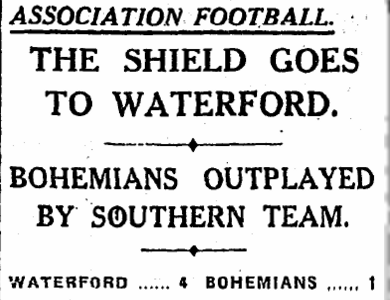
Forshaw played a small part in helping to establish a league footfall foothold in the city, Waterford finished a credible 9th in their first season of League football and even picked up some silverware with a victory of the League of Ireland shield. Despite the hardship of his later life it’s worth remembering his small contribution to the growth of football in Ireland.

There is some great further reading available at the excellent http://playupliverpool.com/

On being the Best

In a recent interview with journalist Andy Mitten the great Xavi Hernandez was asked if Lionel Messi was the “best ever”. Xavi is a true football anorak, he tends not to give glib answers, he’s been one of the greatest midfielders in arguably the greatest club and international sides ever, so his responses should be given a certain gravitas. He replied to Mitten that:

Yes [Messi is the best ever]. Pele and [Diego] Maradona both made a huge difference, but football has evolved. The players are better than they were, the game is better. Physically, tactically, technically and psychologically, football is better than ever. And Messi stands out as the best at the best time in the history of football.

pic_2015-03-08_OTRO_BARCELONA-RAYO_18.v1428485118

Succinctly put. It’s easy to see the logic of Xavi’s arguement, he even name-checks Pele and Maradona, those players who would traditionally vie for the title of the “best ever”. Messi does indeed play at a level, a pace and at a tactical evolve that would be alien to Pelé or even Maradona. If we had access to a time machine and dropped either of these two historical greats into the current Barcelona side then it is likely that we would see what Xavi is talking about. The frenetic pace of elite level football, the amount of ground that would have to be covered, the tactics and shape, the diet and conditioning, even the very rules of the game would be unfamiliar to the Pelé of 1970 or the Maradona of 1986, so of course the 2015 Messi would appear the better player.

To be clear there is a very strong argument that Lionel Messi is indeed the best player in the history of the game. His attacking versatility, his scarcely believable goal scoring rate, the collection of winners medals that he has accumulated through a glittering club career are all testament to this. The one mark in the debit column against Messi that is usually stated is that despite his amazing achievements with Barcelona he has yet to win a senior international tournament with Argentina while both Pele and Maradona were instrumental in winning the World Cup for Brazil and Argentina respectively.

For much of the global history of football the international game was considered the very highest standard of excellence and Pele and Maradona are rightly recognised for their success at this level. However in recent years with the growing dominance of elite European leagues, and an upper echelon of super-wealthy elite clubs within these leagues this has begun to change. It is now arguable that even the best sides at a World Cup would be overall inferior to the matchday squad of better Champions League sides. The expansion in player scouting to truly global proportions, as well as football’s growth in popularity and professionalism (there are now estimated to be more than 265 million active players worldwide according to FIFA) has meant that competitiveness for places and the breath of playing talent available to elite clubs is far beyond anything in the earlier history of the sport.

The hot-housing and accumulation of talent within clubs like Barcelona, Real Madrid and Bayern Munich, means that the elite levels of European club football are the ultimate proving grounds for individual footballing excellence. So surely Messi, having now won four Champions League titles, has achieved as much at such a high standard as any other player who could lay a claim to being the Best?

This would all point to fact that Xavi is right in his choice of Messi as the greatest ever player, that the pace of the modern game and its tactical advancement would mean that players of earlier generations would look like something from that Harry Enfield sketch of black and white era football buffoons. But I feel that this is somewhat unfair, the modern game has become obsessed with the 24 hour football news cycle and a couple of events have suggested that we find it difficult as modern football fans to appreciate footballing achievement if its historical context pre-dates the 1990’s.

Two recent events apart from the Xavi’s quote above have brought this into focus for me. Jamie Vardy’s consecutive goalscoring record and the tenth anniversary of George’s Best’s death. In Vardy’s case he has claimed a very significant landmark, he now has the record for most consecutive goals in the history of the Premier League with  goals in 11 consecutive games. That is to say a record since the rebrand of top flight English football in 1992. This is still a significant achievement, he’s done something that Ruud van Nistelrooy, Alan Shearer or Theirry Henry never managed, and of course we like to view history in bite size chunks, there is no harm in that. Prior to the Premier League there was often mention as I recall of “post-war” records because that’s just how we like to process the passing of time. Credit should be reserved for the likes of Sky Sports who have consistently highlighted that the overall record still belongs to Jimmy Dunne who scored 18 goals over 12 consecutive games in the 1931-32 season.

Little footage remains of Dunne and it’s only Vardy’s recent record breaking feats that have brought him back into the footballing consciousness. Even in Ireland where Dunne was our record goalscorer for 27 years (until this was broken by Noel Cantwell) few are really aware of his feats on a football pitch and Dunne is seldom ever mentioned in greatest Irish XI’s or such like.

Such polls are always fickle, in fact a recent poll by the FAI to select the greatest Irish team in the last 50 years didn’t even include Johnny Giles! And it can’t be said that John lacks any media profile.

FAI XI

The best Irish team of the last 50 years as chosen by Irish football fans. No room for John Giles.

The other landmark in recent days was the tenth anniversary of the death of George Best. Manchester United fans were commemorated Best with banners and chants at Old Trafford and there were many comparisons drawn between the swashbuckling playing style of Best, Law and Charlton with the more prosaic football on offer from Louis van Gaal’s charges.

Best is often cited as the first of a new generation of footballers, one of the first “modern” players. Best made his first team debut in 1963, the year the first Beatles album came out, and the year that poet Philip Larkin claimed “Sexual intercourse began”. That’s the problem with the past, we can only view it in retrospect so of course it appears that Best’s life and career were always on a pre-destined course. So it seems to us he was always the handsome Belfast-boy who was destined to become the “fifth Beatle” , the supremely talented player who was doomed to live fast and burn out young.

But did it have to be that way? Returning to Xavi’s point about Lionel Messi being the best ever, does the comparison with Pelé and Maradona work the other way. Yes they might appear off the pace if they were magically transported into the modern game but then that could be said of any discipline; Jessie Owens would lose to Usain Bolt in a sprint,  in the arts the master practitioners of past would be out of their depth if thrown into a modern milieu, imagine asking Alfred Hitchcock or Cecil B. DeMille to direct a modern Hollywood blockbuster, on digital, with the current demands of a global film industry, they’d be overwhelmed but it doesn’t mean they are not great directors.

What if Best and Pelé were born later? What if Maradona had been born in 1990 not 1960? Players with their control, technique and vision would always thrive, they’d be better protected now from the darker arts of opposing defenders, and they could avail of the most modern training techniques, tactical instruction, diets and so on. Best was at the forefront of the tortuous birth of the modern celebrity sportsman, today Best would have been better understood, the level of public scrutiny to which he was suggested would now be commonplace and both player and his club better able to deal with these extremes. Similarly the excesses of his personal life are better understood, today there would be a far better chance of Best firstly being better protected from the rigours of celebrity and secondly to have better supports available if he did begin to develop a dependency on alcohol. While it might be cynical it is in the best interests of hyper-wealthy football clubs to protect their stars as best they can.

Similarly with Maradona or Pelé, the modern club structures would have meant that Maradona would have been unlikely to move from Barcelona to Napoli (while Napoli are top of Serie A at the time of writing they were struggling when Diego arrived in 1984) due to the wealth gap between even the top clubs in Serie A and the small elite band of hyper-wealthy sides. Perhaps he would never have fallen in with the Camorra, perhaps his drug habit, which had begun towards the end of his time at Barcelona would never have developed as it did. Pelé might likely have followed a similar route to current Brazilian international and fellow Santos alumni Neymar Jr. staying only in Brazil to his early 20s before a lucrative move to Europe.

The greatest players probably should only be judged on their individual eras as one of the greatest facets of football is that while it remains quite close to the original rules of the 1860’s that made it “the simplest game” it is also constantly changing, progressing and reacting. Football would be both instantly recognisable to a time traveller from the past and bewilderingly different.

Messi is unique in world football at present and has a strong claim to being one of the greatest players of all time but our standards for greatness change as time progresses. Just as it would be folly for a football fan in 30 years time to write off Messi’s achievements because of the victories of some as yet unborn player, so to is it our folly to underestimate the accomplishments of those who have gone before.