Catalonia: Mixing football and politics

I wrote this on Catalan independence back in 2012 but in light of recent elections in Catalonia with claims that Catalonia could be declared independent in 18 months I thought this might still be relevant.

Few places on the planet meld the worlds or football and politics together as much as Catalonia and its biggest city Barcelona. As Catalonia goes to the polls in less than two weeks’ time; at stake will not just be the parliamentary seats of the regional government from one of Spain’s 17 provinces but possibly the future of Catalonia and Spain itself.

Catalonia is in a contradictory fashion both one of Spain’s most indebted regions while also being the region that pays the highest amount of taxes to Central government. Disagreements between regional premiere Artur Mas and Spanish Prime Minister Mariano Rajoy over the ability of Catalonia to have more direct control over spending and taxation have led to the hot topic of the regional elections due to take place on November 25th being that of Catalan independence.

This has been demonstrated by large scale pro-independence street marches on the streets of Catalan towns and cities and in the great cathedral of Catalan nationalism the Camp Nou. During last month’s Clasico match with Real Madrid the whole stadium was turned into a giant Catalan flag while the crowd chanted “Independence, Independence”. During their recent visit to Parkhead the Celtic staff greeted their visitors not with the Spanish flag but the Catalan one flying from the stadium flagpoles, a nod and a wink from the Scots who are due to have their own referendum in 2014. Despite the international nature of FC Barcelona’s founding fathers the club has become a focal point for Catalan nationalism, Camp Nou being described as the one place in Catalonia where the Catalan language and political dissent could be vocalised during the Franco regime Its club presidents view the leadership position at the club and on-field success as important political tools and are often aligned with the Catalan nationalist movement, former President Joan Laporta was an MP with Democricia Catalana for example.  The current president Sandro Rosell is the son of former Chief Executive Jaume Rosell who was involved with the club in the final years of the Franco regime in the 1970’s. As the story goes upon hearing of the death of the dictator Rosell and a colleague began tossing a plaster bust of the Generalissimo back and forth to each other before Rosell fumbled and dropped the bust to the floor where it smashed to pieces. It’s a very Barca story.

However it’s worth thinking about where a successful independence movement would leave not only Barcelona but all of Catalan and Spanish football. Projections are suggesting that Catalan Independence parties could gain a majority in the regional parliament this month and would be in position to push for a referendum on Catalan independence. Rajoy and the rest of the Spanish National Government won’t countenance this action, declaring it illegal and beyond the powers of the regional parliament, they have also stated that any new Catalan republic would be barred from entry to the EU, something that Artur Mas has strongly contested in Brussels.

A situation could arise whereby Catalonia would almost be a rogue state within Western Europe, recognised by some but not by others, perhaps in the same way that nations like Kosovo or South Ossetia are treated depending on the political outlook of the nation in question. Even if Catalonia were to universally recognised there would be a situation where in footballing terms the new nation would have to seek membership of UEFA and FIFA as well as set up a separate league system as happened in countries like Croatia after the breakup of Yugoslavia. Although there is a separate Catalonian football association, (they have played over 200 international matches) this body is not affiliated with FIFA and the games that they have played are basically challenge matches against guest teams organised during the Christmas break in the Spanish Football calendar.

It would mean that the appeal of Barca could be greatly diminished, they would the major player in a rump league that would feature some teams of prestige, such as Espanyol but the overall quality would drop significantly. Barcelona would be the big fish in a much smaller pond, their titanic clashes with Real Madrid a thing of the past as far as league and cup games are concerned, and without their rivals, without the great competitive edge fuelled by that desire to get one up on the all-white grandees from central Spain would they be the same team? A rump Catalan league would surely hit Barcelona (and it must be said Real Madrid) in the pocket too; Girona FC are not as appealing an opponent as Real Madrid, Athetic Bilbao or Sevilla for either the stadium spectator or the TV marketing executive. A reduction in league competition could mean that Barcelona’s own exacting standards are lowered and that players, whether cantera products or foreign signings could look to other “bigger” leagues as their desired end destination. Could Barca go from from epochal super-team to stepping stone in a matter of years? The other option would be for Barcelona (and others) to seek to remain in the Spanish league. There is some precedent with this in that teams from the neighbouring principality of Andorra already compete in the lower leagues in Spain. The question then becomes whether the financial and competitive advantages of being part of Le Liga triumph over the traditional Catalan nationalist leanings associated with the club. And let us not forget that it was Jaume Rosell that said “Barça is more than a club, but above all it’s a club for all social classes. Barça includes all ideologies because it represents the whole Catalan people”, the questions of who they represent, and where do they represent them would have to be answered by the Barca board, and it is likely their response would not be greeted with universal approval by the supporters.

And what of the national teams of Spain and Catalonia? As mentioned previously there are annual Catalan international challenge matches played each year in December. Last years’ squad featured the likes of Victor Valdes, Carlos Puyol, Gerard Pique, Xavi, Sergio Busquets, and Cesc Fabregas, all World and European Champions with Spain. A formidable core to have in any international team, but how many of them would be likely to declare for the new Catalan national side, it’s one thing to play a challenge match in the knowledge that you can go back and join your World Champion team-mates during the next international break, it’s quite another to walk away from the most successful international side in the modern era. Despite the rivalry and occasional aggression between Real Madrid and Barcelona, the national team replete with Catalans, Castillians and Basques has been harmonious, the players have stressed that regional divides and identities mean little and this attitude has brought them unprecedented success. Players face similar choices in Ireland with players born in Northern Ireland presented with the option of playing for the North or the Republic. Patriotism, a sense of community, identity and belonging, career advancement all play a part in a players’ decision to declare for either team. The same complex choices could face the footballers of Catalonia and Spain.
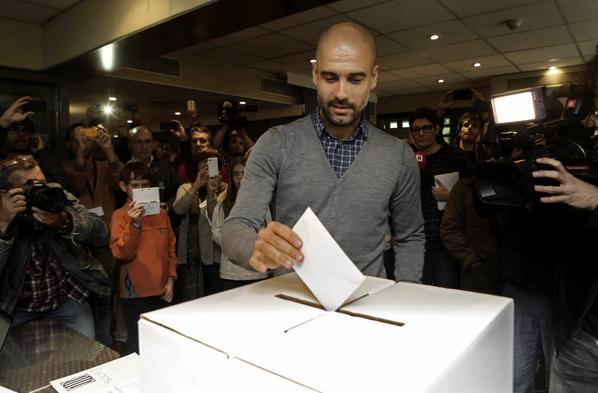
Pep

The international dilemma brings us back to Catalan nationalism, despite over 1.5 million people taking to the streets in Catalonia calling for independence, many from the region are migrants, or children of migrants from other parts Spain especially the south, or indeed a more recent influx of migrants from areas like North Africa who moved to the larger, wealthier cities of Catalonia to earn a living. For them is Catalan nationalism  as much of a priority? They were the outsiders coming into an area that spoke a different language, Catalan and they had to adapt to their surroundings.

One of those ways was through football; Barcelona as well as being a symbol or perhaps even a vehicle for Catalan nationalism are also the club of the foreigner, their founders included Swiss and Englishmen, their heroes have had names like Kubala, Cruyff and Stoichkov, they celebrated an openness internationalism at the height of Spain’s post war isolation and are the global dream team for millions. Barcelona is rightly lauded for focus on home-grown talent but it is also a bit about Argentinian, Brazillian and Dutch brilliance. The immigrants and their children are as much a Barcelona cule as the died- in-the-wool Catalan nationalist, will they appreciate a marginalising of their club or the potential weakening of their all-conquering national team?

Spain has been down paths like these in the past. In the early 80s the country was still in the nascent phases of democracy after the death of General Franco, they were also preparing to host their first World Cup in 1982. Although awarded to Spain as part of a voting pact back in 1966 (some things never change) it became a chance for Spain to continue its reintegration into the Western world after the years of dictatorship with membership of the EEC also on the horizon. However, in other matters there were similarities with modern day Spain as it was also a time of huge economic stagnation, massive unemployment, regional tensions over the devolving of powers; including an active terrorist campaign from Basque separatist group ETA.

Against this background an attempted coup was launched by right wing and military forces in Spain and on 23rd February 1981, 200 armed guards entered the Spanish parliament led by Lieutenant Colonel Antonio Tejero. The swift and determined intervention of King Juan Carlos I who made a televised address denouncing the coup and calling for a return to the proper running of the democratic government saw the coup collapse by the early hours of February 24th. Only a week later Barcelona striker Enrique Castro Gonzalez, better known as Quini was kidnapped at gunpoint shortly after he had helped Barcelona to a 6-0 victory over Hercules. Although the kidnapping turned out to be the work of common criminals and economically motivated  (Quini was eventually released unharmed after 25 days in captivity), early reports suggested that Quini was kidnapped by a Spanish nationalist group who did not want a “separatist” team like Barcelona winning the title.

As ever football and politics seem to be uneasy yet constant bedfellows in Spain, whether the current talks or referenda on Catalan independence is a political ploy, a bargaining chip to gain greater authority over finance, or a political pledge soon to be realised remains to be seen, the fate of a nation and the greatest club and national teams in a generation hangs in the balance.

Originally posted on backpagefootball.com in November 2012
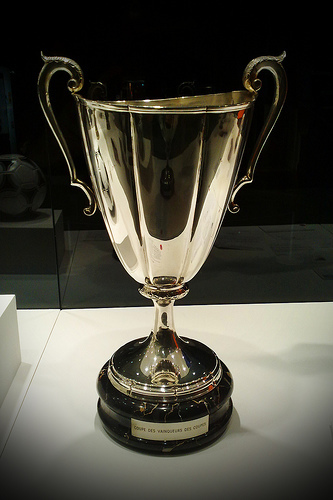
A cup to call our own – a new European trophy for smaller nations?

Remember when Magdeburg, Mechelen, Aberdeen and Dinamo Tbilisi were European champions? Those clubs from East Germany, Belgium, Scotland and Georgia respectively were all winners of the lamentably departed Cup Winners Cup, the UEFA competition that did what it said on the tin and provided a competition for well… Cup Winners.

The Cup Winners Cup, a straight knock out tournament for the victors of domestic knock out tournaments tended to throw up more unexpected champions than in other tournaments and had a greater representation from a broader geographical area. Before the greater consolidation of power and wealth into the hands of a group of superclubs in a handful of leagues the Cup Winners Cup was a chance to see teams from corners of Europe that one was not necessarily exposed to on a regular basis.

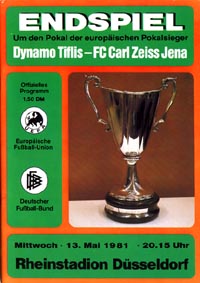
programme

Match programme from the 1981 Cup Winner Cup Final

Since that 1998-99 season UEFA has ran the two main European club competitions of the Champions League and Europa League but as of 2018 that could change. In 2018 the television rights for the two main competitions comes to an end and there area early discussion about returning a 3rd European club competition but one focused mainly on smaller clubs who exit other European competitions early. This could provide a potential windfall for Irish clubs who miss out on the lucrative group stages of either competition and present a tantalising array of possible outcomes. European football beyond September could finally be a realistic expectation for Irish clubs.

Such move would be in keeping with the ethos of UEFA president Michel Platini who has extended the European Championships to 24 sides and made changes to qualifying for club tournaments to give greater representation to smaller nations. Quite what format the tournament would take should UEFA decide to proceed with its creation is still up in the air. As reported in the Guardian the Scottish FA’s Stewart Regan said that

“It’s a discussion around whether it’s a separate third competition exclusively for smaller countries who then relinquish their place in the Europa League and/or Champions League or whether it’s a competition that basically acts as a further safety net for those clubs that enter the Champions League or Europa League but are typically out by August and then [instead] they fall down into a third competition,”

Whether smaller nations would choose to give up on the possibility, albeit a slim one, of qualifying for the Champions League in order to compete in a lower tier competition is dubious but the option for a follow up competition for club sides from smaller nations to compete in beyond August and September could prove to be a welcome boost. Such a competition could generate revenue and interest for clubs and also give club sides from smaller nations the opportunity to test themselves in a competitive environment against sides from other jurisdictions.

Manuel Veth, writing on the subject for the Futbolgrad.com website highlighted the example of the Baltic League competition held between the major teams from the Baltic States or the Royal League held between sides from Denmark, Sweden and Norway as regionalised multi-league tournaments that have already been tried.

A regionalised competition based on a straight knock-out format could prove popular, especially if victory could guarantee something like automatic group phase qualification for either the Champions League or Europa League the following season.

However, significant potential drawbacks from such a hypothetical competition exist. In a regionalised format would their be sufficient interest in a competition between top sides in say the Republic of Ireland, Northern Ireland, Scotland and Wales? Especially if a larger team like Celtic secured qualification through to the Champions League and were not involved? Much would depend on the prize money available and the draw of other sides in the competition. Irish football fans on both sides of the border would have seen interest in Setanta Cup wane once there was significant reductions in the prize money. Such prize money would most likely have to come from TV rights deals and sponsorship and it remains to be seen whether there would be an appetite on behalf of broadcasters to covers games in what would effectively be a third tier competition.

Even moderate TV income would benefit smaller clubs in smaller nations. Perhaps it could be considered in the negotiations of TV rights deals in 2018 with preferred bidders for the Champions League being required to purchase a certain number of games from this new tournament? Similarly UEFA could create a solidarity fund from the massive TV and sponsorship revenues that the Champions League and Europa League enjoy and use such a fund to provide incentives and prize money for clubs from smaller nations competing?

uefa

UEFA headquarters, Nyon

Despite the reforms brought in by Michel Platini and his administration to facilitate greater participation of small nations and their clubs there seems to be a growing gap between the hyper-wealth elite like Real Madrid, Barcelona, Bayern Munich, Chelsea and so on, the historic clubs from smaller and middling sized nations and clubs from more peripheral nations. Whether we like it or not, Ireland in this context is a peripheral nation. There has long been a hope among League of Ireland fans that an Irish side could “do a Rosenburg” and secure regular qualification for the group phases of major competitions but despite Shamrock Rovers making the Europa League group stages those days don’t appear to be on the immediate horizon.

In the absence of regular group stage qualification could a third tournament give us our European fix?

Originally posted on backpagefootball.com 

The 1945 Inter-City Cup: War, Goals, Controversy and death by corner kicks

As you go for a pint in the members bar you may on occasion glance upward and notice the Bohemian F.C. honours list spelt out handsomely in gilt on a dark red background. It makes for impressive reading and is testament to the proud history of our club. Right in the middle of the bar, between the list of League Titles and FAI Cups is a sign that reads “Setanta Cup Champions 2010”. The Setanta Cup is, at the time of writing, our most recent honour. Few of us will forget Anto Murphy’s goal versus Pats in Tallaght Stadium, and it added a little extra relish that Bohs had managed to win a trophy in the enemy’s back- yard so to speak. It is worth noting, however, that though the Setanta Cup is the latest All Ireland soccer competition, it was by no means the first, nor was it the first such competition where Bohemians emerged victorious. To learn about this other, much earlier victory we must go back 70 years, to a time when the most violent conflict in human history still raged, to the first cross border competition since partition; the Inter-City Cup.

The Inter-City Cup, or to give it its full title, the Dublin and Belfast Inter-City Cup was conceived as a way to provide much needed income during the turbulent years of the Second World War. When the First World War had broken out in 1914, the general and oft-repeated assumption was that the war would be over by Christmas, so the sporting calendar continued on much as it had done in peace time. Bohemians and Shelbourne, the only two clubs from outside the six counties, continued to play in an pre-partition league season into 1914-15, but the growing realisation that the war was going to drag out meant that the Football League in Britain was suspended, while the Irish League was reduced to a “Belfast and District League” of only six teams with no room for Bohs and Shels. Many players, especially in Britain came in for heavy criticism for playing on into 1915. Some viewed it as a dereliction of patriotic duty that fit and healthy young men should stay at home and be paid to play football rather than volunteer to fight at the front. This led to the formations of “Football battalions” where prominent footballers were used as promotional tools for enlistment. Some football fans joining up were encouraged by the fact that they would have the chance of serving with their sporting idols.

When the Second World War broke out, the mistakes of the past were avoided. The league season was suspended immediately in Britain while Northern Ireland completed the 1939-40 season (Belfast Celtic won their 13th title) before suspending the Irish League and playing on with a diminished Northern District League. The League of Ireland, being in a neutral country, continued on as usual during the War years. It would prove to be a particularly successful era for Cork United, who would win five titles between 1939 and 1946.

However, gone from the fixture calendar were lucrative games against touring British sides. The lack of income was obviously a significant concern for the clubs north of the border, robbed as they were of regular gates and a full league programme which ultimately led to the creation of the Inter-City Cup. The tournament would run for eight seasons between 1941-42 and 1948-49, and despite the name, did include clubs from outside of Dublin such as Limerick, Cork United, Dundalk and Derry City. While matches were spread around various grounds in Belfast, all games south of the border were to take place in Dalymount. Another interesting feature of the tournament was the significance of corners. If two sides were tied on aggregate in the final, the side who had won the most corners were deemed to be the winner. Bohs learned this to their cost during the 1942-43 competition when they lost the final on corners to Shamrock Rovers having drawn 2-2!

Despite that setback Bohs, would eventually triumph in the competition. The 1944-45 season would be one of highs and lows for Bohemians, but it did at least end in some silverware. Bohs’ league form during the War years was poor; a third place finish in 1940-41 being the sides’ best placing and the 44-45 season would see Bohs finish bottom of the eight team league but would also see them reach two cup finals. An epic, three game semi-final win over Team of the decade, Cork United, would get Bohs into an FAI Cup final against Shamrock Rovers, where in front of the biggest ever Cup Final crowd of almost 45,000 they would lose out to a Podge Gregg winner. Gregg, a native of Ringsend had just returned to Dublin after a spell with Glentoran where he had won the Inter-City cup the previous year.

Bottom of the league, having lost a final to Shamrock Rovers, its fairly obvious that Bohs’ season needed a pick-me-up, and the Inter-City Cup could provide it. So as not to clash too much with regular games, the Inter-City competition was held around April and May each season when most games were coming to an end.  In that particular year, Bohs lost the FAI Cup final to Rovers on the 22nd of April, but less than a week later were in action in round one of the Inter-City.

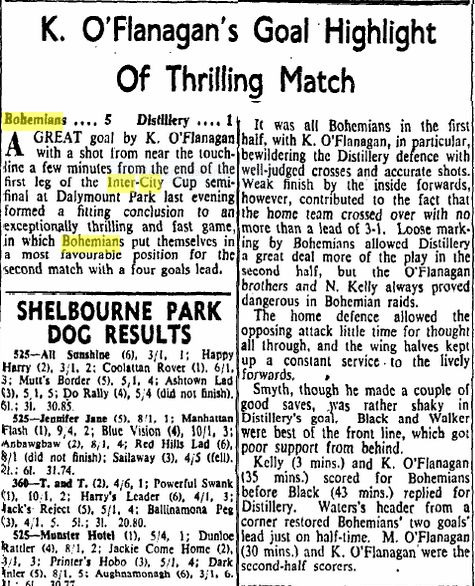
The first round game saw them drawn against fellow amateurs Cliftonville in Solitude on the 28th of April, with a return leg in Dalymount a week later. A 3-2 victory in Belfast with two penalties from full-back Frank Glennon and a Pat Waters goal gave Bohs too commanding a lead for the return leg, which ended as a 1-1 draw. The following round would see them matched with Glentoran; competition winners the previous year, Glentoran had been beaten on corners in the previous round by Limerick and only qualified as the best loser, their luck was out again as the tie finished 3-3 on aggregate so Bohs advanced as winners on corners 10-9 and thanks to an excellent performance by Collins in goal. Victory over Glentoran meant a meeting with Distillery, now based in Lisburn but then firmly ensconced in Grosvenor Park, West Belfast. Bohs would comfortably beat Distillery 8-3 on aggregate, a dynamic 5-1 victory in Dalymount was capped by a stunning strike from Kevin O’Flanagan, who beat the opposing keeper with a shot from out on his own touchline. The Irish Independent correspondent was moved to describe it as “the greatest goal seen in Dublin for years” and very topically likened the speed of the shot to that “of a V2 rocket”. O’Flanagan had the Distillery defence bewildered, and Bohs could have won by an even greater margin, as he finished with two goals. His brother Mick at centre-forward got one, while Noel Kelly and Waters got the other two. Despite going 2-0 down early on in the second leg in Belfast, the Gypsies rallied, and goals from Mattie Burns, Kevin O’Flanagan and Noel Kelly ensured there was no chance of an unlikely comeback.

Semi final

The other semi-final between Belfast Celtic and Linfield was also a high scoring affair, finishing 7-5 on aggregate to Celtic. As a two legged semi-final the first leg was held in Belfast before both sides travelled to Dalymount Park for the second game. With the tie balanced at 2-2 from the first leg, the Linfield goalkeeper and captain Tommy Breen (once of Manchester United and a seasoned international) elected to kick off defending the tramway end of the famous old ground. Due to heavy rain, Breen and his defence were ankle deep in water at that end of the ground which had cut up much worse than the opposite school end. 7 of the 8 goals scored on the day went into the tramway goal and Linfield were out. Breen’s former team, Belfast Celtic, were through to the final and were eager to make up for their defeat to Glentoran the previous year. Celtic had beaten not only Linfield, but Shamrock Rovers and Shelbourne en route to the final. The first leg was to be played in Belfast on May 30th with the return leg in Dalymount on June 2nd. VE day had taken place on May 8th and the laws and censorship brought in during the “Emergency” were lifted shortly afterwards. For the first time in six long years, football fans both North and South could genuinely look forward to the first real cup final in “peacetime”.

It is worth a brief diversion from our narrative to outline the merits of the Belfast Celtic side. Although the club has not existed in any real sense since the end of the 1940’s, they were at the time unquestionably one of the biggest sides on the island of Ireland. By the time the club was dissolved in 1949 they had won 14 league titles, second only to Linfield who by that stage had 19 to their credit. Former players included Mickey Hamill later of Manchester United and Manchester City, former President of the FAI and Government minister Oscar Traynor, Paddy O’Connell who would also play for Man Utd and later managed Real Betis and FC Barcelona, and Louis Bookman, the Lithuanian-born Irish international who became the first Jewish player to play professionally in Britain. Their coach at the time was Elisha Scott, a former player with Belfast Celtic and also Liverpool’s longest serving player ever. Scott was considered with some justification to have been one of the greatest keepers Ireland has ever produced and won ten league titles and six Irish Cups as Belfast Celtic manager. Their starting XI at the time of the Inter-City cup final was also on par with any of their previous sides. They would win the first official Irish League title after the war in 1947-48, and the team that Bohs faced included the likes of midfielder Charlie Tully, who would later join Glasgow Celtic and once famously scored against England direct from a corner in an international, attacker Jimmy McAlinden (an FAI and IFA international) an FA Cup winner with Portsmouth, and fellow international centre half Jackie Vernon who spent much of his career at West Brom.

In the case of Bohs, it would be a last hurrah of sorts. After the end of the Inter-City final, several of the winning side left for pastures new, including young goalkeeper Jimmy Collins, Frank Glennon and Noel Kelly, who would all switch to Shamrock Rovers. They would be joined a year later by their coach Jimmy Dunne, the former record breaking striker and soft-spoken coach, returning to Rovers after patching up his differences with the Cunninghams. Kevin O’Flanagan, a medical doctor was offered a job as a GP in Ruislip, London where he would spend his free time playing for Arsenal at football and London Irish in Rugby. While Bohs would make another FAI Cup final in 1947 (which they would lose after a replay to Cork United) the Inter-City cup would be the last trophy that Bohs would win apart from a pair of Leinster Senior Cups until the Cup final victory over Sligo Rovers in 1970. Bohemians’ insistence on remaining strictly amateur had served them well, as they won Leagues and Cups in the 1920s and 30s, but by the 40s, key players were being picked off by other clubs offering a few pound a week. While Bohemians continued to find and recruit excellent young players, they struggled to keep them for any length of time, the few exceptions being those whose day jobs allowed them the freedom to play without care for additional wages.

The two-legged final would be a close and often controversial affair. In the first leg there was nothing to separate the teams, not even corners as the sides finished level with two goals apiece, six corners each and both sides down to ten men. Kevin O’Flanagan for Bohs and Douglas for Celtic were the men sent off after coming to blows after Douglas kicked the ball out to touch when O’Flanagan was about to take a free. Bohs had taken a two goal lead thanks to an own goal and a finish by Smith, but the free scoring Bohs full-back Glennon ended up getting a roasting from Celtic outside left Paddy Bonnar, who grabbed two second half goals to tie the game. The return leg was no less controversial. Bohs named an unchanged side for the second leg (almost identical to the one which had lost to Shamrock Rovers just over a month before apart from Smith coming in for Frank Morris).

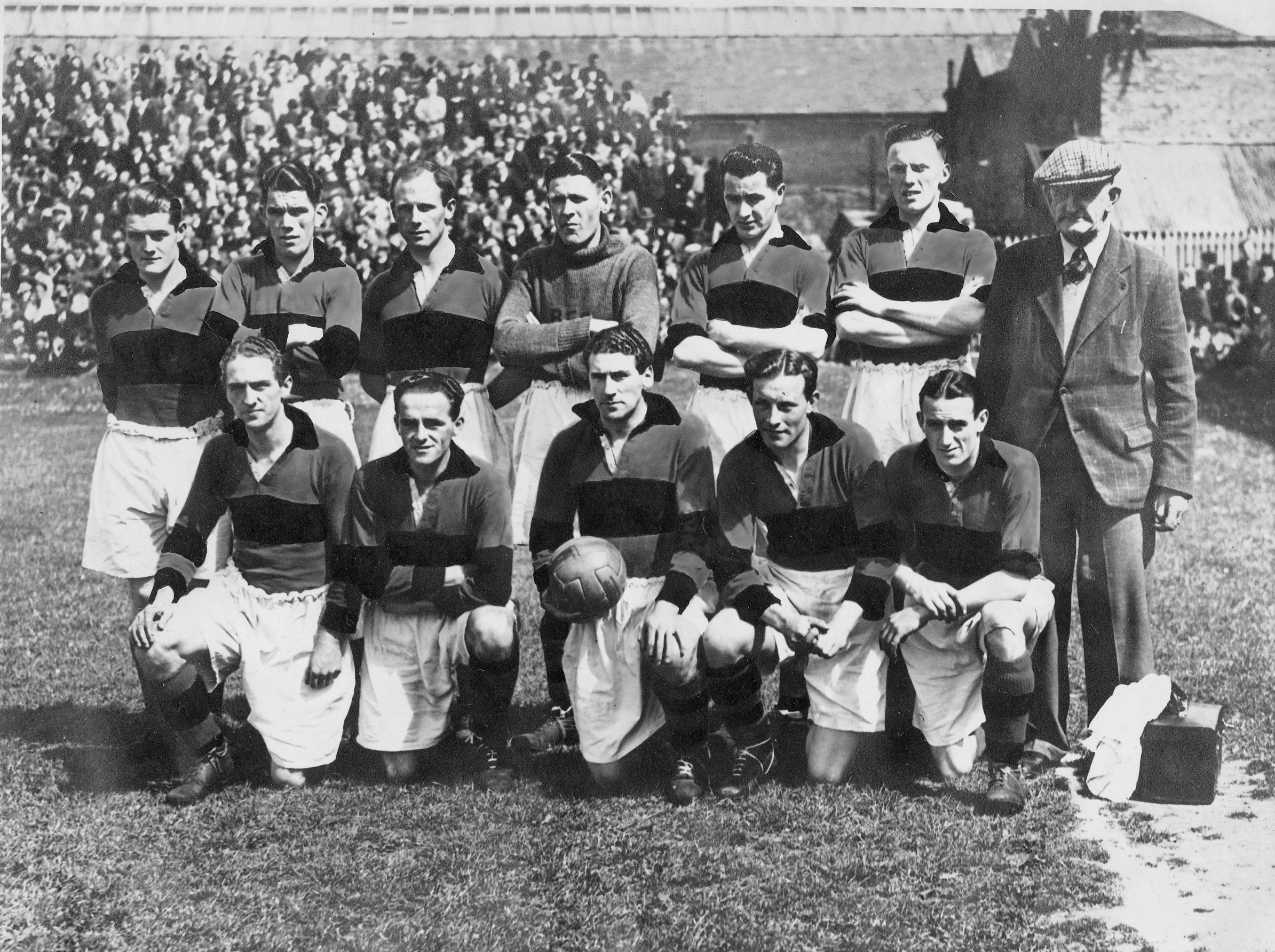
Bohemian FC Inter City Cup winning side

The Bohs side read: Standing – Ossie Nash, Paddy Waters, Billy Richardson, Jimmy Collins, Frank Glennon, Peter Molloy, Charlie Harris (Trainer). Front – Mick O’Flanagan, Noel Kelly, Kevin O’Flanagan (Captain), Matty Burns, Bobby Smith.

Belfast Celtic had suffered some injuries in the first leg with Peter O’Connor and Charlie Currie coming into attack for Johnny Campbell and Tommy Byrne. The second leg remained tight with few opportunities, Jimmy Collins in the Bohs goal being called into action in the first half to deal with chances from both Tully and Bonnar, but it was in the 67th minute that things became more heated when a cross came in from Smith which was trapped by Kevin O’Flanagan and passed into his younger brother Mick who when controlling the ball had a “Thierry Henry moment” and appeared to handle it before firing past Celtic keeper Hughie Kelly. This started furious protests from the Celtic players and led to an altercation between Captains Kevin O’Flanagan and Jimmy McAlinden who both had their names taken by the referee. Despite the Celtic players’ protests, the goal stood. Celtic’s disjointed attack, with the enforced changes since the first leg, had struggled to get past the Bohs defence, with Richardson and Glennon coming in for particular praise. Bohs successfully defended their lead, and after a season of disappointment, were All Ireland champions. It was particularly sweet for the star player Kevin O’Flanagan, who despite his sending off in the first leg, had been key in Bohs’ advancement to the final in much the same way that he had been key during the FAI Cup run scoring three goals by the time they reached that final. By setting up the goal for his brother Mick he had managed to make amends for his below par display in the earlier final versus Shamrock Rovers. Despite being a qualified GP the “Flying Doctor” had failed to diagnose himself with a bout of flu and upon returning home after the defeat to Rovers took his temperature and found that he had played a cup final with a 103 degree temperature!

Final article 1st leg2

It would be the last major trophy that Bohs would win for some time and the Inter-City cup was in some ways was the farewell of the Corinthian era of Bohemians and of Irish football as they signed off as Champions of North and South. Belfast Celtic, meanwhile, would remove themselves from League football only four years later, a mixture of sectarian violence, financial troubles and mismanagement forcing them out of senior football. While the Celtic board believed the withdrawal would only be a temporary measure it would transpire that their successful tour of North America, where they played to packed stadiums and famously defeated the Scottish national team, would in fact be their good-bye to the world of football. Guesting at centre forward for that touring side was none other than Bohs’ Mick O’Flanagan, his “hand of Mick” moment forgotten as he starred for Belfast Celtic as they slipped into history.

*special thanks to Martin Flynn and the Belfast Celtic Society for their assistance with some research for this article.

International football and fluid identity

I wrote the below piece for backpagefootball back in October 2013 after Jack Wilshere posted some comments on twitter about who should and should not play for England. Although some of the examples are a couple of years old now in light of the Jack Grealish saga and numerous other similar situations I hope it still reads as relevant.

Twitter is a tricky beast to master even for the most verbally concise of individuals, while brevity may be the soul of wit the failures of public figures to get their message across in 140 characters or under, in this most brief of mediums has caused much hilarity, irritation and opprobrium in the seven years since the micro-blogging site first appeared. This is not necessarily to say that a failure to master Twitter is a failure in all cases. Not all subjects of discussion can, or should be reduced to bite-size chunks for public consumption. In the age out of the soundbite it is often refreshing to read a piece of well researched long-form journalism on subjects of importance. This is as true of sport as it is of any other topic.

Diego-Costa-Atletico-Madrid-2013_2902425

Diego Costa- born in Brazil but a Spanish International

With this in mind perhaps Jack Wilshere should have paused for a moment to consider his declaration that  “the only people who should play for England are English people” before hitting send, this is not exactly what one might call a nuanced statement. What followed, a row with South African born, England international Cricketer Kevin Pietersen, the name checking of Olympic hero Mo Farah and Manchester United’s Adnan Januzaj, scorn from Frankie Boyle, opinions on the matter from Roy Hodgson and FA Chairman Greg Dyke was probably all a bit more than Jack expected when he composed his tweet. It does however touch on a topic that is very much in vogue at present, especially so after the decision recently taken by Diego Costa of Atletico Madrid to declare for Spain rather than Brazil, the land of his birth. In reality though it is never a topic far from the agenda in International football, Wilshere’s comments, Costa’s decision and next year’s World Cup only serve in bringing it further to the fore.

What it boils down to is the inherent conflict between the International game, as created in the late 19th Century, forged in, and centred on, the idea of the nation state and the 21st Century globalised world with its fluid sense of identity.  Also at play is the tension between the modern post-Bosman era, hyper-capitalist club game with players moving for vast sums of money, the supposed loss of the one-club man and institutional loyalty. And the International arena where, theoretically at least some vestige of the Corinthian spirit lives on, a game where athletes play for the pride in their nation and the jersey they wear.

The problem is international football was never really like this. Tensions around identity, nationalism and financial reward have existed as long as there has been football played. There are plenty of examples to contradict this idealised image but it still persists to a large extent.  We can go back as far as 1890 for one of the first disputes about nationality; with the case of John “Jack” Reynolds born in Blackburn in 1869 he spent much of his youth in Co. Antrim. While playing for the Belfast club Distillery he made his debut for Ireland and went on to win a further four caps, he scored Ireland’s single goal in their 9-1 defeat to England. However while playing for West Brom and Aston Villa he lined out for the English national team winning eight caps and gaining the dubious honour of being the only man in International football history to have scored both for and against England.

The early decades of football were littered with incidents like this, Italy famously had their Oriundi of the 1930’s that helped them to victory in the 1934 World Cup when the Italian team featured men born in Argentina like Luis Monti and Raimundo Orsi who became naturalised Italians. It is a trend that continues in Italy today with players like Thiago Motta (who like Diego Costa had won caps in friendlies for Brazil) and Southampton’s Dani Osvaldo who has six Italian caps to his name despite his familial connection to Italy being an Italian great-grandfather who emigrated to Argentina in the 19thCentury. Spain’s naturalisation of players isn’t restricted to just the likes of Costa or Marcus Senna but stretches back to the 50’s and 60’s and featured the likes Hungary’s record goalscorer Ferenc Puskás as well as players like Alfredo di Stefano and László Kubala who had both played for three international teams.

Incidents like this led to a tightening of laws which meant that any player who had played a competitive game for a nation had to remain committed to that nation regardless, however as mentioned this does not apply if a player has only appeared in a friendly which has seen players like Motta, Jermaine Jones and Alex Bruce switch national allegiances in recent years.

SAN FRANCISCO, CA - MAY 27: Jermaine Jones #13 of the United States in action against Azerbaijan...

Jermaine Jones the German born United States international

What is at the core of the strong reaction to Wilshere’s comments or Costa’s decision is open for debate. For some it is a further example of the footballer as mercenary, willing to play under whatever flag is convenient for the furtherance of their club career and their personal enrichment.  For some it is nostalgia for strong identifiable national styles of play associated with some notion of national values. For some it is simply old-school racism, fear of the Other and the outsider. What matters though are the rules. Generally if you are entitled to a passport for a country (and have not played competitively for someone else) you can play for that nation. There are usually some caveats with this such as a familial connection through a parent or grandparent or a defined period of residence within that country. In some cases FIFA has had to intervene such as attempts by Qatar to naturalise a number of Brazilian footballers, (the Brazilian Ailton was offered $1 million to take Qatari citizenship) but generally this is respected. For example the CAS (Court of Arbitration for Sport) upheld the right reaffirmed in the Good Friday agreement of 1998 for people born in Northern Ireland to hold a Republic of Ireland passport, this held for footballers too and although born and raised in Northern Ireland a number of players have opted to play for the Republic. If someone can travel under the passport of a nation, can live there, own property there, and partake in the democratic life of a nation who is to say that that person, if talented enough cannot play football for that nation?

To ignore that question is to ignore the mobility and fluidity of identity that exists in the modern world. When Jack Wilshere says that “the only people who should play for England are English people” what idea of Englishness does he have? Bulldogs, bangers and mash, cups o’ tea and Carry On movies? What about the third of Londoners who were born outside of Britain? What about people like Fabrice Muamba, born in what is now the Democratic Republic of Congo but who arrived in Britain aged 11 without a word of English but turned down the chance to play with the Democratic Republic of Congo because he dreamed of playing for his home country, England (which he did at all levels up to under- 21).

Rather than seeing this as a threat perhaps we should look at what having a broader, more inclusive, less fixed approached to nationality has to offer. First of all it offers a more level playing field. Most international nations use naturalised players whether they are Italy, Germany or the Cape Verde Islands. To choose not to select all the potential players available to a national team is to put that team at a disadvantage. Secondly and somewhat personally I look at the role that non-Irish born players have played for the Republic of Ireland and my own ideas of what it means to be Irish. Growing up in Dublin in the 80’s was to part of heterogeneous monoculture, practically every person I knew was white and the vast majority were at least titular Catholics. Although this vista changed rapidly as I entered my teens it was the Irish national team that showed me what diversity could mean. Paul McGrath and Chris Hughton were English born, mixed-race Irishmen, heroes to the youths who grew up watching Euro 88 and Italia 90. The cockney, scouse or Scottish accents of Townsend, Aldridge or Houghton made us remember and appreciate our diaspora, while we hailed as “Captain Fantastic” Mick McCarthy with his Barnsley burr. Never as a child did I question this, or view them as less Irish than Packie Bonner or Niall Quinn. Those men changed how we viewed Ireland and Irishness, a change I would opine for the better. At a time of vicious sectarian strife and hatred in the country did any football fan care that Alan Kernaghan was an Ulster Protestant? As we become more global, as nation states lose power and perhaps relevance and borders begin to blur there is no true Englishman, or Irishman or German or Spaniard if ever there was such a thing. All that we can ask is that on the pitch at least we play by the rules and expect that those individuals who wear our country colours represent us to the best of their abilities wherever their city of birth might be. It’s a sentiment I hope I’ve communicated well , that I’ve explored the nuances of history and identity and it’s probably a little too broad a topic for 140 characters, eh Jack?

League of Ireland international XI

Sander Puri the Estonian international and Sligo Rovers player was called up a couple of weeks ago for the European Championship qualifiers against Lithuania and Slovenia. Manager Micky Adams would have been more used to international call-ups from his previous stints as manager of clubs like Leicester City but admitted it wasn’t something he was expecting upon relocation to the north-west of Ireland.

While not all that common foreign internationals who have played in our very own League or Ireland do have a long and storied history, so I set about creating a match day squad and first XI of players who had been capped by their countries who had also played League or Ireland. The only criteria were that they had been capped at some stage, whether before, during or after their Irish adventure and that they were capped by a nation that was not the Republic of Ireland.

The resulting squad is not exhaustive, it is certainly subjective and probably biased but I hope it makes for interesting reading. It contains three World Cup winners, one beaten world cup finalist, a European player of the year, an international World cup captain and a former team-mate of Pelé.

The first XI features players from seven different nations across Europe, Africa, North and Central America in a slightly unorthodox 3-4-3 formation. I’m sure I’ve made glaring omissions so feel free to make your suggestions below.

Goalkeeper

Gordon Banks

World Cup winner with England in 1966, Banks is often credited with making one of the greatest saves in history during the 1970 World Cup when he acrobatically changed direction to deny Pelé a headed goal when holders England met eventual winners Brazil.
Best remembered at club level for his service to Leicester and Stoke City (he won League Cups with both), he tragically lost the vision in one eye after a car accident in 1972. This led to an enforced retirement, which he broke to line out for the Fort Lauderdale Strikers in the NASL in 1977-78. It was around this time that he made his one appearance in the League of Ireland, guarding the net for St. Patrick’s Athletic in the 1-0 win over Shamrock Rovers in Richmond Park in 1977.

Defence

Avery John

Avery John was a high-profile part of a group of Caribbean players that graced the League of Ireland during the 90’s and early 2000’s. He just about edges out ex Galway United and Bray Wanderers man Wesley Charles (100 caps for St. Vincent & the Grenadines) for spot in defence due to the fact that he played in a World Cup.

Avery

Avery John not only featured in the 2006 World Cup for tournament debutants Trinidad & Tobago, he had the dubious distinction of being the first player in the tournament to be sent off, receiving two yellows in the opening game against Sweden. Trinidad survived, gaining a credible 0-0 draw, thanks in no small part to the expertise of their coach Leo Beenhakker who threw on another attacker shortly after John’s dismissal to keep the Swedes pegged back.

During his club career John played with merit for Bohemians (twice), Shelbourne and Longford Town in the League of Ireland. He spawned his own chant while at Bohs, the highly original “Avery, John, John, John” sung to the tune of “Feeling Hot Hot Hot” before moving to the MLS in 2004, first lining out for New England Revolution and later Miami FC and DC United where he retired in 2010.

Alvaro Ros Rodriguez (Alvarito)

One of more unusual members of the team; a two-time Spanish international who featured in away matches against Chile (win) and Argentina (loss), Alvarito spent the bulk of his career at Atletico Madrid winning two Spanish Cups (Copa del Generalisimo as it was during the Franco dictatorship) as well as the 1961-62 Cup Winners Cup against the competitions’ inaugural Champions Fiorentina.

Despite this success Alvarito was never a regular with Atletico, he suffered injuries including a severe leg-break and was mainly understudy to Spanish international Isacio Calleja. However he did start in the final of the 1959-60 Copa del Generalisimo, a famous 3-1 win over city rivals Real Madrid in a packed Santiago Bernabéu.

His experience of the League of Ireland, like many in our team, was short-lived. Upon leaving Atletico Madrid he spent a single season with Real Murcia before joining Shelbourne as a player-coach in 1965, making his debut in a 2-1 win for Shels over Dublin rivals Drumcondra. Some impressive performances followed but a combination of injury and difficulties with the language meant that his stay was brief. What followed after leaving Shels was over 20 years of coaching in the Spanish lower leagues, something that Shels can look on with a little bit of pride as they gave him his first coaching role in the game.

Bobby Smith

Bobby Smith won 18 caps for the United States national team over a seven-year international career and was an NASL All-Star. Born and raised in the town of Trenton, New Jersey, which would later give us NBA All-Star and global diplomat Denis Rodman, Smith began his career at the Philadelphia Atoms in the NASL, winning the Championship in his debut season of 1973.

As was often the case in the 70s players from both sides of the Atlantic would take advantage of the differing season schedules with European players going on loan to North American teams during the summer off-season, and in the case of Smith some American based players going in the opposite direction during the NASL off-season. Smith’s port of call was Dundalk where he was signed up on loan by the legendary Jim McLaughlin who was player-manager at the time. Also signed up was fellow American Dave D’Errico.

Smith would later join the star-studded New York Cosmos where his team-mates would include Pelé, Franz Beckenbauer, Giorgio Chinaglia and Playgirl centrefold Shep Messing. Further NASL Championships would follow before he was transferred to Seattle, followed by a return to Philadelphia (this time to Philadelphia Fury) where he played alongside Irish international John Dempsey. He continued with Philadelphia Fury when the team was sold, renamed and moved to Montreal finishing his career at Montreal Manic in 1981.

Midfield

George Best

In quite an attacking line-up the European Player of the Year for 1968 is included as an attacking right-winger in our League XI. The great George Best, capped 37 times by Northern Ireland, lined out for Cork Celtic in the 1975-76 season. This was only seven years after winning the European Cup and the previously mentioned player of the year award. Though not quite 30 he was already well on the downward spiral of his peripatetic footballing career.

Spells with the LA Aztecs amongst others in the NASL and two seasons with Fulham would follow, as would occasional reminders of his utter beguiling brilliance . League of Ireland fans only witnessed Best live on three occasions in matches against Drogheda United, Bohemians and Shelbourne, although he attracted sizeable crowds Best failed to score in any of his games and left spectators unimpressed.

Ed McIlvenney

When asked to name the moment in football history when England first realised that they were not the world’s greatest team, when they perhaps got their first inkling that those damn foreigners might know something about football after all, many will point to the 1953 destruction of the English national team by Hungary’s Magic Magyars in Wembley. Certainly the 6-3 humiliation had a seismic impact on English theories of footballing superiority.

Some Irish observers may suggest the 2-0 win by an Irish team over the English in Goodison Park, 1949 as another such a moment. A third such game was in England’s second match of the 1950 World Cup (the first time they had deigned to enter, having tended to ignore the pre-war tournaments) when the United States defeated England 1-0 thanks to a goal from Haitian student Joe Gaetjens.

What is often forgotten is that the captain of the American team that day was a Scotsman named Ed McIlvenney. McIlvenney was born in Greenock in Scotland in 1924 and in the late 1940s went to live with his sister in the States, having by that stage played some football for Wrexham, then in the Third Division North. After excelling for the Philadelphia Nationals he was called up to the United States national team for the World Cup.

His Philadelphia team-mate Walter Bahr was usually the captain of the USA national team, however as a Scotsman, McIlvenney was given the honour of captaining the side against the old enemy for what would become a famous upset. Impressed by his performances Matt Busby gave him a chance at Manchester United where he only made a couple of appearances before moving across the Irish sea to sign for Waterford in 1953.

He even had the privilege of being immortalised in a feature film by none other than Sheffield Wednesday icon John Harkes in 2005’s The Game of their Lives which also bizarrely features Bush lead signer Gavin Rossdale as Blackpool legend Stan Mortensen.

Bobby Charlton

Bobby Charlton, much like Ed McIlvenney was signed for Manchester United by Matt Busby, however their similarities in the red shirt of United end there. The second of our World Cup winners, Charlton remains United’s record goal scorer and certainly adds a goal threat to our midfield.

Also like McIlvenney , Charlton signed for Waterford, in this case in 1976 after his spell as Preston North End player-manager had ended in disaster, with the club being relegated in his first season. His number two at Preston was his old team-mate Nobby Stiles, who was married to Johnny Giles’ sister Kay so perhaps it was Nobby’s idea for Bobby to go to Waterford? More likely it was the diplomacy of Joe Delaney (John’s Da) who correctly saw the potential for Charlton to boost Waterford’s crowds.

Charlton’s career in Ireland was, like Best’s brief, but it was slightly more successful, 6,000 souls braved the snow to see him score against Finn Harps in his second game for the club, after impressing everyone during his debut, a 3-2 win over St. Patrick’s Athletic, in which Charlton won the penalty that opened the scoring. Charlton would play twice more but both games ended in defeat with Waterford going down 2-0 to Bohemians and losing 3-0 as Finn Harps gained their revenge in the Cup.

Joseph N’Do

Many of the players discussed in this article were veteran pros who, in the days before hyper-inflated salaries saw the League of Ireland as somewhere they could earn a few quid by playing a handful of games in the twilight of their careers. Then there are those who were international players from smaller nations for whom the League of Ireland offered professional football and even the potential for a mini-run in European competition. Then there’s Joey N’Do.

An African Cup of Nations winner with Cameroon in 2002 (the year before he signed for Pat’s) and a Coupe de France winner with Strasbourg of Ligue 1, N’Do’s presence seems gloriously incongruous, as though he had just stumbled upon the League of Ireland while looking for somewhere else, liked it and decided to stick around.

N’Do’s career has seen him win every honour in the Irish game as well as being voted player of the year in 2006. He has also managed to play for the four main Dublin clubs; St. Pat’s, Shelbourne, Bohemians and Shamrock Rovers (on loan) without incurring the bile and invective of supporters usually associated with moves to local rivals. During his more than ten years in the League he has played a multitude of roles from tricky, skilful winger to deep-lying forward, and in recent years with Sligo Rovers that of deep- lying play maker, his intelligence and reading of the game making up for any loss of pace. His talent is as self-evident as the warmth and joie de vivre which accompanies his game. The images of Joey dancing pitch-side with a trophy after another victory are ones that many of his fans will fondly remember.

Recently he auctioned off his African Cup of Nations medal, his most recent FAI Cup winner’s medal and his World Cup participation medal to raise money for his former team-mate Gary O’Neil who had just been diagnosed with cancer. Joey N’Do, one of the good guys of Irish football.

Forwards

William Ralph ‘Dixie’ Dean

He didn’t like being called Dixie, he much preferred Bill as a moniker. And for a time in the 20’s and 30’s he was the greatest centre forward in the world. Beginning his career at Tranmere, he was snapped up by Everton, the team he supported as a boy, at the age of 18. He would set a scoring record for the Toffees that stands to this day, along with a record for most goals in a season (60) which also remains intact. His international record reads 18 goals in 16 games for England.

To fully understand his celebrity in a pre-television age consider that Dean was an Evertonian beloved of Bill Shankly, that Babe Ruth asked to meet him after an Everton game and bemoaned how little English football players were paid for their talents. In one possibly apocryphal story a captured Italian soldier during World War 2 was said to have shouted at his English captors “Fuck your Winston Churchill, and fuck your Dixie Dean!”.

This is the same Bill ‘Dixie’ Dean who pitched up at Sligo Rovers in 1939 aged 32. Dean scored 10 goals in his seven-league games for Sligo starting with a goal on his debut against Shelbourne. He would score another against Shelbourne in that years Cup Final, however the game finished 1-1 and Dean was unable to repeat this feat in the replay, Sligo going down 1-0 to a William ‘Sacky’ Glen goal in front of almost 29,000 in Dalymount.

Infamously his runner-up medal went missing after the game only for it to reappear in a package sent from Ireland seven years later to Dean who, by then, was then running the Dublin Packet pub in Chester.

Uwe Seeler

Apart from Pele only two other men has played and scored in four World Cups, both are German, one is current Lazio striker Miroslav Klose the other is Uwe Seeler. The runner-up medal Seeler recieved in 1966 when he was 30 years of age was to be his best placed finish. He retired from international football in 1968 but was coaxed back into the national team by coach Helmut Schoen for the Mexico World Cup of 1970. It proved to be schrewd move as the veteran striker scored three goals, including a header against England in the quarter finals to bring the game to extra time. Inevitably Germany prevailed 3-2 with Seeler’s successor Gerd Muller grabbing the crucial winner.

During his career Seeler remained a one club man almost to the end, spending nearly 20 years as a first team player with his local side Hamburg, where both his father Erwin and brother Dieter also played. He remains their record goalscorer to this day with an astonishing 404 goals in 476 games.

uwe

What endeared Seeler to the German public even more than his goals was his humble and friendly attitude, gaining the nickname ‘Uns Uwe’ or ‘Our Uwe’. He turned down Inter Milan coach Helenio Herrera when he came calling, offering a huge transfer fee and salary. For much of his career Seeler played in a regionalised, ‘amateur’ league system in Germany, whatever he earned from football in Germany would have been a paltry amount compared to the riches available in Italy. However he turned down Herrera and remained in Hamburg. In response the club looked after him with a relatively well-paid role as a regional sales rep for Adidas as some sort of compensation.

However, six years after retirement he, along with his former Hamburg teammate Franz Josef Konig lined out for a club other than Hamburg. That club was Cork Celtic. Seeler thought this game was a sponsored event for Adidas but would find out later that it was an actual league match against Dundalk in 1978. Needless to say Seeler scored both goals as part of Cork Celtic’s 2-1 victory.

Geoff Hurst

Aparently Geoff Hurst scored a hat-trick in a World Cup final, but we don’t really hear too much about that. Hurst is the final World Cup winner in our team but was considered a little bit of a wild card in 1966. Originally a defensive midfielder he benifitted from a move up front early in his West Ham career and then the goals began to flow.

He caught the eye of Alf Ramsey and was given a chance for England in a friendly against Germany in February of 1966, impressing in his role up front with Liverpool’s Roger Hunt as England won 1-0 thanks to a Nobby Stiles goal. Hurst got his chance in the World Cup proper due to an injury to Jimmy Greaves in the final group game against France. Hurst seized his opportunity, scoring against Argentina and impressing against Eusebio’s Portugal in the semi-final. He didn’t disappoint in the final either, even if one of his goals didn’t cross the line.

Hurst finished as the second highest scorer in West Ham’s history before moving on to Stoke and then West Brom. After his contract finished there a 34-year-old Hurst signed a one month deal with (once again) Cork Celtic in 1976. He managed three goals in three league games as well as featuring in cup games against Shamrock Rovers and Dundalk.

Team

Gordon Banks

Alvaro ‘Alvarito’ Ros Rodriguez, Avery John, Bobby Smith

George Best, Ed McIlvenney, Bobby Charlton, Joey Ndo

Dixie Dean, Uwe Seeler, Geoff Hurst

Subs: Ryan Thompson (gk), Bobby Tambling, Wesley Charles, Terry McDermott , Peter Lorimer, Mindaugas Kalonas, Jimmy Johnstone, Piotr Suski, Charles Livingstone Mbabazi

Manager: Raich Carter

Original article published on backpagefootball.com in January 2014