Jack Grealish and knowing your true self

Jack Reynolds’ second cap as an Irish International came in the spring of 1890 against England. It was the occasion of Reynolds only goal in the “St. Patrick’s blue” of Ireland, the Distillery winger grabbing what couldn’t even be called a consolation in a 9-1 drubbing at the Ulster Cricket Ground where the diminutive Everton striker Fred Geary grabbed a hat-trick for the three lions.

So far nothing too unusual, Ireland were the whipping boys of the early Home Nations Championship finishing bottom in six of the first seven competitions. What is unusual about Reynolds is that he would end up winning three Home Nation Championships. For England.

Jack Reynolds (born 1869) an Irish and English international

Jack Reynolds circa 1890

Reynolds had been born in Blackburn in 1869 but moved to Ireland at a young age and grew up in Country Antrim. He signed for Blackburn Rovers at the age of 15 before a spell in the Army saw him return on duty to Ireland where he ended up playing for both Distillery and Ulster F.C. during which time he won five caps for the Irish National team.

It was only upon his return to England with West Brom that Reynolds discovered he had actually been born in England. It was during his time in the midlands with West Brom and Aston Villa that he would win his eight caps for the England national team.

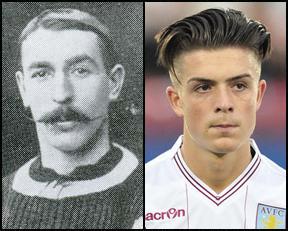
It is tempting to draw parallels between Reynolds and another Jack, young Jack Grealish. Both talented wingers, both Aston Villa players, in fact there may even have been a bit of overlap between Reynolds, whose Villa career ended in 1897 and Grealish’s great grandfather Billy Garraty who joined Villa that same year. But one thing that they won’t have in common it seems is lining out for both Ireland and England.

Grealish has stuck to his guns on his international future, stating earlier this year that he would make a decision come September, Martin O’Neill tried to force the issue by calling him into the squad for the upcoming friendly against England and qualifier against Scotland.

In theory Grealish could have played against England in the friendly and still switched his allegiance to them thereafter, but as things stand it appears that young Jack won’t reveal his hand until September at the earliest.

Much comment has been passed about the apparent rebuttal to O’Neill by Grealish. It prompted former football and rugby captains Kenny Cunningham and Brian O’Driscoll spoke on air about the issue, which was neatly summarised by Dan McDonnell in a recent Irish Independent article.

Rather than debate the pros and cons of a 19 year olds decision (there is plenty already written on the subject) what would perhaps be better to examine is why there is so much fuss about a player who a year ago was lining out on loan at Notts County in League One. A clue to all this hubbub can perhaps be seen in a closer examination of O’Neill’s current squad.

O’Neill has been criticised for not trying out enough new players and sticking with the same ageing group that he inherited from Giovanni Trapattoni. Some new players such as Cyrus Christie and David McGoldrick were blooded in the friendly against the USA, and the uncapped in the current squad include Harry Arter of Bournemouth, Alan Judge of Brentford and Adam Rooney of Aberdeen.

Arter, Judge and Rooney all have certain similarities, they are all in around the same age, 26, 25 and 27 respectively. All have represented Ireland at under age level at some stage. And all three have won their first call-up on the back of impressive seasons, not in the Premier League but in the Championship and in Rooney’s case the SPL.

All three have taken a circuitous route to the Irish International squad, loan moves, dropping down divisions, (including in Arter’s case a spell at non-league Woking) before settling into regular football at their current clubs.

They have all been selected on form rather than reputation; Judge’s trickery helping Brentford to the play-offs, Rooney has scored 27 goals in all competitions this season propelling Aberdeen to second in the SPL, while Arter has been one of the best midfielders in the Championship this year and will join the ranks of Irish internationals in the Premier League next season. This perhaps hints at a career trajectory not dissimilar to an established current international like Jonathan Walters.

Grealish pic

William Garraty & great-great grandson Jack Grealish, both of Aston Villa

It is players like this who are more emblematic of Ireland’s footballing future than Premier League starlet than Grealish.

It’s hard to think of the last time in recent years that an Irish teenager has broken through at Premier League level, the last time that a number of such players came through was the emergence of the likes of Damien Duff, Shay Given, John O’Shea, Richard Dunne and Robbie Keane at the turn of the millennium, most of whom had come through the successful Irish youth sides of Brian Kerr.

I’ve banged on about this before but we are not producing elite level players in any consistent manner.

This paucity of top level talent means that we have a tendency to latch onto talents like Grealish and heap the future of Irish football onto his narrow shoulders rather than looking at our technical deficiencies and the reasons that many of our more technically gifted players are being produced through the coaching and youth development systems of other national associations.

If Grealish makes his decision in September and indicates that he’ll line out for Ireland then our national team will be the stronger for it and any prevarication or seeming reluctance will surely be forgotten, much as it was with former internationals like Clinton Morrison or Jason McAteer.

If he chooses to represent England then rather than letting their ire pour out against a 19-year-old footballer on Twitter, Irish fans might look closer to home at our own coaching structures and player development paths rather than the decision of a young man to represent the nation of his birth.

At a recent Italia 90 nostalgia evening arranged as part of the One City One Book event to celebrate Roddy Doyle’s Barrytown trilogy in Lansdowne Road, the RTE panel of Dunphy, Giles and the late Bill O’Herlihy was reconvened with Paul McGrath and Charlie O’Leary also in attendance. Giles and Dunphy were still trenchant in their criticism of Jack Charlton, his style of football, his lack of professionalism and so on.

And despite the general light-hearted air of the event Dunphy pursued a darker thread of discussion, veering off on a tangent where he discussed the current state of the game.

He decried the death of the street footballer, what an Argentine fan might call a pibe, and stated that football was “dead in Ireland”, Scotland, England and so on, that the quality of player was not being produced by these nations anymore. He referenced the abundance of quality in the squads of the Charlton and Hand eras, how many of these players were regulars at top English clubs.

Dunphy only sees decline but seems to fail to appreciate that the English Premier League is now truly global, it is global in its reach, fans, media influence and the manner in which it sources its players in a way it never did in the past even when Britain was a centre of global empire. The favoured role of the Irish footballer in Britain with our shared language, cultural similarities, intertwined history and geographical proximity count for far less now.

The Premier League is a brutal, unforgiving meritocracy, it doesn’t care where you’re from (even though racism and xenophobia certainly still exist) it cares that you win. As the Premier League has casted its net wider in search of playing talent this has led to young Irish players facing far greater competition.

While we may not be producing Duffs and Keanes in abundance today maybe we haven’t gotten thatmuch worse? Certainly not to the point that football is “dying” as Dunphy maintains, perhaps it’s just that a league that many in Ireland view as our own has gotten more competitive and other nations, once viewed as minnows during Dunphy’s playing career have improved immeasurably. As others have caught up so our access to the elite levels has diminished.

In the past a successful or at least improving Irish side was able to secure the services from top flight clubs of “granny rule” players like John Aldridge, Ray Houghton and Andy Townsend, or though astute scouting recruit players like Mark Lawrenson long before he was a star for Liverpool.

Many of these players were recruited through personal connections, Aldridge and Houghton being recommended by Dave Langan while Preston North End legend Alan Kelly Sr. spotted a teenage Lawrenson and alerted the Irish manager at the time John Giles long before he would have come to the notice of an England manager.

While these recruitment methods still work today the football landscape of the 70s and 80s was not one where agents are as ubiquitous as now, where salaries weren’t as inflated or where people used social media to lambast players for every decision. Modern external pressures and opinions, as well as player empowerment and FIFA eligibility changes mean that things are less straightforward today.

The ancient Greeks had a saying, often quoted by Socrates, which simply said “know thyself”. One interpretation being that before seeking to gain greater knowledge or expertise or before commenting on the actions of others one should first know your own being and nature.

Before we lambast Jack Grealish for not rushing into a decision perhaps Irish fans should consider the Football Association, structure, facilities and challenges that influence the development of football in Ireland and look to why we have not produced another three or four players of Grealish’s profile to replenish our ageing squad.

Jack Grealish’s predecessor Jack Reynolds thought he knew himself, raised and educated in County Antrim where he also played his football, he lined out for Ireland and like a character from Greek tragedy did not realise his error until it was too late.

Let’s allow Jack Grealish the time to get to “know himself”, trying to define who and what you are and what you will represent indelibly is hard enough for any of us, never mind a 19-year-old caught in the public gaze.

First published in May 2015 for backpagefootball.com 
The story of Bruxelles- from star signs to rock stars

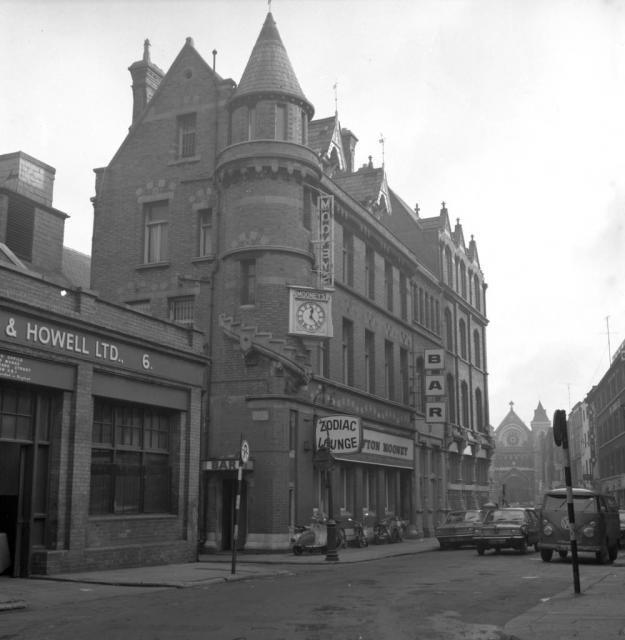
In the late 19th Century there was a revival of interest in those matters spiritual and supernatural. People of the 1880’s and 90’s rediscovered an interest in the forgotten pastime of astrology and this re-emergence of a fascination with astrology and horoscopes might explain the reason that the pub we know today as Bruxelles (more on that name shortly) was originally known as the Zodiac Lounge when it opened its doors for business way back in 1886.

Bruxelles-Bar-Zoodiac

The Zodiac Lounge was part of the famous Mooney’s pub group and was also known as the Grafton Mooney, much as the Parnell Heritage Pub on Parnell Street was known as the Parnell Mooney. The signs of the Zodiac that influenced the pub’s name are still clearly visible in Bruxelles to this day. Just look behind the main bar and you can still see the beautiful tiled mosaics of figures representing each of the star signs, these tiles are almost 130 years old and offer a connection back to the Victorian world of the Zodiac lounge.

Bruxelles-Bar-Zoodiac-2

Bruxelles-Bar-FlagsBut why is it called Bruxelles and why are all those flags hanging from the ceiling? And speaking of that, why are there no stars and stripes hanging there an American friend asks? Well, give me a minute and I’ll tell you. In the early 1970’s the bar came into the ownership of the Egan family who continue to run the pub to this day. The purchase of the pub happened to coincide with Ireland’s entry into the EU (or the EEC as it was then) and in the spirit of European harmony the pub was renamed Bruxelles after the Belgian capital. The flags that hang from the ceiling represent all the member nations of the EU so sorry to any visitors from across the Atlantic but that’s why you don’t see an American, or Canadian or Australian flag there.

Bruxelles-Bar-UndergroundWhile the 70’s brought big changes Bruxelles certainly hasn’t stood still in the intervening decades. The pub, and its famous basement bars became the hangout in Dublin for the emerging Rock scene and was famously frequented by Phil Lynott of Thin Lizzy fame. It’s for this reason that when a statue was erected to Philo, that Harry Street, right next to the pub he knew so well seemed the natural location for its location. The connection with the Lynott clan continues to this day. Philomena, Phil’s Ma in case you didn’t already know, continues to drop by the pub from time to time and has played a big part in its latest development.

The basement bars, so long beloved of rockers, metallers and indie kids have been completely refurbished and extended. The Zodiac Lounge and the Flanders Lounge as they’re dubbed in acknowledgment to the venue’s history look fantastic and the Flanders Lounge has been decked out with a huge amount of Phil Lynott and Thin Lizzy memorabilia kindly donated by Philomena. Phil has his own eponymous snug down the back of the bar and there is a new beer cellar that stretches right out under the flagstones of Grafton Street. It’s the perfect spot to try a pint of Bruxelles own bespoke lager!

The new basement bars are available for private hire and for live music and DJ nights. They’re also a treasure trove for any connoisseur of good beer or good rock music.

Originally poster to Dublintown.ie July 2015

Ireland versus England – The quest for footballing approval

Relationships can be tricky at the best of times. Even when they’re over feelings can remain, passions linger, doubts about whether breaking up was the right decision can cloud one’s judgement.

The unhealthiest of relationships can provoke these reactions and much as we like to think we’ve moved on and we’re being the bigger person we still crave attention; a reaction from our former partner.

Much of recent Irish history, and almost all of our football history has lived out this type of conflict with our spurned partners England. Identifying ourselves as our own strong, confident, distinct individual nation while also being constantly obsessed with either getting one over on the English (Euro 88!) or craving their attention and approval to give validation to our actions.

The footballing split between North and South, between IFA and FAI, was in many ways related back to our messy divorce with the English. Tensions between the footballing centres of Belfast and Dublin had been running high for some time but it was the refusal of a Glenavon side to travel to Dublin for an Irish Cup match against Shelbourne in 1921 due to the civil unrest in the city caused by the War of Independence that proved to be the final straw that triggered the schism.

The split in the associations meant that the FAI were out in the footballing cold as the other UK based associations continued to recognise the IFA as the only legitimate association for the island and refused to play matches involving FAI teams or to release British based players for international matches.

The FAI also lost out on participation in the prestigious home nation championship and a crucial source of revenue. Despite competing the 1924 Olympics it would be 1927 before the FAI would manage to arrange an international match when they lined out against Italy.

While the FAI were understandably put out by these developments and felt that the British associations were acting unfairly they still desperately craved their attention and approval. Britain was after all the home of football and was viewed as the pre-eminent soccer power at the time.

When a South American touring side visited Dublin in 1933 there was much excitement among the Irish media, Uruguay had won gold at the 1928 Olympics as well as the inaugural World Cup but journalists wondered whether South Americans were “capable of challenging English and Scottish supremacy at the game”.

For the Irish football public at the time the British associations were the be all and end all, although they were loath to admit it. Two games highlight this preoccupation more than most, if we look at the two home internationals that bookended World War II, the game against Hungary in March 1939 and the first ever international match against England in September 1946.

The Hungarians had been runners up to Italy in the 1938 World Cup and had played against Ireland twice before in recent years, on both occasions the matches took place in Dalymount Park. However on this occasion the match took place in the Mardyke, the grounds of University College Cork and home to League of Ireland side Cork F.C.

This was the first FAI organised international since the split that had been held outside of Dublin. So why were the World Cup runners up being asked to play in a University sports ground rather than at the larger capacity Dalymount? Well because there was a bigger game taking place in Dalymount just two days earlier on St. Patrick’s Day 1939, when the League of Ireland representative side were taking on their Scottish counterparts.

Even a game against a Scottish League XI was viewed as a huge mark of acceptance for a football association that was yet to reach its 20th birthday. While the game in the Mardyke would attract 18,000 spectators, a respectable return, over 35,000 would pack into Dalymount Park to see the stars of the Scottish League.

Newspaper advertisement for the match against the Scottish League

Sean Ryan, writing in his history of the FAI, noted that as the match against the Scottish League was played at the larger venue and achieved double the attendance to be further evidence of the “massive inferiority complex which Irish soccer had towards Britain”.

He also remarked that commentators at the time were moved to describe the match against the Scottish League as “the most attractive and far reaching fixture that had been secured and staged by the South since they set out to fend for themselves” before adding “for 20 years various and futile efforts have been made to gain recognition and equal status with the big countries at home. Equality is admitted by the visit of the Scottish League.”

This notion of the “big countries” is crucial, by 1939 Ireland had already played against the likes of Italy (world cup winners in 1934 and 1938), Hungary, Germany, Poland and France but it was the visit of the Scottish League that was viewed as delivering some notion of football “equality”.

The Scottish FA wouldn’t accept the offer of a match against the Republic of Ireland until they were drawn together in a qualifying group for the 1962 World Cup so whether this game was actually a sign of acceptance by the Scots, or “equal status” is far from proven.

For the record a competitive Scottish League (valued at staggering £60,000 at the time) side lost 2-1 to their League of Ireland opposition, Johnstone of Sligo Rovers and Paddy Bradshaw of St. James Gate getting the goals. Five of those who played against the Scots on St. Patricks Day; Mick Hoy (Dundalk), Kevin O’Flanagan (Bohemians), Jimmy Dunne (Shamrock Rovers), Joe O’Reilly and goalscorer Bradshaw (both St. James Gate) left Dalymount and headed straight to Cork for the game against Hungary two days later.

Perhaps not the best preparation but slightly better organisation than that arranged for Raith Rovers Tim O’Keefe who missed the match as the ferry to Larne was delayed by two hours.

O’Keefe’s absence meant that there were no Cork men in the XI for the Hungary match which may go some way to explaining the less than electric atmosphere in the ground in what WP Murphy of the Irish Independent described as “one of the most apathetic crowds I have ever seen at an International”. Bradshaw was on the score sheet again along with Manchester United’s Johnny Carey as the Irish gained a 2-2 draw against the Hungarians.

The Scottish League visit and the unexpected victory provided a fillip for Ireland and perhaps suggested some level of acceptance from the home nations, however a full international match had yet to take place. World War II would disrupt football fixtures for the next six years and it was 1946 before an Irish national team took to the field again in a pair of away games,  against Portugal (a 3-1 defeat) and Spain (a surprise 1-0 win).

The first home game would be in September against England, the English FA sending a letter a month earlier saying that they would play a game in Dublin two days after their fixture against Northern Ireland in Belfast. It was not an occasion that Official Ireland could pass up.

At an earlier international game against Poland in 1938 Irish President Douglas Hyde had been expelled by the GAA because of his presence at an Association Football match, in contravention of the infamous rule 27. This had provoked significant criticism of the GAA at the time in both the press and from government benches.

However, the arrival of England was too big a deal for the political elite of Ireland to miss out on. The game was seen as a sort of fence mending exercise with the English after the “Economic war” of the 1930’s and the verbal sparring of De Valera and Churchill during the war years.

De Valera hosted a pre-match reception for the teams and officials, President Sean T. O’Kelly was there for the pre-match introductions and Tánaiste Sean Lemass (alleged to have been a member of Michael Collins’ infamous Squad) was present in the stands for the match.

The English officials were even presented with a replica of the Ardagh Chalice as a memento of their visit. Clearly the Irish wanted to make a big impression on their illustrious visitors and had put a great deal of thought and effort into the reception and hospitality for their guests.

This did not however extend to the team selection, Shamrock Rovers’ Paddy Coad had to cancel his honeymoon to play against England while West Brom centre-forward Davy Walsh pulled out late with injury meaning a late call-up for Mick O’Flanagan of Bohemians as his replacement.

O’Flanagan ran a pub in Marlborough Street in Dublin City Centre and received a phone call there on the morning of the game from Tommy Hutchinson the Bohemian rep on the Irish team selection committee. He was told to get his boots and get to Dalymount Park for the game that evening.

As O’Flanagan recalled:

I went home to Terenure for a bite to eat, had a short rest and then headed off to Dalymount. It was not really sufficient notice as only the previous evening I had brought a party of English journalists to Templeogue tennis club and I hadn’t got home until nearly two in the morning.

It was only when his brother Kevin, then of Arsenal arrived to the stadium straight from the boat that he realised that he would be playing alongside his younger brother against England.

Despite this usual shambolic preparation the Irish team more than put it up to their English opponents. The English had easily defeated Northern Ireland by seven goals to two only two days earlier but were up against more formidable opposition in Dublin.

With eight minutes to go it was still nil all but a young Tom Finney, making only his second appearance for England managed to beat Tommy Breen in the Irish goal. Ireland had pushed their illustrious guests all the way, Everton’s Alex Stephenson had rattled the English crossbar while Kevin O’Flanagan had been agonisingly close with a header.

The Irish had also had to play much of the game with effectively ten men after Huddersfield Town’s Bill Hayes was injured early on and, in the days before substitutions was shunted out to the wing, forcing Johnny Carey into the centre half position.

The Irish Times’ PD MacWeeney was moved to describe the match as “the most exciting International football match ever played at Dalymount Park” while his English equivalents were no less effusive in their descriptions, Henry Rose in the Daily Express was moved to write “If ever a team deserved to win Eire did. They out-played, out-fought, out-tackled, out-starred generally the cream of English talent, reduced the brilliant English team of Saturday to an ordinary looking side that never got on top of the job”.

Though the game could be seen as another in a long line of famous Irish “moral victories” or “glorious failures”, it certainly had the desired effect for the FAI as the game was both a huge commercial success and also gained the craved for recognition from the English.

While Scotland, Wales and Northern Ireland would avoid matches against the Irish further games against the English were more forthcoming. Within three years the Irish had even beaten the English on home soil when they emerged as 2-0 winners in Goodison Park.

And next week we get to live it all over again. While we’d like to think that we are not as needy and requiring of validation from England as we were in 1946 the game on Sunday has still captured the public imagination more than any other friendly.

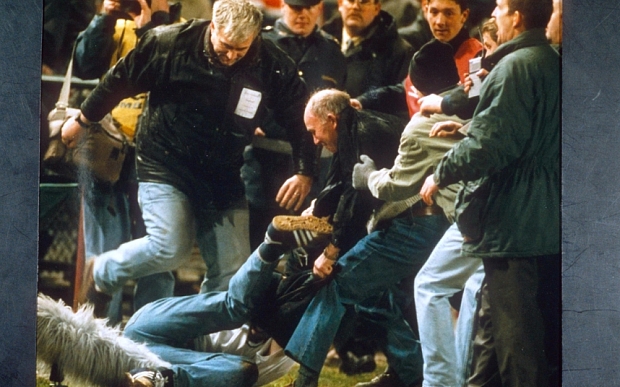
Some commentators, like The Guardian’s Barney Ronay have gone so far as to call the game “pointless and a mistake” , and there are concerns about a recurrence of the ever-popular “Fuck the IRA” chants from sections of the English travelling support while almost 2000 “supporters” will be barred from travelling to Dublin for the game for fear of a repeat of the violent scenes of 1995.

HOOLIGANS_3332587b

English hooligans in the Lansdowne Road riot of 1995

Aside from that there is also the slightly thorny issue of Jack Grealish’s international allegiances as a sidebar to the game. But still we look to this game against the English and see a guaranteed full house for an international friendly, not something that can always be counted on.

The English FA for their part, perhaps cognisant of the events of ’95 made sure to include a friendly against Ireland in Wembley as part of their 150th anniversary celebrations, along with friendlies against original international opponents Scotland and prestige matches against the likes of Germany and Brazil. Were we secretly pleased that they invited us to the party and have chosen to return the favour by coming to Dublin?

It’s 20 years since the debacle in Lansdowne Road and 30 years since Ireland have lost to England, whether that has lessened any Irish inferiority complex will be seen on Sunday.

Originally posted on backpagefootball.com June 2015

Ireland, Aimar and the promise of the 1997 World youth championship

A little over two weeks ago Pablo Aimar retired, a decision that attracted little comment in this part of the world. The former Valencia, Benfica and Argentina star had been trying to regain fitness at Buenos Aires giants River Plate, the club where he first made his name, but had been hampered by ongoing injury problems and had only made a single substitute appearance for Los Millonarios.

In his first spell there Diego Maradona was moved to declare that “Pablo is the only current footballer I’d pay to watch” and described Aimar as the “best player in Argentina over the last couple of years and is even more talented than Riquelme or Saviola”.

Screen Shot 2015-07-30 at 00.03.21

Only slightly taller than El Diego and blessed with a similar array of skills, it wasn’t long before Aimar was given the dreaded “next Maradona” tag ahead of his move to Spain with Valencia. With his slight frame, graceful balletic touch and outrageous trickery, it’s easy to see why a current Argentine star like Lionel Messi had idolised Aimar as a youngster, and claimed that he was one of the players he looked up to.

Aimar falls into the category of great Argentine players who have come to retirement having never won a senior international trophy, a gifted generation that saw the overlapping talents of Juan Sebastian Veron, Hernan Crespo, Juan Roman Riquelme, and many others who have left the game without a World Cup or Copa America to their names.

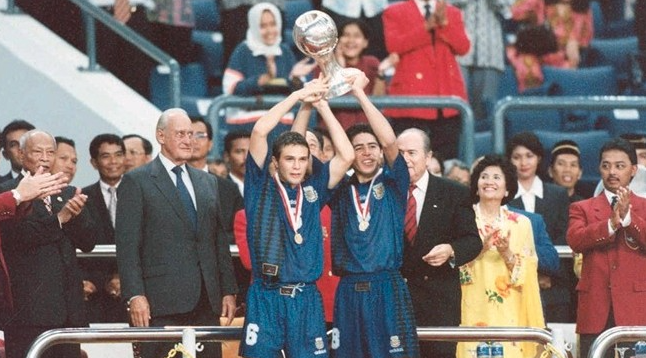
But 18 years ago it looked like things would be much different, because in Malaysia in the summer of 1997, Argentina had just won the FIFA World Youth Championships, a tournament I had watched with rapt attention, not just because of the talents of Pablo Aimar, but because the team they beat in the semi-finals, en route to ultimate victory, was Ireland.

1997 was a strange time to be an Irish football fan. As a teenage supporter I had grown up in an era of success and expectation based on the successful qualifying campaigns for Euro ’88 and the World Cups of 1990 and ’94. However the qualifiers for Euro 1996 had changed a great deal of that expectation into a climate of trepidation, and although results had been initially encouraging, things quickly went downhill with Ireland managing only a 0-0 draw away to Liechtenstein and then losing 3-1 to Austria in Dublin.

This meant that Ireland needed a playoff victory against a youthful Dutch side, full of Ajax players who had just won the Champions League, to progress to England. A two-nil defeat courtesy of a pair of Patrick Kluivert goals ensured the end of the Jack Charlton era, and for the first time in a decade, the Irish national team had to face into a period of uncertainty with their talismanic manager gone and a core group of players edging towards retirement.

But fast forward a year later and what appeared upon the horizon only Brian Kerr and Noel O’Reilly leading their bunch of impressive young players to Malaysia and the FIFA World Youth Championships. There was at least a hint of promise that the generation of McGrath, Moran, Houghton and Aldridge could and would be replaced by young players of quality.

The team that went to Malaysia could have been even stronger but for the fact that the new senior team manager Mick McCarthy chose to stop Ian Harte and David Connolly from travelling. Both players had made their senior debuts the year before and McCarthy wanted them to rest and focus on establishing themselves at their clubs ahead of the new season.

Similarly Everton’s young defender Richard Dunne was unavailable due to injury. The difference between 1997 and the footballing landscape today is noticeable; Connolly was about to move to Dutch giants Feyenoord, while Dunne and Harte were establishing themselves as teenagers in Premier League sides.

The Irish were in a tough group with Ghana, China and the USA with no match being decided by more than a single goal. Things didn’t get off to a great start with Ireland going down 2-1 to Ghana in the opening game although Trevor Molloy, then of Athlone Town got his first goal of the tournament. A 2-1 over the United States and a 1-1 draw with China followed, with Micky Cummins then of Middlesboro getting on the scoresheet in both games, enough to secure the second qualifying spot in the group.

Screen Shot 2015-07-30 at 00.02.37

Next up was the round of 16 match against Morocco who had also finished second in their group behind eventual finalists Uruguay. Ireland opened the scoring with a goal from Neale Fenn before Morocco equalised through a Niall Inman own goal. The game went to extra time before being eventually decided by a 97th minute Damien Duff strike to set up a quarter final meeting with Spain.

The Spanish have tended to be the European masters at the various underage level and their under 20 side contained the likes of David Albelda and Gerard Lopez, and while the Irish rode their luck in the game, they ultimately emerged victorious, that man Molloy on the scoresheet again scoring with a second half penalty, his third goal of the tournament.

This side had now progressed further than any other Irish side ever had in a tournament, to the semi-finals against Argentina. Prior to the Spanish game Kerr had rallied his young charges with that very thought:

Just think, you guys may never again get the chance to play against Argentina, even if you all go on to become senior internationals. The senior World Cup comes around only every four years so think of how many opportunities you will have to meet Argentina during your career.

Kerr’s rousing words had the desired effect against Spain and Ireland would now face a side containing the likes of Walter Samuel, Juan Roman Riquelme, Esteban Cambiasso, Diego Plancente and Pablo Aimar. The Argentines had already dispatched an English side containing the likes of Danny Murphy, Michael Owen, Jamie Carragher and Kieron Dyer, with goals from Riquelme and Aimar sending Ted Powell’s side home and next knocked out the free-scoring Brazilians who themselves had smashed ten past a hapless Belgian side in the round of 16.

In what was a tight game, a somewhat nervous and fatigued Irish side succumbed to a Bernardo Romeo strike early in the second half. Six games in 15 days in the heat and humidity of Malaysia had taken its toll, and while there was a late Irish rally and a missed chance by Glen Crowe in the closing minutes the Argentines were the deserved winners.

They would defeat Uruguay 2-1 in the final three days later, while Ireland, the last European side left in the tournament, would take the bronze medal, with goals from Dessie Baker and Damien Duff securing a 2-1 win over Ghana and revenge for their opening day defeat.

Watching this all unfold in an apartment in Gran Canaria I was convinced I was watching the future of Irish football in action, I indulged in those misguided games of what-iffery that occasionally fill newspaper column inches, trying to picture an Irish Senior XI in 5 years’ time. This is the type of thing that comes back to haunt you when you predict that Neil Mellor will help England’s win Euro 2008. But it seemed inconceivable at the time that players from that squad wouldn’t make the next step.

Screen Shot 2015-07-30 at 00.07.00

Damien Duff, the youngest player in the squad was a bona fide star and already looked the finished article, he even drew favourable comparisons from various media outlets with a certain Liam Brady. I was convinced that Derek O’Connor would provide competition for the No. 1 jersey with a youthful Shay Given, that Robbie Ryan could surely be the next Denis Irwin, Colin Hawkins would provide competition and physicality at centre half while the composed captain; Thomas Morgan would help protect the back four alongside Roy Keane in the senior team. And surely the top scorer, Trevor Molloy, released by Shamrock Rovers only six months earlier, was only weeks away from a move cross channel?

Of course things don’t work like that. Liam Tuohy’s side that got to the 1985 Youth Championships didn’t contain a single player who would win a senior cap and Kerr’s squad didn’t fare much better. Although Duff would win a century of caps for Ireland, the only other team member who would be capped at senior level was Glen Crowe, winning two caps during his first spell with Bohemians. The one other player to win a senior cap for Ireland from that tournament was Jon Macken, then part of the England squad, who would switch his allegiance to Ireland and won a single cap in 2004.

Perhaps these under-age tournaments are always disappointments when viewed retrospectively. Pablo Aimar, voted as one of the players of the tournament and dubbed as one of many new Maradona’s, has been viewed, for all his skill, flair and finesse as an example of unfulfilled potential. Despite two La Liga titles, a Portuguese League title and a UEFA Cup win, there is a sense that he could have achieved more.

While Duff won a hundred caps for Ireland, played at a World Cup and a European Championship and won two Premier League titles with Chelsea, could or should some of his team mates achieved similar success? Players like Fenn, Crowe, Morgan, Hawkins, Dessie Baker and Trevor Molloy had successful careers in the League of Ireland, Robbie Ryan and David Worrell had solid careers in England, but others, such as goalkeeper Derek O’Connor had drifted out of league football within a year.

Part of the joy of such tournaments is the glimpse they give of a potential that has yet to be fulfilled, the glimpse of infinite footballing possibilities, the moment watching the emergence of a small, slightly-built Argentine playmaker and knowing he may never be Maradona but suspecting that maybe, just maybe, he could be. It’s the joy of seeing an 18-year-old Damien Duff playing uninhibited street football and skinning full backs with chalk on his boots.

Just think of Burt Lancaster’s Moonlight Graham or Kevin Costner as Crash Davis in Bull Durham, minor league players who fleetingly tasted ‘success’ even if that success lasted just a single inning in the Majors. For all my naivety as a 15-year-old watching a group of young men, three and four years my senior,  there was that hope that they could populate our next great international side.

To finish on another film reference, I’m brought to mind of what Joey ‘the Lips’ Fagan says at the end of The Commitments when imagining a different future for the band, one of success and record contracts – “Where’s the romance in that?”.

Originally posted on backpagefooball.com in July 2015

The story behind a pub called the Confession Box

The Confession Box pub resides snuggly at 88 Marlborough Street on the ground floor of a fine old Georgian building at the side of Boyers Department Store. At Confession Box you are guaranteed a good pint & no penance.

The name might seem curious at first but when you consider the size of the cosy confines of the pub and the close proximity to the neoclassical grandeur of St. Mary’s Pro- Cathedral, “the Pro” as it is still known by many Dubs, the pubs’ title begins to make a bit more sense.

confession-box-(3)

There is another reported reason for the name of the pub that dates back all the way to the Irish War of Independence (1919-1921). During that conflict the last know excommunications from the Catholic Church in Ireland took place and were directed against the men involved in the ongoing rebellion. At the forefront of issuing these excommunications was Bishop Daniel Cohalan of Cork and it was rumoured that many of those who were excommunicated, including that famous Corkonian Michael Collins, would drop into what was then the “Maid of Erin” pub and would receive Communion and Confession from sympathetic priests from the nearby Pro-Cathedral. Thus the pub earned the nickname of “The Confession Box”.

There is still a great deal of memorabilia adorning the walls of the pub today from that time period with “the Big Fella” featuring prominently.

confession-box-(2)

These were not the Confession Box’s only claims to fame however. In 1793 the building was the birthplace of Dionysius Lardner the noted scientist and economist who became infamous for his rivalry with the most famous engineer in the Industrial revolution, Isambard Kingdom Brunel. He was also reportedly the father of the famous playwright Dion Boucicault, who features elsewhere on DublinTown.

Many years later the pub came into the ownership of the noted sportsman Michael O’Flanagan and was renamed “O’Flanagan’s” until 1965. Michael was a great all-round athlete and was the younger brother of the famous Dr. Kevin O’Flanagan. Michael and Kevin are unique in the world of sport, both committed amateurs, they are the only brothers who have represented their country at senior level in both soccer and rugby. Michael who was playing for Dublin club Bohemians when he won his only cap for the Irish football team in 1946, a late call up to replace injured striker Davy Walsh in a game against England at Dalymount Park. His brother Kevin, then playing for Arsenal only realised he would be lining out alongside his brother when he turned up in the dressing room an hour before kick-off! Mick was also a member of the Irish Grand Slam winning rugby team of 1948, winning his only cap in the 6-0 win over Scotland. Such was the connections with the pub that years after Mick’s sporting retirement a group of sports journalists who were in for a pint decided to found the Soccer Writers Association of Ireland (SWAI) there and then. An association that exists to this day.

confession-box

Today the pub is probably best known for its pints of Guinness, it has been voted the best pint in Dublin by 98FM listeners for the last two years in their Best of Dublin awards. And for their popular live trad music evenings. The pub has recently been refurbished although the changes have been subtle and have preserved the intimated, old world atmosphere so beloved of locals and tourists alike. So next time you’re on Marlborough Street drop in for a pint. We don’t think they do communion wafers anymore.

Originally posted on Dublintown.ie in July 2015

A Springbok ran in Solitude – South Africa’s international debut

South Africa were there from the beginning of organised football in Africa, the game arrived from Britain in the late 19th Century and the national association first affiliated to FIFA in 1910.

As an early African member of FIFA in the 1950’s they agitated for greater representation for African football and in 1957, along with Egypt, Ethiopia and Sudan they were founders of CAF (Confederation of African Football) and were almost among the original participants in the African Cup of Nations, however it was at this point that the thorny issue of Apartheid intruded on proceedings.

As the Sudanese delegate Abdim Halim Mohammed recalled at the time, the South African delegate was:

A chap called Fred Fell, not an Afrikaner but British. We accepted him and accepted South Africa. He accepted we would host the first African Cup of Nations in Khartoum…Then we came to that “area”. He said the government had told him it is either a pure white team or a black team. We said we don’t accept that. We want black and white.

South Africa were understandably disqualified as a result of their intransigence on the issue of a mixed national team and it would be almost forty years before a South African side would compete in the Cup of Nations.

When they did enter the competitions it was as hosts in 1996, Nelson Mandela was President, and a multicultural South African team would emerge as Champions with Mark Williams grabbing both goals in the final against Tunisia.South Africa 1996

Since the 90s post-apartheid South Africa has competed in, and hosted a further Cup of Nations as well as the 2010 World Cup. However their long, controversial and turbulent international history began not in Cape Town or Johannesburg, or even on the continent of Africa, but on a trip to Ireland and in the cities of Dublin and Belfast.

Back in 1899 a football team from the Orange Free State had toured England, notable for the fact that it was an all-black team, while in 1906 a white side had toured South America and played in both Brazil and Argentina, however the Union of South Africa was only formally established in 1910 bringing together four previously separate British colonies.

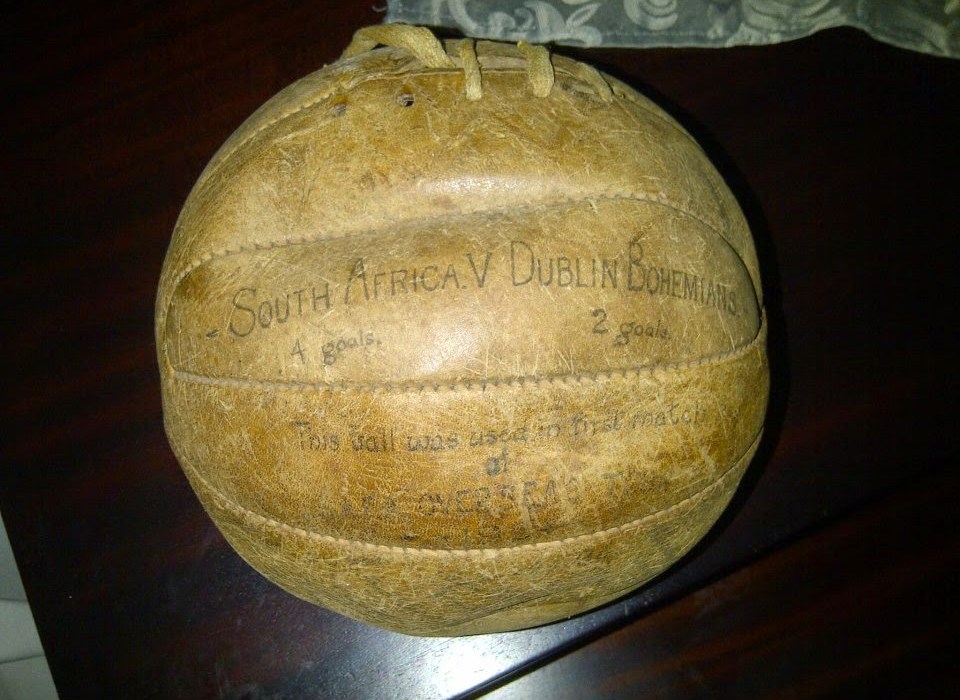
The new football team of this new nation would join FIFA but wouldn’t play a formal international until September 1924 when “The Springboks” came to Europe. Their first port of call for the all-white touring side was Dublin, and their first opponents Bohemian F.C.

By that stage the South African government had already brought in one of first pieces of Apartheid legislation, the 1913 Natives Land Act which limited the ownership of land in South Africa by the majority black population to just 8% of the total area of the country.

While the majority of apartheid legislation was introduced in the late 40s be Prime-minister DF Malan the preceding decades had seen the steady erosion of the rights of the black South African population. Despite these rulings the sporting relations between Britain (and Ireland) with South Africa were flourishing in 1924.

Not only was the football team visiting but in rugby, the British and Irish Lions were on tour in South Africa, while the South African Cricket team was just completing a summer tour of England.

The visiting football team would play three games in Ireland, the first on 30th August versus Bohemians before travelling north of the recently created border to take on the Irish National Team (the IFA selection which from this point on will be referred to as Northern Ireland) in Belfast and a North-West XI playing in Derry in September.

The split between the Belfast based IFA and the recently formed FAI of the Free State was still a sensitive issue, with both associations claiming exclusive use of the name “Ireland” while each association continued to select players from the whole of the island. As just one example of the complexity of this cross-border situation the Free State FAI Cup holders at the time of South Africa’s arrival were the Belfast based Alton United.

There were now two leagues and two national teams on the island of Ireland and although the FAI had sent a side to compete in the 1924 Olympics that summer the fledgling association had yet to play a FIFA recognised match. It was under these circumstances that South Africa; an amateur side at the time would take on not the Free State XI but the reigning League of Ireland champions (and fellow amateurs) Bohemians.

They would meet in Dalymount Park and the touring side would get off to a great start in front of a large Dublin crowd with the South Africans eventually running out 4-2 winners. Bohs were without the influential Bertie Kerr who was injured but did have players of quality such as Paddy O’Kane, Dave Roberts and Jack McCarthy in their side who would all go on to win full caps for Ireland. Incidentally Bohemians were captained by Billy Otto, who had been born in South Africa.

The South African goals would come from Eric Stuart of Western Province, Jim Green of Transvaal and a brace from a 20-year old-striker named Gordon Hodgson.

Hodgson, the son of English emigrants, had worked as a boiler maker in his native South Africa while also lining out for the Transvaal side. Like many of the touring South African side he was physically imposing, standing at six foot one and weighing over 13 stone.

Early reports of the South African tour suggest that their forwards were somewhat rough diamonds in terms of finishing, their good attacking play being undone by some poor marksmanship, Hodgson, however, would certainly prove to be a formidable goal-scorer.

The South African side would spend three months touring Ireland, England and the Netherlands and their teams’ performances, including wins over Chelsea, Aston Villa, Liverpool and Everton would generate significant interest in a number of the Springbok players and several would pursue professional careers in England.

Gordon Hodgson would join Liverpool and make the biggest impression, along with him goalkeeper Arthur Riley and Glasgow-born fullback Jimmy Gray would all join the Reds in 1925. Gray would make a single appearance before joining Exeter City where he played until 1936, while Riley would have to bide his time at Anfield as he would have to replace the legendary Elisha Scott in goal.

Scott was (and remains) Liverpool’s longest serving player and an Anfield hero and was also first choice keeper for Northern Ireland. It would be the 1928-29 season before Riley got any sort of extended run in the Liverpool team though he would eventually amass over 300 appearances for the club.

Hodgson would become a record breaker on the red half of Merseyside, becoming Liverpool’s record goal scorer, a title he would hold for three decades before the arrival of Roger Hunt in the 1960s. Initial interest in Hodgson was piqued when he scored a hat-trick in front of the Kop for South Africa against Liverpool during their tour, something guaranteed to catch the club’s attention.

He would score 233 league goals for Liverpool (including a still standing club record 17 hat-tricks) during his 11 years at Anfield, before, at the age of 32 he was signed by Aston Villa for £3,000. His spell at Villa would be short and he would move to Leeds United for £1,500 in 1937, eventually scoring an impressive 53 goals in 85 appearances for the Yorkshire club.

Gordon Hodgson of Liverpool, South Africa and later England

Gordon Hodgson of Liverpool, South Africa and later England

Hodgson still sits fourth on the all-time top flight scoring chart in English football, by his retirement he had 288 league goals, five above Alan Shearer, and only behind Jimmy Greaves, Steve Bloomer and his contemporary, and city rival Dixie Dean.

It is perhaps because of Dean that Hodgson is not more well know. Liverpool have had their fair share of prolific forwards but what separates Hodgson from the likes of Hunt, Keegan, Dalglish and Rush is that those later era strikers were all trophy winners.

Hodgson played for Liverpool during a trophy-less period, made all the worse by the fact that Everton would win two league titles and an FA Cup during Hodgson’s time there, with Dean being recognised as the greatest centre forward in the world and one of sports’ biggest names.

Despite the obvious scoring prowess of Hodgson he failed to find the net in his next game in Ireland after his brace against Bohemians. In fact contemporary reports mentioned his poor finishing in the game against Northern Ireland; the game that would go down in South African football history as their first international.

The match would take place in Solitude, the home ground of Belfast club Cliftonville in front of a crowd of 6,000, generating the princely sum of £254 in gate receipts on the 24th of September 1924. The South Africans had made some changes to their starting line-up since the match at Dalymount, in came Williams, Touhy, Jacobi and Murray. Out went Howell, Hicking, West and Walker. They had played four games in the London area in the intervening three weeks, their most recent match a 4-2 win over Second Division Chelsea with Hodgson grabbing two.

The Northern Irish didn’t field their strongest side for the game. There was no Elisha Scott to face his Liverpool successor, nor was their star forward, Sheffield United’s Billy Gillespie in their line-up. In fact as a cost saving measure the IFA chose to select only players from the Irish League to save on travelling costs.

This all-domestic XI did cause some confusion as to the status of the game both at the time and subsequently. Some reports, including the Irish Times, referred to the Irish side as an Irish League XI rather than a full national team and for many years the IFA did not list the match as a full international, recognising it only as an amateur match.

The South Africans would also play both the English and Welsh amateur sides on their trip but these would not count as full internationals.

However the game against Northern Ireland has been recognised as a full international since 2001. While the Irish side were all home based there were paid professionals among their ranks including Thomas “Tucker” Croft who had scored the winner against England only a year earlier.

They wore the St. Patrick’s blue jersey of the full International side rather than the green jerseys associated with the Irish amateur side and the match was advertised at the time as a full international by the IFA.

The Irish side took the lead early through Frank Rushe who got on the end of a free kick after ten minutes. Rushe was born in Bessbrook in County Armagh. At the time of the South Africa match, his only senior cap, he was playing for Distillery in the Irish League but had spent the previous season with Dublin side Shelbourne who had finished runners-up to Bohemians in the Free State league.

The South Africans would strike back though, just before half time David James Murray getting them back on level terms before Jim Green, who had also scored in Dalymount, grabbed the winner 15 minutes from time.

Irish football correspondents noted the improvement in play from the South Africans since the match in Dublin and the physical disparity between the well-built Springboks and the less robust Irishmen was commented upon by a number of columnists.

It was also noted that the margin of victory could have been greater for the South Africans if it had not been for their wasteful finishing, with particular mention for young Hodgson who seemed to be having a rare off day.

The South Africans would spend the next three months touring Britain and the Netherlands, including another full international, a 2-1 defeat to the Dutch national team in Amsterdam, though these would be the last games played for the national team by men like Hodgson and Riley.

As mentioned, Hodgson would even line-out three times for his new homeland, England. While he and Riley would have successful careers in England, making almost 800 league appearances between them.

It would be almost thirty years before a black South African would play professionally in Europe when Steve Mokone signed for Coventry in 1955 before playing in Holland, Italy and Spain. Two years after Mokone’s move to Coventry his fellow countryman David Julius would sign for Sporting Lisbon.

Due to the racist policies of apartheid South Africa and the various bans, suspensions and boycotts that resulted, neither man would ever play for the land of their birth, Julius would end up donning the red of Portugal rather than the green and gold of South Africa.

While Hodgson scored for England against Wales during the second of his three caps he at least had the opportunity to play for South Africa against Northern Ireland and the Netherlands. In many ways the tour of 1924 was a false dawn in international footballing terms for South Africa.

The ruling government’s refusal to allow mixed teams meant their expulsion from CAF, FIFA, the Cup of Nations and the World Cup. It was only in the mid-90s that the football isolation of the nation would properly end.

While the record books show that South Africa made its international debut in Belfast in 1924 perhaps that game should have an asterisk against it, and not because the IFA selection they faced included only domestic based players.

Despite the quality of players like Gordon Hodgson and Arthur Riley a truly representative South African XI wouldn’t make its international bow until the Bafana Bafana defeated Cameroon in Durban 68 years later.

Originally posted on backpagefootball.com

Blogging beginnings

I’ve been writing bits and pieces about football in general and Bohemian F.C. in particular for a number of years now. I always avoided trying to start my own blog preferring to write pieces for other websites who were either in the process of establishing themselves or were already well established. They already had readers and an audience and I’ve never felt comfortable chasing that and, well it seemed like a much easier way to get stuff read.

The reason I’ve started this blog now is that I wanted to have all the various articles I’ve written in the one place and maybe have a space to put up bits and pieces that are of even more of a minority interest than usual.

What you’ll find is a good bit of Bohs stuff, some general football musings and even a few other bits I’ve done on Dublin history. So please feel free to share, comment or complain.